
As you now know, when we as a consciousness move beyond the world of the senses in this three-dimensional reality, we can tap into frequencies that carry specific information beyond the vibration of matter and the speed of light. When this happens, the brain processes extremely high amplitudes of energy. Time and time again, we’ve measured and observed this phenomenon in our advanced students’ brain scans. You’ve also learned that when there is an increase in energy in the brain, there will always be an increase in consciousness and awareness—and vice versa. In fact, it’s very difficult to determine whether it is the energy or the level of consciousness that causes these extreme measurements. But I don’t think we can separate the two because you cannot have a change in energy without a change in consciousness, or a change in frequency without a change in information.
As you connect to deeper levels of the unified field, the brain is activated by a greater energy that carries specific information in the form of thoughts and imagery. The brain then literally tracks and records this profound inner event, and to the person having the experience, whatever is happening in their mind seems more real than any past external event. In that moment, the increased energy in the form of a profoundly powerful emotion captures all the mind’s attention. This is the instant the brain and body receive a biological upgrade.
If someone can sit in a chair with their eyes closed during meditation and have a significantly heightened sensory experience without their senses, it begs the question What is happening in the brain to explain this supernatural effect? To the person having the experience, despite the fact that they are sitting still, it seems more real than any other experience (determined by their senses) that they’ve ever had. This begs more inquiry: How can we have a fully amplified sensory experience without our senses? What are the specific functions of the brain and body that translate interactions with the quantum field into profound inner experiences?
In other words, if we can interface with a more coherent field of information, which then creates such stimulating inner events, there must be a neurological, chemical, and biological explanation for such supernatural occurrences. What are the unique systems, organs, glands, tissues, chemicals, neurotransmitters, and cells involved that could give rise to such intensely profound experiences? Could there be physiological components that are just sitting dormant, waiting to be activated?
Four states of consciousness will help provide a framework for the information in this chapter. The first is wakefulness, which of course is when we are aware and conscious. Next is sleep, where we are unconscious and the body is restoring and repairing. Then comes dreaming, which is an altered state of consciousness when the body is catatonic but our minds are engaged in inner visual imagery and symbolism. And finally there are transcendental moments of consciousness that are beyond our understanding of reality. These transcendent events seem to change us and the way we look at the world forever. I want to give you my best understanding about the biology, chemistry, and neuroscience of those transcendental experiences. Let’s start with the molecule melatonin, which is responsible for all of this.
Melatonin: The Dreaming Neurotransmitter
When you wake up in the morning and return to the world of the senses, the moment your eye perceives light through your iris, receptors in the optic nerve send a signal to a part of your brain called the suprachiasmatic nucleus. It then sends a signal to the pineal gland, which responds by making serotonin, the daytime neurotransmitter.
As you will recall, neurotransmitters are chemical messengers that transmit and communicate information between nerve cells. The neurotransmitter serotonin tells your body it’s time to wake up and start your day. As you integrate information between all your senses in order to create meaning between your inner and outer world, serotonin stimulates your brain waves from delta to theta to alpha to beta, causing you to once again realize you’re in a physical body in space and time. Thus, when your brain is firing in beta brain waves, you put much of your attention on your outer environment, your body, and time. That’s normal.
As night falls and it gets dark, a similar but inverse process occurs. The inhibition of light sends a signal along the same route back to the pineal gland, but now the pineal gland transmutes serotonin into melatonin, the nighttime neurotransmitter. This production and release of melatonin slows down your brain waves from beta to alpha, making you sleepy, tired, and less likely to want to think or analyze. As your brain waves slow down to alpha, you become more interested in returning your attention to your inner world rather than your outer world. Eventually, as your body falls asleep and goes into a catatonic state, your brain waves move from alpha to theta to delta, thus inducing periods of dreaming as well as deep, restorative sleep.
By living within the rhythm of our external environment, within this diurnal pattern of wakefulness and sleep (based on where we live in the world), our brain becomes automatically entrained to the daily production of these chemicals at very specific times in the morning and evening. This is called the circadian rhythm. Most of us know that when we move out of this natural rhythm we become out of sorts, such as when we travel to another part of the world where the sun rises and sets several hours ahead of our normal time zone. This is jet lag, and we need some time to recalibrate. When the body gets out of its natural circadian rhythm, it will usually take a few days to readjust to the new environment’s rhythm of sunrise and sunset. This is all chemistry produced from our interaction with our external three-dimensional world—from our eyes’ reaction to the sun and the frequency of visible light.
Melatonin induces rapid eye movement (REM) sleep, a phase of the circadian rhythm that causes dreaming. As the thoughts and chatter in our head diminish, giving way to sleep and eventually the dreaming state, the brain begins to internally see and perceive in images, pictures, and symbols. But before we get into why melatonin is so important, let’s take a closer look at the molecular structure of this dreaming neurotransmitter.
The process of creating melatonin starts with the essential amino acid L-tryptophan, the raw material responsible for making serotonin and melatonin. To be converted into melatonin, it must pass through a series of chemical changes known as methylation. Methylation is the process of taking a single carbon and three hydrogens (known as a methyl group) and applying it to countless critical functions throughout our body such as thinking, repairing DNA, turning genes on and off, fighting infections, and so on. In this case, it’s part of the production of melatonin.
In Figure 12.1, we see methylation in action. Because this methyl group is made up of very stable chemicals, the basic structure of the five- and six-sided rings stay the same during this series of chemical reactions. However, as different groups of molecules attach to those rings, they change the properties and characteristics of the molecule.
Beginning with L-tryptophan, the pineal gland transmutes it into 5-hydroxytryptophan (5-HTP), which then becomes serotonin. Serotonin is a more stable molecule than 5-HTP, can sustain itself in the brain, and has a more useful function, as we’ll soon see. Through another chemical reaction, the pineal gland converts serotonin into N-acetylserotonin and then an additional reaction turns it into melatonin. And all of this happens in the pineal gland. In a 24-hour cycle, the production of melatonin is highest between the hours of 1 A.M. and 4 A.M. This is important to remember.
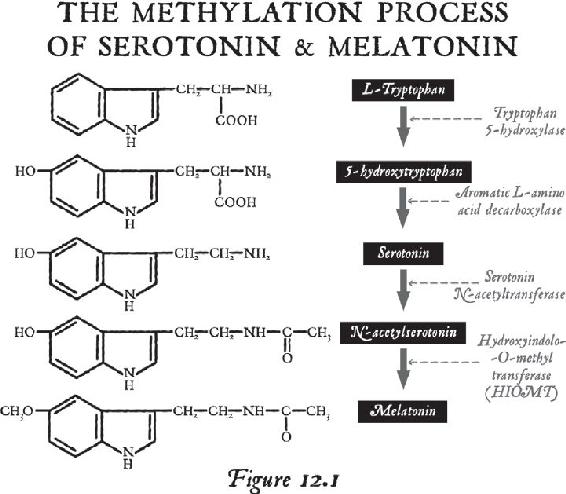
The methylation process of the amino acid L-tryptophan into serotonin and melatonin.
We now know there’s an inverse relationship between our adrenal hormones and melatonin. As adrenal cortisol levels go up, melatonin levels go down. This is the reason why we can’t sleep when we’re under stress. In antiquity, this served as a biological safety mechanism. For instance, if you were chased by a predator a few times on the way to the watering hole, and then you spotted more large beasts in your territory, your body, in its innate intelligence, would want to prevent you from becoming prey yourself. In such cases, sleep and restoration become less important than surviving. More aptly put—staying alive by remaining awake through the night is more valuable than sleeping and risking death.
When the body is trying to rest in this vigilant state, it never gets the restorative sleep it needs because the survival chemicals, like cortisol, have switched on the survival genes. If the perceived stressor is not a saber-toothed tiger, but instead your strained relationship with your ex-spouse, whom you must interact with daily, that chronic stress keeps the survival system activated. Now this safety valve is no longer adaptive but maladaptive. This type of chronic stress alters typical levels of melatonin (and even serotonin), knocking the body out of homeostasis.
But if you lower the levels of cortisol, melatonin levels will increase. In other words, when you break the stress response by overcoming the emotional addiction to those chemicals, your body can go back to long-term building projects instead of constantly dealing with the perceived emergency. Take a look at Figure 12.2 to review the relationship between melatonin and cortisol.
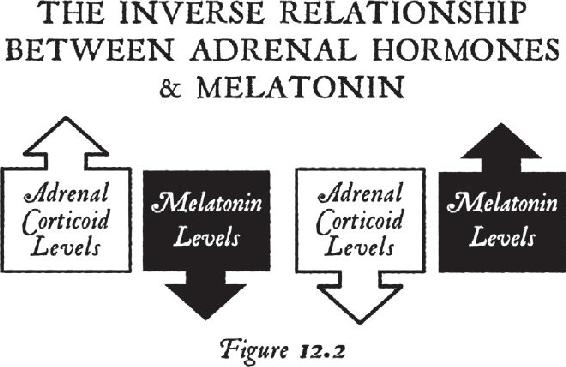
As stress hormones go up, melatonin levels go down. As stress hormones go down, melatonin levels go up.
A chart showing some of the benefits of melatonin.
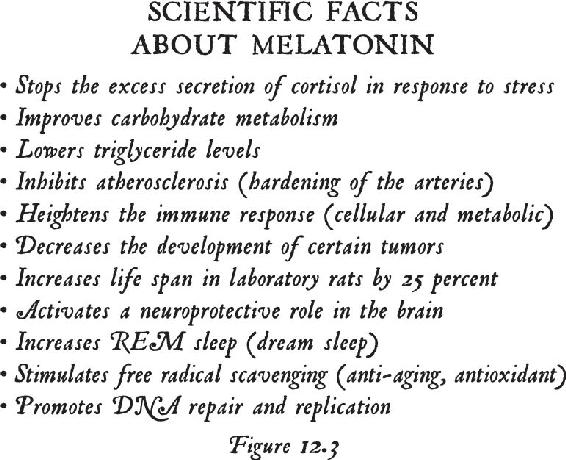
Melatonin has many other interesting applications. For example, it’s been proven to improve carbohydrate metabolism. This is important because when certain people respond to stress, the body takes carbohydrates and stores them as fat—and fat is nothing more than stored energy. This is a result of primitive genes signaling the body to store energy in case there’s a famine. Melatonin has also been known to help with depression. It’s even been proven to increase levels of DHEA, the anti-aging hormone. For more facts about the importance of melatonin, the dreaming neurotransmitter, see Figure 12.3.1
Now let’s deepen your understanding of all the information you’ve been studying in this book up until this point.
Activating the Pineal Gland
For years, I spent enormous amounts of time studying the pineal gland and seeking researchers who did extensive measurements of its metabolites and tissue. My interest was in tying together my findings with some ancient mysteries. One abstract in particular piqued my interest:
The pineal gland is a neuroendocrine transducer secreting melatonin responsible for physiological circadian rhythm control. A new form of bio-mineralization has been studied in the human pineal gland and consists of small crystals that are less than 20 microns in length. These crystals are responsible for electromechanical, biological transduction mechanism in the pineal gland due to the structure and piezoelectric properties.2
That’s a lot of words to digest, but let’s break it down into two meaningful points. The key words here (in reverse order) are piezoelectric properties and transducer.
The piezoelectric effect occurs when you apply pressure to certain materials and that mechanical stress is changed into an electrical charge. To put it in simple terms, the pineal gland contains calcite crystals made of calcium, carbon, and oxygen, and because of their structure, they express this effect. Like an antenna, the pineal gland has the capacity to become electrically activated and generate electromagnetic fields that can tune in to information. That’s point number one. In addition, in the same way an antenna pulsates a rhythm or frequency to match the frequency of an incoming signal, the pineal gland receives information carried on invisible electromagnetic fields. Since all frequency carries information, once the antenna connects to the exact signal of the electromagnetic field, there must be a way to convert and descramble that signal into a meaningful message. That’s exactly what a transducer does—and that’s the second point.
A transducer is anything that receives a signal in the form of one type of energy and converts it into a signal in another form. Take a moment to look around you. The space you are sitting in is filled with TV, radio, and Wi-Fi waves that are all different frequency ranges of invisible electromagnetic energy. (You can’t see any of them with your eyes, but they’re still there.) For example, the antenna that picks up a range of frequencies carrying a signal to your TV is transduced into a picture on your TV screen. When you tune in to an FM station, you are tuning your antenna to a specific electromagnetic frequency. The information carried in that frequency range is then transduced into a coherent signal, which is the music you hear with your ears.
The study I quoted says the pineal gland is a neuroendocrine transducer, capable of receiving and converting signals within the brain. When the pineal gland acts as a transducer, it can pick up frequencies above our three-dimensional space-time, sensory-based reality. Once the pineal gland is activated, it can tune in to higher dimensions of this space and time—which we learned in the previous chapter is the realm of time-space. And like a TV, it can then turn the information carried on those frequencies into vivid imagery and surreal, lucid, transcendental experiences in our mind, including profoundly heightened multisensory visions beyond our vocabulary. This is a bit like experiencing a multidimensional IMAX movie.
At this point, you may be wondering, Since this little gland exists inside my skull, how am I going to exert mechanical stress on the crystals in it, create a piezoelectric effect, and activate the pineal gland so it becomes like an antenna? And how will that antenna pick up frequencies and information beyond matter and light so that it can transduce those electromagnetic signatures into meaningful imagery, like a transcendental experience beyond this three-dimensional reality?
For the pineal gland to become activated, four important things must happen. I will address three of them now, and then I will give you the fourth step when it’s time to learn the meditation.
1. The Piezoelectric Effect
Critical to creating the piezoelectric effect in the pineal gland are the calcite crystals mentioned above and shown in Figure 12.4. Remember, these are very tiny crystals, approximately 1 to 20 microns in length. To put this in context, their size can range anywhere from one-hundredth to one-quarter the width of a human hair. For the most part they are octahedron, hexahedron, and rhombohedron in shape.
As we already learned in Chapter 5, the purpose of the breathing technique we do before many meditations is to pull the mind out of the body by liberating potential energy (stored as emotions) in the lower three energy centers. As we inhale and contract those intrinsic muscles, follow our breath from the perineum all the way up our spine to the top of our head, and then hold our breath and squeeze those muscles more, we’re increasing intrathecal pressure. As I mentioned earlier in the book, this is the internal pressure created when you push up against your insides—for example, when you hold your breath and lift something heavy.
The word piezoelectric is derived from the Greek words piezein, which means “to squeeze or press,” and piezo, which means to “push.” So it’s no coincidence that I ask you to hold your breath and squeeze those intrinsic muscles. When you do this, you are pushing cerebrospinal fluid up against the pineal gland, exerting mechanical stress on it. This mechanical stress translates into an electrical charge, and it’s this exact action that compresses the stacked crystals in the pineal gland and creates a piezoelectric effect: The crystals of the pineal gland generate an electric charge in response to the stress you’re applying.
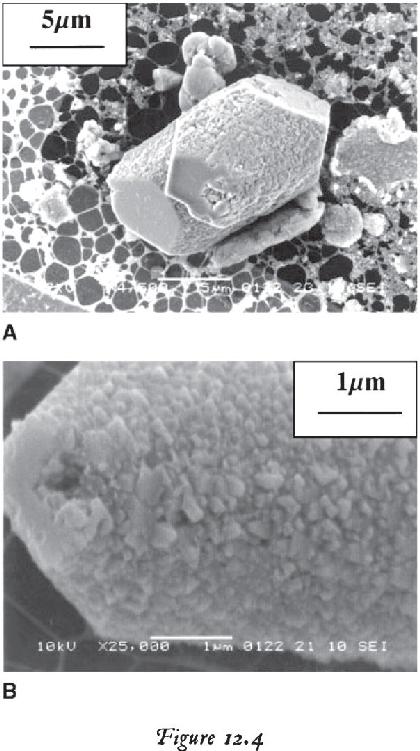
A picture of a calcite crystal found in the pineal gland.
One of the unique characteristics of the piezoelectric effect is that it’s reversible, meaning that the materials exhibiting the direct piezoelectric effect (the crystals) also exhibit a converse piezoelectric effect. Once the crystals in the gland are compressed and are creating an electrical charge, the electromagnetic field that is emanating from the pineal gland causes the crystals in it to stretch as the field increases. When the crystals generating the electromagnetic field reach their limit and can stretch no further, they contract and the electromagnetic field reverses direction and moves inward toward the pineal gland. When the electromagnetic field reaches the pineal gland crystals, it compresses them again, producing yet another electromagnetic field. This cycle of expanding and reversing the field perpetuates a pulsating electromagnetic field.
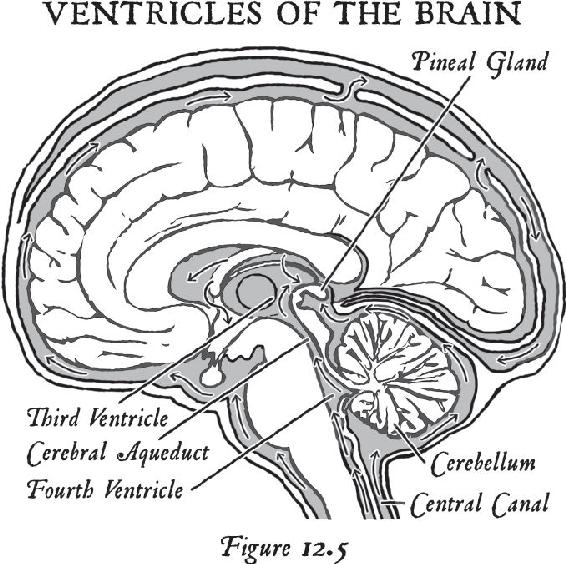
When we inhale through our nose, and at the same time squeeze our intrinsic muscles, we accelerate the cerebrospinal fluid into the brain. As we follow the movement of energy to the top of our head, then hold our breath and squeeze, we are increasing intrathecal pressure. The increased pressure moves the cerebrospinal fluid from the fourth ventricle through a small canal into the third ventricle (arrows). At the same time, fluid traveling around the cerebellum (arrows) compresses the crystals of the pineal gland. The mechanical stress that is applied produces an electrical charge in the pineal gland, creating a piezoelectric effect.
It’s no wonder, then, that I ask you to hold your breath, squeeze, and contract those muscles—and it’s no surprise that I insist you repeat this process over and over. As you keep doing the breath and holding and squeezing again and again, with every cycle of breathing you are activating the piezoelectric properties of the pineal gland. The more you do this, the more you speed up the cycles per second of the expansion and contraction of this electromagnetic field, making the pulses get faster and faster. Now the pineal gland becomes a pulsating antenna, capable of picking up subtler and subtler, faster electromagnetic frequencies.
Take a close look at Figure 12.5. We talked about the movement of cerebrospinal fluid during the breath in Chapter 5, but let’s build on the teaching. As the fluid enters the brain, it moves up through the central canal, through the space between the spinal column and the spinal cord. From this juncture, it flows in two directions. First, the fluid moves into the fourth ventricle, followed by the third ventricle. As the fluid travels from the fourth to the third ventricle, it passes through a narrow path or channel, and nestled right at the back of the third ventricle rests what looks like a tiny pinecone (that’s what pineal means). This is the pineal gland, and it’s about the size of a large grain of rice. Second, the cerebrospinal fluid also flows around the back of the cerebellum to the other side of the pineal gland—surrounding the entire gland with pressurized fluid.
By increasing the intrathecal pressure, you funnel a greater volume of fluid into the chamber of the third ventricle as well as from the space around the cerebellum. So when you hold your breath and squeeze, this extra volume of fluid exerts pressure from both directions up against the crystals, causing them to compress and create the piezoelectric effect. This is the first event that must take place to activate the pineal gland.
2. The Pineal Gland Releases Its Metabolites
Cerebrospinal fluid moves through a closed system called the ventricular system (review Figure 12.5). The ventricular system facilitates the movement of this fluid from the base of the spine, up through the spinal column, through the four chambers of the brain (called aqueducts or ventricles), and back down to the sacrum (the base of the spine). When you inhale and follow your breath to the top of your head and then hold your breath and squeeze up and in, you are accelerating the cerebrospinal fluid.
On the surface of the pineal gland are tiny hairs called cilia, Latin for “eyelashes” (see Figure 12.6). The action of the accelerated fluid moving faster than normal through the chambers of the ventricular system tickles the tiny hairs, which overstimulates the pineal gland. Because the pineal gland is shaped like a phallus, the stimulation produced by the acceleration of fluid moving past it, combined with the electrical activation created by an increase in intrathecal pressure in a closed system, causes the gland to ejaculate some very profound, upgraded metabolites of melatonin into the brain. You’re now one step closer to activating the pineal gland and having a transcendental experience.
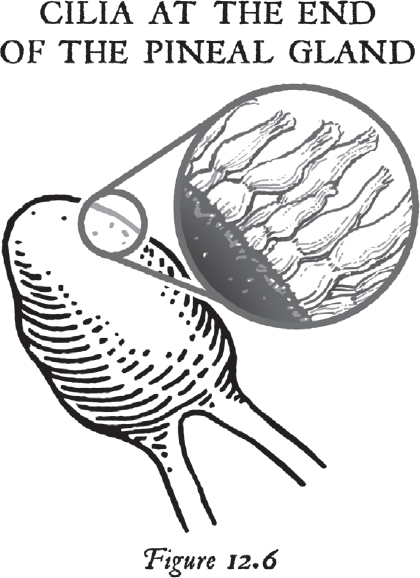
The tiny cilia of the pineal gland become stimulated as the cerebrospinal fluid accelerates through the ventricular system.
3. Energy Is Delivered Directly to the Brain
Much like sending a rocket ship into space, overcoming gravity to get it off the ground is the part that requires the most energy, so to move that energy from our lower centers demands a great deal of intensity and effort. The breath becomes our passionate intention to free ourselves from the self-limiting emotions of our past. The spinal column becomes the delivery mechanism for this energy, and the top of the head becomes the target.
As you know by now, every time you perform the breath, you send charged particles up the spinal column. As these particles increase in velocity and acceleration, they create what’s known as an inductance field (see Figure 12.7). This inductance field reverses the flow of two-way information that typically facilitates communication from the brain to the body and the body to the brain. Much like a vacuum, the inductance field draws the energy from those lower centers—energy involved with orgasm, consumption, digestion, fight-or-flight stress, and control—and delivers it directly to the brain stem in a spiraling motion. As the energy travels up through each vertebra, it passes the nerves that run from the spinal cord to different parts of the body, and some of that energy is then transferred through the peripheral nerves that affect the tissues and organs of the body. The current that runs along these nerve channels activates the body’s meridian system, resulting in all the other systems of the body getting more energy.3
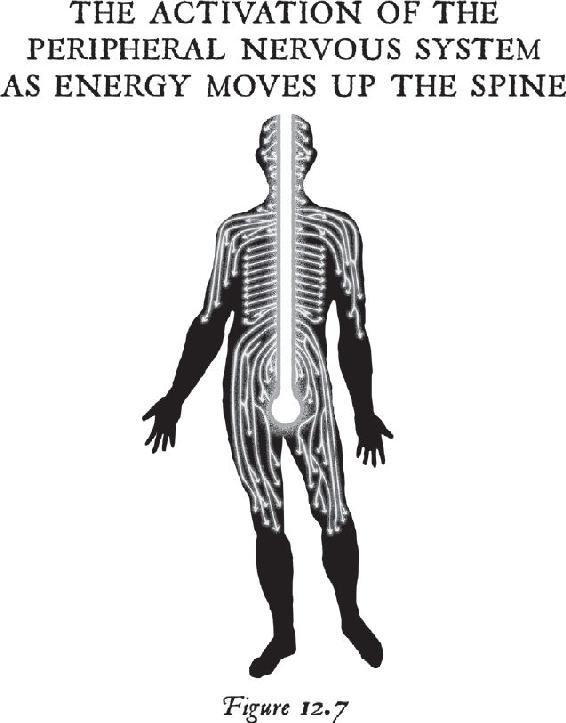
As energy is released from the body to the brain, it passes by each spinal nerve exiting between each vertebra. The excitation of this system further switches on the peripheral nerves, which then transfer more energy to different tissues and organs in the body. As a result, more energy is delivered throughout the body.
Once the energy reaches the brain stem, it must pass through the reticular formation. It’s the job of the reticular formation to constantly edit information going from the brain to the body as well as from the body to the brain. This formation is part of a system called the reticular activating system (RAS), which is responsible for levels of wakefulness. For instance, when you wake up from a deep sleep because you hear a sound in your house, it’s the RAS that alerts you and arouses you. That’s its rudimentary function. However, as the sympathetic nervous system is activated and merges with the parasympathetic nervous system, instead of depleting the body’s stored energy, it releases that energy back to the brain. Once this energy reaches the brain stem, the thalamic gate opens like a door and energy moves through the reticular formation to the thalamus, where it relays information to the neocortex. Now the reticular formation is open and you experience greater levels of awareness. In a sense, you become more conscious and awakened. (Think of the thalamus as a big train station with tracks leading to the higher centers of the brain.) That’s how the brain goes into gamma brain-wave patterns.
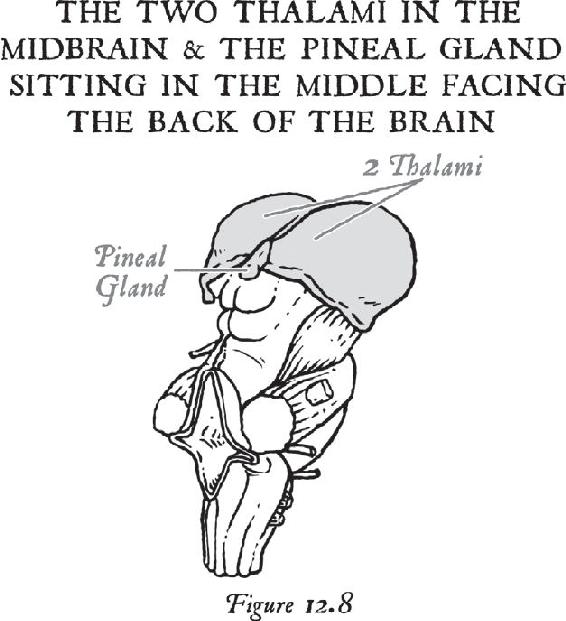
Right between each thalamus located in the midbrain sits the tiny pinecone-shaped pineal gland, facing the back of the brain.
As a side note, there are two individual thalami in the midbrain (one on each side), which feed each hemisphere in the neocortex. The pineal gland sits right between them facing the back of the brain (see Figure 12.8). When the energy reaches each thalamic junction (remember the thalamus is like a relay station to all other parts of the brain), these thalami send a message directly to the pineal gland to secrete its metabolites into the brain. The effect is that the thinking neocortex becomes aroused and goes into higher brain-wave patterns, like gamma. The nature of those chemical derivatives of melatonin relaxes the body and at the same time awakens the mind.
If you remember, when you’re in beta brain waves, your sympathetic nervous system is aroused for an emergency in your outer world and utilizes energy to survive. The difference with gamma brain waves is that instead of losing vital energy, you’re liberating and creating more energy in your body. You’re not in any emergency or survival state when this occurs; you’re in bliss, and your sympathetic nervous system is switching on to arouse you to pay more attention to whatever is happening within your mind.
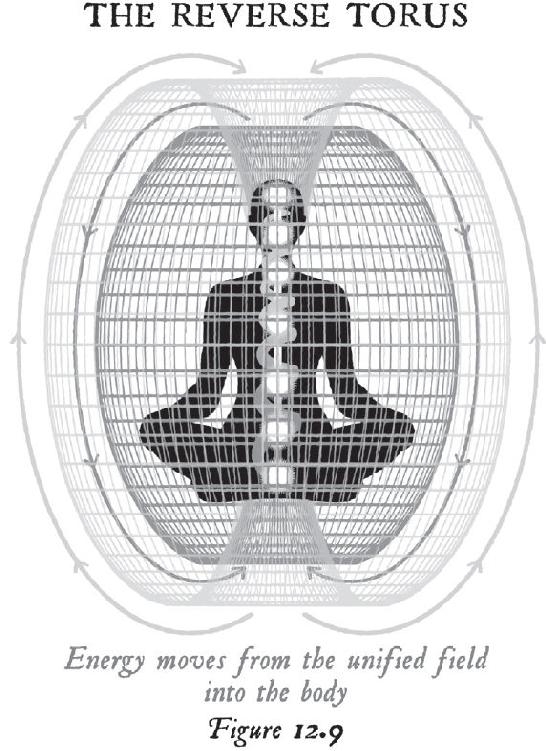
In Chapter 5 I said that when energy moves from the body to the brain, a torus field is created around the body. As you run a current up your spinal column by accelerating the movement of cerebrospinal fluid, your body becomes like a magnet and you create an electromagnetic field around it. A torus field represents a dynamic flow of energy. At the same time the torus field is moving up, out, and around your body, when the pineal gland becomes activated, a reverse torus field of electromagnetic energy is drawing energy into your body through the top of your head. Since all frequency carries information, now your pineal gland is receiving information from beyond the visible light field and from beyond your senses (see Figure 12.9).
When these three happenings occur in tandem, it’s going to feel like you’re having an orgasm in your head. You’ve now created an antenna in your brain, and this antenna is picking up information from realms beyond matter and beyond space and time. Information is no longer coming from your senses or your eyes’ interaction with your environment. Instead, you’re getting information from the quantum field moving to another eye—your third eye—from the pineal gland in the back of your brain.
As energy from the lower three centers is activated during the breath and moves up the spine to the brain, a torus field of electromagnetic energy is created around the body. When the pineal gland becomes activated, a reverse torus field of electromagnetic energy moving in the opposite direction draws energy through the top of the head into the body from the unified field. Since energy is frequency and frequency carries information, the pineal gland transduces that information into vivid imagery.
When Melatonin Gets an Upgrade, Magic Happens
When your pineal gland (or the third eye) is awakened, because it is picking up higher frequencies, these higher energies alter the chemistry of melatonin; the higher the frequency, the greater the alteration. It’s this translation of information into chemistry that primes you for those transcendental, mystical moments. Now you’re opening the door to higher dimensions of space and time. This is why I like to call the pineal gland an alchemist—because it transmutes melatonin into some very profound, radical neurotransmitters.
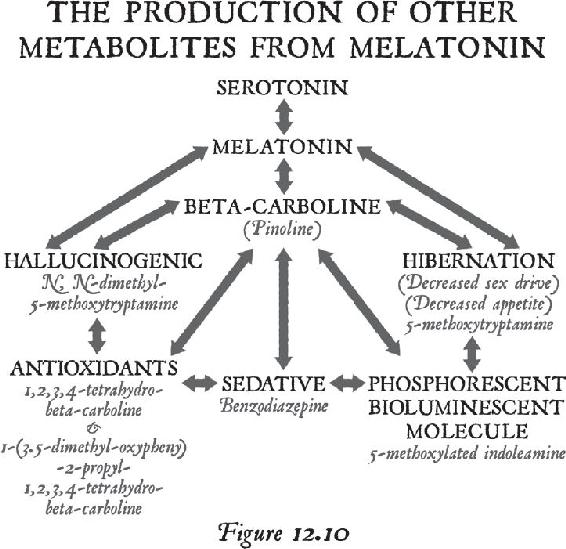
Check out the different metabolites of melatonin that are created when the pineal gland connects to frequencies faster than normal visible light and the mystical molecule gets a biological upgrade.
Take a look at Figure 12.10. As higher frequencies and higher states of consciousness interact with the pineal gland, one of the first things to happen is that these frequencies transmute melatonin into chemicals called benzodiazepines. Benzodiazepines are a class of drugs, from which Valium is created, that anesthetize the analytical mind, so all of a sudden the thinking brain relaxes and stops analyzing. According to functional brain scans, benzodiazepines suppress neural activity in the amygdala, the brain’s survival center. This limits chemicals that cause you to feel fear, anger, agitation, aggression, sadness, or pain.4 Now your body feels calm and relaxed, but your mind is awakened.
Another chemical created from melatonin produces a class of very powerful antioxidants called pinolines (see Figure 12.10). Pinolines are important because they attack free radicals, which harm your cells and cause aging. These antioxidants are anti-cancer, anti-aging, anti–heart disease, anti-stroke, anti-neurodegenerative, anti-inflammatory, and anti-microbial. That’s a perfect formula to upgrade melatonin’s normal role as an antioxidant to the role of a supercharged antioxidant that further restores and heals the body to a greater degree than the melatonin molecule normally does. (See the powerful antioxidants listed in Figure 12.10 that are all produced from metabolites of melatonin.)
If you take that molecule and tweak it again into a cousin of melatonin, you find the same chemical that makes animals hibernate. When melatonin (which makes us sleepy and dreamy) alters just slightly into this more powerful molecule, it carries a message to extend rest and repair even further. This message also causes the body’s metabolism to slow, in some cases for months. It makes sense, then, that when mammals hibernate, they break the typical habits of their habitat; for example, they lose their sex drive, their appetite, their interest in or need to move about in their environment, and their connection to social networks. They hide to protect themselves and to feel safe, and during this time of going within, their body goes into stasis. The same might be true for us as these values elevate. Because the body is no longer the mind, we temporarily lose our interest in the outer world; and because we have no biological drives and aren’t distracted with bodily needs, we’re able to move more fully into the present moment and go deeply within. If you’re going to dream the dream of the future, wouldn’t it be a good idea to get your body out of the way?
If you take that molecule and advance it yet again, you produce the same chemical found in electric eels—a phosphorescent, bioluminescent chemical that amplifies energy in the nervous system. You can refer to Figure 12.10 again. This chemical can be powerful enough to cause a significant shock. I have a strong hunch this is the rare chemical that influences the brain to process those increased amplitudes of energy that we’ve repeatedly measured in our students. Just imagine an electric eel that literally lights up with energy when it gets stimulated. That’s what happens in the brain when it gets activated. But the energy and information that are created do not come from an experience in our environment that we perceive through our senses, but instead from within the brain, caused by an upgrade in frequency. When we see those high-energy levels in the brain, we know that the person is having a profound, subjective experience that can be measured objectively.
Think about that for a moment. Via sensory input from our environment through our eyes, the pineal gland makes serotonin and melatonin. This visible light coming from the sun causes us to move into harmony with our environment, which we call the circadian rhythm. As a result of this process, serotonin and melatonin carry information equal to the frequency coming from the physical world. Because we perceive visible light through our senses, those molecules are inherent to humans; thus they are equivalent to the realm of our three-dimensional reality.
Remember, as Einstein said, that the ceiling of this material world is the speed of light. But what happens as the brain processes an increase in frequency and information from a realm beyond the senses and beyond the speed of light? Is it possible that information and energy coming from the unified field change the chemistry of melatonin to become another chemical counterpart in the brain? And could our brain translate those frequencies into a message? If energy is the epiphenomenon of matter, it makes sense that the information coming from a frequency faster than visible light would be able to alter the molecular structure of melatonin into profound elixirs within our brain. The pineal gland is responsible for translating that information into a chemical variation of melatonin; therefore, that molecule carries a different message equal to that frequency. That new frequency is now influencing an enhanced superchemical. That’s no longer natural—that’s supernatural. Melatonin gets an upgrade.
Not only does this phosphorescent, bioluminescent chemical increase the energy in the brain, but it enhances the imagery the mind internally perceives so that everything looks as though it’s made of vivid, surreal, luminescent light. As a result, people have reported experiencing colors they’ve never seen before because they exist outside their known experience of the visible light spectrum. These colors appear as profound, otherworldly glowing lights in a Technicolor, lucid, opalescent world of suspended beauty. Everything appears as if it’s emitting beautiful light made of vivid, radiant energy that you can feel. This world of golden, shimmering, bright halos within and around everything appears more illuminated than your sensory-based reality. And of course, it will be difficult to take your attention off all its beauty. Because all of your attention is on this experience, it will seem as though you are actually there, totally present, in this other world or dimension.
Take a look at Figure 12.10 again. Alter melatonin one more time and you produce the chemical dimethyltryptamine (DMT), one of the most powerful hallucinogenic substances known to man. This is the same chemical found in ayahuasca, a traditional spiritual plant medicine used in ceremonies by the indigenous people of the Amazon. DMT’s primary active ingredient is said to create spiritual visions and profound insights into the mystery of the self. When ayahuasca or other plant chemicals containing this molecule are ingested, the body receives only DMT, but when the pineal gland is activated, it receives the whole blend of aforementioned chemicals—and this causes some very profound inner experiences. Some of these experiences have been reported to create profound time dilation (time appears infinite), time travel, journeys to paranormal realms, visions of complex geometric patterns, encounters with spiritual beings, and other mystical interdimensional realities. Many of our students during the pineal gland meditation report amazing encounters beyond their known physical world.
When these chemicals are released in the brain, the mind has experiences that appear more real than anything that person has ever encountered in their sensory-based reality. This new dimension is difficult to articulate with language. The novel experience that results will occur as a complete unknown, and if you surrender to it, it’s always worth it.
Tuning In to Higher Dimensions: The Pineal Gland as a Transducer
Depending on the translation you’re using, in Matthew 6:22 Jesus said, “If thine eye be single, thy whole body shall be full of light.” I believe he was talking about activating the pineal gland, because this allows us to experience a broader spectrum of reality. Many of our students can attest to the fact that when their pineal gland becomes activated—when they fully connect with the unified field—their whole body becomes filled with energy and light. Beginning from the cosmic field, energy from beyond their senses enters through the top of their head and travels down throughout their whole body. When this occurs, they experience downloadable information beyond their memory base or the predictable knowns of their daily lives—and it all begins with the chemical alteration of melatonin in the pineal gland.
In all of my research about the pineal gland, I’ve evolved my own understanding of it into the following definition: The pineal gland is a crystalline superconductor that sends, as well as receives, information through the transduction of energetic vibrational signals (frequency beyond the senses, also known as the quantum field) and translates it into biological tissue (the brain and the mind) in the form of meaningful imagery, the same way as an antenna translates different channels onto a TV screen.
When the pineal gland is activated, because you now have this tiny antenna in your brain, the higher the frequency it picks up, the more energy it exerts toward altering and transmuting the chemistry of melatonin. As a result of this change in chemistry, you’re going to get a very different experience from what melatonin normally produces. Perhaps a better way to say it is that you’re going to get a clearer picture. Think of it this way: The higher the frequency, the more your experience will feel like you’ve gone from the picture of a 1960s television screen to a 360-degree IMAX 3-D experience, complete with surround sound. Melatonin, the dreaming neurotransmitter, evolves into a more powerfully lucid neurotransmitter to make our dreams more real.
Throughout this process, the pineal gland has a co-conspirator called the pituitary gland. The pituitary gland looks like a pear and sits behind the bridge of the upper nose, right in the middle of the brain. The front (anterior) part of it is responsible for making most of the chemicals that influence the glands and hormones associated with each of our energy centers. Once the pineal gland is activated and it releases certain upgraded metabolites5 the back (posterior) of the pituitary gland awakens, causing it to produce two important chemicals—oxytocin and vasopressin.6
The first chemical, oxytocin, is known to produce elevated emotions that cause your heart to swell with love and joy (it’s been referred to as the chemical of emotional connection or the bonding hormone). When oxytocin levels are elevated above normal, most people experience intense feelings of love, forgiveness, compassion, joy, wholeness, and empathy—not an inner state you’d probably be willing to trade for something outside of you. (These states are, after all, the beginning of unconditional love.)
When oxytocin levels go up beyond a certain level, research shows that it’s difficult to hold a grudge. In a study conducted by scientists at the University of Zurich, 49 participants played a variation of what is known as the Trust Game 12 consecutive times. In this game, an investor with a certain amount of money must decide either to keep it or to share some of it with another player called the trustee. Whatever sum the investor shares with the trustee is automatically tripled. The trustee is then faced with a decision: keep all the money, leaving the investor with nothing, or share the tripled sum with the investor, who is obviously hoping to make a profit. Basically, the either/or decision comes down to betrayal. While a selfish act is a win for the trustee, it leaves the investor at a loss.
But what if oxytocin is introduced into the equation? In the study, the researchers gave some players a squirt of oxytocin in their nose before the game, giving the others a squirt of placebo. The researchers then took fMRI (functional magnetic resonance imaging) scans of the investors’ brains as they made their decisions regarding the amount to invest and whether or not to trust.
After the first six rounds, the investors were given feedback on their investments and were notified that their trust had been betrayed about half of the time. The participants who received the placebo before playing the game felt angry and betrayed, so they invested much less in the closing six rounds. The participants who received a squirt of oxytocin, however, invested the same amount as they had in the first rounds, despite having been betrayed. The fMRI scans showed the key areas of the brain affected were the amygdala (associated with fear, anxiety, stress, and aggression) and the dorsal striatum (which guides future behaviors based on positive feedback). Participants who received the oxytocin had much lower activity in the amygdala, equating to less anger and fear of being betrayed again, as well as less fear of financial loss. They also had much lower activity in the dorsal striatum, meaning they no longer needed to rely on positive results to make future decisions.7
As this study demonstrates, the moment the posterior pituitary releases its chemicals and oxytocin levels go up, this shuts down the survival centers in the brain’s amygdala, meaning it cools off the circuits for fear, sadness, pain, anxiety, aggression, and anger. Then the only thing we feel is a love for life. We’ve measured the levels of oxytocin in our students before and after our workshops. At the conclusion of the event, some of them had elevated their levels significantly. When we interviewed those students, many of them kept saying, “I’m just so in love with my life and everyone in it. I never want this feeling to go away. I want to remember this feeling forever. This is who I really am.”
The other chemical the pituitary gland makes as the pineal gland is activated is called vasopressin, or antidiuretic hormone. As vasopressin levels go up, the body naturally retains fluids, causing the body to become more water-based. This is important because if you’re going to process a greater frequency, you need water to act as a conduit to better handle the higher frequency in the body, and to then translate that frequency into your cells. The moment vasopressin goes up, it creates a more stable thyroid gland—which affects the thymus and the heart, which affects the adrenals, which affects the pancreas, which produces a chain cascade of positive effects all the way down to the sexual organs.8
When we tune in to these higher frequencies, we have access to a different kind of light—a frequency faster than visible light—and all of a sudden we are activating a greater intelligence within us. Now, because the pineal gland is activated, we can pick up higher frequencies, which in turn produces a change in chemistry. The higher the frequency we pick up, the more it alters our chemistry—which means the more visual, hallucinogenic, and higher-energy experiences we have. The crystals in our pineal gland, acting like a cosmic antenna, are the doorway to these higher vibrational realms of light and information. This is how we have internal experiences that are more real than our external ones.
These pineal metabolite chemicals your body produces fit into the same receptor sites as serotonin and melatonin, but they carry a very different chemical message from a realm beyond sensory-based material reality. As a result, the brain is now primed for a mystical experience, opening the door to other dimensions and moving the individual from a space-time reality to a time-space reality. Since all frequency carries a message and that message is a change in chemistry, once the pineal gland gets activated and you start experiencing and processing these higher frequencies, energies, and elevated levels of consciousness, they often present themselves as complex, changing geometric patterns usually perceived in the mind’s eye. This is good—this is information.
When you have these mystical experiences, because your nervous system is so coherent, it’s able to tune in to these super coherent messages. In the darkness of the void, the pineal gland becomes the vortex for these very organized patterns and packets of information, and as you place your attention on them, just like a kaleidoscope they constantly change and evolve. The same way a TV picks up frequencies and turns them into pictures on the screen, the pineal gland chemically transduces higher frequencies into vivid, surreal images.
In Graphic 13 in the color insert, you can see some of these geometric patterns, which are called divine (or sacred) geometry. Such patterns have been around for thousands of years. In Chapter 8, I mentioned that these patterns appear to look like ancient mandalas. They’re energy and information in the form of frequency, and if you can surrender to them, your brain (via the pineal gland) will transduce those forms, messages, and information into very vivid pictures, imagery, or lucid experiences. The best thing to do when you see or experience these patterns is to surrender to them and not try to make anything happen.
These patterns and forms usually do not appear as two-dimensional or static; instead, they are alive, have depth, and comprise mathematical and very coherent fractal patterns, never ending and infinitely complex. Another way to see this is through the concept of cymatics. Derived from the Greek word for “wave,” cymatics are a phenomenon based on vibration or frequency. Here’s a way to picture them: Imagine if you took the cover off of an old speaker box and laid it flat. If you filled that speaker with fluid, shined a light on it, and began playing classical music up through it, the frequency and vibration of the music would eventually create coherent standing waves. These waves would interfere with each other and eventually create geometric patterns within patterns within patterns. As with a kaleidoscope, you would see these evolving geometric arrangements becoming more highly organized. The difference between the images in the kaleidoscope and cymatics is that the images in the kaleidoscope appear two-dimensional. Geometric patterns such as cymatics, however, appear to be alive and are three-dimensional or even multidimensional. In addition to water, the vibrational effects of cymatics are translatable to sand and air; in other words, these three mediums pick up vibration and frequency and turn them into coherent geometric patterns. (If you search, you can find several videos showing this on YouTube.)
When your pineal gland picks up information, it’s picking up these same types of waves in the environment around you. These coherent, highly organized standing waves that exist beyond the visible light spectrum are constantly being consolidated into packets of information and transduced into images by your pineal gland. They are just patterns of information that are intersecting in a very coherent way, and when you put your awareness on them, they change and evolve to become increasingly more fractal, intricate, beautiful, and divine. It’s all information, and just like a transducer, your pineal gland takes that information and descrambles it into imagery. This is one of the reasons I decided to use the kaleidoscope as a tool in our advanced events, to train students’ brains to be disarmed when they experience this mode of complex imagery, as well as to more easily recognize—and open up to—receiving this type of information. Additionally, as the kaleidoscope causes the brain to move into alpha or theta brain waves and you become more suggestible, you can see how gazing into it in a state of trance primes your subconscious mind for a mystical experience.
Once your pineal gland picks up the imagery, fasten your seatbelt because things are going to get exciting. You might come out of your body and travel down a tunnel of light, or your entire body might become filled with light. You might even feel like you’ve become the entire universe, and when looking down at your body, even find yourself wondering how you’re going to get back into it.
When you start having these very profound, unknown experiences, you have one of two choices: You can contract in fear because it’s the unknown, or you can surrender and trust—because it’s the unknown. The more you surrender and trust, the deeper and more profound your experiences become, and because the experience is so profound, you’re not going to want to rouse yourself back to wakefulness, thereby changing your brain waves back to beta. Instead, this is the time to surrender, relax, and go even deeper into this transcendental state of consciousness. In this moment, you are not sleeping, you are not awake, you are not dreaming—you are transcendent of this reality. If your brain chemistry is right, your body will be totally and completely sedated. This is what we are training for: to experience greater levels of wholeness, oneness, love, and higher consciousness.
But there’s more . . .
Alteration in Chemistry Creates a New Reality
Imagine if in this moment all your senses were increased by 25 percent. If that were the case, everything you were seeing, hearing, tasting, smelling, and feeling would cause you to become more aware of everything around you. If awareness and consciousness are the same, then as your consciousness is heightened, the energy your brain is receiving would also be increased (because you can’t have a change in consciousness without a change in energy, or vice versa). As your brain connects to a different frequency that is processing a new stream of consciousness, it is literally turning on, and because your senses feel amplified, you’ve produced an elevated level of awareness. The higher the energy or frequency, the greater the alteration in your chemistry, and the greater the alteration in your chemistry, the more lucid your experience will be. So when you’re in this transcendental state, you feel more awake and more aware than you are in your day-to-day reality. As your awareness amplifies, you would feel as if you were truly in that transcendental reality.
If you’re picking up information from beyond your senses, information that is not originating from visible light or the sun, then it makes sense that it’s called the “third eye.” Because you had such a profound internal experience, and since new experiences assemble new neural networks, that experience enriches the circuitry in your brain. As your body processes these higher energies, that energy alters your chemistry, and if the end result of an experience is an emotion, then this experience creates elevated feelings and emotions. When it’s activated, you are seeing with a different eye, with inner vision.
If the accumulation of feelings equals an emotion, and emotion is energy, then we know that when you experience survival emotions, because they are a lowering of frequency, you feel more like the density of matter and chemistry. But as you experience these higher states of consciousness, because they vibrate at a higher frequency you will begin to feel less like matter or chemistry and more like energy. That’s why I call this energy in the form of feelings elevated emotions.
If the environment signals the genes in a cell, and experiences from the environment create emotions—and emotions are the chemical feedback from the experience in the environment—then if nothing ever changes in the external environment, nothing changes in the internal environment of the body (which is still the outer environment of the cell). For example, when you live by the same self-limiting emotions for years, your body never biologically changes because it doesn’t know the difference between the emotion coming from the outer environment and the emotion coming from your inner environment. Instead, the body believes it is living in the same environmental conditions because the same emotions are producing the same chemical signals. Just as the body lives in an external environment in which nothing is changing, the cell too lives in a chemical environment in which nothing is changing.
But when you start having these internal experiences of heightened awareness and expanded consciousness—experiences that are more real and sensory than any in the past—the moment you feel that new heightened emotion or ecstatic energy, you’ve altered your internal state, and as a result you’re going to pay more attention to the images of the reality created within you. And if you have a new experience that is so real it captures all the brain’s attention, that new experience (or awakening) embosses the event neurologically in your brain. That new emotion now creates a long-term memory and those new emotions signal new genes, but this time the experience that’s creating the long-term memory is not coming from your outer environment; it’s coming from your inner environment—which is still the outer environment of the cell.
Because the event is so powerful that you cannot not be aware, therefore:
As we know, all perception is based on how the brain is wired from our experiences in the past. We don’t perceive things in our reality the way they are; we perceive reality the way we are. If you just had an internal experience in which you saw profound mystical beings; witnessed a glow, a halo, or light around everything; felt the wholeness, oneness, and interconnectedness of everything and everyone; or experienced a completely different time and space, when you open your eyes after the experience, your spectrum of reality in your waking state will be broadened. That’s because the inner experience changed your brain and now you’re neurologically wired to perceive a greater expression of reality. This is how you begin to change who you are from the inside out. This is how you alter your experience of the three-dimensional world of matter.
Evolution, on both an individual and a species level, is a slow process. You have experiences, you get hurt, you learn your lesson, you grow a little bit. Then you have some more pain, you get the next lesson, you move on to the next challenge, you succeed and achieve goals, you set more goals, you grow again, and the cycle continues. It’s a slow process because you’re not receiving much new information from your outer environment.
But once you have these unknown internal experiences that are more real than anything in your external world, you can never again see reality in the same manner because the experience changes you so profoundly. Another way to say it is that you receive an upgrade or a software update. If all of the reality you perceive is based on your experiences, and you’ve just had an interdimensional experience, your brain is now going to be able to perceive what has always existed but you have never before had the brain circuitry to perceive.
If you continuously have these expansive experiences, you’ll continuously experience a broader and broader spectrum of reality. This lifts the veil of illusion, and when that veil is lifted you can see reality as it truly is—vibrating, shining, connected, and shimmering in luminescent light—and energy is driving the whole process. You’re now tuning in to a greater spectrum of information where all of a sudden everything looks and feels different than it did when you saw it simply as matter—and your relationship changes. This is how the mystics and masters made their way: by tuning in to their inner world and thus broadening their perception of the nature of reality in their outer world. Imagine who you could become if you stopped living by the hallmarks of the lower three energy centers, including survival, fear, pain, separation, anger, and competition, and instead lived from the heart and operated out of love, oneness, and connection to all things, both seen and unseen.
By having enough interdimensional experiences from information beyond the senses, the mystics and masters no longer saw equal to the genes they were born with. They no longer processed things the way the brain they’d been given at birth had been wired—the way the human brain has been imprinted for thousands of years. Instead, because of their interaction with the field, they created the awareness, the circuitry, and the mind to perceive a different reality—one that’s always been there.
These mythic and magical properties of the pineal gland, the brain’s alchemist, are certainly not new information, although it seems modern science is just now catching up to what ancient civilizations have always known.
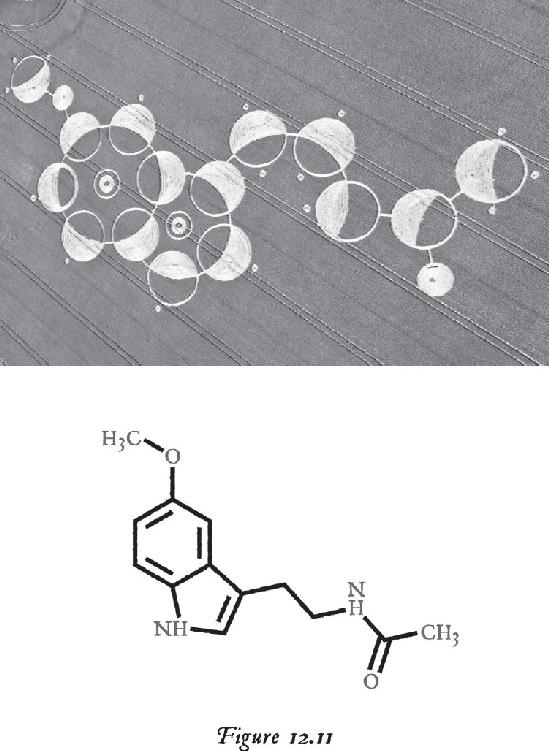
This crop circle found in Roundway, UK, on July 23, 2011, shows the chemical structure of melatonin . . . maybe someone is trying to tell us something.
Melatonin, Mathematics, Ancient Symbols, and the Pineal Gland
On July 23, 2011, a crop circle that looks very much like the chemical structure of melatonin appeared in the English countryside in Roundway near Devizes, Wiltshire. (See Figure 12.11.) Is the crop circle an elaborate hoax? Or is somebody somewhere in another dimension trying to tell us something? As you read this section, you can decide for yourself whether such things happen by coincidence or intelligent design.
The brain has two hemispheres, and if you divided them in half by slicing the brain down the middle, you would perform what is known as a sagittal cut. When looking at the sagittal cut in Figure 12.12, pay particular attention to the location and collective formation of the pineal gland, thalamus, hypothalamus, pituitary gland, and corpus callosum. Does that formation remind you of anything? Meant to signify protection, power, and good health, it’s the ancient Egyptian symbol called the Eye of Horus. Is it possible that there was an ancient teaching about the autonomic nervous system, the reticular activating system, the thalamic gate, and the pineal gland? The Egyptians must have known the significance of the autonomic nervous system and realized that activating the pineal gland meant they could enter the otherworld, or other dimensions.9
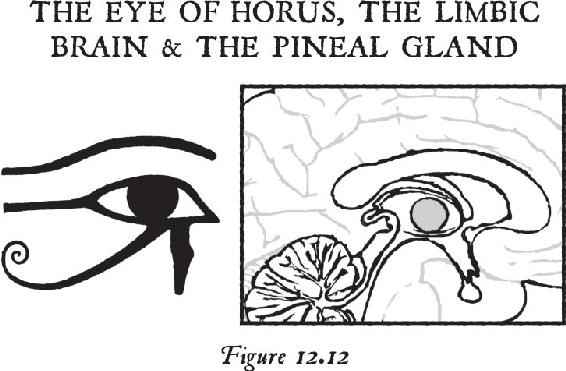
If you slice the brain down the middle, you can view the limbic brain. Take a look and you’ll notice a striking resemblance to the Eye of Horus.
In the Egyptian system of measurement, the Eye of Horus also represented a fractional quantification system to measure parts of the whole. In modern mathematics, we call this the Fibonacci constant, or Fibonacci’s sequence. As I mentioned earlier in the book, this is a mathematical formula that shows up everywhere in nature, displayed in patterns you can see in sunflowers, seashells, pineapples, pinecones, eggs, and even the structure of our Milky Way galaxy. Also known as the golden spiral, the golden mean, or the golden ratio, the Fibonacci constant is characterized by the fact that every number after the first two is the sum of the preceding two.
If you superimposed this formula over the brain and began dividing squares while adding another square and another square, you’d get a fractal pattern, a never-ending pattern that repeats itself at every scale. Starting at the pineal gland, this formula outlines the exact structure of the brain (see Figure 12.13). Are you beginning to think there might be something special going on with the pineal gland?
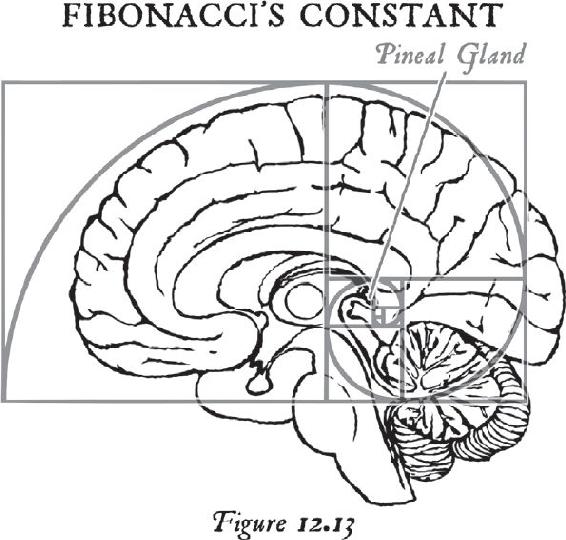
If you follow the golden ratio, Fibonacci’s constant, along the circumference of the brain, the spiral will end at the exact point of the pineal gland.
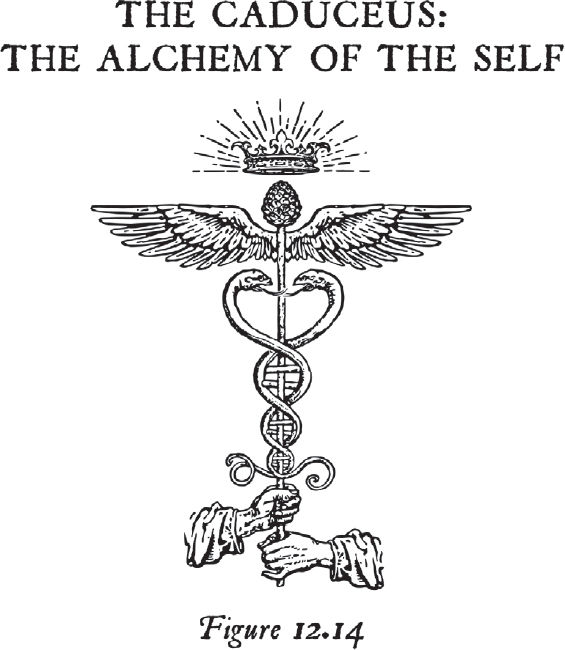
In Greek mythology, Hermes was a messenger of the gods who could move in and out of earthly and divine realms. He was considered a god of transitions and dimensions, as well as a guide to the afterlife. His main symbol was the caduceus, which consists of two snakes wrapped around a rod, the top of which unfolds into wings or birds. (See Figure 12.14.) The caduceus, which Hermes used as a staff, is often considered a symbol of health. Do you think those snakes moving up the staff represent the movement of energy up the spine from the body to the brain, and the wings the liberation of the self when the energy arrives at the pineal gland to signify enlightenment? The crown represents our highest potential and our greatest expression of the divine when we activate our pineal gland (represented by the pinecone). The crowning of the Self is the conquering of the self. This is why I chose this image for the cover of this book.
Tuning In to Higher Dimensions of Time and Space Meditation
Since melatonin levels are at their height between 1 A.M. and 4 A.M., that’s the best time to do this meditation. Start by activating your heart center for one song. Then bless your energy centers, starting with the lowest one, as you learned in the Blessing of the Energy Centers meditation in Chapter 4. Bless this energy center by resting your attention first in the space of that energy center, and then in the space around it. Do this for the first and then for the second energy center, and then focus your attention on the first and second center at the same time. Continue this process with each energy center, creating a bigger field by connecting each new energy center to the prior centers. Eventually you’ll align all eight centers and the energy around your entire body simultaneously. This should take about 45 minutes. Then lie down for 20 minutes and let your autonomic nervous system take the orders to balance the body.
Now sit up and do the breath, bringing that energy all the way up to the top of your head. Hold it and squeeze, compressing the crystals of the pineal gland, thus activating it and creating an electromagnetic field. That field is going to stretch as far as it can go and then it’s going to reverse and compress those crystals. As you increase the frequency, you’re going to pick up higher and higher vibrational realms, and then your brain is going to take that information and turn it into imagery. One last point about this breath: I want to emphasize that it is not necessary to take a fast, deep breath and then squeeze your intrinsic muscles and then hold your breath to the point that you turn purple. Instead, I want you to take a very slow, long, steady breath, coordinating the breath with the contraction of your intrinsic muscles equally as you inhale and slowly follow that breath all the way to the top of your head.
This is the fourth way you can activate the pineal gland. When you’re done with the breath, rest your attention between the back of your throat and the back of your head in space—you are locating that gland, and by placing your attention there, you are placing your energy there. Keep your attention there for about 5 to 10 minutes. As a thought, an awareness, and consciousness, get really tiny and move into the chamber of the pineal gland and sense the space of that room, in the center of this organ, in space. Linger there for about 5 to 10 minutes. Then sense the frequency and space beyond the boundaries of the gland. Radiate the energy beyond that room into the big black space. Direct that energy to carry the intention that this gland release its sacred metabolites for the mystical experience. Broadcast that information into the space beyond your head, in space.
Now open up, tune in to the energy beyond your head in that vast, eternal black space, and just receive. The longer you’re conscious of this energy, and the more you can receive that frequency, the more you are altering and upgrading melatonin to its radical metabolites. Don’t expect anything to happen, don’t try to anticipate—just keep receiving. Finally, lie down again, and let the autonomic nervous system take over. Enjoy the scenery!