
BLESSING OF THE ENERGY CENTERS
We’ve been talking a lot about light and information or energy and consciousness. Now it’s time to go a little deeper into those concepts to help explain how the next meditation works. As you already understand, everything in our known universe is made up of or emits either light and information or energy and consciousness—which are other ways of describing electromagnetic energy. In fact, these elements are so intimately combined that it’s impossible to separate them. Look around you. Even if you don’t see anything other than matter—objects, things, people, or places—there’s also a sea of infinite invisible frequencies that are carrying encoded information. That means not only that your body is made up of light and information, of energy and consciousness, but also that you as a conscious being with a body are made of gravitationally organized light packed with information that is continuously sending and receiving various frequencies, all carrying different signals, just like a radio or a cell phone.
All frequency, of course, carries information. Think about radio waves for a moment. There are radio waves moving through the room you’re sitting in right now. If you turned a radio on, you could tune it to a specific wavelength or signal, and then a little transducer in the radio would pick up that signal and turn it into sound that you could hear and understand as your favorite song, the news, or even a commercial. Just because you can’t see the radio waves in the air doesn’t mean they aren’t there, carrying distinct information on a specific frequency all the time. If you change the frequency a small degree and tune in to another station, a different message will be carried on that wavelength.
Take a look at Figure 4.1A, which shows the entire light spectrum and demonstrates all the electromagnetic frequencies that we know of. The visible light spectrum—where we perceive the various array of colors present in this world we live in—makes up less than 1 percent of all the frequencies of light that exist. That means that the majority of frequencies are beyond our perception, and therefore most of our known reality in this universe cannot be experienced by our senses. So aside from our ability to perceive light being absorbed or reflected off objects and things, the truth is that we are able to perceive only a very small spectrum of reality. There’s a lot of other information available to us besides what we can see with our physical eyes. Remember that when I refer to light, I am talking about all light, which includes the entire spectrum of electromagnetic frequencies—seen and unseen—and not just visible light.
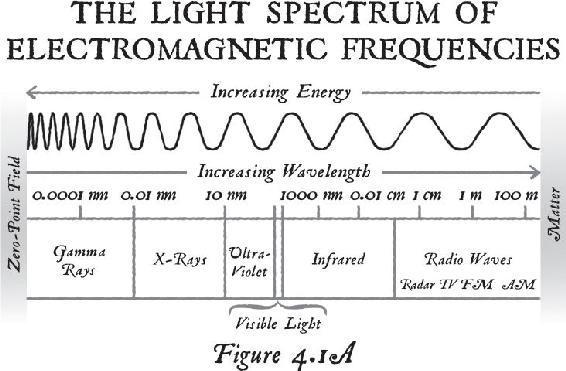
This figure represents the entire spectrum of electromagnetic frequencies from the zero-point field slowing down in frequency all the way to matter. As energy increases (or as the frequency speeds up), the wavelengths decrease. As energy decreases (or as the frequency slows down), wavelengths increase. In the middle, labeled visible light, is the only spectrum of reality we perceive.
For example, even though we don’t see x-rays, they still exist. We know this because we as human beings have the ability to create x-rays, and we can also measure them. In fact, an infinite number of frequencies exists within the spectrum of x-ray light. X-rays are a faster frequency than the visible light we see and therefore have more energy (because, again, the faster a frequency is, the higher its energy). Matter by itself is the densest of frequencies because it’s the slowest and the most condensed form of light and information.
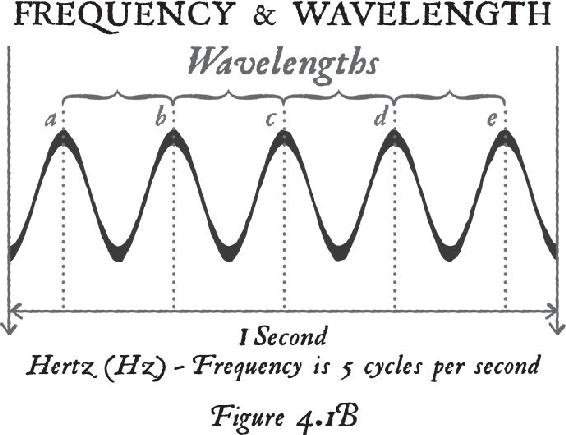
Here we see the relationship between frequency and wavelength. The number of cycles in a complete wave—represented between letters a and b, b and c, and so on—is one wavelength. The space between the two vertical arrows pointing down represents a time interval of one second. In this case, since there are five complete waves within the span of one second, we would say that the frequency is five cycles per second, or 5 Hz.
Take a look at Figure 4.1B. Move your eyes along the horizontal line running through the waves’ hills and valleys, starting at the letter A and then moving to B and then to C. Each time you arrive at the next letter, you have just traveled a full cycle, what is referred to as a wavelength. So the distance between letters A and B is one wavelength. The frequency of a wave refers to the number of wavelengths or cycles produced in one second, which is measured in hertz (Hz). Therefore, the faster the frequency of a wave, the shorter the wavelength. The converse is also true—the slower the frequency, the longer the wavelength (Figure 4.1C). For example, light in the infrared frequency band has a slower frequency than light in the ultraviolet light frequency band, so the wavelengths for infrared light are longer, and the wavelengths for ultraviolet light are shorter. Here’s another example, this time from within the visible light spectrum: The color red has a slower frequency (450 cycles/second) than the color blue (about 650 cycles/second). Therefore, the wavelength of red is longer than the wavelength of blue.
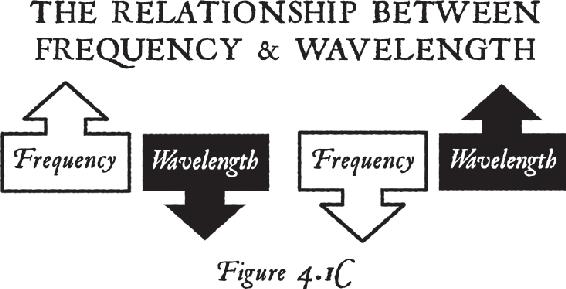
As frequency increases, wavelengths get shorter. As frequency decreases, wavelengths get longer.
Throughout history, people have made several different attempts to photograph and measure fields of light. One prominent example is Kirlian photography, discovered in 1939 by Russian electrician and amateur inventor Semyon Davidovitch Kirlian. With this technique, Kirlian was able to capture images of the electricomagnetic field that surrounds both living and nonliving objects. He found that by putting a sheet of photographic film on a metal plate, placing an object on top of the film, and applying a high-voltage current to the metal plate, an image of the electrical discharge between the object and the plate would show up on the film, appearing like a glowing silhouette of light around whatever was being photographed.
In one of Kirlian’s many experiments, he reportedly photographed two seemingly identical leaves, one from a healthy plant and one from a diseased plant. The photograph of the leaf from the healthy plant showed a strong light field, while the other showed a much weaker glow, leading Kirlian to believe that his photographic technique might be a means of assessing health. While scientists today debate the usefulness of Kirlian photography as a diagnostic tool, research on the technique continues.
A more recent development along these lines comes from German biophysicist Fritz-Albert Popp, Ph.D., who has spent more than three decades studying biophotons, tiny low-intensity light particles that are stored within and emitted by all living things. In 1996, Popp founded the International Institute of Biophysics (IIB), a network of research laboratories from more than a dozen countries around the world that study biophotons. Popp and his fellow IIB researchers believe that the information contained in these light particles, which are stored in DNA, communicates extremely effectively with the cells of the organism, thus playing a vital role in regulating the organism’s function.1 These biophotons can be detected by an extremely sensitive camera designed to measure their emissions: the stronger the emissions as well as the more intense and coherent the light field, the greater communication between cells and the healthier the organism.
In order to sustain life and health, our cells communicate with each other by exchanging vital information transmitted on different frequencies of light. Popp discovered that the reverse is also true: When a cell does not emit enough organized and coherent electromagnetic energy, that cell becomes unhealthy; it’s not able to share information with other cells very well, and without that exchange, it doesn’t have what it needs. So the mechanistic version of the inner workings of the cell that we learned in high school biology is dated. Charged molecules attracting and repelling each other are not responsible for the way cells work. Instead, the electromagnetic energy that the cell emits and receives is the life force that governs those molecules. That’s a vitalistic view that supports the truth of who we are.
What all this means, in effect, is that we are quite literally beings of light, each radiating a very vital life force and expressing an actual light field around our bodies—the totality of each cell expressing and contributing to a vital field of light that carries a message. It would be safe to say, then, that the more we define reality with our senses and live our lives as materialists focusing primarily on the physical (and therefore the more we turn on the stress response), the more we may be missing out on valuable information. That’s because the more we keep narrowing our focus on the matter, objects, things, people, and places in our outer world, the less able we are to sense those other frequencies that aren’t visible to the naked eye. And if we’re unaware of them, they do not exist to us.
As you have already read and, I hope, begun to experience yourself with the meditation in the previous chapter, it’s possible for you to tune in to certain frequencies around you, just like you can tune a radio dial to 107.3. When you close your eyes and sit still and eliminate the external environment (the static that normally keeps you from sensing those other frequencies), you can train yourself to get a clear signal and receive information from it. When you do this repeatedly, you tune in to a new level of light and information that you can use to influence or affect matter. And when you do that, your body experiences syntropy (enhanced order) instead of entropy (disorder, physical breakdown, and chaos). Once you can quiet down your analytical, thinking mind and more readily tune in to this more orderly information, your body automatically responds by processing this new stream of consciousness and energy, thereby becoming more efficient, coherent, and healthy.
Convergent and Divergent Focus
At the beginning of the meditation in the last chapter, I asked you to rest your attention in different parts of your body as well as in the space around different parts of it. Now I want to dive deeper into why I ask you to do that in almost all my meditations. When you practice this, you sharpen your ability to master two different ways your brain can focus: using convergent focus and divergent focus.
Convergent focus is a single-minded or narrow focus on an object—anything having matter. That’s the kind of focus you’re displaying in my meditations when you rest your attention in a specific place in your body. It’s the same kind of focus you use when you pay attention to objects in your environment. Typically, when you go to pick up a glass, call or text somebody, or tie your shoe, you use narrow focus. The majority of the time that you’re in narrow focus, you’re focusing on objects or things (matter) and people or places in the outer world—mostly things that have three dimensions.
Remember our previous discussion about living in survival mode with the hormones of stress continually pumping through our bodies, helping us stay at the ready to fight or flee? When we’re in that state, we narrow our focus even further because paying very close attention to the external, physical world becomes very important. In effect, we become materialists, defining reality with our senses. The different compartments of the brain that normally work in community then begin to subdivide, no longer communicating effectively with each other—and no longer working together seamlessly in a state of coherence (orderliness). Now they’re in an incoherent state, sending incoherent messages down the spinal cord to various parts of the body. We’ve seen this over and over again when we do brain scans to measure brain waves.
As I’ve said before, when your brain is incoherent, you are incoherent. And when your brain is not working right, you are not working right. It’s as though instead of playing a beautiful symphony, your brain and body are producing a cacophony. And because of this unbalanced, incoherent state, you are left trying to control or force outcomes in your life. You try to predict a future that’s based on the past, and you do that in part by paying more attention to your outer world of objects and things than to your inner world of thoughts and feelings. In other words, you stay in narrow, convergent focus—obsessively thinking about the same things over and over again. That’s what stress does. It influences you to obsess about your problems so you can be prepared for the future worst-case scenario based on your past memories. Being prepared for the worst outcome gives you a better chance of survival because no matter what happens, you are prepared for it.
However, when you change your attention from using this narrow focus to adopting a more open and broad focus, as you will do in this meditation, you can become aware of the space and so the light and energy around your body in space. This is called a divergent focus. You go from focusing on some thing to focusing on no thing—on the wave (energy) instead of the particle (matter). Reality is both the particle and the wave; it’s both matter and energy. So when you practice using narrow focus to rest your attention in different parts of the body—acknowledging the particle—and then you open your focus so that you sense the space around these parts of your body in space, acknowledging the wave, your brain changes into a more coherent, balanced state.
Entering the Subconscious Mind
In the 1970s, Les Fehmi, Ph.D., director of the Princeton Biofeedback Centre in Princeton, New Jersey, discovered how this shift in attention from narrow to open focus changes brain waves. Fehmi, a pioneer in attention and biofeedback, was trying to find a method for teaching people how to move their brain waves from beta (conscious thought) to alpha (relaxed and creative). The most effective way to make the shift, he discovered, was by directing people to become aware of space or nothingness—adopting what he called open focus.2 The Buddhist tradition has been using this method of meditation for thousands of years. As you open your focus and sense information instead of matter, your brain waves slow down from beta to alpha. This makes sense because when you are sensing and feeling, you are not thinking.
As your thinking brain—the neocortex—slows down, you are able to get beyond the analytical mind (also called the critical mind), which separates the conscious mind from the subconscious mind (see Figure 4.2). Now you’re able to move into the seat of your body’s operating system—the autonomic nervous system, which you read about in the previous chapter—and now your brain can work in a more holistic fashion.
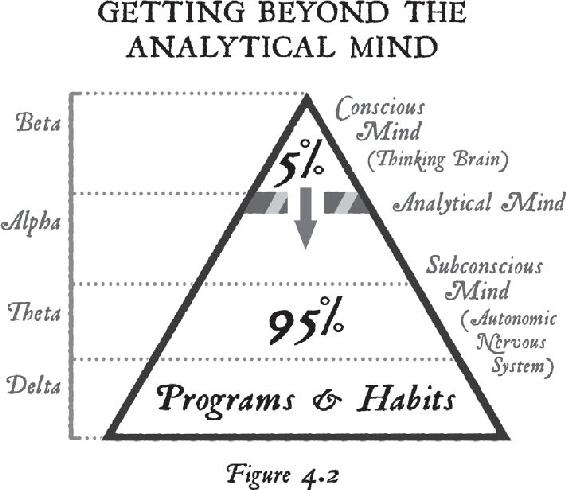
One of the main purposes of meditation is to move beyond the analytical mind. What separates the conscious mind from the subconscious mind is the analytical mind. As you slow your brain waves down, you move out of your conscious mind and thinking brain, past the analytical mind, into the operating system of the subconscious mind, where all those automatic programs and unconscious habits exist.
As you do the Blessing of the Energy Centers meditation I will teach you later on in this chapter, you’ll place your attention in each of your body’s energy centers (also referred to as chakras—meaning wheels—in ancient East Indian Vedic texts), and then you’ll open your focus. Because where you place your attention is where you place your energy, as you place your attention in each center and your energy moves to it, each one of these individual centers begins to become activated.
It’s no mystery that if you have a sexual fantasy in your mind and brain, for example, as energy moves into that center of your body it’s going to become activated in a very specific way, and when it does, organs, tissues, chemicals, hormones, and nervous tissue are all going to respond. If you’re hungry and you’re thinking about what you’re going to eat, it’s no coincidence that your digestive juices turn on, you salivate, and your body prepares for the experience of eating dinner because energy is activating that area. If you’re thinking about telling your boss off or arguing with your daughter, you secrete adrenaline ahead of the actual confrontation. In each of these cases, the thought you’re thinking becomes the experience. I will explain this in more detail in the next section when we talk about the individual energy centers, but for now it’s enough to know that this happens because each center produces its own chemical hormonal expression, which then activates the organs, tissues, and cells in each area.
So imagine what would begin to happen if you were able to slow your brain waves down in a meditation and get into the operating system of each of these energy centers by placing your attention in the space around each center, opening your focus. Each of these centers would then become more orderly and more coherent, which would signal neurons to create a new level of mind and activate the organs, tissues, and cells of that region, producing each center’s own hormones and chemical messengers. And if you did this repeatedly, over time you would begin to effect real, physical change.
In the community of students who do this work, people have healed themselves of chronic bladder infections, prostate problems, impotence, diverticulitis, Crohn’s disease, food allergies and sensitivities like celiac disease, ovarian tumors, elevated liver enzymes, acid reflux, heart palpitations, arrhythmias, asthma, lung conditions, back problems, thyroid conditions, throat cancer, neck pain, chronic migraine, headaches, brain tumors—and more. We’ve seen all kinds of improvements in people from doing this particular meditation, sometimes even after the very first time they do it. Those dramatic healings were possible because students were able to epigenetically change the expression of their DNA, switching some of their genes on and others off, changing how those genes express proteins in their physical bodies (as you learned in Chapter 2).
How Your Body’s Energy Centers Work
We’re about to take a closer look at each of the body’s energy centers, but first I want to explain a bit more about how they work. Think of each of them as an individual center of information. Each has its own specific energy that carries a corresponding level of consciousness, its own emission of light expressing very specific information, or its own frequency carrying a certain message. Each also has its own individual glands, its own unique hormones, its own chemistry, and its own individual plexus of neurons. Think of these individual clusters of neurological networks as mini-brains. And if each one of those centers has its own individual brain, then each also has its own individual mind. (Take a look at Figure 4.3, which lists the location of each center as well as the anatomy and physiology that are associated with each.)
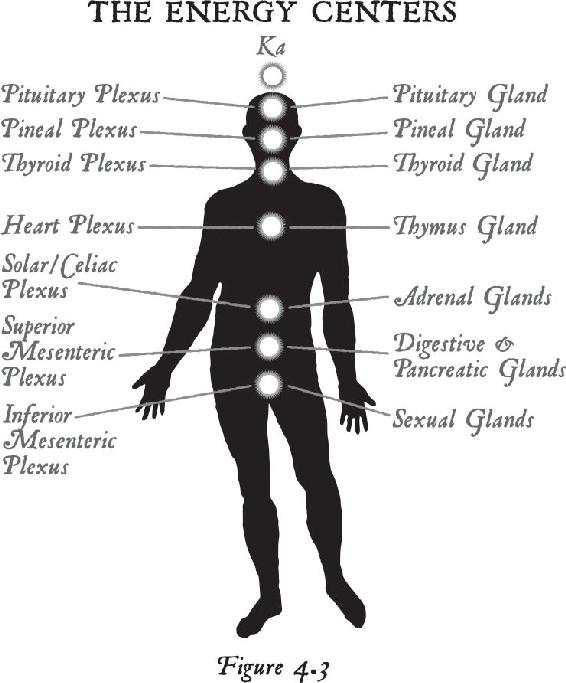
Each energy center of your body has its own biological makeup. They have their own glands, hormones, chemicals, and individual mini-brains (a plexus of neurons) and therefore their own mind.
As you learned in the second chapter, when consciousness activates neurologic tissue, it creates mind. Mind is the brain in action, so if each one of these energy centers has a plexus of neurons, then each has its own individual mind—or better said, each center has a mind of its own. What activates the mind is energy with a directive and intention, a conscious intent. When each of these centers becomes activated, it in turn activates hormones, tissues, chemicals, and cellular functions—and it emits energy.
For example, when your first center (the seat of your reproductive glands) is activated with energy, its mind has a very specific agenda and intention. When you as a conscious being have a thought or a fantasy—that’s consciousness, by the way, acting on neurological tissue—the next thing you know, your body is physiologically changing and therefore so is your energy. Your body secretes chemicals and hormones from those corresponding glands to emotionally prepare you for intercourse. You have more energy in that center now, and it’s releasing its own specific frequency carrying an intentional message.
That energy, carrying the conscious intention, is activating that reproductive center, and the mind in the brain is influencing the mind in the body at the level of its individual nerve plexus. This mind located in that specific area of the body, through this mini-brain, operates on the subconscious level through the autonomic nervous system. It’s beyond your conscious control. We could say that the body is now following the mind as the mini-brain in that energy center activates the related glands, which in turn activate corresponding hormones that signal the appropriate chemicals to change the body’s emotional state and physiology. And then you are emitting a very clear energy carrying a specific directive out of that center. We have all felt that kind of energy from a very sexual person. Once the energy is moving through that neurological tissue or plexus of neurons, it creates mind at that level, so when it’s activated, that center has a mind of its own.
The second center also has its own mind. And when we activate its mini-brain and thus its mind, we trust our gut—and the same sequence of events happens in this center as we just saw in the first energy center, but with different corresponding neurocircuitry, hormones, chemicals, emotions, energy, and information. In fact, this area has been called the second brain because of the hundreds of millions of neurons and neural connections here (more than exist in either the spinal cord or in the peripheral nervous system). In fact, 95 percent of the feel-good hormone serotonin in your body is found not in your brain but in your bowels.3 So trusting our gut literally means trusting our instincts. It’s almost as if our body and this center’s brain can override our analytical, rational thinking brain and mind.
How about your heart center? What happens when you lead with your heart? Like the first two centers, this fourth center, located in the middle of the chest, has its own frequency, its own hormones, its own chemicals, its own emotions, and its own mini-brain that draws from a field of energy and information that surrounds it. And when you lead with your heart you tend to be more caring, kind, inspired, selfless, compassionate, giving, grateful, trusting, and patient. When this mini-brain gets that information, it sends instructions and messages to the organs and tissues that are located in that part of the body and you emit loving energy from this specific center of information.
Now let’s look at each of these energy centers in more detail. Some of the centers will overlap a bit in function, but for the most part, if you know even just a little about the body, they are pretty self-explanatory. You can review Figure 4.3 again if you need to.
Getting Better Acquainted with the Energy Centers
The first energy center governs the region of your sex organs, including your perineum, your pelvic floor, the glands that are connected to your vagina or penis, your prostate if you’re a man, your bladder, your lower bowel, and your anus. This energy center has to do with reproduction and procreation, elimination, sexuality, and sexual identity. The hormones estrogen and progesterone in women and testosterone in men are correlated with this center. This energy center is also associated with the inferior mesenteric nerve plexus.
A tremendous amount of creative energy exists in this first center. Think about the amount of energy you use to make life and create a baby. When this center is in balance, your creative energy flows easily and you are also grounded in your sexual identity.
The second energy center is behind and slightly below your navel. It governs the ovaries, uterus, colon, pancreas, and lower back. It has to do with consumption, digestion, elimination, and the breaking down of food into energy—including digestive enzymes and juices as well as the enzymes and hormones that balance your blood sugar levels. This center is also connected to the superior mesenteric nerve plexus.
This energy center is also related to social networks and structures, relationships, support systems, family, cultures, and interpersonal relationships. Think about it as the center for holding on or letting go—consuming or eliminating. When this center is in balance, you feel safe and secure both in your environment and in the world.
The third energy center is located in the pit of your gut. It governs the stomach, small intestine, spleen, liver, gall bladder, adrenal glands, and kidneys. The associated hormones include adrenaline and cortisol, the kidney hormones, and chemicals like renin and angiotensin, erythropoietin, and all the liver enzymes, as well as the stomach enzymes like pepsin, trypsin, chymotrypsin, and hydrochloric acid. This energy center is also related to the solar plexus, which is also called the celiac plexus.
This center is associated with our will, power, self-importance, control, drive, aggression, and dominance. It is the center of competitive action and of personal power, self-esteem, and directed intention. When the third center is in balance, you use your will and your drive to overcome your environment and the conditions in your life. Unlike the second center, this center becomes naturally activated when you perceive that your environment is not safe or is unpredictable, so you must protect and take care of your tribe and yourself. The third center is also active when you want something and you need to use your body to get it.
The fourth energy center is located in the space behind your breastbone. It governs the heart, lungs, and thymus gland (the body’s main immunity gland, known as the “fountain of youth”). The hormones associated with this center include growth hormone and oxytocin as well as a cascade of 1,400 different chemicals that stimulate the immune system’s health via the thymus gland (responsible for growth, repair, and regeneration of the body). The nerve plexus this center governs is the heart plexus.4
The first three centers are all about survival and reflect our animal nature or our humanity. But in this fourth energy center, we are moving from being selfish to being selfless. This center is associated with the emotions of love and caring, nurturing, compassion, gratitude, thankfulness, appreciation, kindness, inspiration, selflessness, wholeness, and trust. It is where our divinity originates; it is the seat of the soul. When the fourth center is in balance, we care about others and we want to work in cooperation for the greatest good of the community. We feel a genuine love for life. We feel whole, and we are satisfied with who we are.
The fifth energy center is located in the center of your throat. It governs the thyroid, parathyroid, the salivary glands, and tissues of the neck. The hormones associated with this center include the thyroid hormones T3 and T4 (thyroxine), the parathyroid chemicals that govern the body’s metabolism, and circulating calcium levels. The nerve plexus this center governs is the thyroid plexus.
This center is associated with expressing the love you felt in the fourth center, as well as speaking your truth and personally empowering your reality through language and sound. When the fifth center is balanced, you voice your present truth, which includes expressing your love. You feel so pleased with yourself and with life that you just have to share your thoughts and feelings.
The sixth energy center is located in the space between the back of your throat and the back of your head (if that’s too complicated to picture, just think of it as the center of your brain slightly toward the back of your head). It governs the pineal gland, which is a sacred gland. Some people call the pineal the third eye, but I call it the first eye. It’s associated with the door to higher dimensions and shifting your perception so you can see beyond the veil or see reality in a nonlinear way.
When this center is opened, it’s like a radio antenna you can use to tune in to higher frequencies beyond the five senses. This is where the alchemist in you awakens. I devote a whole chapter to the pineal gland later in the book, but for now, know that the pineal gland secretes hormones like serotonin and melatonin (as well as some other wonderful metabolites), which are responsible for your circadian rhythms of feeling awake in response to visible light during the day and sleepy in response to being in darkness at night. In fact, the pineal gland is sensitive to all electromagnetic frequencies besides visible light and can produce corresponding chemical derivatives of melatonin that change your view of reality. When this gland is in balance, your brain works in a clear manner. You are lucid, more conscious of both your inner world and your outer world, seeing and perceiving more each day.
The seventh energy center is located in the center of your head and includes the pituitary gland. This gland has been called the master gland because it governs and creates harmony in a downward cascade from this center of your brain to your pineal gland, your thyroid gland, your thymus gland, your adrenal glands, your pancreatic gland, and all the way to your sexual glands. This is the center of the body where you experience your greatest expression of divinity. This is where your divinity, your highest level of consciousness, originates. When this gland is in balance, you are in harmony with all things.
The eighth energy center is located about 16 inches (40 centimeters) above the head, so it is the only energy center that is not associated with an area of the physical body. The Egyptians called it the Ka. It represents your connection to the cosmos, to the universe, to the whole. When this center becomes activated, you feel worthy to receive—and that opens you up to insights, epiphanies, deep understandings, and creative downloads of frequency and information that come into your physical body and brain not from memories stored in your nervous system but from the cosmos, the universe, the unified field, or whatever you want to call that power that is greater than our individual selves. We access the data and memory of the quantum field through this center.
Evolving Our Energy
Now that I have described each of these energy centers in detail, let’s take a more dynamic look at how they can work. Certainly, our bodies are designed to use energy in each of the centers as I have outlined. But what happens when we do more with our energy than just survive? What happens when instead of releasing all our energy outward (to procreate, to digest food, to run from danger, and so on), we begin to consistently evolve some of that energy upward from one center to the next, increasing its frequency as it ascends?
Here’s what that would look like: We start out by channeling our creative energy from the first center. When we feel safe and secure enough to create, that creative energy evolves, ascending and flowing into the second center. When we have to master some limitation or overcome some condition in our environment, we are able to put the creative energy to good use, and then it will flow to the third center—the seat of our will and power.
When we successfully transcend the adversity in our life, which has challenged us to grow and overcome, we have the opportunity to feel more whole, more free, and more satisfied and we’re then able to feel genuine love for self and others as the energy flows through and activates the fourth center. When that happens, we then want to express our present truth—what we’ve learned or the love or wholeness we feel—and that allows the energy to then move through and turn on our fifth center. After this, when the evolution of energy activates the sixth center, dormant areas of the brain open so that the veil of illusion is lifted and we perceive a broader spectrum of reality than we ever saw before. We then begin to feel enlightened, the body moves more into harmony and balance, and our external environment (including the natural world surrounding us) also moves into more harmony and balance as the energy ascends in activating the seventh center. Once we feel that enlightened energy, we begin to truly feel worthy and the energy can finally rise to activate the eighth center, where we receive the fruits of our efforts—visions, dreams, insights, manifestations, and knowingness that come not from anywhere within our minds and bodies as memories but from a greater power in and around us. This continuous flow of evolving energy from our first center to our eighth center is illustrated in Figure 4.4A.
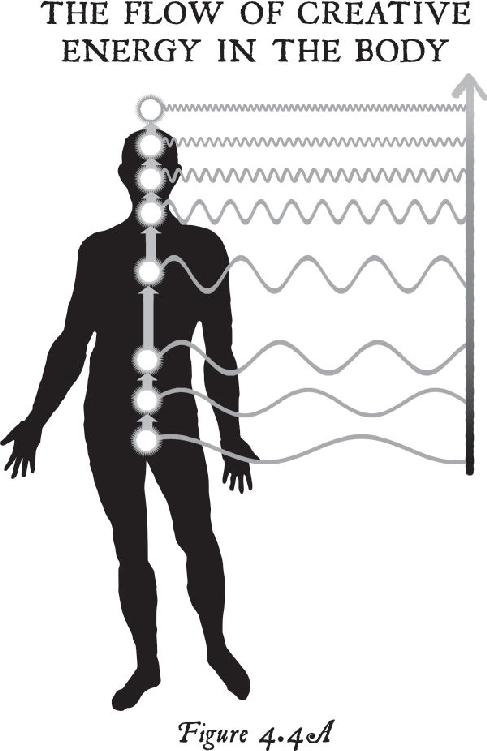
As we evolve our creative energy, it can be channeled from the first center all the way up to the brain and beyond. Each energy center has its own individual frequency that carries its own individual intent.
That’s the kind of personal evolution that happens when the energy flows consistently—the ideal. What all too often happens, however, is that the events of our lives and the way we react to them cause our energy to get stuck so that it doesn’t flow in this magnificent pattern I just outlined. The places in your body where the energy gets stuck are the energy centers associated with the issues you’re dealing with. Figure 4.4B depicts what happens when the energy gets stuck and can’t flow to the higher centers.
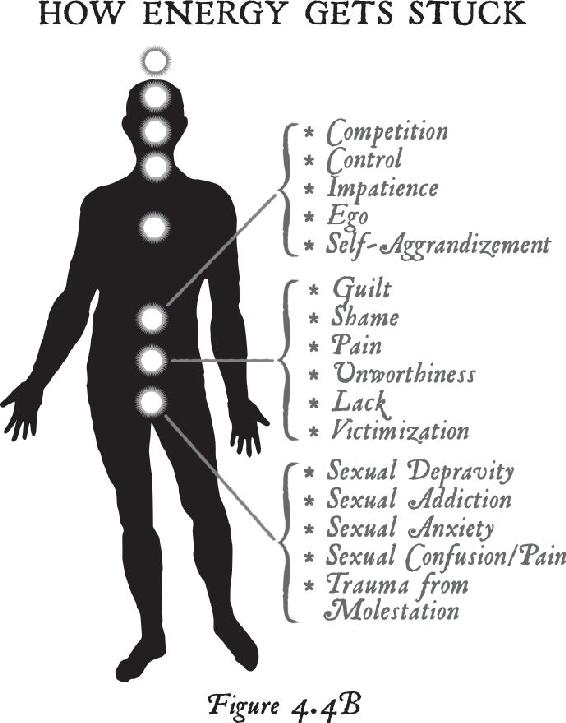
When energy becomes stuck in our body, it cannot flow to the higher centers. Since emotions are energy, these emotions get stuck in different centers and we cannot evolve.
If, for example, a person has been sexually abused or has been conditioned since childhood to think that sex is bad, their energy can stay stuck in the first center, the center associated with sexuality, and they may have problems accessing creativity. If, on the other hand, a person can access their creative energy but doesn’t necessarily feel safe enough to use their creativity in the world (instead feeling victimized by their social and interpersonal relationships), or if they have been traumatized or betrayed by another person, they might hold on to that energy in their second center. Such a person would be likely to feel excessive amounts of guilt, shame, suffering, low self-esteem, or fear. Now, if a person can get their energy flowing up to the third center but they have ego issues and they feel self-important, self-absorbed, controlling, domineering, angry, overly competitive, and bitter, then their energy gets stuck in their third center and they may have control issues or motivation issues. If a person cannot open their heart and feel love and trust or if they are afraid to express love or how they truthfully feel, energy can also become frozen in the fourth and fifth centers, respectively.
While energy can get stuck in any of the energy centers, these first three centers are where it tends to get stuck most often. And when it’s stuck, it can’t evolve and flow in the seamless current described earlier, which switches on the higher energy centers where we’re in love with life and want to give back. Getting that circuit flowing the way it was designed to do is the whole point of doing the Blessing of the Energy Centers meditation—we bless each of these centers so we can get stuck energy flowing again.
Drawing from Our Energy Field
As we discussed earlier, our bodies are surrounded by invisible fields of electromagnetic energy that are always carrying a conscious intention or directive. When we activate each of the body’s seven energy centers, we could say that we are expressing energy out of these centers. Simply put, when we as conscious beings activate a specific energy in each individual center, we stimulate the associated neurological plexuses to produce a level of mind that then activates the proper glands, tissues, hormones, and chemicals in each center. Once each unique center is turned on, the body emits energy carrying specific information or intention from it.
However, if we keep living in survival and we are overly sexual, over-consuming, or overstressed by living our lives from the first three centers, we keep drawing from this invisible field of energy carrying information that surrounds the body, and we are consistently turning it into chemistry. The repetition of this process over time causes the field around the body to shrink. (See Figure 4.5.) As a result, we diminish our light and there is no energy that carries a conscious intention moving through these centers to create the correlated mind in each. Essentially, we’ve tapped our own energy field as a resource. That limited level of mind with its limited amount of energy in each center will send a limited signal to the surrounding cells, tissues, organs, and systems of the body. The result can produce a weakened signal and a lower frequency of energy carrying vital information to the body. Therefore, the lowering frequency of the signals creates disease. We could say that from an energetic level, all disease is a lowering of frequency and an incoherent message.
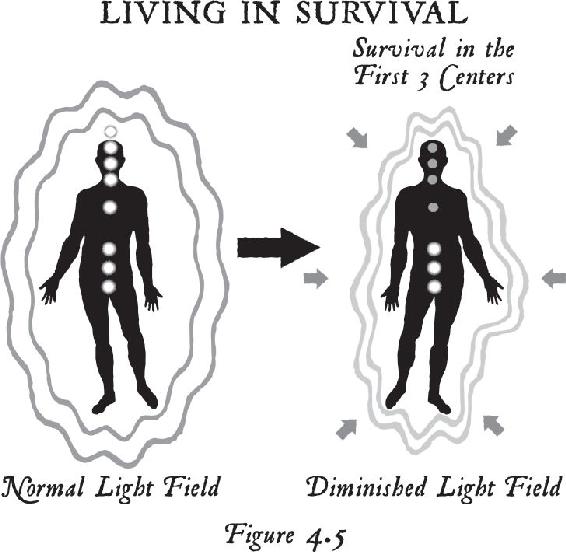
The first three centers are energy consumers. When we overutilize these first three centers, we constantly draw from the invisible field of energy and turn it into chemistry. The field around our body begins to shrink.
Remember how I said that the lower three energy centers of the body are concerned with survival, so they represent our selfish nature? They’re about using power, aggression, force, or competition so we can survive the conditions in our environment long enough to consume food to nourish ourselves and then procreate and keep the species going (as opposed to the upper five centers, which represent our selfless nature and are concerned with more altruistic thoughts and emotions). Nature has made these lower three centers very pleasurable so that we keep engaging the actions related to them and what they represent. Having sex (first center) and eating (second center) are quite enjoyable, as is connecting and communicating with others (also the second center). Personal power (third center) can be intoxicating, including the success of overcoming obstacles, getting what we want, competing against others and winning, surviving in a particular environment, and pushing ourselves to move our bodies around.
You can see, then, why some people may tend to overutilize one or more of their first three centers, and in so doing, consume more of the field of vital energy and information surrounding the body. For example, an overly sexual person draws extra energy from the field of energy surrounding their first center. A person trapped in shame or guilt who feels victimized, holds on to the emotions of the past, and constantly suffers is consuming excess energy from the energy field surrounding their second center and so holds on to energy in that center. An overly controlling or stressed person pulls additional energy from the field surrounding their third center. When our consciousness is not evolving, neither is our energy.
The Subatomic Level
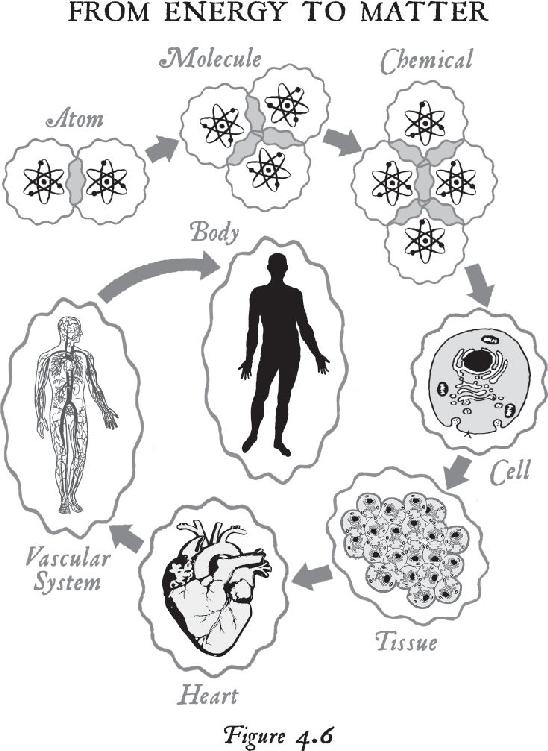
All of this starts at the subatomic or quantum level—so let’s discuss how that happens. Take a look at Figure 4.6. If you take two atoms each with its own nucleus and you put them together to form a molecule, the overlapping of the two circles where they bond is where they’re sharing light and information. And because they’re sharing information, they’re sharing a similar energy that has a particular frequency. What’s holding those two atoms together as a molecule is an invisible field of energy. Once these atoms join to form a molecule and exchange information, they will have different physical properties and characteristics, such as a different density, a different boiling point, and a different atomic weight—to name a few—than when they were sitting side by side, separated. It’s important to note that what is giving the molecule its specific properties as well as holding it into form and structure—into matter—is the invisible field of energy that is surrounding matter. Molecules could not bond without sharing information and energy.
As atoms bond together and share energy and information, they form molecules. The molecule has an invisible field of light surrounding it made up of the energy and information that give it the physical properties to hold it together. As more atoms join that molecule, it becomes more complex and forms a chemical, also with an invisible field of light surrounding it that is the energy and information giving it the physical properties to hold it together.
As more atoms join the chemical, it becomes more complex and can form a cell. The cell is surrounded by its own specific invisible field of energy and information, giving it instructions to function. A group of cells that join together, in turn, become a tissue, with a field of energy and information that allows the cells to function in harmony. The tissues join together to become an organ, with a field of energy and information that allows the organ to function in a healthy manner.
The organs join together to become a system, again with a specific invisible field of light surrounding it, providing the physical properties for it to function as a whole. Finally, the systems join together to form a body. The body’s surrounding field of light holds the energy and information providing it with the physical properties to hold it together and give it instructions for life.
If you add another atom, you form yet another different molecule that again has different physical properties and characteristics and a different atomic structure. And if you keep adding more and more atoms, you form a chemical, and there’s an invisible field of energy around that chemical that’s holding it together in physical form, giving life to that chemical. Those atomic forces are real and measurable.
If you take enough chemicals and you put them together, you’re going to ultimately form a cell, and the cell also has an invisible field of energy surrounding it and giving life to the cell. The cell is actually feeding off different frequencies of light. It’s not molecules and positive or negative charges that are instructing the cell to do what it does. According to the new field of biology called quantum information biology, it’s the biophotons we discussed earlier and their patterns of light and frequency that the cell emits and receives that give the instructions. The healthier the cell, the more coherent the biophotons it emits. If you remember from what you’ve learned so far, coherence is an orderly expression of frequency. The exchange of information (via electromagnetic frequencies of light) between the cell and this field of energy surrounding it happens faster than the speed of light, which means it happens on the quantum level.5
To continue, if you put a group of cells together, you form a tissue, and that tissue has an invisible field of unifying coherent frequency and energy that causes all of those individual cells to work together in harmony, functioning as a community. If you take that tissue and further develop it into a more specialized function, you form an organ, and an organ also has an invisible field of electromagnetic energy. That organ literally receives information from this invisible energy field. In fact, the memory of the organ actually exists in the field.
The way this can affect transplant patients is fascinating. Probably the most famous example is the story of Claire Sylvia, who wrote a book called A Change of Heart about her experiences after receiving a heart and lung transplant in 1988.6 All she knew at the time was that her new organs came from an 18-year-old male donor who had died in a motorcycle accident. After the transplant, the 47-year-old professional dancer and choreographer developed cravings for chicken nuggets, French fries, beer, green peppers, and Snickers bars, none of which were foods she had enjoyed before. Her personality also changed—she became more assertive, more confident. Her teenaged daughter even teased her about developing a man’s gait. When Sylvia eventually tracked down the family of her donor, she discovered the foods she had craved after the transplant were indeed the young man’s favorites. That vital information was stored in the light field of the organ.
The most dramatic story illustrating this involves an 8-year-old girl who, after receiving a heart transplant from a 10-year-old girl, began having vivid nightmares about being murdered.7 The donor had indeed been murdered, and the perpetrator had not been caught. The patient’s mother took her to a psychiatrist who was convinced that the girl was dreaming about events that had actually occurred. They contacted the police, who opened an investigation using the girl’s detailed account of the murder, including information on the time and place of the crime, the weapon, the physical characteristics of the criminal, and the clothing the murderer was wearing. The killer was identified, arrested, and convicted.
So in these cases, that information in the energy field surrounding the transplanted organ changed the expression of the energy field of the individual once the person had a transplant—its different light and different information mixing with the transplant patient’s preexisting field. The recipient can pick up on that information as memory in the field, and it influences their mind and their body. The energy, holding specific information, is influencing matter.
Then when you group organs together, you form a system—such as the musculoskeletal, cardiovascular, digestive, reproductive, endocrine, lymphatic, nervous, and immune systems, to name a few. These systems function by drawing information from the invisible field of energy and consciousness that surrounds them. And when you put all the systems together, you form a body that also has an invisible field of electromagnetic energy surrounding it, and that vital electromagnetic field of light is who we really are.
Now back to the hormones of stress. As I mentioned earlier, when you’re in survival mode and you’re drawing too much from this invisible field of energy to turn it into chemistry in your physical body—whether you’re oversexed, overeating, overstressed, or all at once—this energetic field around your body diminishes. That means there’s not enough energy or light surrounding the body to give the proper instructions to matter for homeostasis, growth, and repair. When that occurs, these individual centers no longer receive, process, or express energy, and they no longer produce a healthy neurological mind to send the necessary signals to the associated parts of the body where these centers innervate. Since that energy with a conscious intent moving through or activating neurological tissue creates mind, the energy centers diminish in the expression of the minds to regulate the cells, tissues, organs, and systems of the body because there’s no energy moving through them. The body begins to function more like a piece of matter without the proper coherent energy of light and information. Those mini-brains become incoherent just as our brain becomes incoherent.
In addition, when the brain is incoherent and compartmentalized because of the hormones of stress, that incoherent brain then sends a very incoherent message—like static on a radio—down the central nervous system to each of the plexuses of neurons that have to do with communicating with the body. And when these mini-brains receive incoherent messages, then they send an incoherent message through the organs, tissues, and cells in each area in the body that’s related to each one of these centers. This in turn affects the hormonal expression and nerve conductivity going to different organs and tissues and cells in the body, and this incoherence begins to create disease or imbalance. The result is that when these individual brains become incoherent, each corresponding area of the body becomes incoherent. And when they don’t work well, we don’t work well.
Increasing Energy
In the Blessing of the Energy Centers meditation, when you learn how to rest your attention in each of these centers and become aware of the space around them, you create coherence in each of these little brains in the same manner as you create coherence in the big brain between your ears. And as you acknowledge the particle (matter) by resting your attention in your perineum (for the first center), or in the space behind your belly button (for the second center), or in the pit of your gut (for the third center), or in the center of your chest (for the fourth center), and so on, you’re anchoring your attention in that center. And where you place your attention is where you place your energy.
Then you’ll move to placing your attention in—or opening your focus to—the space around each of those centers—tuning in to the energy beyond that center. And as you do this, it’s vitally important that you move into a state of elevated emotion, such as love or gratitude or joy. As you know from previous chapters, this is important because the elevated emotion is energy, and the longer you can hold that open focus from a state of elevated emotion, the more you will build a very coherent field with a very high frequency around that center in your body.
Once you build that coherent field around a center, that center has a coherent energy with the right instructions to draw from. The atoms, molecules, and chemicals that form the cells that create the tissues that make up the organs and the systems of the body will be drawing from a new field of light and information and a more coherent energy carrying a more intentional message, giving new instructions to each center of the body. The body will then begin to respond to a new mind. As you surrender and move into the present moment, and you understand that where you place your attention is where you are placing your energy, you can build a new field of light and information and raise the frequency of the signal. And that intentional thought directs energy through each center to produce a new mind in that individual brain. As each center draws from a new field of frequency and information, the body moves back toward balance or homeostasis. And in this new state, you become more energy and less matter, more wave and less particle. The more elevated the emotion, the more energy you create and the more dramatic a shift can result.
If, on the other hand, you stay stuck in the survival emotions of worry, fear, anxiety, frustration, anger, distrust, and so on, you don’t have this energy, this information, and this light around your body. As the frequency, light, and energy slow down and become more incoherent in each center, you become more matter and less energy until your body begins to become diseased. That’s the point of doing this meditation: to speed up the frequency so it entrains the lower disorganized frequency back into coherence and orderliness, raising the frequency of matter or entraining matter to a new, more coherent mind.
But remember, you can’t muscle this. You can’t just will it or force it to happen. You can’t do it by trying, you can’t do it by hoping, and you can’t do it by wishing, because you can’t do it with your conscious mind. You have to get into your subconscious mind, because that’s where the operating system is—the autonomic nervous system that functions and controls all these centers.
You have to get out of your beta brain-wave pattern, because beta keeps you in your conscious mind, separated from your subconscious or your autonomic nervous system that actually runs the show. The deeper you go in meditation—from beta brain waves to alpha brain waves and then even to theta brain waves (the half-awake, half-asleep state of deeper meditation)—the slower your frequency and the more access you have to the operating system. So in the Blessing of the Energy Centers meditation, your job is to slow your brain waves down and combine an elevated emotion with an intent to bless each energy center for the greatest good—loving them into life—and then surrender and allow your autonomic nervous system to take over, because it already knows how to do that without any help from your conscious mind. You’re not thinking, you’re not visualizing, and you’re not analyzing. You’re doing something that may at first seem much more difficult: You’re planting a seed of information and letting go, allowing it to take the instructions and energy and use them to create more balance and order in your body.
We have actually measured how effectively our students can use this meditation to both increase the energy in each of their energy centers and achieve balance among the centers. To do this, we use the gas discharge visualization device that you read about in a previous chapter to take measurements of participants’ energy fields both before and after they do the Blessing of the Energy Centers meditation. The GDV technology uses a specialized camera to take images of a subject’s finger while a weak (and totally painless) electrical current is applied to the fingertip for less than a millisecond. The body responds to the current by discharging an electron cloud made up of photons. While the discharge is not visible to the naked eye, the GDV device’s camera can capture it and translate it into a digital computer file. Then a software program called Bio-Well uses the data to create an image like the one you see in Graphic 4 in the color insert.
Graphics 4A–4D show how balanced (or imbalanced) the subject’s energy centers are, both before and after meditation. The Bio-Well software uses the same GDV data to estimate the frequency of each energy center and compare it to the norm. Balanced energy centers would appear in perfect alignment, while imbalanced centers would make an off-center pattern. The size of the circle representing each energy center shows whether its energy is less than, equal to, or greater than average, and by how much. The left side of each example in Graphic 4 shows the measurements of the subject’s energy centers taken before we started our workshop, while the right side shows the measurements taken a few days later.
Now look at Graphics 5A–5D. The left side of this figure shows the measurement of the energy field around each student’s entire body before we started the event, while the right side shows the measurement of the field around the whole body afterward.
We have also used the GDV device to measure how this meditation (as well as any of the other meditations in this book) enhances the energy field surrounding the entire body. As you’ll soon read in the instructions, at the beginning of the meditation I repeatedly ask you to place your attention not only on various parts of your body, but also on the space around those parts of your body—and then, at the end of the meditation, on the space around your entire body. As you have learned, where you place your attention is where you place your energy, so if you are putting your focus on this space, that’s naturally where your energy is going to go. In doing this, you’re using your attention, awareness, and energy to build and enhance the field of light and information surrounding your body. This in turn creates order and syntropy instead of disorder and entropy. Now you are more coherent energy and less matter—and you have your own enhanced field of light and information that you can draw from to create.
Blessing of the Energy Centers Meditation
This meditation has become one of the most popular meditations among our students and has created an impressive number of supernatural results. As I did in the previous chapter, I will give you some basic instructions so that if you choose to do the meditation on your own, you’ll know how to proceed.
Begin by placing your attention in the first energy center, and then move to opening up your attention to the space around this center. Once you can sense this space around the energy center, bless that center for the greatest good, and then connect to elevated emotions—like love, gratitude, or joy—to raise the frequency of this center and also create a coherent field of energy.
Do this for each of the seven energy centers in the body, and when you come to the eighth center, a place about 16 inches above your head, bless this center with gratitude or appreciation or thankfulness, because gratitude is the ultimate state of receivership. This center will then begin to open the door to profound information from the quantum field.
Now open your focus and place your attention on the electromagnetic energy surrounding your entire body, building a new field of energy. As your body draws from a new field of electromagnetic energy, you become more light, more energy, and less matter—and you raise your body’s frequency.
Remember: If you are going to create the unlimited, you have to feel unlimited. If you are going to heal in a magnificent way, you have to feel magnificent. Tap into elevated emotion and sustain it throughout the meditation.
Once you’ve blessed each of the energy centers, lie down for at least 15 minutes. Relax, surrender, and let your autonomic nervous system take the orders and integrate all of this information into your body.