
If you want to experience the supernatural in your own life—by healing your body, creating new opportunities you could never have imagined before, and having transcendent, mystical experiences—you first need to master the concept of the present moment: the eternal now. There’s a lot of talk about being present or being in the now these days. While most people understand the basics of what that means (not to think about the future or live in the past), I want to offer you a completely different understanding of the concept. It’s going to require that you get beyond the physical world—including your body, your identity, and your environment—and even beyond time itself. This is where you turn possibility into reality.
After all, if you don’t get beyond who you think you are and the way you’ve been conditioned to believe the world works, it’s not possible to create a new life or a new destiny. So in a very real sense, you have to get out of your own way, transcend the memory of yourself as an identity, and allow something greater than you, something mystical, to take over. In this chapter, I’m going to explain how that works.
First, let’s take a look at how the brain functions. When any neurological tissue in the brain or the body is activated, it creates mind. Consequently, from a neuroscientific understanding, mind is the brain in action. For instance, you have a specific mind to drive your car. You have another mind to take a shower. You have a different mind when you sing a song or listen to music. You use a specific level of mind to execute each of those complex functions because you’ve probably done each of these tasks thousands of times, so your brain turns on in a very specific way whenever you do any of them.
When your brain is in action as you drive your car, for example, you are in fact turning on a specific sequence, pattern, and combination of neurological networks. Those neural networks (or neural nets) are simply clusters of neurons that work together as a community—just like an automatic software program or a macro—because you’ve done that particular action so many times. In other words, the neurons that fire together to accomplish the task become more wired together.1 As you consciously choose to perform the task of driving your vehicle, we could say that you are automatically selecting and instructing those neurons in your brain to turn on to create a level of mind.
For the most part, your brain is a product of the past. It has been shaped and molded to become a living record of everything you have learned and experienced up to this point in your life. Learning, from a neuroscientific standpoint, is when neurons in your brain assemble to form thousands of synaptic connections and those connections then assemble into complex, three-dimensional neurological networks. Think of learning as your brain getting an upgrade. When you pay attention to knowledge or information and it makes sense to you, this interaction with the environment leaves biological impressions in your brain. When you experience something new, your senses write the story neurologically in your brain and even more neurons come together to make even more enriched connections, upgrading your brain even further.
Experiences not only enhance the brain circuitry, but they also create emotions. Think of emotions as the chemical residue from past experiences—or chemical feedback. The stronger the emotional quotient from an event in your life, the more the experience leaves a lasting impression in your brain; that’s how long-term memories are formed. So if learning means making new connections in your brain, memories are when you maintain those connections. The more you repeat a thought, choice, behavior, experience, or emotion, the more those neurons fire and wire together and the more they will sustain a long-term relationship.
In Anna’s story in the previous chapter, you learned most of your experiences come from your interaction with your external environment. Since your senses plug you into the external environment and neurologically record the narrative in your brain, when you experience a highly charged emotional event—bad or good—that moment becomes embossed neurologically in your brain as a memory. Therefore, when an experience changes how you normally feel chemically and heightens your attention to what caused it, you will associate a specific person or thing with where your body is at a particular time and place. That’s how you create memories by interacting with the outer world. It’s safe to say that the only place the past actually exists is in your brain—and in your body.
How Your Past Becomes Your Future
Let’s take a closer look at what happens biochemically inside your body when you think a thought or feel an emotion. When you think a thought (or have a memory), a biochemical reaction begins in your brain causing the brain to release certain chemical signals. That’s how immaterial thoughts literally become matter—they become chemical messengers. These chemical signals make your body feel exactly the way you were just thinking. Once you notice you are feeling a particular way, then you generate more thoughts equal to how you’re feeling, and then you release more chemicals from your brain to make you feel the way you’ve been thinking.
For example, if you have a fearful thought, you start to feel fear. The moment you feel fear, that emotion influences you to think more fearful thoughts, and those thoughts trigger the release of even more chemicals in the brain and body that make you continue to feel more fear. The next thing you know, you get caught in a loop where your thinking creates feeling and your feeling creates thinking. If thoughts are the vocabulary of the brain and feelings are the vocabulary of the body, and the cycle of how you think and feel becomes your state of being, then your entire state of being is in the past.
When you fire and wire the same circuits in your brain over and over again because you keep thinking the same thoughts, you are hardwiring your brain into the same patterns. As a result, your brain becomes an artifact of your past thinking, and in time it becomes easier to automatically think in the same ways. At the same time, as you repeatedly feel the same emotions over and over again—since as I just said, emotions are the vocabulary of the body and the chemical residue of past experiences—you are conditioning your body into the past.
So now let’s look at what that means for you on a day-to-day basis. Given what you just learned about feelings and emotions being the chemical end products of past events, the moment you wake up in the morning and search for the familiar feeling called you, you are starting your day in the past. So when you start to think about your problems, those problems—which are connected to the memories of past experiences of different people or things at certain times and places—create familiar feelings such as unhappiness, futility, sadness, pain, grief, anxiety, worry, frustration, unworthiness, or guilt. If those emotions are driving your thoughts, and you cannot think greater than how you feel, then you are also thinking in the past. And if those familiar emotions influence the choices you are going to make that day, the behaviors you’re going to exhibit, or the experiences you are going to create for yourself, then you’re going to appear predictable—and your life is going to stay the same.
Now let’s say after you wake up, you turn off your alarm, and as you lie there in bed, you check your Facebook, your Instagram, your WhatsApp, your Twitter, your texts, your e-mails, and then the news. (Now you are really remembering who you are as you reaffirm your personality and connect to your past-present personal reality.) Then you go to the bathroom. You use the toilet, brush your teeth, take a shower, get dressed, and then head for the kitchen. You drink some coffee and eat breakfast. Maybe you watch the news or check your e-mail again. It’s the same routine you follow every day.
Then you drive to work using the same old route, and when you get there you interact with the same coworkers you saw the day before. You spend your day performing pretty much the same duties you performed yesterday. You might even react to the same challenges at work with the same emotions. Then after work, you drive home; maybe you stop at the same grocery store and buy the food you like and always eat. You cook the same food for dinner and watch the same television show at the same time while sitting in the same place in your living room. Then you get ready for bed in the same way you always do—you brush your teeth (with your right hand starting from the upper right side of your mouth), you crawl into the same side of the bed, maybe you read a little, and then you go to sleep.
If you keep doing these same routines over and over again, they will become a habit. A habit is a redundant set of automatic, unconscious thoughts, behaviors, and emotions that you acquire through frequent repetition. Basically, it means your body is now on autopilot, running a series of programs, and over time, your body becomes the mind. You’ve done this routine so many times that your body automatically knows how to do certain things better than your brain or conscious mind. You just switch on the autopilot and go unconscious, which means you’ll wake up the next the morning and essentially do the same things all over again. In a very real sense, your body is dragging you into the same predictable future based on what you have been repeatedly doing in the same familiar past. You will think the same thoughts and then make the same choices that lead to the same behaviors that create the same experiences that produce the same emotions. Over time, you’ve created a set of hardwired neurological networks in the brain and you have emotionally conditioned your body to live in the past—and that past becomes your future.
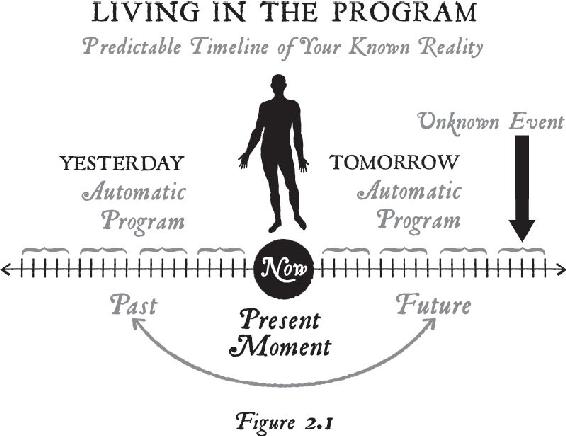
If you were looking at a timeline of your day, starting with waking up in the morning and continuing until you go to bed that night, you could pick up that timeline of yesterday or today (your past) and place it in the space reserved for tomorrow (the future) because essentially the same actions you took today are the ones you are going to take tomorrow—and the day after that, and the day after that. Let’s face it: If you keep the same routine as yesterday, it makes sense that your tomorrow is going to be a lot like your yesterday. Your future is just a rerun of your past. That’s because your yesterday is creating your tomorrow.
Take a look at Figure 2.1. Each of those vertical lines represents the same thought that leads to the same choice that initiates an automatic behavior that creates a known experience that produces a familiar feeling or an emotion. If you keep reproducing the same sequence, in time all those individual steps merge into one automatic program. This is how you lose your free will to a program. The arrow represents an unknown experience dropping in somewhere between you driving to work in traffic, knowing you are going to be late again, and you trying to stop by the dry cleaner’s on your way.
We could say that your mind and body are in the known—the same predictable future based on what you did in the same familiar past—and in that known, certain future there’s no room for the unknown. In fact, if something new happened, if something unknown were to unfold in your life at that moment to change the same predictable timeline of your day, you’d probably be annoyed at the disruption of your routine. You’d likely consider it troublesome, problematic, and downright inconvenient. You might say, “Can you come back tomorrow? This is not the right time.”
A habit is a redundant set of automatic unconscious thoughts, behaviors, and emotions that develop through repetition. It’s when you’ve done something so many times that your body is programmed to become the mind. Over time, your body is dragging you to a predictable future based on what you’ve been doing in the past. Therefore, if you’re not in the present moment, you’re probably in a program.
The fact is, there’s no room for the unknown in a predictable life. But being predictable is not how the unknown works. The unknown is unfamiliar, uncertain—but it’s also exciting because it occurs in ways you cannot expect or anticipate. So let me ask you: How much room in your routine, predictable life do you have for the unknown?
By staying in the known—following the same sequence each day of thinking the same thoughts, making the same choices, demonstrating the same programmed habits, re-creating the same experiences that stamp the same networks of neurons into the same patterns to reaffirm the same familiar feeling called you—you are repeating the same level of mind over and over again. In time, your brain becomes automatically programmed to do any one of those particular sequences more easily and effortlessly the next time, and then the next time, and so on.
As each of these individual steps merge into one complete step, thinking a familiar thought of an experience of somebody or something at some place in some time will automatically create the anticipation of the feeling of the experience. If you can predict the feeling of any experience, you are still in the known. For instance, the thought of having a meeting with the same team of people you have worked with for years can automatically cause you to call up the emotion of what that future event will feel like. When you can predict the feeling of that future event—because you’ve had enough past experiences to make it known to you—you are probably going to be creating more of the same. And of course, you are right. But that’s because you are the same. By the same means, if you are in the automatic program and you cannot predict the feeling of an experience in your life, you will probably be hesitant to engage it.
We need to look at one more aspect of thinking and feeling to get the full picture of what’s happening when you keep living in the same state of being. This thinking-feeling loop also produces a measurable electromagnetic field that surrounds our physical bodies. In fact, our bodies are always emitting light, energy, or frequencies that carry a specific message, information, or intention. (By the way, when I say “light,” I am not just referring to the light we see but to all spectrums of light—including x-rays, cell phone waves, and microwaves.) In the same way, we also receive vital information that is carried on different frequencies. So we are always sending and receiving electromagnetic energy.
Here’s how that works. When we think a thought, those networks of neurons that fire in our brain create electrical charges. When those thoughts also cause a chemical reaction that results in a feeling or an emotion, as well as when a familiar feeling or emotion is driving our thoughts, those feelings create magnetic charges. They merge with the thoughts that create the electric charges to produce a specific electromagnetic field equal to your state of being.2
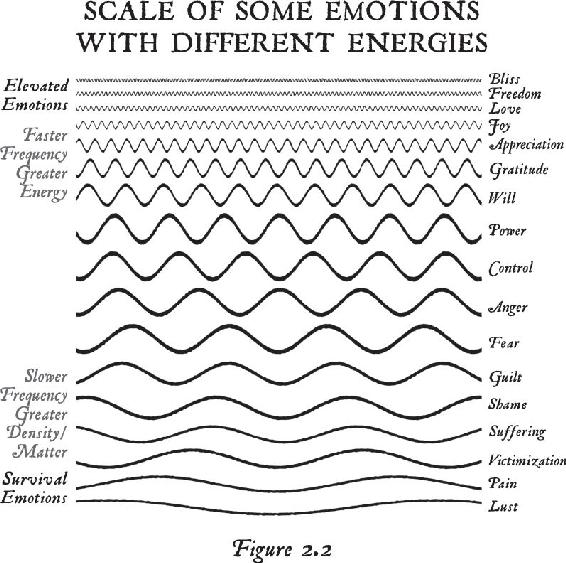
Think of emotions as energy in motion. When someone experiencing a strong emotion walks into a room, their energy (aside from their body language) is often very palpable. We have all felt another person’s energy and intent when they were angry or very frustrated. We felt it because they were emitting a strong signal of energy that carried specific information. The same is true of a very sexual person, a person who is suffering, or a person who has a calm, loving energy: All those energies can be sensed and felt. As you might expect, different emotions produce different frequencies. The frequencies of creative, elevated emotions like love, joy, and gratitude are much higher than the emotions of stress, such as fear and anger, because they carry different levels of conscious intent and energy. (See Figure 2.2, which details some of the different frequencies associated with various emotional states.) You’ll read more about this concept later in the book.
Emotions are energy in motion. All energy is frequency and all frequency carries information. Based on our own personal thoughts and feelings, we are always sending and receiving information.
So if we are re-creating the past day after day, thinking the same thoughts and feeling the same emotions, we are broadcasting the same electromagnetic field over and over again—sending out the same energy with the same message. From the perspective of energy and information, this means the same energy of our past continues to carry the same information, which then keeps creating the same future. Our energy, then, is essentially equal to our past. The only way we can change our lives is to change our energy—to change the electromagnetic field we are constantly broadcasting. In other words, to change our state of being, we have to change how we think and how we feel.
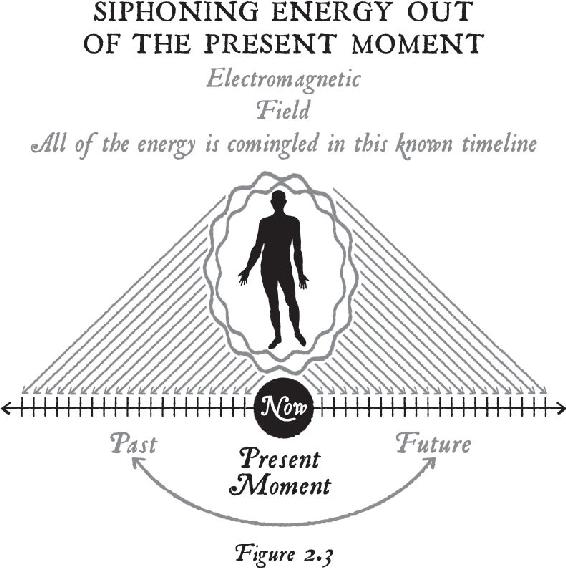
If where you place your attention is where you place your energy, the moment you put your attention on familiar feelings and memories, you are siphoning your energy into the past and out of the present moment. In the same way, if your attention is constantly on all the people you have to see, the places you have to go, the things you have to do at certain times in your known familiar reality, then you are siphoning your energy out of the present moment and into the predictable future.
If where you place your attention is where you place your energy (a key concept you’ll read more about later in this chapter), then the moment you place your attention on a familiar emotion, your attention and your energy are in the past. If those familiar emotions are connected to a memory of some past event involving a person or an object at a particular place and time, then your attention and your energy are in the past as well. As a consequence, you are siphoning your energy out of the present moment into your past. By the same means, if you start to think about all the people you have to see, the things you have to do, and the places you have to go at certain times in your routine day, you are siphoning your attention and energy into a predictable known future. Take a look at Figure 2.3, which illustrates this point.
All of your energy is now completely comingled with those known experiences in that specific line of time. Your energy is creating more of the same and your body is going to follow your mind to the same events in your same reality. Your energy is being directed out of the present moment and into the past and the future. As a result, you have very little energy left to create an unknown experience in a new timeline.
Figure 2.3 also shows how the electromagnetic energy you emanate is a vibrational match with everything known to you. So as you start your day, when you have the thought of the toilet, the next thing you know there you are walking toward the toilet. Then you have the thought of the shower and you find yourself in the shower, adjusting the water temperature. You have the thought of the coffeemaker and you’re projecting your attention and energy to the coffeemaker, and as you automatically walk to the kitchen to make your morning cup of java, once again your body is following your mind. And if you’ve done that for the last 22 years, your body is going to effortlessly coast right over there. Your body is always following your mind—but in this case, it’s been repeatedly following your mind to the known. That’s because that’s where your attention—and therefore your energy—is.
So now let me ask you this: Could it ever be possible for your body to start following your mind to the unknown? If so, you can see that you would have to change where you put your attention, and that would lead to changing your energy, which would require you to change how you think and how you feel long enough for something new to happen. While it may sound incredible, this is indeed possible. It makes sense that just as your body has been following your mind to every known experience in your life (like the coffeemaker each morning), if you were to start investing your attention and energy into the unknown, your body would then be able to follow your mind into the unknown—a new experience in your future.
Priming Your Mind and Body for a New Future
If you are familiar with my work, you know that I’m in love with the concept of mental rehearsal. I am fascinated by how we can change the brain as well as the body by thought alone. Think about that for a moment. If you focus your attention on specific imagery in your mind and become very present with a sequence of repeated thoughts and feelings, your brain and body will not know the difference between what is occurring in the outer world and what is happening in your inner world. So when you’re fully engaged and focused, the inner world of imagination will appear as an outer-world experience—and your biology will change accordingly. That means you can make your brain and body look as if a physical experience has already happened without having the actual experience. What you put your attention on and mentally rehearse over and over again not only becomes who you are from a biological perspective, it also determines your future.
Here’s a good example. A team of Harvard researchers took a group of volunteers who had never before played the piano and divided the group in half. One half practiced a simple five-finger piano exercise for two hours a day over a period of five days. The remaining half did the same thing, but just by imagining they were sitting at the piano—without physically moving their fingers in any way. The before-and-after brain scans showed that both groups created a dramatic number of new neural circuits and new neurological programming in the region of their brains that controls finger movements, even though one group did so by thought alone.3
Think about this. The folks who mentally rehearsed the actions had brains that looked like the experience had already happened—even though they never lifted a finger. If you were to put them in front of a piano after five days of mental rehearsal, many of them would be able to play the exercise they imagined pretty well, even though they had never before tickled the ivories. By mentally imagining the activity every day, they installed the neurological hardware in preparation for the experience. They repeatedly fired and wired those brain circuits with their attention and intention, and over time the hardware became an automatic software program in their brains and it became easier to do the next time. So if they were to start to play after five days of mental practice, their behaviors would become easily aligned with their conscious intentions because they primed their brains for the experience ahead of time. That’s how powerful the mind can be, once trained.
Similar studies show the same kinds of results with muscle training. In a pioneering study at the Cleveland Clinic, ten research subjects between the ages of 20 and 35 imagined flexing one of their biceps as hard as they could in five training sessions a week for 12 weeks. Every other week, the researchers recorded the subjects’ electrical brain activity during their sessions and measured their muscle strength. By the end of the study, the subjects had increased their biceps’ strength by 13.5 percent, even though they hadn’t actually been using their muscles at all. They maintained this gain for three months after the training sessions stopped.4
More recently, a research team made up of scientists from the University of Texas at San Antonio, the Cleveland Clinic, and the Kessler Foundation Research Center in West Orange, New Jersey, asked subjects to visualize contracting their elbow flexor muscles. As they did so, they were instructed to urge the muscles to flex as strong and hard as possible—adding a firm intention to their strong mental energy—for 15-minute sessions, five days a week, for 12 weeks. One group of subjects was instructed to use what is called external or third-person imagery, imagining themselves performing the exercise by observing themselves in a scene in their heads separate from the experience (like watching a movie of themselves). A second group was instructed to use internal or first-person imagery, imagining that their bodies as they existed right then in real time were doing the exercise, making it more immediate and realistic. A third group, the control, did no practice. The group using external imagery (as well as the control group) showed no significant change, but the group using internal imagery showed a 10.8 percent increase in strength.5
Another team of researchers from Ohio University went so far as to wrap the wrists of 29 volunteers in surgical casts for one month, ensuring they wouldn’t be able to move their wrists even unintentionally. Half the group practiced mental-imagery exercises for 11 minutes a day, five days a week, imagining they were flexing their immobilized wrist muscles while actually remaining completely still. The other half, the control group, did nothing. At the end of the month, when all the casts came off, the muscles of the imagery group were twice as strong as those of the control group.6
Each of these three muscle studies shows how mental rehearsal not only changes the brain, but can also change the body by thought alone. In other words, by practicing the behaviors in their mind and consciously reviewing the activity on a regular basis, the bodies of the subjects looked like they had been physically performing the activity—and yet they never did the exercises. Those who added the emotional component of doing the exercise as hard as possible to the intensity of the mental imagery made the experience even more real and the results more pronounced.
In the piano-playing study, the brains of the research subjects looked as though the experience they’d imagined had already happened because they had primed their brains for that future. In a similar way, the subjects in the muscle-flexing studies changed their bodies to look as if they had previously experienced that reality—just by mentally rehearsing the activity through thought alone. You can see why when you wake up in the morning and start thinking about the people you have to see, the places you have to go, and the things you have to do in your busy schedule (that’s mentally rehearsing), and then you add an intense emotion to it like suffering or unhappiness or frustration, just like the elbow flexor volunteers who urged their muscles to flex without moving them at all, you are conditioning your brain and body to look like that future has already happened. Since experience enriches the brain and creates an emotion that signals the body, when you continuously create an inward experience that is as real as an outer experience, over time you’re going to change your brain and body—just like any real experience would.
In fact, when you wake up and start thinking about your day, neurologically, biologically, chemically, and even genetically (which I will explain in the next section), it looks as though that day has already happened for you. And in fact, it has. Once you actually start the day’s activities, just as in the experiments above, your body is naturally and automatically going to behave equal to your conscious or unconscious intentions. If you’ve been doing the same things for years on end, those circuits—as well as the rest of your biology—are more readily and easily activated. That’s because not only do you prime your biology every day with your mind, but you also re-create the same physical behaviors in order to reinforce those experiences further in your brain and body. And it actually becomes easier to go unconscious every day because you keep mentally and physically reinforcing the same habits over again—creating the habit of behaving by habit.
Making Genetic Changes
We used to think that genes created disease and that we were at the mercy of our DNA. So if many people in someone’s family died of heart disease, we assumed that their chances of also developing heart disease would be pretty high. But we now know through the science of epigenetics that it’s not the gene that creates disease but the environment that programs our genes to create disease—and not just the external environment outside our body (cigarette smoke or pesticides, for example), but also the internal environment within our body: the environment outside our cells.
What do I mean by the environment within our body? As I said previously, emotions are chemical feedback, the end products of experiences we have in our external environment. So as we react to a situation in our external environment that produces an emotion, the resulting internal chemistry can signal our genes to either turn on (up-regulating, or producing an increased expression of the gene) or to turn off (down-regulating, or producing a decreased expression of the gene). The gene itself doesn’t physically change—the expression of the gene changes, and that expression is what matters most because that is what affects our health and our lives. Thus, even though someone may have a genetic predisposition for a particular disease, for example, if their genes continue to express health instead of expressing that disease, they won’t develop the condition and will remain healthy.
Think of the body as a finely tuned instrument that produces proteins. Every one of our cells (except red blood cells) makes proteins, which are responsible for the body’s physical structure and physiological function. For example, muscle cells make specific proteins known as actin and myosin, and skin cells make the proteins collagen and elastin. Immune cells make antibodies, thyroid cells make thyroxine, and bone-marrow cells make hemoglobin. Some of our eye cells make keratin, while our pancreatic cells make enzymes like protease, lipase, and amylase. There isn’t an organ or a system in the body that does not rely on or produce proteins. They are a vital part of our immune system, digestion, cellular repair, and bone and muscle structure—you name it, they’re a part of it. In a very real way, then, the expression of proteins is the expression of life and is equal to the health of the body.
In order for a cell to make a protein, a gene must be expressed. That’s the job of the genes, to facilitate making proteins. When the signal from the environment outside of the cell reaches the cell membrane, the chemical is accepted by a receptor outside of the cell and makes its way to the DNA inside the cell. Then a gene makes a new protein that’s equal to that signal. So if the information coming from outside of the cell does not change, the gene keeps making the same protein and the body stays the same. Over time, the gene will begin to down-regulate; it will either shut off its healthy expression of proteins or it will eventually wear out, like making a copy of a copy of a copy, causing the body to express a different quality of proteins.
Different classifications of stimuli up-regulate and down-regulate genes. We activate experience-dependent genes, for example, by doing new things or learning new information. These genes are responsible for stem cells getting the instructions to differentiate, transforming into whatever type of cell the body needs at that particular time to replace cells that are damaged. We activate behavioral state–dependent genes when we are in high levels of stress or arousal, or in alternate states of awareness, like dreaming. You can think of these genes as the fulcrum of mind-body connection because they provide a link between our thoughts and our bodies, allowing us to influence our physical health through various behaviors (meditation, prayer, or social rituals, for example). When genes are altered in this way, sometimes within minutes, those altered genes can then be passed on to the next generation.
So when you change your emotions, you can change the expression of your genes (turning some on and others off) because you are sending a new chemical signal to your DNA, which can then instruct your genes to make different proteins—up-regulating or down-regulating to make all kinds of new building blocks that can change the structure and function of your body. For example, if your immune system has been subject to living in the emotions of stress for too long and has certain genes activated for inflammation and disease, you can turn on new genes for growth and repair and switch off the old genes responsible for disease. And at the same time, these epigenetically altered genes will begin to follow new instructions, making new proteins and programming the body for growth, repair, and healing. This is how you can successfully recondition your body to a new mind.
So as you read earlier in this chapter, this means that if you’re living by the same emotions day in and day out, your body believes it’s in the same environmental conditions. Then those feelings influence you to make the same choices, causing you to demonstrate the same habits that then create the same experiences that then produce the same emotions all over again. Thanks to these automatic, programmed habits, your cells are constantly being exposed to the same chemical environment (outside your body in your environment as well as outside the cells but within your body). That chemistry keeps signaling the same genes in the same way—and so you’re stuck because when you stay the same, your genetic expression stays the same. And now you are headed for a genetic destiny because you don’t have any new information coming from the environment.
But what if the circumstances in your life change for the better? Shouldn’t that also change the chemical environment surrounding your cells? Yes, that happens, but not all the time. If you’ve spent years conditioning your body to this cycle of thinking and feeling, and then feeling and thinking, without realizing it you’ve also conditioned your body to become addicted to these emotions. So simply changing the external environment by, say, getting a new job doesn’t necessarily break that addiction any more than someone addicted to drugs would be able to stop their cravings just by winning the lottery or moving to Hawaii. Because of the thinking-feeling loop, sooner or later—after the novelty of the experience is over—most people return to their baseline emotional state, and the body believes it is in the same old experience that created the same old emotions.
So if you were miserable in your old job but managed to get a new one, you might be happy for a few weeks or even a few months. But if you had spent years conditioning your body to be addicted to misery, you would eventually return to that old emotion because your body would crave its chemical fix. Your outer environment may have changed, but your body will always believe its internal chemistry more than its external conditions, so it remains emotionally locked into your old state of being, still addicted to those old emotions. That’s just another way of saying you’re still living in the past. And because that internal chemistry hasn’t changed, you can’t change the expression of your genes to make new proteins in order to improve the structure or the function of your body, so there’s no change in your health or your life. That’s why I say you have to think greater than the way you feel to make any real, lasting changes.
In the winter of 2016, at our advanced workshop in Tacoma, Washington, my team and I performed a study on the effect elevated emotions had on immune function, taking saliva samples from 117 test subjects at the start of the workshop and then again four days later at the workshop’s conclusion. We measured immunoglobulin A (IgA), a protein marker for the strength of the immune system.
IgA is an incredibly powerful chemical, one of the primary proteins responsible for healthy immune function and the internal defense system. It’s constantly fighting a barrage of bacteria, viruses, fungi, and other organisms that invade or are already living within the body’s internal environment. It’s so powerful that it’s better than any flu shot or immune system booster you could possibly take; when it’s activated, it’s the primary internal defense system in the human body. When stress levels (and therefore the levels of stress hormones like cortisol) go up, this lowers levels of IgA, thereby compromising and down-regulating the immune system’s expression of the gene that makes this protein.
During our four-day workshop, we asked our study participants to move into an elevated emotional state such as love, joy, inspiration, or gratitude for nine to ten minutes three times a day. If we could elevate our emotions, we wondered, could we boost our immune system? In other words, could our students up-regulate the genes for IgA simply by changing their emotional states?
The results amazed us. Average IgA levels shot up by 49.5 percent. The normal range for IgA is from 37 to 87 milligrams per deciliter (mg/ dL), but some people measured more than 100 mg/dL at the end of the workshop.7 Our test subjects showed significant, measurable epigenetic changes without having any significant experiences in their external environment. By attaining states of elevated emotion even for just a few days, their bodies began to believe that they were in a new environment, so they were able to signal new genes and change their genetic expression (in this case, the protein expression of the immune system). (See Figure 2.4.)
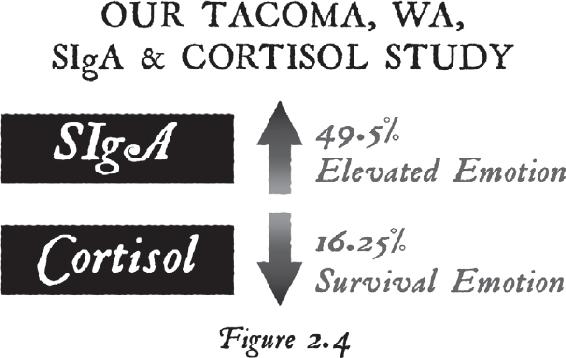
As we practice maintaining elevated emotions and changing our energy, we can literally up-regulate new genes that make new healthy proteins to strengthen our internal defense system. As we reduce our survival emotions, and minimize the need for our external protection system, we down-regulate genes for the production of stress hormones. (SIgA in the figure above stands for salivary immunoglobulin A; cortisol represents stress hormones. Both were measured in saliva.)
This means that you might not need a pharmacy or an exogenous substance to heal you—you have the power from within to up-regulate the genes that make IgA within a few days. Something as simple as moving into an elevated state of joy, love, inspiration, or gratitude for five to ten minutes a day can produce significant epigenetic changes in your health and body.
Where Attention Goes, Energy Flows
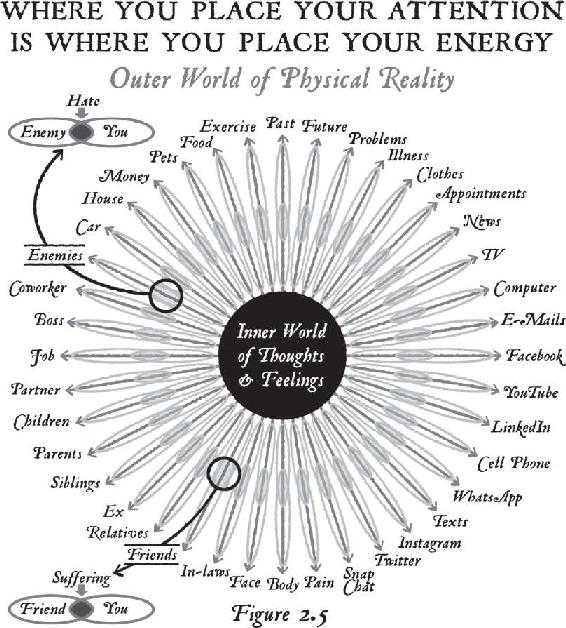
Since where you place your attention is where you place your energy, when you wake up in the morning and immediately start putting your attention and energy on all the people you have to see that day, the places you have to go, the objects you own, and the things you have to do in the three-dimensional world, your energy becomes fractured. All of your creative energy is flowing away from you, as Figure 2.5 illustrates, to all the things in the outer world that compete for your attention—your cell phone, your laptop, your bank account, your house, your job, your coworkers, your spouse, your kids, your enemies, your pets, your medical conditions, and so on. Take a glance at Figure 2.5. It is obvious that most people’s attention and energy are directed to their outer material world. It begs the question: How much energy do you have left in your inner world of thoughts and feelings to create a new reality?
Consider for a moment that each of these people or things you give so much attention to is a known in your life because you’ve experienced it. As I mentioned earlier in the chapter, you have a neurological network in your brain for each one of those things. Since they are mapped in your brain, you perceive and so experience them from your past. And the more you keep experiencing them, the more automatic and enriched the neural circuits for each of them become because the redundancy of the various experiences keeps assembling and refining more and more circuits. That’s what experience does; it enriches the brain. So you have a neurological network about your boss, a neurological network about money, a neurological network about your partner, a neurological network about your kids, a neurological network for your financial situation, a neurological network for your house, and neurological networks about all your physical-world possessions because you’ve experienced all of those people or things at different times and places.
Every person, object, thing, place, or situation in our familiar physical reality has a neurological network assigned to it in our brain and an emotional component connected to it because we’ve experienced all these things. This is how our energy becomes bonded to our past-present reality. Therefore, as you place your attention on all these elements, your energy is flowing away from you and it leaves little energy in your inner world of thoughts and feelings to create something new in your life.
If you look at the magnified portions of the figure where the two ovals intersect, these represent how we use different elements in our outer world to reaffirm our emotional addiction. You may use your friends to reaffirm your addiction to suffering, you may use your enemies to reaffirm your addiction to hatred. It begs the question, How much of your creative energy could you be using to design a new destiny?
When your attention, and therefore your energy, is divided between all these outer-world objects, people, problems, and issues, there’s no energy left for you to put on your inner world of thoughts and feelings. So there’s no energy left for you to use to create something new. Why? Because how you think and how you feel literally creates your personal reality. Therefore, if you are thinking and feeling equal to everything that you know (that’s the known), you keep reaffirming the same life. In fact, we could say that your personality is no longer creating your personal reality; now your personal reality is creating your personality. Your external environment is controlling your thoughts and feelings. There’s a biological match between your inner world of thoughts and feelings and your outer-world, past-present reality made of people and objects at certain times and places. You are continuously keeping your life the same because you are keeping your attention (thoughts) and your energy (feelings) the same.
Finally, if how you think and how you feel broadcasts an electromagnetic signature that influences every area of your life, you are broadcasting the same electromagnetic energy and your life never changes. We could say that your energy is equal to everything in your past-present reality—and you are re-creating the past. That’s not the only limitation that occurs, though. When you place all your attention and energy on the outer world and you keep reacting to the same conditions in the same way—in a state of chronic stress, which causes the brain to be in a constant state of arousal—your inner world becomes imbalanced and your brain begins to work inefficiently. And then you become less effective in creating anything at all. In other words, you become a victim of your life instead of the creator of your life.
Living by the Hormones of Stress
Now let’s take a closer look at how we end up getting addicted to our negative emotions—or more precisely, what we call the hormones of stress. The moment we react to any condition in our outer world that tends to be threatening, whether the threat is real or imagined, our body releases stress hormones in order to mobilize enormous amounts of energy in response to that threat. When this occurs, the body moves out of balance—that’s exactly what stress is. This is a natural and healthy response, because in antiquity, that chemical cocktail of adrenaline and cortisol and similar hormones were released when we were facing some danger in the outer world. Maybe a predator was chasing us, for example, and we had to make the decision to fight, run, or hide.
When we are in survival mode, we automatically become materialists, defining reality with our senses: by what we can see, hear, smell, feel, and taste. We also narrow our focus and put all our attention on matter—on our bodies existing in a particular space and time. The hormones of stress cause us to give all our attention to our outer world because that’s where the danger lurks. Back in the days of early humans, of course, this response was a good thing. It was adaptive. It kept us alive. And once we had focused our attention on the cause and then the danger had passed, the levels of all those stress hormones went back into balance.
But in modern times, that’s no longer the case. After just one phone call or e-mail from our boss or a family member that elicits a strong emotional reaction such as anger, frustration, fear, anxiety, sadness, guilt, suffering, or shame, we turn on the primitive fight-or-flight nervous system, causing us to react as if we were are being chased by a predator. The same chemistry automatically stays switched on because the external threat never seems to go away. The truth is that many of us spend the majority of our time in this state of heightened arousal. It’s become chronic. It’s as though the predator is not out there in the wild, making an occasional toothy appearance, but is instead living in the same cave as we are—a toxic coworker whose desk is right next to ours, for example.
Such a chronic stress response is not adaptive; it’s maladaptive. When we’re living in survival mode and those hormones of stress like adrenaline and cortisol keep pumping through our body, we stay on high alert instead of returning to balance. As in Anna’s experience in Chapter 1, when this imbalance is maintained long-term, chances are we are headed for disease, because long-term stress down-regulates the healthy expression of genes. In fact, our bodies become so conditioned to this rush of chemicals that they become addicted to them. Our bodies actually crave them.
In this mode, our brains become overly alert and aroused as we try to predict, control, and force outcomes in an effort to increase our chances of survival. And the more we do this, the stronger the addiction becomes and the more we believe we are our bodies connected to our identities and our environment, living in linear time. That’s because that’s where all of our attention is.
When your brain is aroused and you are living in survival mode, and you have to keep shifting your attention to your job, to the news, to your ex, to your friends, to your e-mails, to Facebook, and to Twitter, you’re activating each of these different neurological networks very quickly. (Review Figure 2.5.) If you keep doing this over time, the act of habitually narrowing your focus and shifting your attention compartmentalizes your brain and it no longer works in a balanced fashion. And when that happens, you are training your brain to fire in a disordered, incoherent pattern, which causes it to work very inefficiently. Like a lightning storm in the clouds, different neural networks fire out of order, so your brain works out of sync. The effect is similar to a group of drummers all banging on their skins at the same time but not together or with any rhythm. We will talk much more about the concepts of coherence and incoherence in a later chapter, but for now it’s enough to know that when your brain gets incoherent, you get incoherent. When your brain isn’t working optimally, you’re not working optimally.
For each outer-world person or thing or place you’ve experienced in your life that is a known, you have an emotion connected to it because emotions—which are energy in motion—are the chemical residue of experience. And if most of the time you’re living by those addictive stress hormones, you might use your boss to reaffirm your addiction to judgment. You might use your coworkers to reaffirm your addiction to competition. You might use your friends to reaffirm your addiction to suffering. You might use your enemies to reaffirm your addiction to hatred, your parents to reaffirm your addiction to guilt, your Facebook feed to reaffirm your addiction to insecurity, the news to reaffirm your addiction to anger, your ex to reaffirm your addiction to resentment, and your relationship with money to reaffirm your addiction to lack.
This means your emotions—your energy—are comingled, even bonded, with every person, place, or thing you experience in your known, familiar reality. And that means there’s no energy available for you to create a new job, a new relationship, a new financial situation, a new life, or even a newly healed body. Let me say it another way. If how you think and how you feel determines the frequency and information you are emitting in your energy field, which has a significant effect on your life, and if all your attention (and so all your energy) is tied up in your outer world of people, objects, things, places, and time, there is no energy left in your inner world of thoughts and feelings. Therefore, the stronger the emotion you are addicted to, the more you will place your attention on that person, object, place, or circumstance in your outer world—giving away most of your creative energy and causing you to feel and think equal to everything you know. It becomes difficult to think or feel in any new ways when you are addicted to your outer world. And it’s possible that you can become addicted to all the people and things in your life that are causing all your problems in the first place. That’s how you give your power away and mismanage your energy. If you review Figure 2.5, you’ll find a few examples to illustrate how we create energetic bonds to all the elements in our outer world.
Take a look at Figure 2.6. On the left side of the diagram, you see two atoms bound by an invisible field of energy. They’re sharing information. It’s energy that is bonding them together. On the right side of the diagram, you see two people who are sharing an experience of resentment and who are also bonded by an invisible field of energy that keeps them connected energetically. In truth, they are sharing the same energy and so the same information.
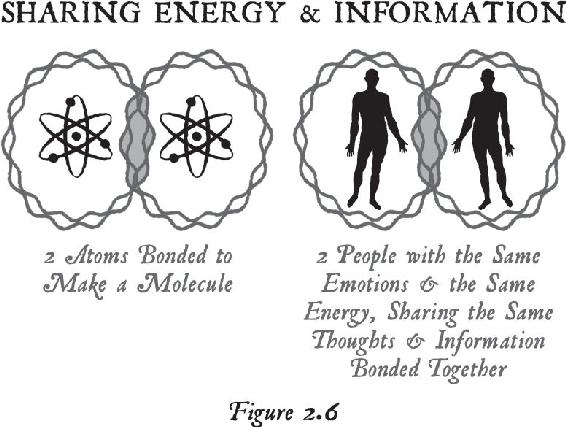
Just like two atoms that bond together to form a molecule—which share energy and information—when two people share the same emotions and energy, and communicate the same thoughts and information, they become bonded together as well. In both cases, they are bound by an invisible field of energy that keeps them connected. If it takes energy to separate these two atoms, it is going to take energy and awareness to take our attention off the people and conditions in our life that we’ve given so much creative energy away to.
To separate the two atoms, it takes energy. By the same means, if your attention and energy are bound to the same people, places, and things in the outside, physical world, you can understand that it’s going to take energy and effort to break those bonds when you’re in meditation. This begs the question: How much of your creative energy is tied up in guilt, hatred, resentment, lack, or fear? The truth is that you could be using all that energy to re-create a new destiny.
To do that, you’re going to have to get beyond all of those things in your outer world by taking your attention off them. That’s why we use meditation as the model to change our internal state. This allows us to break from our associations to every body, every one, every thing, every where, and every time long enough to journey within. Once you overcome your emotional body and you take your attention off everything known to you in your outer world, you call your energy back to you, breaking the bonds with your past-present reality (which has been staying the same). You’re going to have to make the transition from being somebody to being no body—which means you have to take your attention off your body, your pain, and your hunger. You’re going to have to go from being someone to being no one (taking your attention off your identity as a partner, a parent, and an employee). You’ll have to go from keeping your attention on some thing to placing your attention on no thing (forgetting all about your cell phone, your e-mails, and getting a cup of coffee) and from being somewhere to being no where (getting beyond any thoughts about the chair you’re meditating in or where you’ll be going later today) and from being in linear time to being in no time (with no distracting memories or thoughts about the future).
I’m not saying that your cell phone or your laptop or your car or your bank account is bad, but when you’re overly attached to those things and they’ve captured your attention to such a degree that you can’t get beyond thinking about them (because of the strong emotions you associate with them), those possessions own you. And then you can’t create something new. The only way to do that is to learn to call all of that fractured energy back so you can overcome the emotions of survival that you have become addicted to and that keep all your energy bound to your past-present reality. Once you take your attention off all those exterior elements, you start to weaken your energetic and emotional bonds with those things and you finally begin to free up enough available energy to create a new future. That’s going to require you to become aware of where you’ve been unconsciously placing your attention, and—like separating the two atoms—it’s also going to take some energy to consciously break those bonds.
People come up to me all the time in workshops and tell me their computer hard drive crashed or someone stole their car or they lost their job and they don’t have any more money. When they tell me they have lost people or things in their life, you know what I always say to them? “Great! Look how much available energy you have now to design a new destiny!” By the way, if you do this work well and manage to call your energy back to you, it will most likely be uncomfortable at first, even a little chaotic. Get ready, because certain areas of your life may fall apart. But don’t worry. That’s supposed to happen because you’re breaking the energetic bonds between yourself and your same past reality. Anything that is no longer in a vibrational match between you and your future is going to fall away. Let it. Don’t try to put your old life back together because you’re going to be way too busy with the new destiny you’re calling to yourself.
Here’s a great example. A friend of mine who was vice president of a university showed up for a board meeting about three weeks after he started doing this meditation work. He was the backbone of that university. The students and faculty loved him. He walked into the board meeting and sat down—and they fired him. So he called me and said, “Hey, I don’t know if this meditation process is working. The board just fired me. Aren’t great things supposed to happen to me when I am doing the work?”
“Listen,” I told him. “Don’t you hold on to those emotions of survival, because then you’ll be in your past. Instead, keep finding the present moment and creating from that place.” Within two weeks he fell in love with a woman he later married. He also soon received an offer for an even better job as vice president of a much larger and better university, which he gratefully accepted.
A year later, he called me again to tell me that the college that fired him was now asking him to return as president. So you never know what the universe has in store for you as your old reality falls away and your new one begins to unfold. The only thing I can assure you of is this: The unknown has never let me down.
Calling Your Energy Back
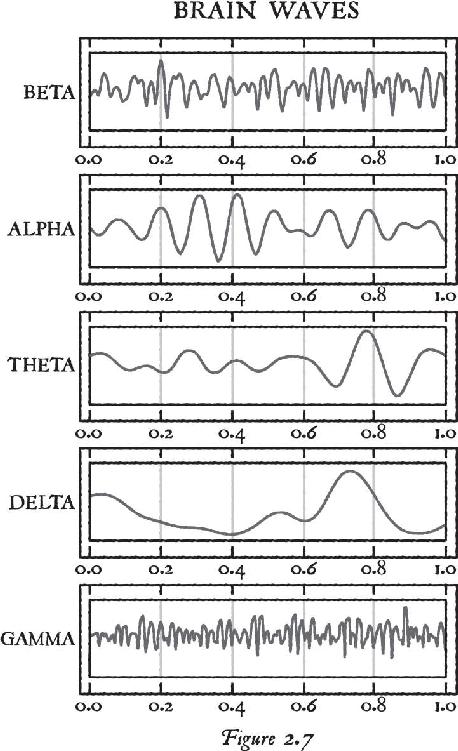
If you’re going to disconnect from the outer world, you have to learn how to change your brain waves. So let’s talk about brain-wave frequencies for a moment. Most of the time that you are awake and conscious, you are in the beta range of brain-wave frequencies. Beta is measured in low-range, medium-range, and high-range frequencies. Low-range beta is a relaxed state when you don’t perceive any threats from the outer world but you are still aware of your body in space and time. This is the state you are in when you are reading, paying attention to your daughter during a friendly conversation, or listening to a lecture. Mid-range beta is a slightly more aroused state, such as when you are in a group of people, introducing yourself to everyone for the first time, and you have to remember everyone’s name. You’re more vigilant, but you’re not overly stressed or completely out of balance. Think of mid-range beta as good stress. High-range beta is the state you’re in when you’re jacked up on the hormones of stress. These are the brain waves you display when you exhibit any of the survival emotions, including anger, alarm, agitation, suffering, grief, anxiety, frustration, or even depression. High-range beta can be more than three times higher than low-range beta and twice as high as mid-range beta.
While you may spend most of your waking time in beta-frequency brain waves, you also dip into alpha-frequency brain waves throughout your day. You display alpha brain waves when you are relaxed, calm, creative, and even intuitive—when you’re no longer thinking or analyzing and instead you’re daydreaming or imagining, like a trance state. If beta brain waves indicate when you are placing the majority of your attention on your outer world, alpha brain waves indicate when you are placing more of your attention on your inner world.
Theta-frequency brain waves take over in that twilight stage when your mind is still awake but your body is drifting off to sleep. This frequency is also associated with deep states of meditation. Delta-frequency brain waves usually come during deep, restorative sleep. However, over the last four years my research team and I have recorded several students who can move into very deep delta brain waves during meditation. Their bodies are deeply asleep, and they are not dreaming, but their brain scans show that their brains are processing very high amplitudes of energy. As a result, they report having profound mystical experiences of oneness, feeling connected to everyone and everything in the universe. See Figure 2.7 to compare the different brain-wave states.
Gamma-frequency brain waves indicate what I call a superconscious state. This high-frequency energy occurs when the brain gets aroused from an internal event (one of the most common examples is during meditation when your eyes are closed and you are going within) instead of an event that happens outside the body. We’ll talk more about gamma brain waves in later chapters.
A comparison of different brain waves.
One of the biggest challenges people have when they meditate is switching out of high-range (and even mid-range) beta and slipping into alpha and then theta brain-wave frequencies. It’s absolutely vital to do so, though, because when they slow down their brain waves to these other frequencies, they are no longer paying attention to the outer world and all the distractions they’re so used to thinking about when they’re under stress. And since they’re not analyzing and strategizing, trying to prepare for the worst-case scenario in their future based on their fearful memories of the past, they have the opportunity to become present, to exist only in the now.
Wouldn’t it be wonderful during a meditation to disconnect your association to all the elements in your outer environment, to get beyond your body, your fears, and your schedule and forget about your familiar past and your predictable future? If you do it right, you will even lose track of time. As you overcome your automatic thinking, your emotions, and your habits in meditation, that is exactly what happens: You get beyond your body, your environment, and time. You weaken the energetic bonds with your past-present reality and find yourself in the present moment. Only in the present moment can you call your energy back to you.
This does take some effort (although it will get easier with practice) because you’re living by the hormones of stress most of the time. So let’s look at what happens when you aren’t in the present moment during meditation so you’ll know how to handle that when it arises. Understanding this skill is important because if you can’t get beyond your stresses, your problems, and your pain, you can’t create a new future where those things don’t exist.
So let’s say you’re sitting in your meditation and you start to have some stray thoughts. You’re in the habit of thinking that way because you’ve been thinking the same way and putting your attention on the same people and things at the same time and place for years now. And you have been automatically embracing the same familiar feelings on a daily basis just to reaffirm the same personality that’s connected to your same personal reality—repeatedly conditioning your body into the past. The only difference now is that because you’re trying to meditate, your eyes are shut.
As you are sitting there with your eyes closed, you are not physically seeing your boss. But your body wants to feel that anger because every time you see her in your waking day—50 times a day, five days a week—you are in the habit of feeling bitterness or aggression. Similarly, when you get e-mails from her (which happens at least 10 times a day), you unconsciously have the same emotional reaction to her, so your body has grown accustomed to needing her to reaffirm your addiction to anger. It wants to feel the emotions it has become addicted to, and like an addict craving a drug, the body is craving the familiar chemicals. It wants to feel that familiar anger at your boss because you didn’t get the promotion or it wants to feel judgment about your coworker who always wants you to cover for him. Then you start thinking about other colleagues who annoy you and other reasons to be upset with your boss. You’re sitting there trying to meditate, but your body is throwing the kitchen sink at you. That’s because it wants its chemical fix of familiar emotions that you normally feel throughout your waking day with your eyes open.
The instant you notice what’s happening—that you are putting all of your attention on that emotion—you become aware that you’re investing your energy into the past (because emotions are records of the past), so you stop and return to the present moment and you begin to disinvest your attention and energy out of the past. But then in a little while, you start to feel frustrated and angry and resentful again, and you realize what you are doing. You remember that your body is trying to feel those emotions in order to reaffirm its addiction to those chemicals, and you remember that those emotions drive your brain into high-range beta brain waves—and you stop. Every time you pause, settle your body down, and return to the present moment, you are telling your body that it is no longer the mind—you are the mind.
But then thoughts start drifting into your mind about the people you have to see and the places you have to go and the things you have to do later that day. You wonder if your boss has answered that e-mail yet, and you remember that you haven’t returned your sister’s phone call either. And today is trash day, so you remind yourself you need to put out the trash. And all of a sudden you become aware that by anticipating those future scenarios, you are investing your attention and your energy into the same known reality. So you stop, return to the present moment, and once more disinvest your energy out of that predictable, known future and make room for the unknown in your life.
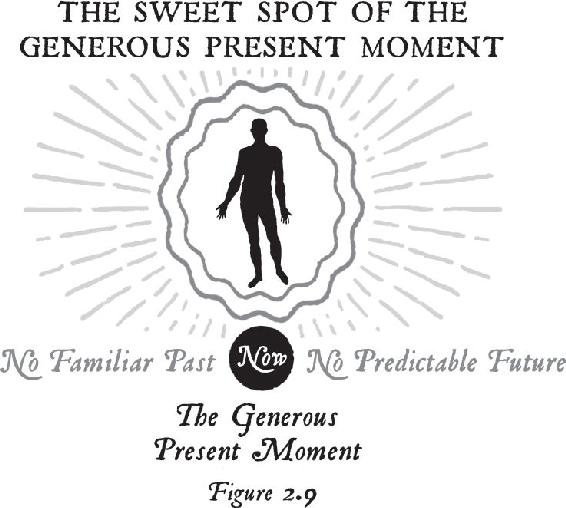
Take a look at Figure 2.8. It shows that once you find yourself in that sweet spot of the generous present moment, your energy (represented by the arrows) no longer goes away from you to the past and future the way it did back in Figure 2.3. Now you are divesting your energy from that familiar past and predictable future. You are no longer firing and wiring the same circuits in the same way, and you are no longer regulating and signaling the same genes in the same way by feeling the same emotions. If you keep doing this process, you are continuously calling all that energy back to you by breaking the energetic bonds that keep you connected to your past-present reality. This happens because you are taking your attention and your energy off your outer world and placing it instead on your inner world, and you’re building your own electromagnetic field surrounding your body. Now you have available energy that you can use to create something new.
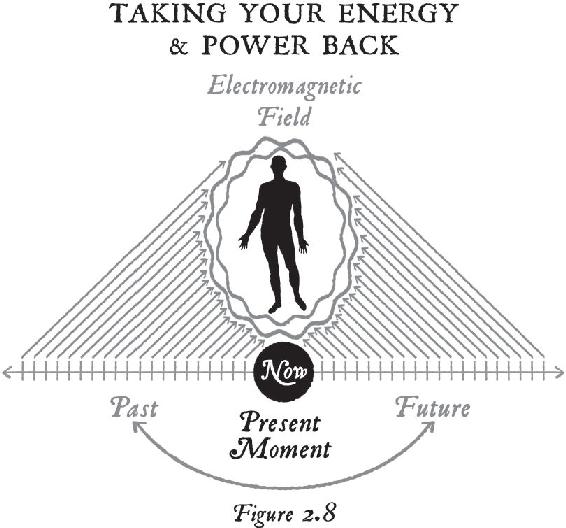
As you take your attention off your past-present reality or your predictable future reality, you are calling energy back to you and building your own electromagnetic field. Now you have available energy to heal yourself or to create a new experience in your life.
Not surprisingly, your attention eventually begins to wander again. As you continue to sit in meditation, your body becomes more annoyed and impatient because it wants to do something. After all, you’ve programmed it every day to get up and follow the same routine. It wants to quit meditating, open its eyes, and see someone. It wants to hear something on TV or talk to someone on the phone. It prefers to taste breakfast instead of sitting there doing nothing. It would like to smell coffee brewing, like it does every morning. And it would love to feel something like a hot shower before it starts the day.
The body wants to experience physical reality with its senses in order to embrace an emotion, but your goal is to create a reality from a world beyond your senses that’s defined not by your body as the mind but by you as the mind. So as you become aware of the program, you keep settling your body down into the present moment. The body tries again to return to the familiar past because it wants to engage in a predictable future, but you keep settling it back down. Each time you overcome those automatic habits, your will becomes greater than your program. Every time you keep settling your body back to the present moment, like training a dog to sit, you are reconditioning your body to a new mind. Each time you become aware of your program and you labor for the present moment, you are stating that your will is greater than your program. And if you keep returning your attention (and therefore your energy) back to the present moment and you keep noticing when you are present and when you are not, sooner or later your body is going to surrender. It is this process of continuously returning to the present moment every time you become aware that you’ve lost it that begins to break the energetic bonds with your familiar known reality. And when you do return to the present moment, what you’re actually doing is getting beyond your physical-world identity and unfolding into the quantum field (a concept I will explain in detail in the next chapter).
The hardest part of every war is the last battle. That means that when your body as the mind is raging, causing you to think that you cannot go any further, wanting you to stop and return to the world of the senses, you keep persevering. You truly step into the unknown—and sooner or later you will begin to break the emotional addiction within you. When you get beyond your guilt, your suffering, your fear, your frustration, your resentment, or your unworthiness, you are freeing your body from the chains of those habits and emotions that keep you anchored in the past—and as a result, you are liberating energy that is now coming back to you. As the body releases all of this stored emotional energy, it is no longer becoming the mind. You discover that right on the other side of your fear is courage, right on the other side of your lack is wholeness, and just beyond your doubt is knowing. When you step into the unknown and surrender your anger or hatred, you discover love and compassion. It’s the same energy; it has just been stored in the body and now it’s available for you to use to design a new destiny.
So when you learn to overcome yourself—or the memory of yourself and your life—you break the bonds you have with every thing, every person, every place, and every time that’s keeping you connected to your past-present reality. And when you finally overcome your anger or your frustration, and you liberate energy that was trapped in the past, you call that energy back to you. As you liberate all of that creative energy that has been tied up in those survival emotions—within you and all around you—you are building your own personal energy field around your body.
In our advanced workshops, we’ve actually measured this effect of calling the energy back. We have experts who use very sensitive equipment called a gas discharge visualization (GDV) machine with a specially designed sensor (called a Sputnik antenna) developed by Konstantin Korotkov, Ph.D. It measures the ambient electromagnetic field in the workshop conference spaces to see how the energy changes as the workshop progresses. On the first full day of some of our advanced workshops, we sometimes see the energy in the room drop. That happens because once we start meditating and those students have to overcome themselves by breaking the energetic bonds with everyone and everything in their known reality, they are calling energy back to themselves. They’re drawing energy from the greater field, and the field in the room can diminish as the participants begin to build their individual field of energy around their own bodies—and now they have available energy to use to design a new destiny. Of course, as our entire group gets beyond themselves the first day, they finally build their own light field, and as their energy keeps expanding each day, they begin to contribute to the energy in the room. As a result, we finally witness the energy in the room rise. To see what this sometimes looks like, find Graphics 1A and 1B in the color insert.
One way to increase your chances of a successful meditation is to give yourself enough time so you don’t get distracted by trying to rush through the experience. When I meditate, for example, I allow for two hours. I don’t have to take two hours every time, but I know myself well enough by now to realize that if I have only one hour, I’m going to tell myself there’s not enough time. If I have two hours, on the other hand, I can relax, knowing I have plenty of time to find the present moment. Some days I find the sweet spot of the present moment pretty quickly, while on other days I have to work for an hour at bringing my brain and body back into the present.
I am a very busy person. Some days when I have just arrived home for three days between workshops or events, I wake up in the morning and immediately think of the three meetings I have planned that day with different staff members, mentally rehearsing what I have to talk about. Then I think about the e-mails I have to get done before I go to those meetings. Then I think about the flight I have to catch that afternoon. Then I make a mental note about the phone calls I have to make on the drive to the airport. You get the idea.
As that happens and I am thinking about the same people I have to see, the same places I have to go, the same things I have to do, all at the same time in my known familiar reality, I realize that I’m priming my brain and body to look like that future has already happened. I become conscious that my attention is in the known future, and I stop anticipating the known and turn back to the present moment. As I do that, I’m beginning to unfire and unwire those neural connections. Then I might get a little emotional and become impatient and a little frustrated thinking about something that happened yesterday. And since emotions are a record of the past and where I place my attention is where I place my energy, I become aware that I’m investing my energy in the past. Then the hormones of stress may get my brain aroused, and my body gets a bit fired up into high-range beta brain waves and I have to settle it back down into the present moment again. And as I do that I’m no longer firing and wiring the same circuits in my brain, and I’m disinvesting my energy out of the past.
And if I am aware of the same thoughts that are connected to those same familiar feelings, when I stop myself from feeling the same way, I am no longer conditioning my body into the past and I’m no longer signaling the same genes in the same ways. And if emotions are the end products of experiences in the environment, and if it’s the environment that signals the gene, then when I stop feeling those same emotions, I am no longer selecting and instructing the same genes in the same ways. That not only affects the health of my body, but it also no longer primes my body to be in the same future, based on living in the past. So as I inhibit those familiar feelings, I am changing the genetic program of my body. And since the hormones of long-term stress down-regulate the expression of healthy genes and create disease, every time I am able to stop when I catch myself feeling any of those emotions that are related to stress, I am no longer conditioning my body to stay addicted to the emotions of stress.
When you are in the sweet spot of the generous present moment, your familiar past and your predictable future no longer exist and now you are ready to create new possibilities in your life.
If I do it properly—overcoming my familiar thoughts and emotions of my known past and future—then energetically, neurologically, biologically, chemically, hormonally, and genetically, that predictable future (as well as the familiar past I used to affirm it) no longer exists. If I’m no longer firing and no longer wiring those same old neural networks (by no longer thinking about those memories of the people or things at certain times and places), and I keep returning to the present moment, I am calling energy back to me. Take a look at Figure 2.9 and you can see how the familiar past and the predictable future no longer exist.
Now I’m in the sweet spot of the generous present moment, and I have available energy to create. I’ve built my own energy field surrounding my body. Every time I’ve labored—sometimes for hours—to get beyond myself and find that place called the eternal now, and I truly break through, I’ve always thought the same thing: That was so worth it.