
RECONDITIONING THE BODY TO A NEW MIND
In this chapter, we’re going to discuss how to do a breathing technique we use before we start many of our meditations. I’m going to explain it in detail here because understanding how this works is vital to your ability to truly change your energy and free your body from the past. As you’ll see, the proper use of the breath is one of the keys to becoming supernatural. To get all the benefits of this technique, your knowledge of what you will be doing and why you are doing it will serve as the foundation for the experience and so will make the how easier for you—not to mention making the technique more effective. Once you understand the physiology of how this particular breath works, you will be able to assign meaning to the activity, put more intention behind it, do it properly, and experience all of the benefits of using breath to pull the mind out of the body and then recondition your body to a new mind.
Before we start, I want to review the thinking-feeling loop we discussed in Chapter 2 because the concepts are central to the meditation in this chapter. As you will recall, thoughts cause biochemical reactions in your brain that release chemical signals, and those chemical signals make the body feel exactly the way you were just thinking. Those feelings then cause you to generate more thoughts that make you feel the same way you were just thinking. So your thoughts drive your feelings, and your feelings drive your thoughts, and eventually this loop hardwires your brain into the same patterns, which conditions your body into the past. And because emotions are a record of past experiences, if you can’t think greater than how you feel, this thinking-feeling loop keeps you anchored to your past and creates a constant state of being. This is how the body becomes the mind—or in time, how your thoughts run you and your feelings own you.
So once your body becomes the mind of that emotion, your body is literally in the past. And since your body is your unconscious mind, it is so objective that it does not know the difference between the experience in your life that creates the emotion and the emotion you are creating by thought alone. Once you are caught in this thinking-feeling loop, the body believes it is living in the same past experience 24 hours a day, 7 days a week, 365 days a year. The body believes it’s in the same past experience because to the body, the emotion is literally the experience.
Let’s say you’ve had a few difficult experiences in your life that have branded you emotionally, and you’ve never got over the fear, bitterness, frustration, and resentment those experiences engendered. So every time you have an experience in your external environment that is similar in some way to what happened previously, the experience triggers you and you feel the same emotions that you did at the time of the first event. Once you feel the same emotion you felt 30 years ago when the event initially occurred, it’s quite possible that you will behave in the same way you did at that time because those emotions are driving your conscious or unconscious thoughts and behaviors. Now those emotions have become so familiar to you that you believe that’s who you are.
By the time you are in your mid-30s, if you keep thinking, acting, and feeling the same way without changing anything about yourself, the majority of who you are becomes a memorized set of automatic thoughts, reflexive emotional reactions, unconscious habits and behaviors, subconscious beliefs and perceptions, and routine familiar attitudes. In fact, 95 percent of who we are as adults is so habituated through repetition that the body has been programmed to be the mind, and the body, not the conscious mind, is running the show.1 That means that only about 5 percent of who we are is conscious and the remaining 95 percent is a subconscious body-mind program. So in order to create something significantly different in our lives, we must find a way to pull the mind out of the body and change our state of being, which is exactly what the meditation I will teach you at the end of this chapter is designed to do.
How Energy Gets Stored in the Body
Now let’s look at how the thinking-feeling loop works in relation to the body’s energy centers—especially the first three, the survival centers, where it causes the most problems. That’s because most people’s thoughts and feelings activate those energy centers. As you’ll remember from the previous chapter, each of the body’s energy centers has its own individual energy, information, glands, hormones, chemistry, and neurocircuitry—and its own individual mini-brain or mind (or, really, each has a mind of its own). These mini-brains become programmed in the body to operate subconsciously through the autonomic nervous system. In this way, each center has its own energy and corresponding level of consciousness, and each is associated with specific emotions corresponding to that center.
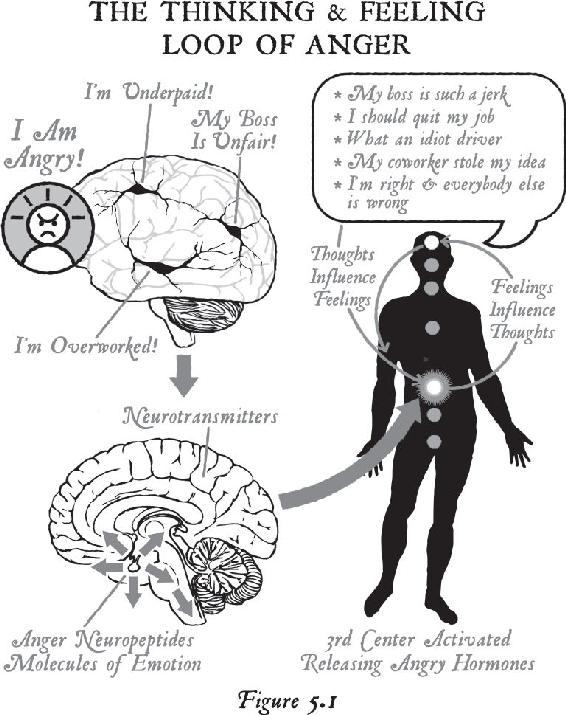
So let’s say you think a thought, such as My boss is unfair. Figure 5.1 depicts how thinking that thought turns on a neurological network in your brain. Then you have another thought, I’m underpaid, and you turn on a second neurological network. Then you think, I’m overworked, and now you’re off to the races. Because mind is the brain in action, if you keep thinking more thoughts along the same lines and you activate enough networks of neurons firing in tandem—in a specific sequence, pattern, and combination—you produce a level of mind, which then creates an internal representation or an image of yourself in your brain’s frontal lobe. That’s where you can make your internal thoughts more real than your outer environment. In this case, you see yourself as an angry person. If you accept, believe, and surrender to that idea, that concept, or that image without any analysis, the neurotransmitters—chemical messengers that send information between neurons in your brain that produce that level of mind—begin to influence neuropeptides, which are chemical messengers created by the autonomic nervous system within the limbic brain. Think of neuropeptides as molecules of emotion. Those neuropeptides signal hormonal centers, in this case turning on the adrenal glands in the third energy center. As the adrenal glands release their hormones, you’re feeling pretty ticked off. And you broadcast a specific energy signature through the third energy center that in effect carries the message, “Send me another reason to feel the way I’m already feeling—send me another reason to feel angry.” As this center becomes activated, it produces a specific frequency that carries a particular message.
This graphic demonstrates how we store energy in the form of emotions in our third center as a result of getting caught in a specific thinking and feeling loop.
Your brain monitors your chemical state, and the moment you feel angry, it’s going to think more corresponding thoughts equal to how you feel. My boss is such a jerk! I should quit my job. What an idiot driver! My coworker stole my idea! I’m right and everyone else is wrong. It fires and wires similar circuits in the same way over and over again, and if you turn on enough of those circuits, you keep producing that same level of mind. This reaffirms your identity with the same image in your forebrain. And then the limbic brain creates more of the same neuropeptides, which then signal the same hormones from your third energy center, and you start to feel even more angry and frustrated—which then influences you to think more of the same corresponding thoughts. The cycle can go on for decades, whether what you’re thinking is justified or not, and then the redundancy of that cycle hardwires the brain into a certain pattern (in this case the pattern of anger) and repeatedly conditions the body emotionally into the past.
The body becomes the mind of anger, so the anger is no longer in the mind that’s in your brain (the 5 percent of your thought that is conscious) but instead the emotion of anger becomes stored as energy in the body-mind, the 95 percent of your mind that is subconscious. Because it’s subconscious, you’re not aware that you’re doing this, but that is exactly what is happening. So all that emotion, which was originally created from thought (because all thoughts have a corresponding energy), becomes stored as energy in the body, stuck in the third center, the solar plexus.
This stored energy produces a corresponding biological effect—in this case, it could be adrenal fatigue, digestive problems, kidney issues, or a weakened immune system—not to mention other psychological effects like a short temper, impatience, frustration, or intolerance. Over the years, you keep producing the same thoughts that keep signaling the same feelings and you continue hardwiring your brain into this very finite pattern—and in the same way you keep reconditioning the body to become the mind of anger. Thus an enormous amount of your creative energy is stored in the body’s third energy center as anger, bitterness, frustration, intolerance, impatience, control, or hatred.
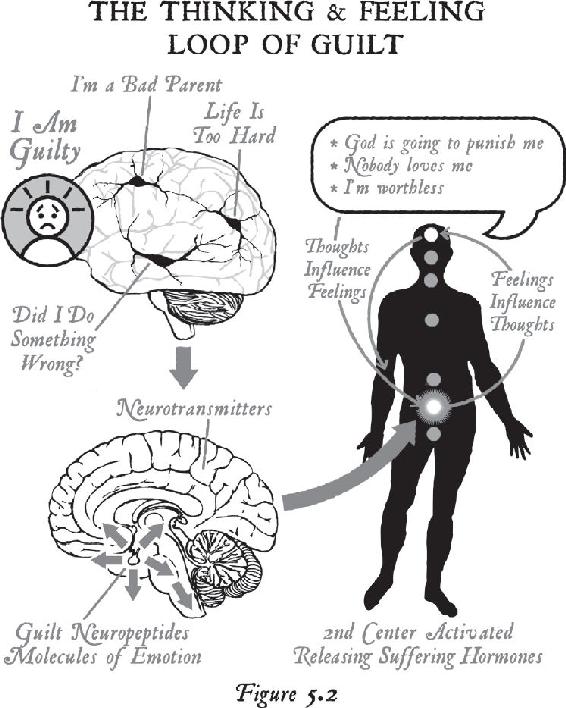
What if, instead of feeling angry, you start having thoughts that make you feel victimized or guilty? Life is too hard! I’m a bad parent. I shouldn’t have been so rude. Did I do something wrong? If you take a look at Figure 5.2, you’ll see that the same thing happens: Thinking those thoughts turns on a different network of neurons in your brain. If you fire and wire enough of those networks, you produce a different level of mind, and the brain creates the internal image of yourself that reaffirms your identity (in this case, as a guilty person). You start thinking, God’s going to punish me. Nobody loves me. I’m worthless. Once you accept, believe, and surrender to these guilty thoughts without any analysis, the neurotransmitters activating neural networks in your brain influence a different blend of neuropeptides this time (neuropeptides that are equal to those thoughts about feeling guilty) and then those neuropeptides signal a different hormonal center—in this case, the second center. And over time, as you re-create the same loop of thinking and feeling and feeling and thinking, you’re going to begin to store your energy in the body in the second center. This begins to produce a biological effect: Since you feel guilt in your gut, you may start to feel nauseated or sick, or you may experience pain in this area of your body—along with emotions like suffering, unhappiness, or even sadness.
This graphic demonstrates how we store energy in the form of emotions in our second center as a result of getting caught in a different thinking and feeling loop.
If over time you keep feeling guilty, you think more guilty thoughts that fire and wire more neurons that signal more neuropeptides that cause the release of more hormones in the second center. As this happens, you continue to condition the body to become the mind of guilt and suffering, so you’re storing more and more energy as emotion in the second center. You also continue to broadcast a specific energetic signature carrying specific information through the second energy center into your body’s energy field.
So now let’s say that you start having a totally different set of thoughts. What happens if you have sexual fantasies about someone? Now you’re turning on a different network of neurons in your brain and you’re producing a different level of mind. And just as before, if you get enough of those networks firing and wiring, you’re going to get a different internal representation in the frontal lobe of your brain. And once the thought or image you are paying attention to becomes more real than your outer world, in that moment the thought literally becomes the experience and the end product of that experience is the corresponding feeling.
As a result, your body gets turned on. That center now is activated with a specific energy carrying a specific message or intent, which then turns on the individual plexus of neurons in that center to produce a specific mind, which then signals genes in the corresponding glands to make chemicals and hormones equal to those thoughts. Now you’re convinced you’re the stud or vixen of the universe. And if you accept, believe, and surrender to that thought or image of yourself without any analysis, then those neurotransmitters in the brain will begin to influence a different blend of neuropeptides in the limbic brain. They’ll signal hormones in the first energy center, programming the autonomic nervous system to prepare that center to become activated. I think you’re very familiar with the biological effects that happen next.
Those biological reactions will cause you to keep feeling a certain way, and you’re going to think more corresponding thoughts equal to that feeling. And now you’re storing energy in the first center, and you are broadcasting a vibrational signature carrying a specific message from that center into the energy field in your body. Your brain is monitoring how you’re feeling, and you’re going to generate even more corresponding thoughts—and the cycle continues. This is how the body responds to the mind and ultimately becomes the mind.
So now you understand how your thoughts condition your body to become the mind of whatever emotion you are experiencing and how, when that happens, you’re storing more energy in the corresponding energy center for that emotion. The center where the majority of that energy gets stored is the one associated with the emotions you have been repeatedly experiencing.
If you are overly lustful, overly sexed, or overly preoccupied with wanting to be seen by others as sexually desirable, your energy is stuck in your first center. If you experience an overabundance of guilt, sadness, fear, depression, shame, unworthiness, low self-esteem, suffering, and pain, your energy will become stuck in your second center. And if you have problems with anger, aggression, frustration, control issues, judgment, or self-importance, your energy is stuck in your third center. (Hopefully by now you have done the Blessing of the Energy Centers meditation and have begun to experience how the energy in each of your centers is able to evolve from one center to the next, increasing its frequency as it moves up.)
In time, the body becomes the mind of that emotion, and once that energy as an emotion is stored (or more accurately, once it becomes trapped) in one or more of those lower energy centers, then the body is literally in the past. This means you no longer have energy available to create a new destiny. When that happens, your body becomes more matter and less energy because as you have read, the first three centers (which are based on survival emotions) shrink the vital field of energy surrounding your body.
To be clear, I am not saying that you shouldn’t ever have sex, enjoy food, or even feel stressed. What I am saying is that when you are out of balance, it’s because these first three centers are out of balance. And imagine if all three of these survival centers become overstimulated all at once—you can easily see how your body’s energy would diminish over time. When that happens, there’s not much available energy for growth, repair, healing, creation, or even just returning to balance.
By the same means, many people who feel out of balance may retreat from their lives and limit the amount of food they eat. By digesting less food, their body has more energy to balance itself. They may also abstain from sexual intercourse for a period of time to allow the body to restore itself. During their retreat, they will also remove themselves from the constant stimulation they normally receive from their environment, including their friends, kids, coworkers, appointments and schedules, job, computers, homes, and cell phones. This helps the body keep from reacting (consciously or unconsciously) to all those familiar elements in their outer world that they associate with thoughts and emotional memories from the past.
The breath technique I’m about to teach you gives you a way to liberate that trapped energy that’s stored in the first three centers so it can be free to flow to the brain—from whence it came. And when you use the breath to liberate those emotions, that energy becomes available for higher purposes. You’ll have more energy to heal yourself, create a different life, manifest more wealth, or have a mystical experience, to name just a few possibilities. Those emotions that are stored in the body as energy will be transmuted into a different type of energy carrying a different message through the elevated emotions of inspiration, freedom, unconditional love, and gratitude. It’s the same energy; it’s just locked up in the body. The breath is a way to pull the mind out of the body. You will be using your body as an instrument of consciousness to ascend your energy—turning those survival emotions into creative emotions. As you free your body from the chains of the past and liberate this energy, you have available energy to do the uncommon—to achieve the supernatural.
Think about a magnet as you look at Figure 5.3. Magnets, of course, have polarity. They each have a north pole and a south pole; one end has a positive charge and the other end has a negative charge. The polarity between the ends of a magnet is what causes the magnet to produce an electromagnetic field. The stronger the polarity between the two poles, the larger the electromagnetic field the magnet produces. You can’t see that electromagnetic field, but it exists—and it can be measured.
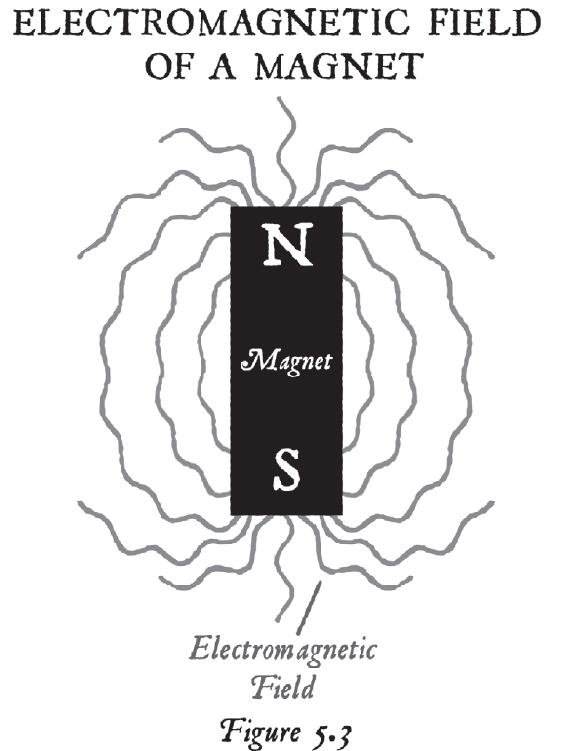
A magnet has a measurable invisible electromagnetic field surrounding it. The stronger the polarity between the north and south poles, the more current moves through the magnet and the bigger the electromagnetic field.
The strength of a magnet’s electromagnetic field can even influence matter. If you were to take tiny metal shavings and lay them on a piece of paper, put another piece of paper over that first piece of paper, and then set a magnet on top of that second piece of paper, those metal shavings would organize themselves within the magnet’s electromagnetic field. The electromagnetic field of the magnet is powerful enough to affect material reality—even though the frequency of this field exists beyond your senses. Figure 5.4 illustrates this.
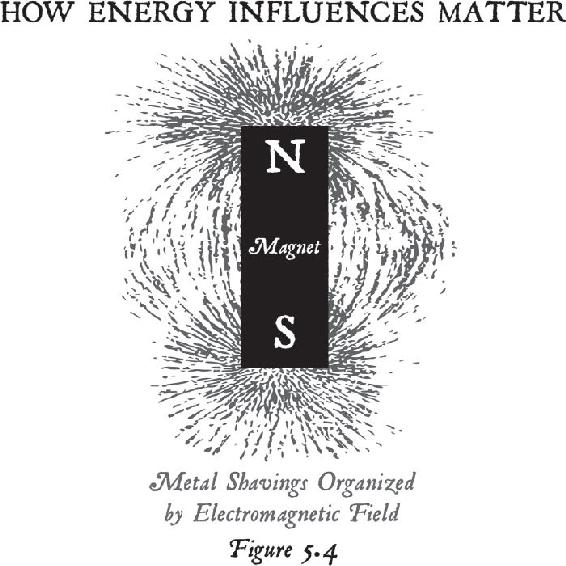
The electromagnetic field of a magnet will organize metal shavings placed under it into the patterns of its field.
The Earth is a magnet. And like any other magnet, it has a north pole and a south pole, as well as an electromagnetic field surrounding it. While this field itself is invisible, we’re all familiar with one amazing way to see that it exists; the Earth’s electromagnetic field deflects the sun’s photons, and during a solar flare or a mass coronal ejection, that field deflects trillions of tons of photons hurled toward the Earth in a pulsating, colorful phenomenon known as the northern lights.
Your body is also a magnet. Ancient cultures (especially Asian cultures) have known this for thousands of years. Your north pole is your mind and brain, and your south pole is your body at the base of your spine. When you’re living by the hormones of stress (the emotions of survival) or when you’re overutilizing the other two survival energy centers, you are constantly drawing energy from this invisible field. The energy then no longer flows through the body, because the body, in survival mode, is pulling the energy from the field and storing it in the body—specifically in the first three energy centers. (This is what happens when the thinking/feeling loop we talked about earlier is activated.)
If this goes on long enough, the body won’t have any electrical charge running through it at all, and without an electrical charge, it can’t create the field of electromagnetic energy that normally surrounds it. When that happens, the body is no longer like a magnet. Now it’s like a piece of ordinary metal—a magnet that’s lost its charge. As you can see in Figure 5.5, the body then becomes more matter and less energy (or more particle and less wave).
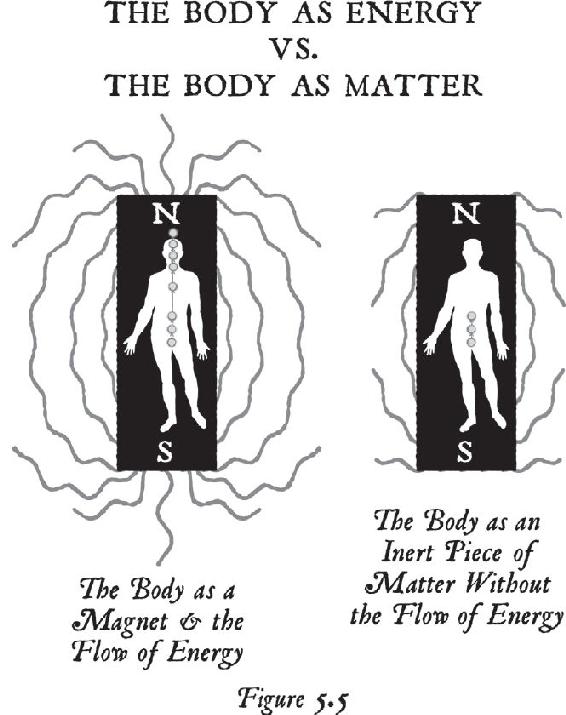
When there is a flow of energy moving through the body, just as with a magnet, there is a measurable electromagnetic field surrounding the body. When we’re living in survival and we’re drawing from the invisible field of energy around the body, we diminish our body’s electromagnetic field. In addition, when energy is stuck in the first three survival centers because we are caught in a thinking and feeling loop, then there’s less current running through the body and there is less of an electromagnetic field.
Of course, if there were a way to get this energy that’s stored in the first three centers moving again, the current would resume flowing and the body would re-create the electromagnetic field. The breath does just that—it gives us a way to pull the mind out of the body and to move all that stored energy from the first three centers up the spine to the brain, restoring the electromagnetic field surrounding the body. Once that happens, we can use that energy for things other than survival. Let’s take a look at the way our physical bodies are constructed so we can understand what makes that possible.
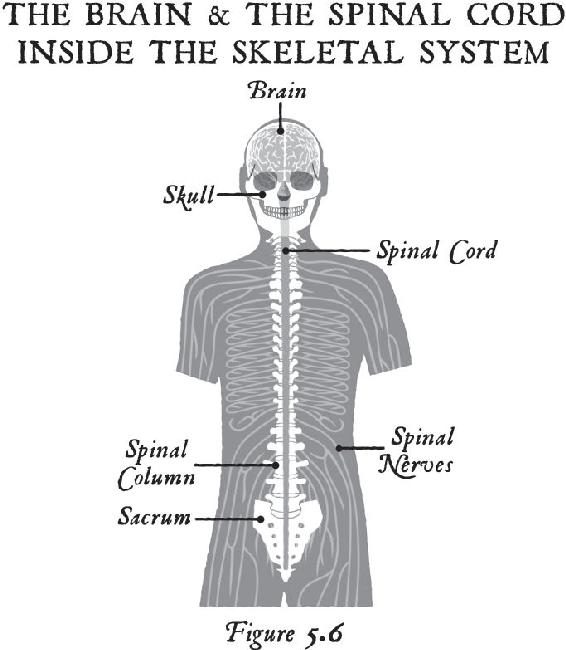
Your sacrum, your spinal column, and your skull are the bony structures that protect the most delicate system in your body: the central nervous system, which controls and coordinates all other systems.
Take a look at Figure 5.6. You have a bone at the base of your spine called your sacrum that looks like an upside down triangle with a plateau on the top. On top of that flat surface sits the spinal column, which extends all the way up to your skull. Inside that closed system is the central nervous system, which is made up of the brain and the spinal cord. The spinal cord is actually an extension of your brain. The skull and the spinal column protect this most delicate system.
The central nervous system is one of your body’s most important systems because it controls and coordinates all the other systems in the body. Without the aid of the central nervous system, you couldn’t digest your food, you couldn’t void your bladder, you couldn’t move your body, and your heart couldn’t beat. You couldn’t even blink your eyes without the nervous system. So you can think of the nervous system as the electrical wiring that runs the machine of your body.
Inside this closed system is cerebrospinal fluid that’s filtered from the blood in the brain. This fluid bathes the brain and the spinal cord, and it’s responsible for giving the central nervous system buoyancy. It acts as a cushion to protect the brain and spinal cord from trauma, and it flows in various rivers and paths that transport nutrients and chemicals to different parts of the nervous system all over the body. By its very nature, this fluid acts as a conduit to enhance electrical charges in the nervous system.
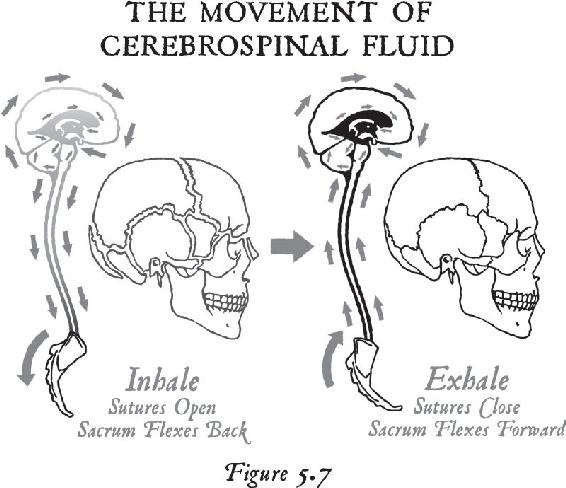
Now let’s go back to your sacrum. Every time you inhale, that sacrum bone flexes back slightly, and every time you exhale it flexes forward just a little bit. This is an extremely subtle movement—too subtle for you to notice, even if you try. But it happens. And at the same time you inhale, the sutures of your skull (the joints between the individual plates of your skull, which fit together like pieces of a puzzle and give the skull a degree of flexibility) open up just slightly, and as you exhale, they close back up.2 Again, this is extremely subtle. You can’t feel it happening.
The movement of your sacrum back and forth as you slowly breathe in and out, along with the sutures of the skull opening and closing, propagates a wave within the fluid of this closed system, and it slowly pumps that cerebrospinal fluid up your spine all the way to the brain, passing through four chambers called cerebral aqueducts or ventricles. If you were to tag one molecule of cerebrospinal fluid and follow it from the base of your spine all the way up to your brain and then all the way back down to your sacrum, you’d see that it would take 12 hours to make a complete circuit.3 So in essence, you flush your brain twice a day. Check out Figure 5.7 to see what that looks like.
As you inhale, your sacrum slightly flexes back and the sutures of your skull expand. As you exhale, your sacrum slightly flexes forward and the sutures close. It is this natural action of breathing that slowly propagates a wave to move cerebrospinal fluid up and down the spinal cord and throughout the brain.
So think about what would happen if you contracted the intrinsic muscles of your perineum (your pelvic floor, the same muscles you use for intercourse and elimination) and you locked them down, and then while they were locked down, you next contracted the muscles of your lower abdomen, locking those muscles down, and then you did the same with the muscles of your upper abdomen. If you kept squeezing and contracting those muscles in your first three energy centers by contracting your core muscles, that fluid in your central nervous system would move up, as illustrated in Figure 5.8. You’d be moving that cerebrospinal fluid in your central nervous system up your spine. Each time you tighten the muscles of those centers, the fluid would be forced upward.
Now imagine you then placed your attention on the top of your head. Where you place your attention is where you place your energy, so if you put your attention at the top of your head, that would become your target for moving energy. Now think about taking one slow, steady breath through your nose and at the same time, squeezing and holding the muscles of your perineum, then those of your lower abdomen, and then those of your upper abdomen—all while following your breath up your spine and through your chest, your throat, and your brain, and all the way to the top of your head. Imagine that when you get to the top of your head, you hold your breath as you keep squeezing. You’d be pulling that cerebrospinal fluid all the way up toward your brain.
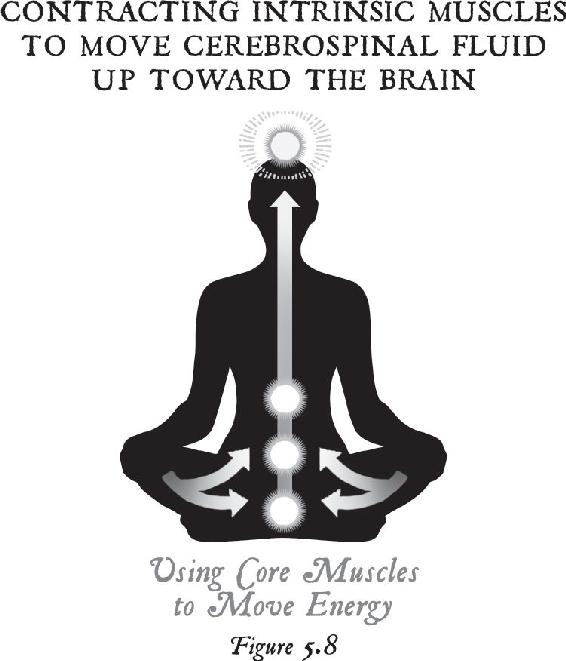
As you contract the intrinsic muscles of your lower body and at the same time take in a slow steady breath through your nose, while placing your attention on the top of your head, you accelerate the movement of the cerebrospinal fluid toward your brain and you begin to run a current through your body and up the central axis of the spine.
That’s significant because cerebrospinal fluid is made up of proteins and salts in solution, and the moment proteins and salts dissolve in solution, they become charged. If you take a charged molecule and accelerate it—as you would if you pulled that molecule up your spine—you create an inductance field. An inductance field is an invisible field of electromagnetic energy that moves in a circular motion in the direction the charged molecules are moving in. The more charged molecules you accelerate, the bigger and more powerful the inductance field. Take a look at Figure 5.9 to see what an inductance field looks like.
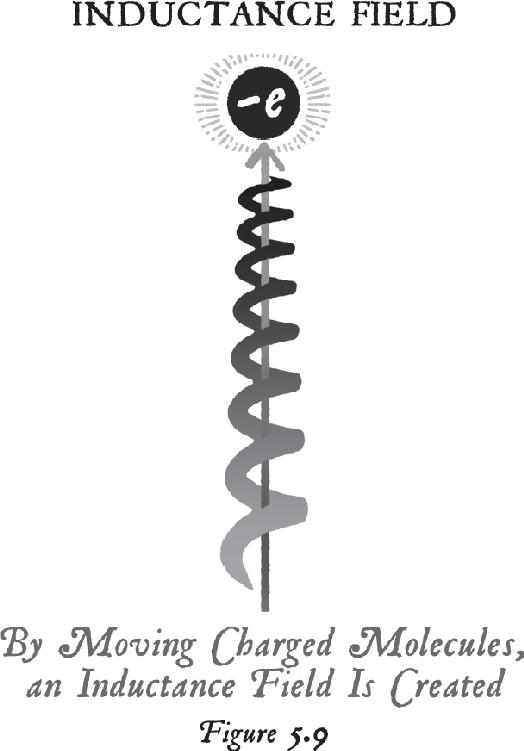
Cerebrospinal fluid is made of charged molecules. As you accelerate charged molecules in one direction up the spine, you produce an inductance field that moves in the direction of the charged molecules.
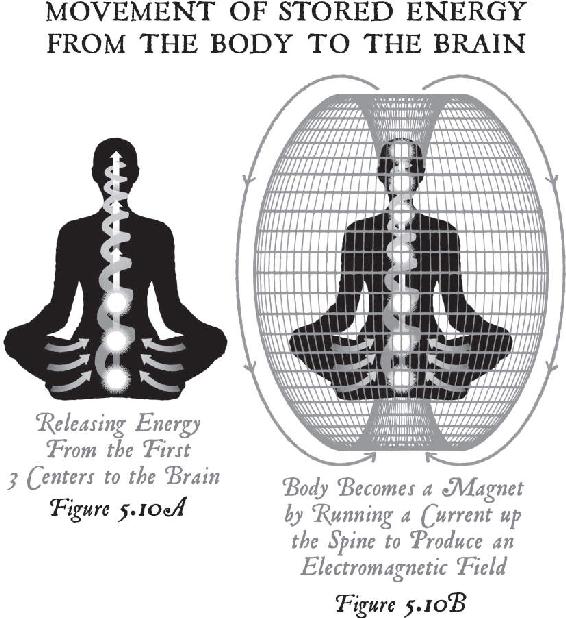
As the inductance field is created by the acceleration of the cerebrospinal fluid up the spine, it will draw the stored energy in the first three centers back to the brain. Once there is a current flowing from the base of the spine all the way to the brain, the body becomes like a magnet and an electromagnetic torus field is created.
Think of the spinal cord as a fiber-optic cable that acts as a two-way highway simultaneously communicating information from the body to the brain and from the brain to the body. Every second, important information is relayed from your brain to your body (such as the desire to walk across the room or to scratch an itch). At the same instant, a lot of information from the body is carried up your spinal cord toward the brain (such as the knowledge of where your body is in space or the signal that you are hungry). Once you accelerate these charged molecules in one direction up the spine, the resulting inductance field will reverse the current of information flowing from the brain down through the body, and it will then draw energy from the lower three centers up the spine to the brain. Take a look at Figure 5.10A to see how that works. Now there’s a current running through the body and the central nervous system—just like a magnet—and as a result, the same kind of electromagnetic field of energy that surrounds a magnet surrounds the body, as you can see in Figure 5.10B.
The field of electromagnetic energy you’ve created is a three-dimensional field, and as it moves, this energy creates a torsion field or a torus field. By the way, the shape of this electromagnetic field is a familiar pattern in the universe; this pattern shows up in the shape of an apple as well as in the shape of a black hole in a distant galaxy. (See Figure 5.11.)
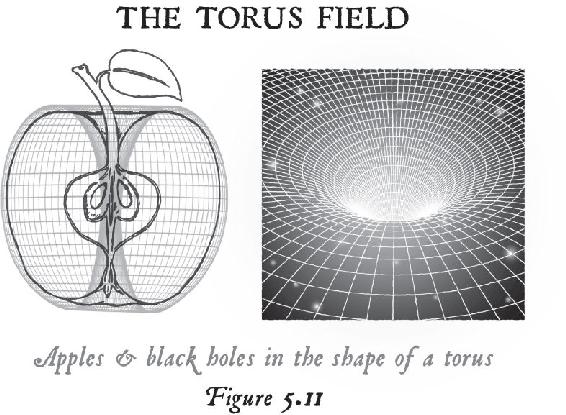
From apples to black holes, the shape of a torus is a recurring pattern of creation in nature.
So now you understand that by doing this breathing technique, you’re starting to stir up all this stored energy in a very big way. And if you do this technique correctly and you do it enough times, you are going to wake up a sleeping dragon.
Evolving the Energy to the Brain
Once this energy becomes activated, the sympathetic nervous system (a subsystem of your autonomic nervous system that arouses the brain and body in response to a threat in your outer environment) turns on, and energy begins to move up from the body’s lower three energy centers to the brain. But instead of the body being aroused because of some external condition, you are turning on the sympathetic nervous system by passionately engaging the breath from within. As the sympathetic nervous system starts to merge with the parasympathetic nervous system (another subset of your autonomic nervous system that relaxes your brain and body, such as after a big meal), it is as if traveling energy from the lower centers is ejaculated into the brain. When this energy reaches the brain stem, a gate called the thalamic gate opens up and all that energy is permitted to enter the brain.
Once this energy that was initially stored in the body enters the brain, the brain produces gamma brain-wave patterns. (We’ve recorded many students producing gamma brain waves during this breathing technique.) Gamma brain waves—which I call superconsciousness—are notable not only because they produce the highest amounts of energy of all the brain waves, but also because that energy comes from within the body instead of being released in reaction to a stimulus in the environment, the outer world.
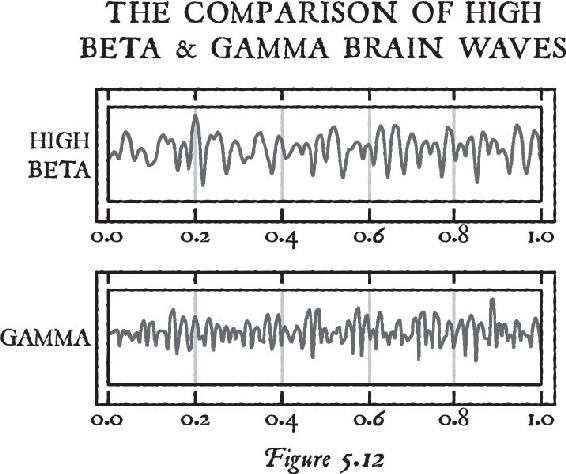
In contrast, the brain produces high-range beta brain waves when the body releases stress hormones, allowing you to be super alert to danger in your environment. In beta, the outer world seems more real than your inner world. While gamma waves create a similar type of arousal in the brain—which then causes a heightened sense of awareness, consciousness, attention, and energy related to more creative, transcendental, or mystical experiences—the difference is that in gamma, whatever is happening in your inner world becomes much more real to you than many experiences you’ve had in your outer world. Take a look at Figure 5.12 and review how similar beta and gamma brain waves are.
Through the release of the energy stored in the body’s first three energy centers, the brain becomes aroused and moves into gamma brain waves. When this occurs, the brain may go into high-beta brain waves on the way to the gamma range. High-beta brain waves are typically produced by the arousal of the brain through stimulation from our outer environment, which causes us to put our attention on the cause.
Gamma brain waves are typically created by stimulation from our inner environment, which causes us to pay attention to whatever is going on in the inner world of our mind. This comparison shows how similar high-beta and gamma brain-wave patterns are, though gamma frequencies are faster.
Many of our students who do this breath technique produce significant high-beta brain waves on their way to the gamma range (the highest-frequency brain waves)—or they may simply stay in these very high-level beta states. We’re finding that being in the highest levels of beta can also signal that the person is paying more attention to their inner world than to their outer world. In addition to seeing more energy in the brain after this breathing technique, we have also repeatedly observed more significant amounts of brain coherence.
Take a look at Graphics 6A and 6B in the color insert. You can see two students who have done the breath successfully. They have very high-frequency beta brain waves that transition to gamma brain waves. Notice the high amplitudes of their brain waves in gamma. The higher the amplitudes, the higher the energy in their brains. The students demonstrate 160 and 260 standard deviations above typical gamma brain waves. To give you a reference, 3 standard deviations above normal is usually considered high. In Graphic 6A(4) you can also witness much more brain coherence after the breath. The red patterns in the brain show extremely high amounts of brain coherence in every measured brain-wave state.
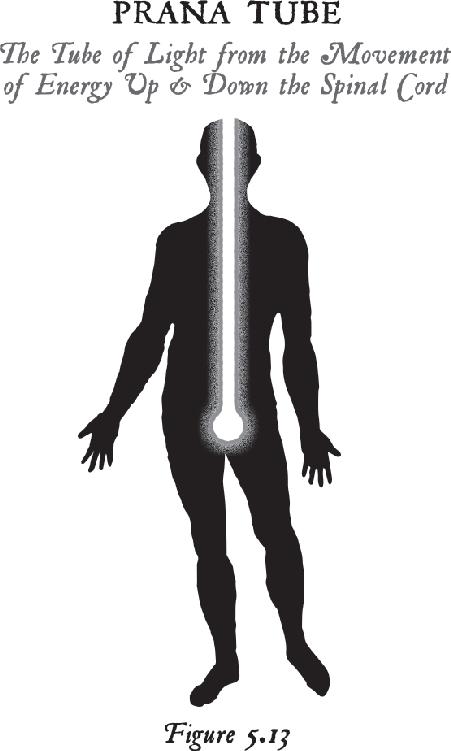
The prana tube is a tube of light or energy that represents the movement of life force up and down the spinal cord. The more energy moving along the spine, the stronger the field of the prana tube. The less energy moving along the spine, the weaker the prana and thus, the less life force delivered in the body.
As you do this powerful breathing technique, you are drawing the energy that’s been stored in those lower three centers—the energy you use for orgasm and to make a baby, to digest a meal, to run from a predator—and instead of releasing it out into chemistry, you’re going to draw it up your spine like you would draw fluid up a straw, and release it into your brain.
In fact, there’s a tube of energy or light called the prana tube running along your spinal column (see Figure 5.13). Prana is the Sanskrit word for “life force.” Yogis have known about this tube—which is not a physical structure but an energetic one—for thousands of years. This tube is considered etheric because of the electrical information in the spine that constantly moves through it. The more energy moves in the physical spinal cord, the more energy is created as light in this tube. And the more energy created in this tube, the more energy moves in the spine and the greater the expression of life. Sometimes when I teach this meditation, people will say to me, “I don’t really feel my prana tube.” Well, you don’t really feel your left ear either until you put your attention on it, right? So when I ask you to contract your muscles and pull that energy up, you’ll be pulling it up through the spine and creating a more powerful prana tube along your spinal cord.
It’s important to add here that this is not a passive breath—it’s an extremely active, passionate process. Moving this stored energy—energy that has been stored for years and years, maybe even decades—takes an act of intention and will. To evolve your limited survival emotions, as an alchemist turns base metals like lead into gold, you are taking self-limiting emotions like anger, frustration, guilt, suffering, grief, and fear and turning them into elevated emotions, such as love, gratitude, and joy. Other elevated emotions to consider tapping into include inspiration, excitement, enthusiasm, fascination, awe, wonder, appreciation, kindness, abundance, compassion, empowerment, nobility, honor, invincibility, uncompromising will, strength, and freedom—not to mention divinity itself, being moved by the spirit, trusting in the unknown or in the mystic or the healer within you.
Remember, evolving this energy takes a level of intensity that is greater than the body as the mind, greater than your addiction to any survival emotion. You must be inspired to become more energy than matter, using your body as an instrument of consciousness to ascend your energy. So don’t let your body be your mind. Remember that you are liberating your stuck energy, turning guilt or suffering or anger or aggression into pure energy, and as the body liberates that energy, you’re freeing yourself and you will feel overjoyed, in love with life, and inspired to be alive.
As you pull this energy up the spine in this meditation, you’ll follow your breath all the way to the top of your head. When it gets there, I want you to hold your breath while you keep squeezing those muscles in your perineum and your abdomen. When you do that, you increase the pressure inside your spinal cord and spinal column. That pressure, called intrathecal pressure, is inside a closed system. It’s the same pressure you exert when you take a breath and lift something heavy—you’re pushing against your insides. But in this breath you’ll be very specifically directing all that pressure, all that energy, and all that spinal fluid up your spine and into your brain.
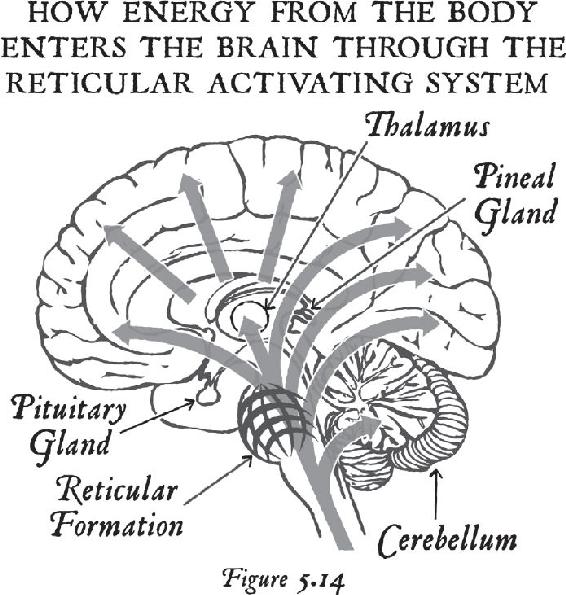
As the thalamic gate opens up, a lot of the creative energy that was stored in the body passes through the reticular activating system to each thalamus and the pineal gland. Then that energy is relayed to the neocortex, producing gamma brain waves.
When that pressurized fluid reaches the back of your brain stem, all of a sudden the lower-brain centers like the brain stem, cerebellum, and limbic brain open up to this energy through a cluster of nuclei called the reticular formation. That energy then passes through the thalamic gate up to the thalamus (the part of the brain that relays signals from the sensory receptors) located in the midbrain, which serves as a junction box. Next, all of that stored energy moves directly into your higher brain center, the neocortex. That’s when gamma waves begin to occur. When the energy reaches the thalamus, it is also relayed to the pineal gland, and something amazing happens. That gland releases some very powerful elixirs, one of which anesthetizes the analytical mind and thinking brain.
See Figure 5.14, which shows the thalamus, the reticular formation, the thalamic gate, and the moment of energy hitting the higher brain centers.
We’ll talk more about the pineal gland in a later chapter, but for right now, know that when that happens, it’s like an orgasm in your head. This is a very powerful energy that has been called the movement of the kundalini. I personally don’t like to use that word because it may conjure up opinions or beliefs from a limited understanding of this energy that may discourage some people from doing the breath, but I do want you to understand that this is the energy you are evoking with this breath.
If you look at Graphic 6B(4) in the color insert, you can see the area surrounding the pineal gland is quite active in the student producing gamma brain waves. Look at the blue arrows. The red area suggests the activation of energy in the pineal gland as well as a region of the limbic brain associated with strong emotions and formation of new memories. Graphic 6B(5) is a three-dimensional picture of the same student’s brain. Once again, the pineal area shows a significant amount of energy coming from inside the brain.
Embracing Elevated Emotions
You’ve just read how the breathing exercise in this chapter pulls the mind out of the body as it liberates stored energy from the first three energy centers—the centers of survival. Once you do that, it’s time to recondition the body to a new mind, the second part of the meditation, which involves attaining elevated emotional states.
I want to clarify here why embracing elevated emotions is so powerful. As you’ve learned from our discussion about genes in the second chapter, we now know that it’s the environment that signals the gene, not the other way around. If an emotion is the end product of an experience in the environment, it is the emotion that turns gene expression on or off.
When you embrace these elevated emotions in this meditation, what you are actually doing is signaling your genes ahead of the environment. The body doesn’t know the difference between an emotion created by an experience you are having in the outside environment and an experience you are creating internally by embracing this new, elevated emotion. So when you embrace that elevated emotion and think thoughts that are greater than the self-limiting ones that kept you stuck in the past, your body begins to prepare chemically for the future (because it thinks that future is happening now). In other words, if you do the meditation correctly enough times, the body responds as though the healing or any condition you are manifesting in your environment has already taken place.
These elevated emotions have a higher (and faster) frequency than more base emotions, like guilt, fear, jealousy, and anger. And since all frequency carries information, when we change the frequency, we change our energy. That new energy can then carry new information—a new consciousness or set of intentions or thoughts. The more elevated the emotion, the faster the frequency and the more you feel like energy instead of matter—and the more energy becomes available to create a more coherent energy field, shifting further away from disease and more toward health (or for that matter, toward signaling any gene). When your emotions are self-limiting, on the other hand, they have a lower frequency, and you feel more like matter instead of energy—and then it takes more time to create change in your life.
Here’s an example: If at some point in your past you were shocked, betrayed, or traumatized by an event with a high emotional charge that has left you feeling pain or sadness or fear, chances are that experience has been branded into your biology in numerous ways. It’s also possible that the genes that were activated by this experience might keep your body from healing. So in order for you to change your body into a new genetic expression, the inner emotion you create has to be greater than the emotion from that past outer experience. The energy of your empowerment or the amplitude of your inspiration must be greater than your pain or sadness. Now you are changing the inner environment of the body, which is the outer environment of the cell; the genes for health can be up-regulated while the genes for disease can be down-regulated. The more profound the emotion, the louder you’re knocking on your genetic door and the more you’re going to signal those genes to change the structure and function of your body. That’s how it works.
We can actually prove this because in one of our 2017 advanced workshops in Tampa, we measured gene expression in a randomized selection of 30 workshop participants.4 The results showed that our students were able to significantly change the expression of eight genes over the course of the four-day workshop by changing their internal states. There is only one possibility in 20 that the results were due to chance—that’s the threshold of significance that statisticians usually use. The functions of these genes are far-ranging. They’re involved in neurogenesis, the growth of new neurons in response to novel experiences and learning; protecting the body against various influences that tend to age cells; regulating cell repair, including the ability to move stem cells to those sites in the body where they are needed to repair damaged or aging tissue; building cellular structures, especially the cytoskeleton (the framework of rigid molecules that give our cells shape and form); eliminating free radicals, and so decreasing oxidative stress (associated with aging and many major health conditions); and helping our bodies identify and eliminate cancerous cells, thereby suppressing the growth of cancer tumors. Activating the genes for neurogenesis was particularly significant because most of the time our students were in meditation, they were so present in their inner world of imagination that their brains believed they were in the actual event. See Figure 5.15 below to learn what each of these genes does and why it is important for our health.
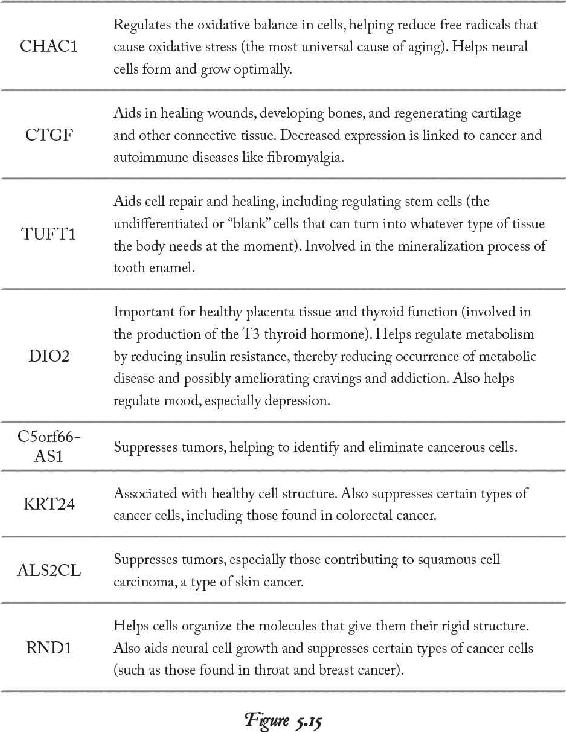
These are the specific genes that were regulated in four days in our Advanced Workshop in Tampa, Florida, in 2017.
If our students have changed their gene expression by creating elevated emotions in just a few days, imagine what you can do if you practice this meditation for a few weeks. By using this breath technique to release the familiar emotions stored in the body from years of thinking and feeling the same way, and then by emotionally rehearsing new states every day, with practice these unlimited emotions will become the new normal for you. Your brain will think different thoughts equal to those elevated emotions. Finally, by embracing these unlimited emotions instead of the same limited ones, when you understand that you are signaling new genes and making new proteins that are responsible for the change in structure and function of your body, you can assign more meaning to what you are doing. That leads to a greater intention, which creates an even greater outcome.
It is a scientific fact that we use about 1.5 percent of our DNA. The rest is called junk DNA. There is a principle in biology called endowment that holds that nature never wastes anything that it is not going to use. In other words, if the junk DNA is there, there must be a reason—otherwise nature in its infinite wisdom would have evolved it away (because the universal law is if you don’t use it you lose it). So think of your genes as a library of potentials. There are infinite combinations of gene variations that can be expressed in those latent genes. They are waiting for you to activate them. There are genes for an unlimited genius mind, for longevity, for immortality, for an uncompromising will, for the capacity to heal, for having mystical experiences, for regenerating tissues and organs, for activating the hormones of youth so you have greater energy and vitality, for photographic memory, and for doing the uncommon, just to name a few.
It’s all equal to your imagination and creativity. As you signal any of those genes ahead of the environment, your body will express a greater potential by expressing new genes to make new proteins for a greater expression of life. So when I ask you to feel certain elevated emotions when you recondition the body to a new mind, know that as you embrace each emotion, you are knocking on your own genetic door. So I invite you to surrender to the process and fully engage in the experience.
Reconditioning the Body to a New Mind Meditation
Before we start the formal meditation, we are going to do some practice sessions. They build on several individual instructions so you can learn this step by step. Once you’ve mastered each individual step, we can put it all together. So let’s start by sitting up straight in a chair and putting both feet flat on the floor, or sitting on the floor in the lotus (cross-legged) position with a pillow under your buttocks. Place your hands uncrossed in your lap. If you like, you can close your eyes.
When you’re ready to begin, lift up your perineum, your pelvic floor—the same muscles that you use for intercourse and elimination. Do not hold your breath as you do this—breathe normally. Squeeze those muscles as tightly as you can and hold for five seconds; then let go and relax. Do it again and hold it for the same amount of time. Do it a third time, holding it for about five seconds, and then relax again. I want you to gain conscious control over these muscles because you are going to be using them in a different way.
Now contract the same muscles in the perineum and at the same time contract the muscles in your lower abdomen. Pull your lower abdomen up and in, locking down these first two centers. Hold for five seconds and then relax. Pull those same muscles up and in again and squeeze. Hold for five seconds again, and then relax. Repeat this once more. Remember to keep breathing as you do this—don’t hold your breath.
Now, this next time, squeeze the muscles of your perineum, and at the same time squeeze the muscles of your lower abdomen while also contracting the muscles of your upper abdomen. You’re tightening your entire core now—the first three centers. Hold all of those muscles for five seconds and relax. Do this again, pulling the muscles in a little more this time. Hold for five seconds and then relax. Now do it one more time, and as you squeeze and hold those muscles, see if you can squeeze them a little tighter and lift them a little higher. Hold for a while and then relax.
Since experience creates neurological networks in your brain, as you perform each step and build on the previous one, you are installing the neurological hardware in your brain in preparation for the experience. I am asking you to use the same muscles that you might have used for years, but now in a different way. This action will begin to milk these centers and liberate energy that’s been stored in your body for a very long time.
Now we’re going to change it up. Take your finger and place it on the top of your head, and work your fingernail right into the center of your scalp so you will remember where that point is once you take your finger away. Remember that where you place your attention is where you place your energy, so that point is your target. Put your hands back in your lap and without contracting any muscles yet, take one slow, steady breath through your nose. All I want you to do is follow your breath from your perineum, through your lower abdomen, through your upper abdomen, through the center of your chest, through your throat, through your brain, all the way to the top of your head where your finger was. When you get to the top of your head, hold your breath and keep your attention right on the top of your head and let your energy follow your awareness. Hold for about ten seconds and then relax.
Place your finger on the top of your head again, then take it away and make sure you can feel that point without your finger there. Rest your hands on your thighs. Now do one more breath without contracting any muscles. This time when you inhale through your nose, imagine you are pulling energy up that tube—like drawing fluid up a straw—all the way to the top of your head. When you get to the top of your head, hold your breath for about the same amount of time you did before, and let your energy follow your awareness—then relax.
Now it’s time to start putting it all together. With this next breath, when you inhale through your nose, pull those muscles up and in at the exact same time. Start by locking the muscles of your perineum, engaging the muscles of your lower abdomen and simultaneously contracting the muscles in your upper abdomen. And as you squeeze the muscles in each center—with the intention of pulling all of that stored energy in the lower body into the brain—follow your breath through each of those three centers. As you continue to squeeze those muscles and lock those first three centers down, pull your breath up through your chest (the fourth center), then through your throat (the fifth center), then through your brain (the sixth center). Pull it all the way up to the top of your head, keep your attention there, and hold your breath as you keep squeezing your core muscles. Hold for about ten seconds and then relax as you exhale.
Repeat that breath at least two more times, tightening the muscles of your first three centers as you pull your breath up your spine through each energy center all the way to the top of your head. Then hold your breath for a time, and finally relax as you exhale.
Remember, as you do this, you’re using your body as an instrument of consciousness and your full intent should be to pull the mind out of the body. You’re liberating energy that has been locked in your lower three centers and moving it up to the higher centers where you can use it for healing your body or creating something new, instead of just for survival.
Practicing this many times so you are very familiar with these steps will be very useful before you begin several of the meditations in this book. Be patient with yourself; just like learning anything for the first time, you have to do this many times before you truly master it. In the beginning, it may feel awkward because you have to synchronize the actions of your body with the intention of your mind. Eventually, though, if you practice this technique enough, you will be able to coordinate all of these steps into one motion.
I am aware that there are many different breathing techniques, and you may well have had success with one or more of them in the past. Even so, I urge you to try this one, even if you already have some other favorite, because if you do something new, you can have a new experience. If you keep doing the same thing, you will keep creating the same experience. And if you do nothing, you get nothing. Yes, this technique takes some real effort, but once you become more skilled, you’ll see it’s worth the effort and then some.
You are now ready to begin the formal meditation. If you purchase my Reconditioning the Body to a New Mind CD or audio download from drjoedispenza.com, you’ll find the recording includes a song I’ve specifically chosen to truly inspire you to raise your energy. As you listen, I want you to interpret the music as the movement of energy. If you do the meditation on your own, practice the breath while you listen to one inspiring song that’s between four and seven minutes long. Then open your focus, putting your attention on different parts of your body as well as the space around those parts of the body. Next, unfold as pure consciousness into the unified field, staying in the generous present moment and becoming no body, no one, no thing, no where and in no time.
Now it’s time to cultivate several elevated emotions one by one, emotionally rehearsing each. Remember: The more powerful your feelings, the more you are up-regulating your own genes. Bless your body, bless your life, bless your soul, bless your future as well as your past, bless the challenges in your life, and bless the intelligence within you that is giving you life. Finish by giving thanks for a new life before it has been made manifest.