

I had just finished a keynote lecture on a Saturday night in Orlando, Florida. The following morning, while packing my bags in preparation for my afternoon flight home, I turned on the television to catch up on the political situation in the United States. It was in the thick of the 2016 presidential election, and since I had been out of the country traveling and lecturing over the previous three weeks, I was curious about what had transpired during my time away. I quickly surfed through the channels to find a news station, set the remote down, and while halfway paying attention to the TV, continued packing. Suddenly, a commercial came on that caught all my attention, and in an instant I understood why we call television programming.
The commercial began with a nighttime exterior shot of a couple’s home. As the camera zooms in on the house, the words “Night #14 with Shingles” appear on the screen. When the shot moves to the interior, tender yet foreboding music plays while an elderly man moans in pain at the foot of his bed. His concerned wife enters the room and asks him how he’s doing. “It hurts,” he replies. In the lower right corner in a tiny font almost the same color as the background are the words “Actor Portrayal.”
The wife walks over with a look of despair and slowly lifts her husband’s shirt, revealing huge, red-scabbed lesions covering more than half his lower back. The imagery is shocking, grotesque, and horrific, looking like nothing less than a large third-degree burn. In my 31 years of practice, I’ve examined hundreds of people with shingles and have never seen anything that looked so severe as the manufactured lesions in this commercial. I immediately knew it was designed to evoke a strong emotional response with the viewing audience—because it certainly did in me.
Once you see the rash on the man’s back, the commercial achieves its goal of commanding your attention. Because the portrayal of the rash is so arresting, it changes the way you were feeling from only a few moments before your present state of watching it. The moment the commercial significantly changes your internal emotional state, it causes you to put more of your attention and awareness on the source of the disruption in your external environment. The stronger the emotion it causes (stimulus), the more you lean in and pay attention (response). This association of stimulus and response, or conditioning, is how long-term, or associative, memories are created.
This process of conditioning begins by pairing a symbol or an image with a change in an emotional state—a combination that opens the doorway between the conscious and subconscious mind. In the case of the shingles commercial, now that they have captured all your attention (and begun the programming process), you can’t help but naturally wonder what they’re about to say next. The commercial continues with a somber male narrator: “If you’ve ever had chicken pox, the shingles virus is already inside of you. As you get older, your immune system weakens and it loses its ability to keep the shingles virus in check.” By using emotional branding, this is the first instance where the commercial raises ethical questions by telling the audience that the immune system weakens with age. Next, we see the man in the bathroom looking at himself in the mirror. He looks worried, broken, and defeated.
The scene changes to his wife talking on the phone in the kitchen. “I just can’t stand seeing him like this,” she says.
Next, we see the man doubled over on his bed, palm to forehead, wincing in pain. The narrator then makes a direct suggestion, reinforced by the same words appearing on the screen: “1 in 3 people will get shingles in their lifetime.” The narrator continues while the same words remain on the screen. “The shingles rash can last up to 30 days.”
The scene cuts to his wife pleading directly into the camera: “I just wish there was something I could do to help.”
Again, we see the man in pain, and on the screen appear the words: “1 in 5 people with shingles will have long-term nerve pain.” These words remain on the screen for the remaining narration, which says, “Some people with shingles will have long-term nerve pain, which can last a few months to a few years. Don’t wait until someone you love develops shingles. Talk to your doctor or pharmacist about your risk.”
Let’s take a closer look at what this commercial is attempting to do. First, it puts you in an emotional state by changing how you feel. Once it captures your attention, you immediately become more open and suggestible to the information that follows. Now that you’re more prone to accept, believe, and surrender to this information (without analyzing it), if you’re feeling fearful, victimized, vulnerable, worried, shocked, weak, tired, or in pain, you’re more susceptible to the information equal to those emotions. You might start wondering if the ailment could happen to you.
At various points during the commercial, certain “facts” appear written on the screen, allowing you to read along. This serves to reinforce the programming. Also, while the thinking brain is focused on reading the copy, the content of the narration slips behind the conscious mind and into the subconscious mind. Like an audio recorder, it records the entire script and creates an internal program.
Next, through a direct, literal suggestion, the narrator has instilled fear in you by personally suggesting you already have the shingles virus in your body and that because of the natural process of aging, your immune system is no longer strong enough to take care of the virus. This turns on your emotional brain (the seat of your autonomic nervous system), allowing it to become programmed. Once the suggestions make it to your autonomic nervous system, it takes the orders without question and gets busy making chemical changes in your body equal to the literal suggestions. In other words, your body is going to subconsciously and automatically be programmed to weaken your immune function. In conclusion, you’re at risk and you’d better not wait until you contract it. The commercial’s effect goes even a little further: if you’ve ever had chicken pox and after watching this you “think” your immune system is weak because of your age, you will decide you have an even greater need to prevent getting shingles, so you will be even more motivated to buy the drug.
If you happen to be a person who has shingles and you’re watching this commercial, when you see that your condition is not as severe as the actor’s shingles, you may find yourself thinking, I should take the drug now so that it doesn’t get any worse. I don’t want to end up like him. If you don’t have shingles, at the commercial’s end you may still be left quietly wondering, Am I part of the two-thirds of the population that is safe? Or am I in the one-third of the population that will get the virus? If you think, I hope I’m not part of the one-third, it means you believe there may be a chance that you’re susceptible and vulnerable, leaving you unconsciously thinking that you already have it.
You know what I found most absurd about this commercial? They never even mention the drug, which means they don’t have to reveal its side effects. Since the commercial had now piqued my curiosity, I stopped packing and looked on the Internet for another commercial by the same pharmaceutical company. I wanted to know what drug they were suggesting would alleviate the severity of the actor’s exaggerated, manufactured lesions. After a quick search, I found several similar commercials with the same theme and wording but with slight variations. They all shared one thing in common, however; they were all designed to capture your attention.
In the next commercial I watched, a woman is wearing goggles and swimming in a lap pool. Everything is black and white. In a twist on the previous commercial, the narrator (speaking in an authoritative female British accent) is the shingles virus and the narration is coming from within the woman’s head:
“Impressive, Linda. Age isn’t slowing you down, but your immune system weakens as you get older, increasing the risk for me—the shingles virus. I’ve been lurking inside you since you had chicken pox. I could surface at any time as a painful blistering rash.” The scene then abruptly cuts from black and white to color and a man lifts his shirt to reveal the worst shingles rash you’ve ever seen. Again, the grotesque, blistering lesion can’t help but attract your attention. As quickly as the scene turns to color, it returns to the swimmer in black and white.
The commercial continues in a similar manner and formula as the previous one: First make an arresting statement or show a shocking image to change the viewer’s emotional state, then cause them to be more suggestible to the information via the change in their emotional state, and finally use autosuggestion to make them wonder if they already have shingles. This ad also infers that even though you might be healthy, work out, and take care of yourself, you can still become a victim of the virus, further suggesting that no one is immune. Again, the words on the screen reinforce the message: “1 in 3 people get me in their lifetime. Linda, will it be you?” If you identify with the woman in any manner, the voice is talking directly to you.
The tone of the commercial then changes as a new male narrator begins speaking in a confident, lighthearted tone, devoid of worry or concern. In a similar British accent, the voice says, “And that’s why Linda got me—Drug X.” The scene remains in black and white except for the woman’s bathing suit, her swim cap, and the name of the drug, which appears on the screen in a large, sophisticated font. Now the drug has been imprinted into your brain at yet another level. Once again, the ad has created an association between your health and safety and the drug that will protect you. The tagline comes on the screen as the narrator reads it aloud, stating that the drug helps “to boost your immune system against shingles. To help protect her against you, shingles.”
At the end of the commercial, that narrator says, “Drug X is used to prevent shingles in adults fifty years and older. The drug is not to be used to treat shingles, and it does not help everyone.” Here’s the punch line: “You should not take the drug if you have a weakened immune system.”
Whoa—what? Back up. Here’s the irony: They just told you that as you age, your immune system weakens and you’re at a greater risk for shingles. The drug is supposed to strengthen your immune system, but you shouldn’t use it if you have a weakened immune system. Now comes the dilemma: If you still choose to take the drug, you believe the drug to be more powerful than your possibly weakened immune system. The programming worked.
What the clever, if not unethical, advertisers understand is that this message is confusing and disorienting to your conscious mind. At the same time, however, they are programming your subconscious mind with the idea that your immune system is weak, you probably already have the virus within you, and chances are high that you’ll get shingles, even if you are healthy. In addition, you are told that without the medication, you are likely to suffer—even though there is no guarantee that the shingles will go away easily—and that it still might not work if your immune system is weak.
Finally come the side effects (which are not side effects, but direct effects): “A shingles-like rash, redness, pain, itching, swelling, hard lumps, warmth, bruising or swelling at the injection site, and headache. Talk to your doctor if you plan to be around newborns or people who are pregnant or have a weakened immune system because the vaccine has a weakened version of the chickenpox virus and you could infect them.”
Wow! I started to wonder what planet I was living on. This type of programming makes you wonder if we really have free will or if we’re all making choices based on what we have been conditioned to believe is the answer, whether that’s a certain type of beer, shampoo or conditioner, the latest smartphone, or a pill that may or may not provide relief from the shingles virus you may or may not even have. Most of the time advertising appeals to lack and separation by reminding you to want what you don’t have, desire what you need to fit into a social consciousness, or satiate a feeling of emptiness or loneliness. And of course, in this case, if you’re sick or feeling like you’re sick, the advertiser has the answer to your symptoms.
In one final search, I came across a similar commercial with the same theme—an actor dramatically suffering for 17 days, the shocking exposure of a huge lesion, and words on the screen to influence the viewer’s thoughts while reinforcing the same content. Like the other commercials, this one explicitly informs the public that the drug is not used to treat shingles, but at the end of the commercial the handsome man smiles and declares, “I think I’m going to give it a try.” Meanwhile, I’m left wondering why he would give it a try if he already has had shingles for 17 days, especially if the drug doesn’t treat the condition. Now I’m really confused.
Years ago, I learned in my training that by definition, hypnosis is a disorientation of the inhibitory processes of the conscious mind, bypassing the analytical mind so that one becomes highly responsive to suggestions and information in the subconscious mind. As the conscious mind is busy and preoccupied trying to figure things out, the subconscious mind takes it all in without discretion. If you can disorient people with information (or in today’s world, disinformation), shock, or confusion, you just opened the door to programming their subconscious mind.
In this chapter, we’re going to learn how to do the opposite and positively reprogram the negative programming we’ve been conditioned to for most of our lives.
Three Minds in One Brain: The Conscious, Subconscious, and Analytical Mind
By now, you know that when you change your brain waves from beta to alpha, you slow down your neocortex (the analytical, thinking brain). As your brain waves slow down, you leave the domain of the conscious mind and enter the realm of the subconscious mind. We could say, then, that if you are somewhat conscious and aware but not actively engaged in thought, your consciousness is moving out of the thinking neocortex and entering the midbrain, otherwise known as the subconscious, the home to the autonomic nervous system and the cerebellum.
If you’ve ever witnessed someone completely captivated by a television show, so much so that when you tried to speak to them they didn’t hear you, it’s possible that they were experiencing alpha brainwave states—a state highly suggestible to information. Suggestibility is the ability to accept, believe, and surrender to information without analyzing it. In this state, the viewer is so engrossed, so focused on what they’re watching, that they appear entranced and motionless. Nothing else exists to them except the object of their attention.
If the person doesn’t analyze the information they are being exposed to, they are likely to accept, believe, and/or surrender to it because there is no analytical filter. It makes logical sense, then, that the more suggestible you are, the less analytical you are. The opposite is also true: The more analytical you are, the less suggestible you are to information; therefore, it is less likely that your brain will be in an alpha brain-wave or trance state. Take a look at Figure 8.1 to help you understand the relationship between suggestibility, the analytical mind, trance, and brain waves.
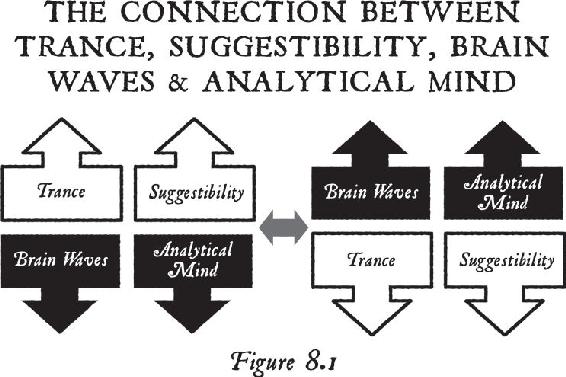
As your brain waves slow down and you get beyond your analytical mind, your brain moves into trance and you’re more suggestible to information. The inverse is also true. As your brain waves speed up, you become more analytical, the brain moves out of trance, and you become less suggestible to information. Suggestibility is your ability to accept, believe, and surrender to information without analyzing it.
What the creators of the commercials I mentioned earlier fully understand is that the best way to program a person to take a desired action is to put them into an alpha brain-wave state so that the information presented is not analyzed. When the commercial is repeated, or a similar one with the same message is played over and over, sooner or later that program is going to enter the viewer’s subconscious. The more we are exposed to the stimulus (in this case, the commercial), the more automatic the programmed response becomes. Eventually, when we’ve unconsciously memorized the stimulus and the response is automatic, the conscious mind no longer needs to think about or analyze the incoming information. Meanwhile, the subconscious mind maps the information, recording and storing it like a voice or video recording. Once it is mapped in your brain, each time you are exposed to the commercial, it continues to prime the same neural networks, further reinforcing the same program, thought, and belief. Now, not only can information influence your health, but it can also give you the solution to the problem the commercial is actually creating.
Other situations that increase suggestibility include shock, trauma, or a strong emotional reaction. For instance, when people are stunned or exposed to emotionally charged situations, it’s common that the brain goes into an altered state. As the brain pauses because of a sensory overload, such as a motor vehicle accident, the person enters a suggestible state. In severe cases, the person surrenders to the shock, becomes frozen and numb, and their ability to think becomes impaired. Therefore, when someone is exposed to an aggressive rash and feels sickened by the images (combined with the right music and narration to create an ominous or foreboding mood), the door to the subconscious mind opens, making the person more easily programmable.
If you remember, the subconscious mind sits right below the conscious mind. The limbic brain is the home of the subconscious and the autonomic nervous system, which controls all the automatic biological functions that happen on a moment-to-moment basis. Once a thought is programmed, like a servant carrying out their master’s orders, the ANS carries out the request of the thought.
If you are repeatedly told that your immune system weakens as you age, and that one out of three people who have had chicken pox in their life will get shingles, the emotionally charged experience allows the message to make it past your thinking, analytical mind. In response to this information, your ANS follows the orders and can begin to actually weaken your internal defense system.
For the advertisers to really get their money’s worth in this commercial endeavor, it’s best for them to repeatedly run the commercials late in the evening when we are most suggestible to programming. Why? Because melatonin levels rise in response to darkness, and melatonin causes our brain waves to slow down in preparation for sleeping and dreaming. Because our brain waves are moving from beta, to alpha, to theta, to delta in the evening, people are less analytical and their subconscious window opens. As daylight wakes us up in the morning and our brain begins producing serotonin, the reverse process occurs; our brain waves go from delta, to theta, to alpha (where, again, our subconscious is open to programming), and eventually to beta.
So if you’re an advertiser and you know the majority of the public is not aware of the way subconscious programming works, why not create a series of late-night commercials with your desired messaging, accent it with just the right amount of fright and concern so as to capture the viewer’s attention, and proceed to program their autonomic nervous system to get busy taking the orders just before they fall asleep?
A good rule of thumb: Don’t watch anything on television or on the Internet or participate in any mode of entertainment that you don’t want to experience—not only before bed, but ever.
Kaleidoscope Eyes: Entranced in Trance
For years, I’ve been thinking about how we’re all constantly programmed into self-limited beliefs; that is, believing that we need something outside of us to change how we feel inside of us. This is, after all, what advertising is all about—the never-ending dependence on, and consumption of, external sources to make us feel happy or better. This belief, which reminds us of our separation from wholeness, is incessantly ingrained in us through the media, television shows, commercials, the news, video games, websites, and sometimes even music. It’s a simple strategy, really: If you can suspend people in the feelings of lack, fear, anger, opposition, prejudice, pain, sadness, and anxiety, they remain dependent on someone or something outside of them to make those feelings go away. If you remain in a perpetual state of busyness, and are always preoccupied in survival emotions, you never actually have the opportunity to believe in yourself.
But what if it was possible to undo or reverse that programming so you had unlimited beliefs about yourself and your life? That’s exactly what we’ve been doing for several years at our advanced workshops using two simple tools, including one that children have been playing with for ages—a kaleidoscope. The only difference is that we’re applying it in a technologically advanced way to induce trance.
Up until this point, we’ve been moving into trance and alpha and theta brain-wave states with our eyes closed during meditation. But if we can create alpha and even theta brain-wave states with our eyes open, and intentionally expose ourselves to information relevant to our life’s dreams and goals, we can reprogram ourselves into supernatural states rather than the unconscious states we experience daily. But why the kaleidoscope?
For many years now, my primary passion has been the mystical. Each time I have one of these profound and super-lucid experiences, they create lasting changes within me that deepen my understanding of myself and my connection to the mystery of life. Once you have a mystical experience and get your first glance behind the veil, you can never go back to business as usual, and with every subsequent mystical experience you have, you move closer to source, wholeness, oneness, and the indivisible unified field. The good news is that mystical experiences are no longer relegated to people like Teresa of Avila, Francis of Assisi, or a Buddhist monk who’s been meditating for 40 years. Every person is capable of engaging, experiencing, and accessing the mystical.
When I’m having a mystical experience, it seems more real to me than anything I have ever known in my life, and I lose track of space and time. Often, just before I become entwined in it, I see in my mind (and sometimes in my outer world) circular, geometric patterns made of light and energy. They tend to look like mandalas, except they’re not static; they’re standing waves of interfering frequencies that appear as fractal patterns. The only way I can describe their properties is that they are alive, moving, changing, and ever evolving into more complex patterns within patterns.
These patterns look like what you see when you look into a kaleidoscope, but instead of being two-dimensional, they are three-dimensional. When I see and rest my attention on these divine geometric patterns, they change, and I know in a moment—as my brain takes that pattern of information and transduces it into vivid imagery—I am about to have a profound mystical experience. That’s why my team and I wanted to create a kaleidoscope visual for my students—to hopefully induce those types of experiences. But we couldn’t find any real footage of a kaleidoscope. At the time, all the fractal geometry media files on the Internet were computer generated, and I wanted to create a more realistic representation. After much searching, my team and I found a family that has been making kaleidoscopes for three generations, so we bought one of their best pieces.
Next, we rented a camera by RED, the leading manufacturer of the professional digital cinema cameras most often used in Hollywood films. We fitted the camera with a lens that attaches to the end of a fiber-optic filament, which we inserted inside the kaleidoscope. Once we placed the camera inside the kaleidoscope, we affixed a motor to the end that rotates so its internal crystals and oils would move in smooth, consistent transitions. For hours in a Seattle, Washington, studio we captured beautiful images and colors while filming against a black backdrop. The black represents the absence of anything physical (the place where we become no body, no one, no thing, no where, in no time). This is the infinite black space or void that you learned about in Chapter 3.
As we recorded all the footage over the course of several days, gravity caused the crystals and oil to fall and accelerate with every rotation, so a technician had to tediously account for every second, frame by frame, to ensure the transitions were smooth. If the transition was not fluid, it risked breaking the viewer’s focus or trance state. It took months to refine our footage into the one-hour video that we use during our advanced workshops. Finally, we had talented composer Frank Pisciotti create the accompanying soundtrack. We wanted our students to be continuously mesmerized by the beautiful symmetry and changing geometric forms.
Mind Movies: The Motion Picture of Your Future
At our advanced workshops, every participant receives a fun and easy-to-use software program called Mind Movies to make a movie about their future self and their life. We use this in tandem with the kaleidoscope video. Depending on what the student wants to create in their life, the movie they make about their future exposes them to images and specific written suggestions and information designed to assist them in creating it—just like the shingles commercial helps you to read along. This could range from healing from a disease to strengthening their immune system, creating a new job, manifesting new opportunities, traveling the world, attracting abundance, finding a new life partner, having mystical experiences, and more. Its purpose is to remind them that they can accomplish their dreams, create the uncommon, and become supernatural. The goals of this personalized media presentation include:
The Mind Movie technology was founded by two business partners from Australia, Natalie and Glen Ledwell. They are not only the founders but also the poster children for its capabilities. Their journey began in 2007 when a friend showed them a movie he had created about his life. Later, he approached them with the idea of starting a business based on what would become Mind Movie software. Getting the business off the ground required them to create a website to distribute the software so they could instruct people from all around the world on how to make their own movies. Yet they already had four businesses and knew almost nothing about the Internet or e-commerce. Glen could barely turn on a computer and Natalie hadn’t even heard of YouTube. They recognized, however, that Mind Movie had the potential to be a very powerful tool to help people build the belief that they could create real outcomes in their lives.
With that in mind, they decided to post a video about the power of Mind Movies on YouTube. At the end of the video, viewers were encouraged to visit their website, where they could learn how to build their own.
In early 2008, after receiving countless e-mails from customers telling them how Mind Movies had changed their lives, Natalie and Glen decided to go all in. They flew to the United States, attended an Internet marketing seminar, joined the Marketing Mastermind Group, and began planning Mind Movie’s global launch. Yet when they arrived in the United States, they had nearly drained their bank account, leaving almost no money to pay for the remaining services required to launch the business. This meant learning, mastering, and implementing everything for the launch themselves. For months, they worked 12-hour days out of their office—otherwise known as their bedroom. In the process, they ventured so far outside their comfort zone that they no longer knew what a comfort zone was. Faced with daily technical, business, and personal challenges, they had one secret weapon in their arsenal—their own Mind Movie.
In their Mind Movie, Natalie and Glen defined the number of customers they wanted to attract and who those customers would be. They described the respect of their industry peers and plotted out what they would do once their business was a success, such as the restaurants where they would eat and the family holidays they would take. Finally, they wanted to produce $1 million worth of sales (Why not aim high? they thought. Their marketing friends were doing million-dollar launches, albeit with $5,000 programs). They watched their Mind Movie multiple times a day to de-stress and remain focused and inspired, even though everything in their current reality seemed to be working against them. But they knew all their effort, risk, and dreams would culminate on the day of their global launch. The finish line was in sight—and then the unthinkable happened.
Scheduled for September 2008, their launch coincided with the global financial crisis. Financial institutions around the world were facing cataclysmic losses, while families and individuals lost their savings, assets, and livelihoods in the worst downturn since the Great Depression. Meanwhile, Glen and Natalie were facing their own financial hardships. By launching the business, they’d racked up $120,000 in credit-card debt. If the business failed, they’d lose everything—their home, cars, and investments, in addition to being buried under an insurmountable debt.
On the morning of their launch, unbeknownst to them, their e-mail delivery system was down for scheduled maintenance, so none of their customers received confirmation e-mails for their purchase. By lunchtime, they had already received thousands of customer support e-mail complaints, in addition to challenges with their online bank (the bank wanted to freeze their account due to unusual activity). By evening, however, they had experienced the most memorable day of their lives.
In the first hour on the first day, they had hit the $100,000 mark, and by day’s end they’d grossed $288,000. In the end, Glen and Natalie ended up generating $700,000 based on a $97 program with no up-sells. But the story doesn’t end there.
They were, of course, delighted with their achievement, but they faced one last monumental challenge. Because of the volatile and uncertain financial climate at the time, their bank froze their account so they couldn’t access the money. This meant they couldn’t pay commissions to their affiliates or the $120,000 they owed to creditors, or deliver profit sharing to the people who had helped them launch the business. Everything hinged on their funds being released. Finally, after six months of sticking to their vision and watching their Mind Movie, they gained access to their account, lifting the financial burden that had nearly sent them into bankruptcy. But here’s where the story gets really good.
As the world was still reeling economically, the value of the U.S. dollar against the Australian dollar was still grossly different, so thanks to the exchange rate, when they transferred their money back to Australia, they ended up earning an extra $250,000. With that, as well as with the commissions they received in exchange for promoting partner affiliate programs, Glen and Natalie actually met their $1 million goal.
They credit a huge part of their success—which was the complete opposite of what everyone else in the world was experiencing—with the fact that they focused on their Mind Movie every single day.
While this is a great example of the potential of Mind Movies, and while the options to create your own Mind Movie are endless, the process is relatively the same. Students first pick their own song—one they will never tire of listening to. Next, they choose images and/or videos of either themselves or a future event and lay them out sequentially to tell a story of what their future looks like. Finally, we ask them to come up with specific words, phrases, or affirmations to add to the scenes, which they superimpose over the images. In the exact same way that TV commercials program people to be victims or to experience want and lack, Mind Movies can program students to be unlimited in a life they are capable of creating.
In our advanced workshops, our students watch the kaleidoscope video before they watch their Mind Movies because it helps them induce and sustain alpha- and theta-trance states with their eyes open, opening the doorway between the conscious and subconscious mind. Throughout their meditation while in an alpha or theta brain-wave states, they are more suggestible to their own reprogramming process. This is important because the more suggestible they are while using their Mind Movie, the less likely they are to become analytical and have constant internal thoughts such as How’s this going to happen? or This is impossible! or How am I going to afford that? or It didn’t happen last time so why should it now?
While the kaleidoscope induces students into trance to open the subconscious to programming, the Mind Movie is the new program. Mind Movies program our students’ subconscious minds the same way that television commercials program us, but in more positive, unlimited, and constructive ways. When our brain’s thoughts are silenced, the conscious mind is no longer analyzing incoming information. As a result, whatever information we are exposed to in this state encodes directly into the subconscious. Just like recording or videotaping something to be automatically played back later, we’re recording a new program in the subconscious mind.
A great amount of research over the years has documented how the right and left hemispheres of the neocortex relate to one another. We now know that the right hemisphere processes spatial, nonlinear, abstract, and creative thinking, while the left hemisphere processes logical, rational, linear, methodical, and mathematical thinking. The latest research, however, also suggests the right hemisphere processes cognitive novelty and the left hemisphere processes cognitive routine.1 This means that when we learn new things, the right hemisphere is more active, and when new learnings become routine, they’re then stored in the left hemisphere.
The majority of people operate from the left hemisphere of their brain because they’re hardwired into automatic habits and programs they’ve memorized. This is why language is stored in the left hemisphere—it’s routine. You can think about the right hemisphere as the territory of the unknown and the left hemisphere as the territory of the known. It makes sense, then, that the right hemisphere would be romantic, creative, and nonlinear, while the left hemisphere would be methodical, logical, and structured. We’ve actually seen this dual processing occurring while watching our students’ brain scans in real time.
Because the kaleidoscope’s flow of geometric fractal patterns within patterns does not look like any one, any thing, any where, in any time, its patterns are designed to bypass the perceptual networks and associative centers in the brain that relate to known people, things, objects, places, and times. Its ancient geometrical patterns reflect repeating fractal patterns found all throughout nature; thus they activate lower-brain centers. It’s for this reason you can’t look into the kaleidoscope and see your Aunt Mary, a bicycle you owned in sixth grade, or the house where you grew up—because you’re not activating or triggering the associative centers related to the memories primarily located in the left hemisphere of your brain. As you stop thinking and analyzing, and start moving into alpha or theta brain-wave patterns, more activity occurs in the right hemisphere. If the left hemisphere operates in the known, and the right hemisphere operates in the unknown, as activity increases in your right hemisphere, you are more open to creating something unknown and new.
Graphics 9A(1) and 9A(2) in the color insert show brain scans of two students who are in coherent alpha and theta states. In Graphic 9A(3), you’ll see another student’s entire brain in theta while viewing the kaleidoscope. Graphic 9A(4) shows the brain scan of a student watching the kaleidoscope; the right side of their brain is more activated while they engage in the novelty of the experience during a trance state.
When we play the kaleidoscope in our advanced workshops, we play it in a dark room so melatonin levels increase, thereby enhancing brainwave changes. I ask students to relax and consciously slow down their breathing. As their respiration slows down, so do their brain waves, moving from beta to alpha. I then ask them to continuously relax into their body and to get ever more in touch with it. I want to get them into the state somewhere between half awake and half asleep, when they’re most suggestible, further priming their brain to accept the programming of their Mind Movie.
Just as late-night infomercials influence people because the production of melatonin (in preparation for restorative sleep) causes their guard to drop, I want our students’ melatonin levels to be elevated and their brain waves to be in alpha and theta so they are wide open to the information and the possibilities in their Mind Movie.
The Soundtrack of Your Future Life
Music has a way of calling up the memory of a specific time and place in our life. It’s for this reason the entertainer Dick Clark said, “Music is the soundtrack of your life.” The moment a magically nostalgic song starts playing, your brain begins recalling images of certain times and places, and those images connect you to the experience of different people and events. Neurologically speaking, the song acts as an external cue, causing a specific set of neural networks in your brain to fire. By association, you see images in your mind that have been frozen in time. We call this an associative memory.
If you take the memory of that song further and really feel it, get into it, and maybe even sing and dance along, you might notice that the corresponding emotions connected to your memories begin to move throughout your body. Whether the memory of that song relates to your first love, spring break your senior year of college, or what you felt before walking onto the field before the biggest game of your life, every one of those memories is strongly embedded with feelings and emotions. When you feel the emotion deeply enough, it connects you to the energy of your past, and the stronger the emotional response, the greater the memory. In the moment you feel and experience that memory, it brings your past to life, and in your mind you are instantly transported through time into the experience. Just as it did in the past, your body comes out of its resting state, causing you to feel the same emotions of your past and reproduce a level of mind equal to that past memory. For that moment, your entire state of being is in the past.
Long-term memories are stronger when the amplitude of the emotions associated with the event is high. Whether a long-term memory is positive or negative, however, has no bearing on how our mind processes the memory. For example, memories of traumas, betrayals, and shocking events carry equally powerful emotions, except they are negative rather than joyful. Once we remember and relive the pain, fear, anger, sadness, and intensity of the emotions connected to those traumatic memories, our internal chemical state changes. This causes us to pay more attention to whomever or whatever created the original emotions in our external environment.
So what if you could create a movie of your future and pair it with a song that motivates and inspires you so much that it pulls you out of your resting state, changes your state of being, and connects you to the energy of your future memories? If music is the soundtrack of your life, then just as certain songs transport you to the past, couldn’t you bring your future to life in the same way?
This is where Mind Movies come in. By purposefully pairing very powerful and moving images of your future, adding words and phrases to reinforce the content, and combining them with elevated emotions and inspiring music, you create long-term memories that move your biology out of the past and into the future. In other words, the images elicit feelings that correlate to the experiences you want to have in your future. This could include images of homes you want to live in, vacations you want to take, a new career, the freedom of expression, a healed relationship or body, interdimensional experiences, and so on. These are just some of the infinite possibilities that exist in your future timeline. When you watch your Mind Movie, as you connect to the feelings and emotions of your future, the higher the emotions you feel, the more you pay attention to the images that created those emotions. Now you’re creating long-term memories of your future—and you are bringing your future to life. The magical, interdimensional component of the future is your song, because it’s the feelings associated with your song that change your energy equal to how you will feel when that future unfolds. This is why it’s best to choose music that’s inspirational, motivational, or aspirational.
Next, you add words of affirmation or knowing to the Mind Movie that remind you of who you are and what you believe about your future. You could even add a timeline if you want to. Some examples could include:
If you think of your favorite music video or a scene from your favorite musical, chances are you know all the words of the song as well as the images that correspond to every note, beat, melody, and harmony. Most likely, the power of that combination evokes a time and a place in your life that was inhabited by a particular set of people, feelings, emotions, and experiences. This is exactly what you’re doing with your Mind Movies, except instead of remembering the past, you’re creating memories of the future. If you heard your song enough times while observing the images of your future, isn’t it possible that when you heard your song without viewing your Mind Movie, you’d be automatically transported into those images of a new future, just like you were transported back to your past? With practice, not only are you feeling the emotions that connect you to the memories of your future, but your biology is aligning to that future as well.
You already know why this happens: If your body is the unconscious mind, and it doesn’t know the difference between the experience that creates the emotion and the emotion you create by thought alone, in the present moment your body begins to believe it is living in that future reality. Since the environment signals the gene, and emotions are the consequences of experiences in the environment, by embracing the emotions of the event before the actual experience, you begin to change your body to be biologically aligned to your future in the present moment. Since all genes make proteins and proteins are responsible for the structure and function of your body, your body begins to biologically change to look like your future is already happening.
Putting It All Together
What if you invited a group of people to retreat from their lives for four or five days, and in the process removed the constant stimulation in their external environment that reminded them of who they thought they were as a personality? If you separated them long enough from the people they know, the places they go, and the things they do every day at the exact same time, they would be reminded of who they really are: unlimited human beings. And if you spent the first day or two teaching them how to create more coherence in their hearts and brains—and they repeatedly practiced cultivating these states every day—it makes sense that sooner or later they would get better at opening their hearts and making their brains work more proficiently. In fact, they would be more focused on a vision of a new future without being distracted, and at the same time, they could more easily feel the emotions of that new future. As they created more coherence in their brains and hearts, they would create more coherence in their own energy fields, and this would create a clearer electromagnetic signature.
As they continuously worked on overcoming themselves, their bodies, their environment, and time—slowing down and changing their brain waves, unfolding into the unified field, and transcending this three-dimensional environment—it would become increasingly easier and more familiar for them to activate their heart center and create. After they practiced getting beyond their body, emotions, habits, pain, disease, identity, limited beliefs, analytical mind, and unconscious programs, by the time the practice of Mind Movies was introduced, they would be ready to absorb a greater degree of information equal to who they were becoming, which would increase their ability to connect with their future. This is how we use Mind Movies at our workshops.
You can think of a Mind Movie as a 21st-century version of a vision board (a tool used to clarify, focus on, and maintain specific life goals), except it’s dynamic instead of static. When used with the kaleidoscope, the Mind Movie technology is a great tool to help you bring your future to life by repeatedly experiencing it. It’s also is a great way to gain clarity on what you want to unfold in your life—and to remind yourself on a daily basis what that future holds for you. This is called intention.
Because Mind Movie technology is so versatile, it can be used across many applications and in a variety of settings. Not only can the technology be used to create relationships, wealth, health, careers, and other material items, it’s also being used with children and teens to help them create a future vision so they feel they have some control over their lives. So many young people today are overwhelmed because of the frenetic pace, pressure, and demands of social media and modern society. Suicide is a leading cause of death for teens in the United States, so the founders of Mind Movie are using the technology in schools to help teens envision a brighter, more specific future for themselves.
Mind Movies are also used in corporate settings for team building and visioning. Entrepreneurs use the software to develop businesses, create mission statements, and strategize and create business plans. Imagine a team of motivated people not only reading and intellectualizing their mission statement, but also seeing it unfold in a dynamic, visual format—before it happens.
Integrative healing is another arena in which practitioners use this technology to help patients envision the healthiest version of themselves, assist them with their healing process, and keep them on task with a new lifestyle that must be maintained daily. This includes addiction treatment and recovery facilities helping patients become clear on the future they want to create in the next phase of their recovery. Mind Movies have also supported the generationally unemployed in finding new jobs or careers and living more future-oriented and productive lives, not only for themselves but also for their families.
As you can see, the applications for this technology are endless. No matter how it’s applied, the power of Mind Movies resides in enabling people to construct a new reality by reminding themselves of the daily choices they must make, the new behaviors they must demonstrate, and the feelings they want to live by. Once you program these feelings and behaviors subconsciously, you can break your addiction to old habits, familiar lifestyles, and unconscious reactions. It’s entirely up to you how creative you want to get when piecing together your future.
While anytime is a good time to watch your Mind Movie, I suggest watching it first thing in the morning and right before bed, because this is when you are most suggestible. If you watch it as soon as you wake up, you’re starting your day off on a positive note by being mindful and focused on what you want to achieve for the day, as well as for your future. When you view it at night before you go to bed, your subconscious mind can contemplate it while you sleep, align your body and mind to your future, and come up with solutions that your autonomic nervous system can carry out while you sleep. Basically, you can use it anytime you need motivation or to make a different choice. They key is to make sure you’re completely present when you watch it.
Since implementing Mind Movies, I’ve seen our students manifest new homes and heard stories of homes selling that had been on the market for years. I’ve seen vacations spontaneously appear and witnessed new relationships develop out of nowhere. I’ve listened to countless testimonials of abundance, freedom, new careers, new cars, healings of all kinds, relief from unbearable hardships, and of course, profound mystical experiences that have permanently altered the recipients. But it’s not magic or sorcery. It’s simply learning how to become a conscious creator—learning how to align to your own destiny.
Think of your Mind Movie as if you are turning on a radar device to track your future. Then, as you repeatedly visit the future in your heart and mind, all the thoughts, choices, actions, experiences, and emotions you experience between your present reality and your future reality become course corrections that deliver you to your target. The more you keep your future alive with your intention, attention, energy, and love, the more it starts to unfold as a new reality because you’re remembering your future just as you remember your past. Your job, then, is to continuously fall in love with that vision of the future, keep your energy up, and not let the circumstances (environment), hardwired attitudes, familiar negative feelings, or unconscious habits derail you from your goals.
What makes this technology so profound is that we perceive reality based on pattern recognition—links between the neural networks in our brains and the objects, people, and places in our external environment. For example, when you see someone you recognize, the neural networks in your brain instantly recall memories and experiences with that person. By contrast, if someone is not wired in your brain, you probably won’t recognize them. If your brain doesn’t have the hardware (familiarity with the images, thoughts, and emotions from the Mind Movie) installed before your future unfolds—if you don’t have the neural architecture wired into your brain—how will you recognize your new partner, your new job, your new house, or your new body? (Think of it like this: You can’t open a Microsoft Word document on a Mac computer unless you already have the Microsoft Word software installed.) If you can’t feel the emotions and create the energy of your future reality, you might not recognize or trust that future unknown experience when it finds you. That’s because your energy and emotional state are not in alignment with that experience, so instead of feeling certainty or a knowing, you may feel fear or uncertainty.
So many of my advanced students have told me they are on their third, fourth, even fifth Mind Movie because everything in their previous ones has come true. I am always amazed and humbled to hear the stories of how their creations came to be. No matter how varied their manifestations are, they all share one thing: They trained the body to follow the mind toward an intentional future. This makes sense because if you have been putting in the time to study, memorize, and create the neural connections of your future, that is where you have been placing your attention. And as you know by now, where attention goes, energy flows.
Take a look at Graphic 10 in the color insert. This shows an example of a student’s brain activity while he is watching his Mind Movie. There is an enormous amount of energy in his brain because he is fully involved in the experience.
Taking It One Step Further: Getting Dimensional
There’s one final way we use the Mind Movie technology in our work. Once our students have neurologically mapped their entire presentation, I ask them to pick a scene from the Mind Movie and unfold into a particular space and time, experiencing that scene three-dimensionally in their mind during their meditation. If you notice, I never use the word visualize in my teachings. Visualization usually involves just seeing something in the mind’s eye, so it appears as a flat or two-dimensional image. For example, if you visualize a picture of a car, you will create a picture of a car. Instead, I want you to experience everything in the scene using all five senses so it feels like a real-life, three-dimensional experience.
Many people who have been introduced to my work have wondered why I spend so much time on becoming aware of “the space” their body occupies in space, as well as opening their focus to the space around their body and the space that the room occupies in space. Aside from the coherent changes my cues produce in the brain, it’s all training for this mindful activity of pairing our Mind Movie with the kaleidoscope during meditation.
When a student begins the dimensionalizing process, before they see anything in their mind, they are instructed to unfold as an awareness into the scene. When they start, I want the participant to become aware that they are in their scene only as a consciousness. This means they are not their body and they lack their senses. They begin as an awareness in the emptiness of space, as if they are incapable of seeing, hearing, feeling, tasting, or smelling anything.
Once they become aware that they are an awareness, I ask them to choose a scene from their Mind Movie. This causes their brain to naturally start adding sensory input, which begins to bring dimension to the scene in their mind. Next they are instructed to start sensing what’s to their right, their left, above them, and below them. The act of sensing fills in this scene with three-dimensional structures, forms, and space. As they expand their awareness to what else is in the scene, their senses begin recruiting other senses, further filling in the scene with more forms, structures, curves, textures, scents, images, feelings, and space. Finally, when the scene comes to life in their mind, in the future space and time of that scene, they start inhabiting their body—not the body that is sitting there in the chair meditating, but the physical body of their future. They are asked to feel their arms, legs, torso, muscles, and so on until they can feel their entire body in that scene. Then they are ready to move about in that scene and experience that reality.
My theory is that when they simultaneously activate enough of the neural networks assigned to the objects, things, and people in a specific space and time, their possibility of having a full-on, holographic, IMAX-type experience increases. This is because as the student becomes present and unfolds into a fully dimensional scene, a large majority of the brain turns on, including the neural architecture that is allocated to both the sensory (feeling) and motor (moving) aspects of their body, as well as the proprioception (awareness of body position) of where they are in space. The next thing they know, they are having a real-life sensory experience of their future with their eyes closed, in the present moment.
Take a look at Graphic 11 in the color insert. It is the brain scan of a student who is experiencing a seemingly real Mind Movie scene in meditation. She has quite a bit of energy in her brain while she is dimensionalizing the scene. She described this moment as a full-on virtual sensory experience. Her subjective experience was quantified objectively in this scan.
Many of our students have reported that the experiences in their meditation were more real than any past external experience. Their senses were enhanced without external stimuli to excite their senses, yet all they were doing was sitting in their chair with their eyes closed. Many have reported that in their lucid experience, they smelled certain fragrances like colognes, the aroma of specific flowers like jasmine and gardenias, or the familiar scent of leather in their new car they were sitting in. I’ve also heard students report specific memories, like the stubble on their face from not shaving, the wind blowing through their hair, or the feeling that their body was filled with a powerful energy. Students have also given testimony to specific sounds they could clearly hear, such as distant church bells coming from a European church near where they were vacationing, or the bark of their dog when they were in their new home. Several students have also said that the colors they saw were incredibly clear and vivid, or they experienced amplified tastes like coconut, chocolate, and cinnamon. The combination of all of the different senses literally created a new experience for them.
It’s our five senses that plug us into our external reality. Typically, when we have a new experience, everything we see, hear, smell, taste, and feel is sent to the brain through those five sensory pathways. Once all that sensory information makes it to the brain, clusters of neurons begin to organize into networks. The moment the neurons string into place, the limbic brain makes a chemical called an emotion. Because experience enriches the brain and creates an emotion that signals new genes in the body, in the rich sensory moment of a student’s internal experience—without ever using their external senses—they’re changing their brain and body to look like their future has already happened. Isn’t that what experience does? I love to hear a person who has just come out of one of those experiences tell me, “You don’t understand—I was there! I know it is going to happen because it already has and I already experienced it!” That’s because the experience has already happened.
When we fully experience a reality in this field of consciousness and energy without a body, the energy of the new experience serves as the template for physical reality. The more energy you invest in your future, and the more you keep experiencing and emotionally embracing it before it happens, the more you leave an energetic imprint in that future reality. And your body should follow your mind to that unknown future, because that’s where your energy is. As you continue to place your attention and energy on it, you fall more deeply in love with it, and because love bonds all things, you are bonding with that future and it is being drawn to you.
For more information about the Mind Movie or the kaleidoscope, please visit my website at drjoedispenza.com/mindmovies or drjoedispenza.com/kaleidoscope, respectively.
Kaleidoscope and Mind Movie Meditation
In our advanced workshops, we instruct our students to create a Mind Movie before they arrive at our event so they can integrate their Mind Movies with the kaleidoscope video during meditation. We begin by getting heart centered, which you learned in Chapter 7, locking into those elevated emotions for several minutes and radiating that energy beyond their bodies into space. Then we guide them in the following meditation.
Unfold into the present moment, and when you attain that state, open your eyes and stare into the kaleidoscope. Once in trance, switch to your Mind Movie. Spend maybe eight minutes with the kaleidoscope, then eight minutes watching your Mind Movie, and then repeat the cycle. When you’ve watched your Mind Movie enough that you can predict the next scene, you’ve mapped it neurologically. Over time, you’ll associate different parts of the song you have chosen with the different images of your Mind Movie.
Finally, spend seven minutes watching the kaleidoscope while just listening to the music from your Mind Movie. As you gaze into the kaleidoscope in trance and hear your song, by association your brain automatically recalls different images from your Mind Movie. This causes you to further remember your future biologically—automatically and repeatedly firing and wiring neural networks. Now your brain is being programmed to look like the new future has already happened, while the emotions are signaling new genes to biologically change your body in preparation for your new future.
Watch the kaleidoscope in tandem with your Mind Movie every day for a month, or at least try to watch your Mind Movie twice daily—as soon as you wake up and right before you go to sleep. You might even want to keep a journal to record all the wonderfully unexpected adventures and serendipitous happenings that, as you look back, you will see as points on a map that led you to manifesting this future. Consider creating several Mind Movies—one for health and wellness, for example, and another for romance, relationships, and wealth.