Thirty-six-year-old Ivan Santiago stood patiently on a New York City street, along with a handful of paparazzi gathered behind a velvet rope outside a service entrance to a four-star Lower East Side hotel. They were awaiting a foreign dignitary who was about to exit the building and jump into one of two black SUV limos waiting at the curb. But Santiago wasn’t clutching a camera. One hand held a brand-new red backpack, while the other reached inside the partially unzipped bag and took hold of the grip of a pistol outfitted with a silencer. Santiago, an imposing Pennsylvania corrections officer with a bald head that would make Vin Diesel proud, knew a thing or two about deadly weapons. He’d never had to fire one while on duty, but he was ready to fire one today.
Moments before, Santiago had been on his way home, without a single thought of guns, backpacks, foreign dignitaries, or assassination. But now here he was, finger on the trigger, brow knit into an intimidating scowl, and mere seconds from turning into a killer. The hotel door opened, and out sauntered his mark in a crisp, white dress shirt, sporting shades and carrying a leather briefcase. The man took only two or three strides toward the waiting limo before Santiago whipped his gun out of the backpack and fired three times. The man fell to the sidewalk, motionless, his shirt stained red.
Seconds later, a man named Tom Silver appeared out of nowhere, calmly put one hand on Santiago’s shoulder and his other on Santiago’s forehead, and said, “On the count of five, I’ll say, ‘Fully refreshed.’ Open your eyes and wake up. One, two, three, four, five! Fully refreshed!”
Santiago had been hypnotized to shoot a stranger (actually a stuntman) using what turned out to be a harmless Airsoft prop gun in an experiment run by a handful of researchers who set out to test the unthinkable: Using hypnosis, was it possible to program a law-abiding, all-around good person to become a cold-blooded assassin?1
Hidden inside the SUV, eyes riveted to the scene, were the researchers working with Silver: Cynthia Meyersburg, Ph.D., then a postdoctoral fellow at Harvard specializing in experimental psychopathology; Mark Stokes, Ph.D., a neuroscientist at Oxford who studies the neural pathways of decision making; and Jeffery Kieliszewski, Ph.D., a forensic psychologist with Human Resource Associates in Grand Rapids, Michigan, who’s done work in super- maximum-security prisons and hospitals for the criminally insane.
The day before, the researchers had started out with a group of 185 volunteers. Silver (a certified clinical hypnotherapist and forensic-hypnosis investigation expert who once helped the Taiwan Department of Defense bust open a $2.4 billion international arms-trading scandal) screened all 185 participants to determine how suggestible they were to hypnosis. Only about 5 to 10 percent of the population are considered very susceptible to hypnosis. In the test group, 16 passed muster and were given a psychological evaluation to weed out those who might suffer permanent psychological harm from the experiment. Eleven progressed to the next test, which determined whether, under hypnosis, they would reject deeply rooted social norms; this would show which were the most suggestible.
Divided into smaller groups, the subjects were taken to a fairly busy restaurant for lunch, but unbeknownst to them, they’d been given a posthypnotic suggestion that once they sat down, their chairs would feel very hot, to the point where they’d quickly become so warm that they’d strip to their underwear—right there in the restaurant. While all of the subjects complied with the instructions to varying degrees, the researchers eliminated seven who they felt either were playing along or just weren’t suggestible enough to fully follow the prompt. The others stripped to their underwear within seconds; they really thought their chairs were extremely hot.
The four who progressed to the next level were invited to take a test no one would be able to fake. The subjects were to step into a deep metal bathtub filled with 35°F ice water, just 3° above freezing. One at a time, the subjects were wired to devices that monitored their heart rate, breathing rate, and pulse, while a special thermo-imaging camera monitored both their body temperature and the temperature of the water. Hypnotizing them, Silver told the subjects they would feel no discomfort from the cold water and, in fact, would feel as though they were stepping into a nice, warm bath. Anesthesiologist Sekhar Upadhyayula administered the test as emergency medical technicians stood by.
This test would make or break the experiment. Normally, when someone is exposed to water this cold, an involuntary gasping reflex happens as the water reaches nipple level. The heart rate and respiratory rate climb, the person starts to shiver, and the teeth begin to chatter. It’s the autonomic nervous system taking over in an automatic attempt to maintain internal balance—something that’s not under conscious control. Even if a person were in a deep state of hypnosis, the amount of sensation being sent to the brain under these extreme circumstances would normally be too overwhelming to maintain a hypnotic state. If any of the subjects passed this test, they were indisputably suggestible to a very high degree.
Three of the subjects were indeed in deep states of hypnosis, but not deep enough to withstand this kind of intense cold without their bodies losing homeostasis. The longest any of them could stay in the bath was 18 seconds. But the fourth subject, Santiago, stayed in for just over two full minutes before Dr. Upadhyayula called a halt to the test.
Although Santiago’s heart rate was high before the experiment, once he stepped into the water, his heart rate calmed down immediately. There wasn’t so much as a flutter on his EKG or a single blip in his respiratory rate. Santiago sat among ice cubes as though he were soaking in a warm bathtub; indeed, that’s exactly what he believed he was doing. The man never flinched nor did his body fall into hypothermia, and the researchers knew they’d found the subject they were looking for.
Because Santiago was so suggestible under hypnosis that his body could overcome such an extreme environment for this amount of time and his mind could control his autonomic functions, he was ready for the final test.
Santiago’s background check had shown he was a great guy, the researchers noted. He was a trusted employee, a devoted son, and a loving uncle. He was certainly not the type of man who would agree to kill somebody in cold blood. Would Silver succeed in getting such a man to turn into an assassin?
For this next phase of the experiment to be valid, Santiago couldn’t know what was being staged; he couldn’t make any connection between the experiments he was taking part in and the scene in front of the hotel next to where the study was taking place. As part of the plan, the television producers in charge of filming the experiments told him he hadn’t been selected to continue in the program, although they wanted him to return the next day for a short exit interview. Before Santiago left, he was told he wouldn’t be put under hypnosis again.
Santiago returned the following day. While he was chatting with a producer, the team went to work staging the scene outside. The stuntman strapped on blood packs; the Airsoft prop gun (which had the blast and recoil action of a real firearm) was placed inside a red backpack and laid on the seat of a parked motorcycle right outside the entrance to the building. A velvet rope line was set up outside the hotel service entrance, right next door, and staged paparazzi were in place with their film and video cameras. Two SUVs were parked on the street, looking ready to drive off with the “foreign dignitary” and his entourage.
Back upstairs, Santiago happily answered questions in his “exit interview,” until the producer excused herself for a moment, saying she’d be right back. Soon after she left the room, Silver entered, saying he wanted to say good-bye to Santiago. As Silver shook Santiago’s hand, he gave a little tug on his arm that prompted Santiago, by now well conditioned to this cue, to drop immediately into a hypnotic trance. He went limp on the couch.
Silver told him “a bad guy” was downstairs, adding, “He’s gotta be erased. We’ve got to get rid of him, and you’re the one to do it.” He told Santiago that once he exited the building, he’d see a red backpack on a motorcycle, and inside would be a gun. He told Santiago that he was to grab the red backpack and walk over to the velvet rope, where he’d wait for the dignitary, who’d be carrying a briefcase, to emerge from the hotel. He told Santiago, “As soon as he comes out the doors, you’re going to point the gun at his chest and fire that gun: Bang! Bang! Bang! Bang! Bang! But as soon as you do it, you’ll simply, completely, totally forget that it ever happened.”
Finally Silver implanted both an audible and a physical stimulation trigger that would send Santiago back into a hypnotic state, under which he’d follow the posthypnotic suggestion Silver had given him: He told Santiago that he’d recognize a segment producer outside the building, and the man would shake his hand and say, “Ivan, you did a spectacular job.” Silver told Santiago to nod “yes” if he’d do what Silver had instructed, and Santiago complied. Then Silver brought him out of the trance and acted as if he were truly just saying good-bye.
The producer returned to the room after Silver left and thanked Santiago, telling him the exit interview was over and he could leave. Soon after, Santiago left the building, thinking he was going home.
Once he was outside, the segment producer walked up to him, shook his hand, and said, “Ivan, you did a spectacular job.” That was the trigger. Immediately, Santiago looked around, saw the motorcycle, walked over to it, and calmly picked up the red backpack sitting on the seat. Seeing the velvet rope line and the paparazzi, he walked over next to them and slowly unzipped the bag.
In moments, a man carrying a briefcase strode out the door. Without flinching, Santiago pulled the gun out of the backpack and shot the man in the chest several times. The blood bags under the “dignitary’s” shirt erupted, and he dramatically collapsed to the ground.
Silver almost immediately appeared on the scene and had Santiago close his eyes. The stuntman made a hasty exit as Silver then brought Santiago out of his trance. The psychologist Jeffery Kieliszewski appeared and suggested Santiago follow him inside with the others for a debriefing. Once inside, the researchers told a surprised Santiago what had happened and asked him if he had any memory of what he’d done or what had just unfolded outside. Santiago didn’t remember a thing—that is, until Silver suggested to him that he would.
Programming the Subconscious
In the first few chapters, you read about many different individuals who accepted a possible imagined scenario, and like magic, their bodies responded to that picture in their minds: individuals who’d been trapped for years by the involuntary tremors of Parkinson’s disease but increased their dopamine levels by thought alone, only to see their spastic paralysis mysteriously vanish; a chronically depressed woman who, over time, physically changed her brain and transmuted her debilitating emotional state into joy and well-being; asthmatics who experienced a full-blown bronchial episode brought on by nothing more than water vapor, but then reversed their bronchial constriction in seconds by inhaling exactly the same water vapor; and, of course, the men with severe knee pain and compromised range of motion who miraculously improved after having sham knee surgery and remained healed years later.
In all of these cases and more, it could be said that each subject first accepted and then believed in the suggestion of better health, and then surrendered to the outcome without further analysis. When these people accepted the potential of recovery, they aligned themselves with a future possible reality—and changed their minds and brains in the process. As they believed in the outcome, they emotionally embraced the idea of better health, and as a result, their bodies, as the unconscious mind, were living in that future reality during the present moment.
They conditioned their bodies to a new mind and so began to signal new genes in new ways and express new proteins for better health—and they moved into a new state of being. Once they surrendered to a new possible scenario, they no longer analyzed how it was going to happen or when it would manifest; they simply trusted in a better state of being and maintained that new state of mind and body for an extended period of time. It was that sustained state of being that switched on the right genes and programmed them to stay on.
Whether they took a regimen of daily sugar pills lasting weeks or even months, received a single saline injection, or submitted to fake surgery, these individuals reaffirmed their acceptance, belief, and surrender for the duration of the study they participated in. If they were taking a pill daily to relieve pain or depression, the pill was a constant reminder for them to condition, expect, and assign meaning to their intentional activity, thus reinforcing the internal process over and over again. If it was a weekly visit to the hospital to see a doctor and be interviewed about their improvement, the choice to interact in a particular environment with doctors, nurses, equipment, and waiting rooms triggered a host of sensory responses, and through associative memory, they were reminded of a possible new future. They were conditioned from past experiences that the place called “a hospital” was where people went to get well. They began to anticipate their future changes and, therefore, assigned intention to the whole healing process. Because all these factors had meaning, they helped make the placebo patients more suggestible to the outcomes they experienced.
So now let’s address the elephant in the room: No real physical, chemical, or therapeutic mechanisms made these changes happen. None of these people had actual surgery, took active medication, or received any real treatment to create these significant alterations in health. The power of their minds so influenced their bodies’ physiology that they became healed. It’s safe to say that their real transformation happened independent of their conscious minds. Their conscious minds may have initiated the course of action, but the real work happened subconsciously, with the subjects remaining totally unaware of how it happened.
The same is true of Ivan Santiago. The power of his mind under hypnosis so influenced his physiology that even when he was sitting in a freezing ice-cube bath, he didn’t so much as flinch. It was the power of his subconscious mind altered by a mere suggestion, however, not his conscious mind, that was responsible for this feat. If he hadn’t accepted the suggestion, the outcome would have been very different. In addition, he did what he did without thinking about how he was able to do it; in fact, in his mind, he wasn’t sitting in an ice bath. He was sitting in a perfectly pleasant tub of warm water.
So just as with hypnosis, the placebo effect is created by a person’s consciousness somehow interacting with the autonomic nervous system. Quite simply, the conscious mind merges with the subconscious mind. Once the placebo patients accept a thought as a reality, and then believe and trust in the end result emotionally, the next thing that happens is that they get well.
A cascade of physiological events automatically carries out the whole biological change—without their conscious minds being involved. They’re able to enter the operating system where these functions already happen routinely, and when they do, it’s as if they’ve planted a seed in fertile ground. The system automatically takes over for them. In fact, it’s not anyone’s job to do anything. It just happens.
None of the subjects could consciously spike dopamine levels by 200 percent and control involuntary tremors with the mind, manufacture new neurotransmitters to combat depression, signal stem cells to morph into white blood cells to mount an immune response, or restore knee cartilage in order to reduce pain—just as Santiago couldn’t have consciously avoided flinching when he lowered his body into that tub. Anyone trying to accomplish any of these feats would certainly be unsuccessful. These people would have to get help from a mind that already knows how to initiate all of these processes. To succeed, they’d have to activate the autonomic nervous system, the subconscious mind, and then assign it the task of making new cells and healthy new proteins.
Acceptance, Belief, and Surrender
I have mentioned the word suggestibility throughout this book as if being suggestible were something that all of us could simply do voluntarily on command. As you read in the story at the beginning of the chapter, it turns out that it’s not that easy. Let’s face it. Some of us—certainly Ivan Santiago—are more suggestible than others. And even those who are more suggestible respond to certain suggestions better than other suggestions.
For example, some of the hypnotism test subjects had no problem stripping to their underwear in public when given that posthypnotic suggestion, yet they were unable to subconsciously accept the idea that a tub of frigid ice water was really a warm Jacuzzi. This was true even though posthypnotic suggestions (including the suggestion that Santiago shoot the stranger) are generally more difficult to make stick, compared to suggestions that alter someone’s state temporarily during the hypnotic trance itself.
And like hypnosis, the placebo response also doesn’t just work for everyone. The placebo patients you’ve read about who were able to make positive changes last for years (like the men who had the sham knee surgery) respond much like hypnotherapy subjects who’ve been given posthypnotic suggestions. For some, like these men, such suggestions work beautifully. For others, not much happens.
For instance, when they’re sick or suffering from a disease, many people simply can’t accept the idea that even a drug, procedure, treatment, or injection can help them—let alone that a placebo might work. Why not? It takes thinking greater than how they feel—in turn allowing those new thoughts to drive new feelings, which then reinforce those new thoughts—until it becomes a new state of being. But if familiar feelings have become the means of familiar thinking and the person can’t transcend that habituation, he or she is in the same past state of mind and body, and everything stays the same.
However, if those same people who can’t accept that a drug or procedure could make them well could reach a new level of acceptance and belief, and then surrender to that end without constantly fretting, worrying, and analyzing, then they could reap greater rewards from the process. That’s what suggestibility is: making a thought into a virtual experience and having our bodies consequentially respond in a new manner.
Suggestibility combines three elements: acceptance, belief, and surrender. The more we accept, believe, and surrender to whatever we’re doing to change our internal state, the better the results we can create. Similarly, when Santiago was under hypnosis and his subconscious mind was in control, he could totally accept what Silver told him about the “bad guy” who needed to be eliminated, he could believe that Silver was telling the truth, and he could surrender to carrying out the detailed instructions Silver gave him, without ever analyzing or thinking critically about what he was about to do. There was no hand-wringing and asking for proof. There was no second-guessing. He just did it.
Adding in Emotion
So when we are presented with the idea of better health, and we can associate that hope or thought—that something outside of us is going to change something inside of us—with emotional anticipation of the experience, we’re becoming suggestible to that end result. We condition, expect, and assign meaning to the whole delivery system.
But the emotional component is key in this experience; suggestibility isn’t just an intellectual process. Many folks can intellectualize being better, but if they can’t emotionally embrace the result, then they can’t enter into the autonomic nervous system (as Santiago did using hypnotism), which is vital because that’s the seat of the subconscious programming that’s been calling all the shots (as discussed in Chapter 3). In fact, it’s generally accepted in psychology that a person who experiences intense emotions tends to be more receptive to ideas and is therefore more suggestible.
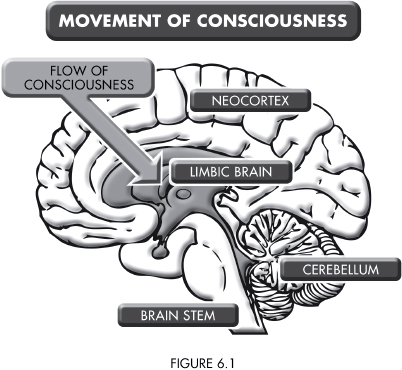
The autonomic nervous system is under the control of the limbic brain, which is also called the “emotional brain” and the “chemical brain.” The limbic brain, depicted in Figure 6.1, is responsible for subconscious functions like chemical order and homeostasis, for maintaining the body’s natural physiological balance. It’s your emotional center. So as you experience different emotions, you activate this part of the brain, and it creates the corresponding chemical molecules of emotion. And since this emotional brain exists below the conscious mind’s control, the moment you feel emotion, you activate your autonomic nervous system.
When you feel an emotion, you can ultimately bypass your neocortex—the seat of your conscious mind—and activate your autonomic nervous system. Therefore, as you get beyond your thinking brain, you move into a part of the brain where health is regulated, maintained, and executed.
So if the placebo effect requires you to embrace an elevated emotion ahead of the actual experience of healing, then when you amplify your emotional response (and come out of your normal resting state), you’re activating your subconscious system. Allowing yourself to feel emotions is a way to enter the operating system and program a change, because you’re now automatically instructing the autonomic nervous system to begin creating the corresponding chemistry as if you were getting better. And the body receives a blend of those natural alchemical elixirs from the brain and mind. As a result, the body is now becoming the mind emotionally.
As we’ve seen, these can’t be just any emotions. The survival emotions that we already explored in the last chapter knock the brain and body out of balance and so downregulate (or shut off) the genes needed for optimal health. Fear, futility, anger, hostility, impatience, pessimism, competition, and worry won’t signal the proper genes for better health. They actually do the opposite. They turn on the fight-or-flight nervous system and prepare your body for emergency. You’re now losing vital energy for healing.
It’s a similar situation with trying to make something happen, by the way. The moment you’re trying, you’re pushing against something because you’re endeavoring to change it. You’re struggling, attempting to force an outcome, even if you don’t realize that’s what you’re actually doing. That knocks you out of balance, just as the survival emotions do, and the more frustrated and impatient you become, the more out of balance you get. Remember in The Empire Strikes Back, when Yoda said to Luke Skywalker that there is no try, only do (or do not)? The same is true with the placebo response: There is no try; there’s only allow.
All those negative and stressful emotions are so familiar to us and connect to so many past known events that when we focus on them, those familiar emotions keep the body connected to the same past conditions—which, in this case, is poor health. No new information can then program your genes in any new ways. Your past reinforces your future.
On the other hand, emotions like gratitude and appreciation open your heart and lift the energy in your body to a new place—out of the lower hormonal centers. Gratitude is one of the most powerful emotions for increasing your level of suggestibility. It teaches your body emotionally that the event you’re grateful for has already happened, because we usually give thanks after a desirable event has occurred.
If you bring up the emotion of gratitude before the actual event, your body (as the unconscious mind) will begin to believe that the future event has indeed already happened—or is happening to you in the present moment. Gratitude, therefore, is the ultimate state of receivership. Look at Figure 6.2 to review the difference between the expression of survival emotions and the expression of elevated emotions.
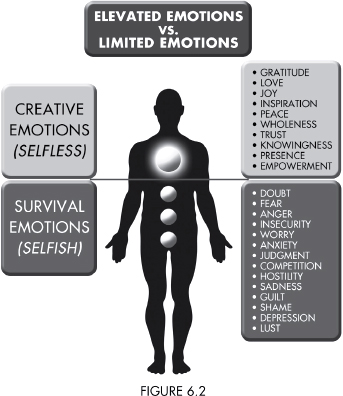
Survival emotions are derived primarily from the stress hormones, which tend to endorse more selfish and more limited states of mind and body. When you embrace elevated, more creative emotions, you lift your energy to a different hormonal center, your heart begins to open, and you feel more selfless. This is when your body starts to respond to a new mind.
If you can bring up the emotion of appreciation or thankfulness, and combine it with a clear intention, you’re now beginning to embody the event emotionally. You’re changing your brain and body. Specifically, you’re chemically instructing your body to know what your mind has philosophically known. We could say that you’re in a new future in the present moment. You’re no longer using familiar, primitive emotions to keep you anchored to the past; you’re now using elevated emotions to drive you into a new future.
Two Faces of the Analytical Mind
Let’s go back to the idea introduced earlier that we each have different levels of our own acceptance to a suggestion, resulting in a spectrum of suggestibility. Everyone has his or her own level of susceptibility to thoughts, suggestions, and commands—from both outer and inner realities—based on many different variables. Think of your level of suggestibility as being inversely related to your analytical thinking (as illustrated in Figure 6.3): the greater your analytical mind (the more you analyze), the less suggestible you are; and the lesser your analytical mind, the more suggestible you are.
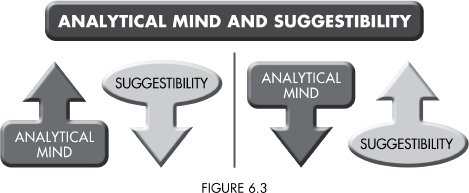
The inverse relationship between the analytical mind and suggestibility.
The analytical mind (or the critical mind) is that part of the mind you consciously use and are aware of. It’s a function of the thinking neocortex—the part of the brain that’s the seat of your conscious awareness; that thinks, observes, and remembers things; and that resolves problems. It analyzes, compares, judges, rethinks, examines, questions, polarizes, scrutinizes, reasons, rationalizes, and reflects. It takes what it has learned from past experience and applies it to a future outcome or to something it hasn’t yet experienced.
In the hypnosis experiment described at the start of this chapter, for example, 7 of the 11 subjects given the posthypnotic suggestion to peel their clothes off in the public restaurant didn’t fully comply. It was the analytical mind that brought them “back to their senses.” The moment they began to analyze—Is this right? Should I do this? What will I look like? Who’s watching? What will my boyfriend think?—the suggestion was no longer as powerful, and they returned to their old, familiar state of being. The folks who immediately stripped to their underwear, on the other hand, did it without questioning what they were doing. They were less analytical (and so more suggestible) than their counterparts.
Since the neocortex is divided into two halves called hemispheres, it makes sense that we analyze and spend a lot of time thinking in duality: you know, good versus bad, right versus wrong, positive versus negative, male versus female, straight versus gay, Democrat versus Republican, past versus future, logic versus emotion, old versus new, head versus heart—you get the idea. And if we’re living in stress, the chemicals we’re pumping into our systems tend to drive the whole analytical process faster. We analyze even more in order to predict future outcomes so that we can protect ourselves from potential worst-case scenarios based on past experience.
There’s nothing wrong with the analytical mind, of course. It has served us well for our entire waking, conscious lives. It’s what makes us human. Its job is to create meaning and coherence between our outer worlds (the combined experiences of people and things at different times and places) and our inner worlds (our thoughts and feelings).
The analytical mind works best when we’re calm, relaxed, and focused. This is when it’s working for us. It simultaneously reviews many aspects of our lives and provides us with meaningful answers. It helps us choose from myriad options in order to make decisions, learn new things, scrutinize whether to believe in something, judge social situations based on our ethics, get clear on our purpose in life, discern morality with conviction, and evaluate important sensory data.
As an extension of our egos, the analytical mind also protects us so that we can cope and survive best in our external environments. (In fact, one of the ego’s main jobs is protection.) It’s always evaluating situations in the external environment and assessing the landscape for the most advantageous outcomes. It takes care of the self, and it also tries to preserve the body. Your ego will let you know when there’s potential danger, and it will urge you to respond to the condition. For example, if you were walking down the street and saw the oncoming cars driving too close to the side of the road where you were walking, you might cross the street to protect yourself—that’s your ego giving you that guidance.
But when our egos are out of balance due to a barrage of stress hormones, our analytical minds go into high gear and become overstimulated. That’s when the analytical mind is no longer working for us, but against us. We get overanalytical. And the ego becomes highly selfish by making sure that we come first, because that’s its job. It thinks and feels as though it needs to be in control to protect the identity. It tries to have power over outcomes; it predicts what it needs to do to create a certainly safe situation; it clings to the familiar and won’t let go—so it holds grudges, feels pain and suffers, or can’t get beyond its victimhood. It will always avoid the unknown condition and view it as potentially dangerous, because to the ego, the unknown is not to be trusted.
And the ego will do anything to empower itself for the rush of addictive emotions. It wants what it wants, and it will do whatever it takes to get there first, by pushing its way to the front of the line. It can be cunning, manipulative, competitive, and deceptive in its protection.
So the more stressful your situation, the more your analytical mind is driven to analyze your life within the emotion you’re experiencing at that particular time. When this happens, you’re actually moving your consciousness further away from the operating system of the subconscious mind, where true change can occur. You’re then analyzing your life from your emotional past, although the answers to your problems aren’t within those emotions, which are causing you to think harder within a limited, familiar chemical state. You’re thinking in the box.
Then because of the thinking and feeling loop discussed earlier in the book, those thoughts re-create the same emotions and so drive your brain and body further out of order. You’ll be able to see the answers more easily when you get beyond that stressful emotion and see your life from a different state of mind. (Stay tuned.)
As your analytical mind is heightened, your suggestibility to new outcomes decreases. Why? Because an impending emergency isn’t the time to be open-minded: entertaining new possibilities and accepting new potentials. It’s not the time to believe in new ideas and openly let go and surrender to them. It’s not the time to trust; instead, it’s the time to protect the self by measuring what you know against what you don’t know in order to determine the greatest chances of survival. It’s the time to flee from the unknown. So it makes sense that as the analytical mind is endorsed by the stress hormones, you’ll narrow your thinking, be unlikely to trust and believe in anything new, and be less suggestible to believing in thought alone or in making any unknown thought known. Thus, you can use the analytical mind or ego to work for you or against you.
The Inner Workings of the Mind
Think of the analytical mind as a separate part of the conscious mind that divides it from the subconscious mind. Since the placebo works only when the analytical mind is silenced so that your awareness can instead interact with the subconscious mind—the domain where true change occurs—the placebo response is possible only when you can get beyond your self and so eclipse your conscious mind with your autonomic nervous system.
Look at Figure 6.4 for a simple illustration of this. Let the circle in the figure represent the total mind. The conscious mind is only about 5 percent of the total mind. It’s made up of logic and reasoning as well as our creative abilities. These aspects give rise to our free will. The other 95 percent of the total mind is the subconscious mind. This is the operating system where all of the automatic skills, habits, emotional reactions, hardwired behaviors, conditioned responses, associative memories, and routine thoughts and feelings create our attitudes, beliefs, and perceptions.
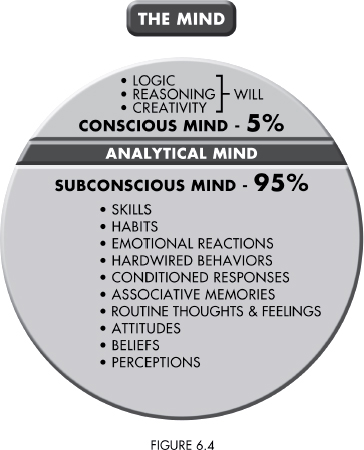
This is an overview of the conscious mind, the analytical mind, and the subconscious mind.
The conscious mind is where we store our explicit, or declarative, memories. Therefore, declarative memories are memories that we can declare. They’re the knowledge we’ve learned (termed semantic memories) and experiences we’ve had in this lifetime (episodic memories). You might be a woman who grew up in Tennessee; who rode horses in childhood until you fell off and broke your arm; who had a pet tarantula at age 10 that escaped from its cage, requiring you and your family to sleep at a hotel for two days; who won the state spelling bee at age 14 and now never misspells a word; who studied accounting in college in Nebraska; who presently lives in Atlanta so that you can be near your sister (who took a job for a large corporation); and who is now getting a master’s degree in finance online. Declarative memories are the autobiographical self.
The other type of memories we have are implicit, or nondeclarative, memories, sometimes also called procedural memories. This kind of memory kicks in when you’ve done something so many times that you aren’t even consciously aware of how you do it. You’ve repeated it so often that now your body knows it as well as your brain. Think of riding a bike, operating a clutch, tying your shoes, tapping a phone number or a PIN on a keypad, or even reading or speaking. These are the automatic programs that have been discussed throughout this book. You could say that you no longer have to analyze or consciously think about the skill or habit you’ve mastered, because it’s now subconscious. This is the programmed operating system, which is depicted in Figure 6.5.
When you’ve mastered how to do something until it has become hardwired in your mind and emotionally conditioned to your body, then your body knows how to do it as well as your conscious mind. You’ve memorized an internal neurochemical order that has become innate. The reason is simple: Repeated experience enriches the brain’s neural networks and then finally seals the deal when it emotionally trains the body. Once the event is neurochemically embodied enough times through experience, you can turn on the body and the corresponding automatic program just by accessing a familiar subconscious thought or feeling—and then you momentarily move into a particular state of being, which executes the automatic behavior.
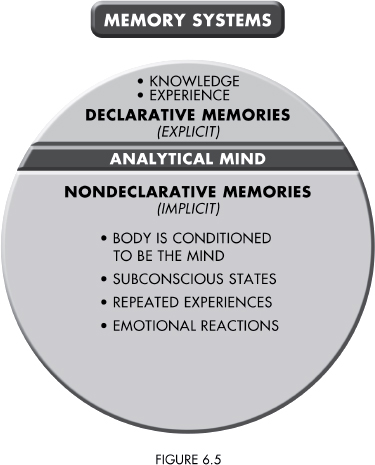
Memory systems are divided into two categories: declarative memories (explicit) and nondeclarative memories (implicit).
Since implicit memories are developed from the emotions of experience, two possible scenarios explain how this unfolds: (1) A highly charged one-time emotional event can be immediately branded and stored in the subconscious (for example, a childhood memory of being in a big department store and getting separated from your mother), or (2) the redundancy of emotions derived from consistent experience will also be repeatedly logged there.
Since implicit memories are part of the subconscious system of memory and are routed there either by repeated experience or by highly charged emotional events, when you bring up any emotion or feeling, you’re opening a door to your subconscious mind. Since thoughts are the language of the brain and feelings are the language of the body, the moment you feel a feeling, you’re turning on your body-mind (because your body has become your subconscious mind). You’ve just entered the operating system.
Think about it like this: When you feel a certain familiar way, you’re subconsciously accessing a series of thoughts derived from that particular feeling. You’re autosuggesting thoughts on a daily basis equal to how you feel. These are the thoughts you accept, believe, and surrender to as if they were true. Therefore, you’re more suggestible only to the thoughts that are matched to exactly the same feeling. As a result, those thoughts that you unconsciously think about are the ones you accept, believe, and surrender to over and over.
Conversely, it could also be said that you’re much less suggestible to any thoughts that are not equal to your memorized feelings. Any new thought that reflects an unknown possibility just wouldn’t feel right. Your self-talk (the thoughts that you listen to every day) slips by your conscious awareness on a moment-to-moment basis and stimulates the autonomic nervous system and the flow of biological processes, reinforcing the programmed feeling of who you think you are. Remember the study in Chapter 2, where researchers found that optimists responded more favorably to suggestions that were positive while pessimists responded more unfavorably to suggestions that were negative.
By the same means, if you were to change how you feel, could you become more suggestible to a new stream of thoughts? Absolutely! By feeling an elevated emotion and allowing a whole new set of thoughts to be driven by that new feeling, you’d increase your level of suggestibility to what you were feeling and then thinking. You’d be in a new state of being, and your new thoughts would then be the autosuggestions equal to that feeling. And when you feel emotions, you’re naturally activating your implicit memory system and the autonomic nervous system. You can simply allow the autonomic nervous system to do what it does best: restore balance, health, and order.
Isn’t that what many people did in the placebo studies mentioned earlier? Weren’t they able to bring up an elevated emotion like hope or inspiration or the joy of being well? And once they saw a new possibility without ever analyzing it, wasn’t their level of suggestibility influenced by those feelings? As they felt those corresponding emotions, didn’t they enter the operating system and reprogram their autonomic nervous system with new orders—by thought alone—autosuggesting equal to those emotions?
Opening the Door to the Subconscious Mind
If there are different degrees of suggestibility, then that can be demonstrated visually by showing different thicknesses of the analytical mind. The thicker the barrier between the conscious mind and the subconscious mind, the more difficulty you’ll have getting into the operating system.
Take a look at Figures 6.6 and 6.7 on the following two pages, which represent two people with different types of minds.
The person in Figure 6.6 has a very thin veil between the conscious and subconscious minds and therefore is very open to suggestion (like Ivan Santiago from the beginning of the chapter). This person will naturally accept, believe, and surrender to an outcome, because he or she doesn’t analyze or intellectualize too much. Folks like this might be more innately prone to accept that a thought is a potential experience and embrace it emotionally so that the package becomes imprinted on the autonomic nervous system, ready to be executed as a reality. These people don’t spend a lot of time trying to figure things out in their lives, and they don’t overthink many things. If you’ve ever seen a hypnosis stage show, the subjects who make it to the front of the room usually fall into this category.
Now contrast this with Figure 6.7. If you look at the thicker analytical mind that separates the conscious and subconscious minds, you can easily see that this person is less prone to taking suggestions at face value without a significant degree of help from his or her intellectual mind in evaluating, processing, planning, and reviewing. People like this are highly critical and will make sure they’ve analyzed everything before simply surrendering and trusting.
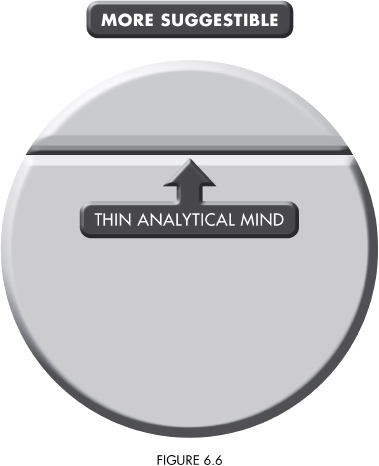
A less analytical mind (represented by the thinner layer in the illustration) is more suggestible.
Bear in mind that some of us have a more built-up analytical mind even without constantly living by our stress hormones. We might have studied different subjects in college or lived with parents who reinforced the mechanisms of rational thought when we were young, or maybe it’s just part of our nature. (Nevertheless, you can have a significantly broad analytical mind and still learn how to get beyond it—I certainly did—so there’s hope.)
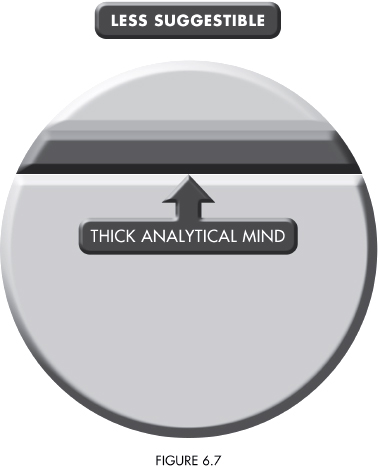
A more developed analytical mind (represented by the thicker layer in the illustration) is less suggestible.
As I said before, neither of these types is more advantageous than the other. I think a healthy balance between the two works very well. Someone who’s overanalytical is less likely to trust and flow in his or her life. Someone who’s overly suggestible might be too gullible and less functional. The point I want to make is that if you’re continually analyzing your life, judging yourself, and obsessing about everything in your reality, then you’ll never enter the operating system where those old programs exist and reprogram them. Only when a person accepts, believes, and surrenders to a suggestion does the door between the conscious and subconscious minds open. That information then signals the autonomic nervous system and—presto!—it takes over.
Now take a look at Figure 6.8. The arrow represents the movement of consciousness from the conscious mind into the subconscious mind, where the suggestion is biologically embossed into the programming system.
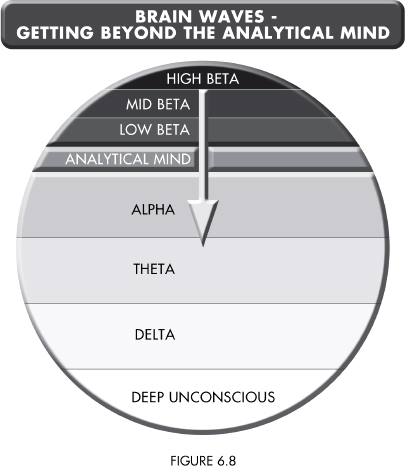
This figure represents the relationship between brain-wave states and the movement of awareness from the conscious mind to the subconscious mind, moving past the analytical mind during the practice of meditation.
A few additional elements can also silence the analytical mind and open the door to the subconscious mind in order to increase a person’s level of suggestibility. For example, physical or mental fatigue increases your suggestibility. Certain studies have shown that the limited exposure to social, physical, and environmental cues in sensory deprivation can cause increased susceptibility. Extreme hunger, emotional shock, and trauma also weaken our analytical faculties, therefore making us more suggestible to information.
Demystifying Meditation
Like hypnosis, meditation is another way to bypass the critical mind and move into the subconscious system of programs. The whole purpose of meditation is to move your awareness beyond your analytical mind—to take your attention off your outer world, your body, and time—and to pay attention to your inner world of thoughts and feelings.
Many stigmas surround the word meditation. Most people conjure up images of a bearded guru on a mountaintop, immune to the elements and sitting in perfect stillness; a monk in a simple robe, his face adorned with a huge, mysterious smile; or even a young and beautiful woman, with flawless skin, on the cover of a magazine, dressed in stylish yoga clothes and looking serenely free from the enslavement of all of the demands of daily life.
When we see these images, many of us might perceive the discipline required as too impractical, too out of reach, and beyond our abilities. We might see meditation as a spiritual practice that doesn’t fit into our religious beliefs. And some of us are simply overwhelmed with the seemingly endless varieties of meditation available and are unable to decide where to begin. But it doesn’t have to be that difficult, “out there,” or confusing. For this discussion, let’s just say that the whole purpose of meditation is to move our consciousness beyond the analytical mind and into deeper levels of consciousness.
In meditation, we move not just from conscious mind to subconscious mind, but also from selfish to selfless, from being somebody and someone to being no body and no one, from being a materialist to being an immaterialist, from being some place to being no place, from being in time to being in no time, from believing that the outer world is reality and defining reality with our senses to believing that the inner world is reality and that once we’re there, we enter “non-sense”: the world of thought beyond the senses. Meditation takes us from survival to creation; from separation to connection; from imbalance to balance; from emergency mode to growth-and-repair mode; and from the limiting emotions of fear, anger, and sadness to the expansive emotions of joy, freedom, and love. Basically, we go from clinging to the known to embracing the unknown.
Let’s reason this for a moment. If your neocortex is the home of your conscious awareness and it’s where you construct thoughts, use analytical reasoning, exercise intellect, and demonstrate rational processes, then you’ll have to move your consciousness beyond (or out of) your neocortex in order to meditate. Your consciousness would have to essentially move from your thinking brain into your limbic brain and the subconscious regions. In other words, in order for you to dial down your neocortex and all the neural activity that it performs on a daily basis, you’d have to stop thinking analytically and vacate the faculties of reason, logic, intellectualizing, forecasting, predicting, and rationalizing—at least temporarily. This is what’s meant by “quieting your mind.” (Revisit Figure 6.1, if you need to.)
According to the neuroscientific model that I outlined in the previous chapters, to quiet your mind would mean that you’d have to declare a “cease-fire” on all of the automatic neural networks in your thinking brain that you habitually fire on a regular basis. That is, you’d have to stop reminding yourself of who you think you are, repeatedly reproducing the same level of mind.
I know that sounds like a huge task that may well be overwhelming, but it turns out that practical, scientifically proven ways exist for us to accomplish this feat and make it a skill. In the workshops that I teach around the world, many ordinary people who’d never meditated before got pretty good at doing this—once they learned how. You’ll learn these methods in the chapters that follow, but first, let’s increase your level of intention so that when you get to the how-to, you’ll reap greater rewards (just as did the aerobic exercisers in Quebec from Chapter 2 who were told that their well-being would be enhanced by their efforts and, thus, could assign meaning to what they were doing—and then got better results).
Why Meditation Can Be So Challenging
The analytical neocortex uses all of the five senses to determine reality. It’s very preoccupied with putting all of its awareness on the body, the environment, and time. And if you’re the least bit stressed, then your attention will be directed to and will amplify all three of these elements. When you’re under the gun of the fight-or-flight emergency system and you switch on your adrenaline, just like any animal threatened in the wild, all of your attention will be placed on taking care of your body, finding escape routes in your environment, and figuring out how much time you have to make it to safety. You overfocus on problems, obsess about your looks, dwell on your pain, think about how little time you have to do what you need to do, and rush to get things done. Sound familiar?
Because you’re so hyperfocused on this external world and your problems in it when you’re living in survival, it’s easy to think that what you see and experience is all there is. And without the external world, you’re no one, no body, no thing, and in no place. How frightful that is for an ego that’s trying to control all of its reality by constantly reaffirming an identity!
It might make it easier if you remind yourself that when you’re living in survival, what you sense is truly just the tip of the iceberg, only a limited array of ingredients making up your external world. You identify with the many variations and combinations in your external world that reflect back to you who you think you are—but that doesn’t mean there isn’t more. In fact, every time you learn something new, you change how you see the world. The world hasn’t really changed; only your perception of it has changed. (We’ll learn more about perception in the next chapter.)
For now, it’s enough to keep in mind that if your goal is to effect change and you haven’t been able to make it happen with all your external-world resources, then clearly you’ll need to look outside the limits of what you see, sense, and experience for your answers. You’ll need to pull from other sources you haven’t yet identified—from the unknown. So in that sense, the unknown is your friend, not your foe. It’s the place where the answer lies.
Another reason it becomes difficult for us to pull our attention away from all of the conditions of our outer world and place our attention on our inner world is that most people are addicted to stress hormones—to feeling the rush of chemicals that are the result of our conscious or unconscious reactions. This addiction reinforces our belief that our outer world is more real than our inner world. And our physiology is conditioned to support this, because real threats, problems, and concerns do exist that need our attention. So we become addicted to our present external environment. And through associative memory, we use the problems and conditions in our lives to reaffirm that emotional addiction in order to remember who we think we are.
Here’s another way to say it: The stress hormones we experience while living in survival mode give the body a high dose of energy and cause the five senses—which plug us into external reality—to become heightened. So naturally, if we’re continuously stressed, we’ll define reality with our senses. We become materialists. When we try to go within and connect with the world of “non-sense” and the immaterial, it takes some effort to break our conditioned habit and our addiction to the chemical rush we get from our external reality. How, then, could we possibly believe that thought is more powerful than physical, three-dimensional reality? If that’s how we see things, it becomes challenging to change anything by thought alone, because we’ve become enslaved to our bodies and our environments.
Maybe one antidote to that is rereading the stories in Chapter 1—and reading the stories from my workshops later, in Chapters 9 and 10. Reinforcing new information that shows us that what we think should be impossible is indeed possible helps us remind ourselves that there’s more to reality than what our senses perceive. Whether we want to admit it or not, we are the placebo.
Navigating Our Brain Waves
If meditation is about entering the autonomic system so that we can become more suggestible and overcome the challenges just mentioned, then we need to know how to get there. The short answer is that we get there on a brain wave. The brain state we happen to be in at any given time has a huge effect on how suggestible we are at that moment.
Once you learn what these different states are and how to recognize them when you’re in them, you can train yourself to move from one state to another, up and down the scale of brain-wave patterns. It takes some practice, of course, but it is possible. So let’s explore these different states to learn more about them.
When neurons fire together, they exchange charged elements that then produce electromagnetic fields, and these fields are what are measured during a brain scan (like an electroencephalograph, or EEG). Humans have several measurable brain-wave frequencies, and the slower the brain-wave state we’re in, the deeper we go into the inner world of the subconscious mind. In order of slowest to fastest, the brain-wave states are delta (deep, restorative sleep—totally unconscious), theta (a twilight state between deep sleep and wakefulness), alpha (the creative, imaginative state), beta (conscious thought), and gamma (elevated states of consciousness).
Beta is our everyday waking state. When we’re in beta, the thinking brain, or neocortex, is processing all of the incoming sensory data and creating meaning between our outer and inner worlds. Beta isn’t the best state for meditation, because when we’re in beta, the outer world appears more real than the inner world. Three levels of brain-wave patterns make up the beta-wave spectrum: low-range beta (relaxed, interested attention, like reading a book), mid-range beta (focused attention on an ongoing stimulus outside the body, like learning and then remembering), and high-range beta (highly focused, crisis-mode attention, when stress chemicals are produced). The higher the beta brain waves, the further away we get from being able to access the operating system.
Most days, we move back and forth between beta and alpha states. Alpha is our relaxation state, where we pay less attention to the outer world and start to pay more attention to our inner world. When we’re in alpha, we’re in a light state of meditation; you could also call that imagination or daydreaming. In this state, our inner world is more real than our outer world, because that’s what we’re paying attention to.
When we go from high-frequency beta to slower alpha, where we can pay attention, concentrate, and focus in a more relaxed manner, we automatically activate the frontal lobe. As the previous material has presented, the frontal lobe lowers the volume on the brain circuits that process time and space. Here, we’re no longer in survival mode. We’re in a more creative state that makes us more suggestible than we were in beta.
More challenging is learning how to drop down even further into theta, which is a kind of twilight state where we’re half-awake and half-asleep (often described as “mind awake, body asleep”). This is the state we’re shooting for in meditation, because it’s the brain-wave pattern where we’re the most suggestible. In theta, we can access the subconscious, because the analytical mind isn’t operating—we’re mostly in our inner world.
Think of theta as the key to your own subconscious kingdom. Take another look at Figure 6.8. It shows brain-wave states and how they correlate with the conscious and subconscious mind. Then take a look at Figure 6.9, which illustrates the different brain-wave frequencies.
You’ll find this brief tour through brain-wave patterns even more useful when you get to the practice of meditation, later in the book. Don’t expect that you’ll necessarily be able to drop right into theta on command, of course, but having some knowledge of what the various brain states are and what effect they have on what you’re trying to achieve will help.
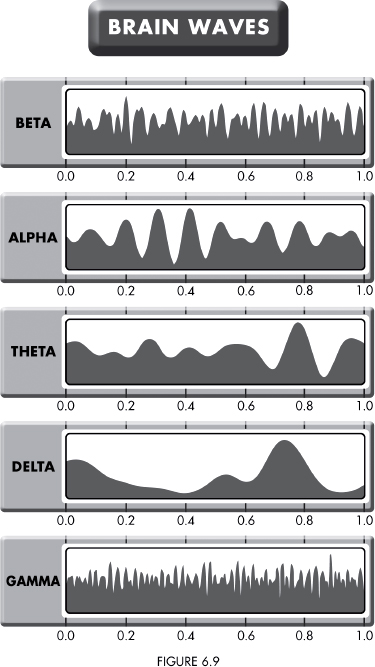
This illustration shows the different brain-wave states (during a one-second interval). Gamma brain-wave patterns are included because they represent a level of super-awareness, which reflects a heightened state of consciousness.
Anatomy of an “Assassination”
Now let’s return to the story of Ivan Santiago and the other hypnosis subjects from the start of this chapter. Obviously, these folks have an easier time getting past their analytical minds than most of us. They seem to have both a neuroplasticity and an emotional plasticity that allow them to make their inner worlds more real than their outer worlds. In their normal waking states, they probably spend more time in alpha than in beta, so they have fewer stress hormones circulating that can pull them out of homeostasis. Their highly suggestible states better enable their conscious minds to control the autonomic functions of their subconscious minds.
Yet they’re not all the same; several different degrees of suggestibility were demonstrated in this study. The 16 people who passed the initial evaluation were certainly suggestible, although they weren’t all as suggestible as those who passed the next test by taking their clothes off in public after being given a posthypnotic suggestion to do so, going against deeply rooted social norms. The four who passed that test were certainly highly suggestible, able to be greater than their social environment. But when it came to immersing themselves in the ice water, three of those four couldn’t go that far; they weren’t able to be greater than their physical environment.
Only Santiago, who remained greater than his physical environment in extreme conditions for an extended period of time while having dominion over his body, demonstrated the highest level of suggestibility. He was able not only to withstand the frigid ice bath, but also to be greater than his moral environment, by following the posthypnotic suggestion to shoot the “foreign dignitary,” despite the fact that his conscious personality was hardly one of a cold-blooded killer.
In terms of the placebo effect, it takes a similar high degree of suggestibility to be greater than the body and greater than the environment for an extended period of time—that is, to accept, believe, and surrender to the idea of your inner world being more real than your outer world. But in just a few chapters, you’ll learn how you can not only change your beliefs and become more suggestible, but also use that state to program your subconscious mind—not to shoot a stuntman with a prop gun, fortunately, but to triumph over whatever health issues, emotional traumas, or other personal matters you may be dealing with.
