The Placebo Effect in the Brain
If you’ve read my previous book, Breaking the Habit of Being Yourself, you’ll find that this chapter reviews much of that material. If you feel that you already have a good command of that information, you may choose to either skip this chapter completely or skim it to brush up on those concepts as needed. If in doubt, I recommend that you read this chapter, because a thorough understanding of what is presented here will be necessary to fully understand the chapters that follow.
As the stories in the last two chapters illustrate, when we truly change our state of being, our bodies can respond to a new mind. And changing our state of being begins with changing our thoughts. Because of the size of our enormous forebrain, the privilege of being a human being is that we can make thought more real than anything else—and that’s how the placebo works. To see how the process unfolds, it’s vital to examine and review three key elements: conditioning, expectation, and meaning. As you’ll see, these three concepts all seem to work together in orchestrating the placebo response.
I explained conditioning, the first element, in the discussion about Pavlov in the previous chapter. To recap, conditioning happens when we associate a past memory (for example, taking an aspirin) with a physiological change (getting rid of a headache) because we’ve experienced it so many times. Think about it like this: If you notice that you have a headache, essentially you become aware of a physiological change in your inner environment (you’re feeling pain). The next thing you automatically do is look for something in your outer world (in this case, an aspirin) to create a change in your inner world. We could say it was your internal state (being in pain) that prompted you to think about some past choice you made, action you took, or experience you had in your external reality that changed how you were feeling (taking an aspirin and getting relief).
Thus, the stimulus, or cue, from the outer environment, called the aspirin, creates a specific experience. When that experience produces a physiological response or reward, it changes your internal environment. The moment you notice a change in your inner environment, you pay attention to what it was in your outer environment that caused the change. That event—where something outside of you changes something inside of you—is called an associative memory.
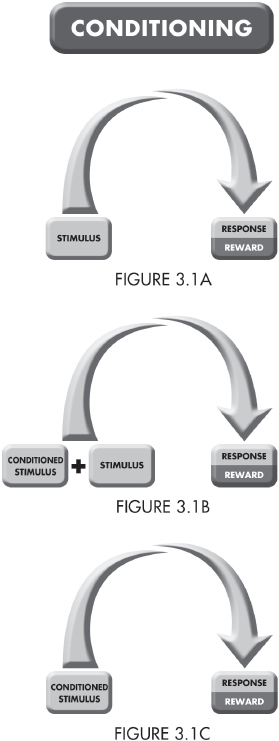
If we keep repeating the process over and over again, by association the outer stimulus can become so strong or reinforced that we can replace the aspirin for a sugar pill that looks like an aspirin, and it will produce an automatic inner response (lessening the pain of the headache). That’s one way the placebo works. Figure 3.1A, Figure 3.1B, and Figure 3.1C illustrate the conditioning process.
Expectation, the second element, comes into play when we have reason to anticipate a different outcome. So, for example, if we have chronic pain from arthritis and get a new medication from the doctor, who enthusiastically explains to us that it’s supposed to alleviate our pain, we accept his suggestion and expect that when we take this new medication, something different will happen (we won’t be in pain anymore). Then, in effect, our doctor has influenced our level of suggestibility.
Once we become more suggestible, we’re naturally associating something outside of ourselves (the new medication) with the selection of a different possibility (being pain-free). In our minds, we are picking a different future potential and hoping, anticipating, and expecting that we’ll get that different result. If we emotionally accept and then embrace that new outcome we’ve selected, and the intensity of our emotion is great enough, our brains and our bodies won’t know the difference between imagining that we’ve changed our state of being to being pain-free and the actual event that caused the change to a new state of being. To the brain and the body, they are the same.
In Figure 3.1A, a stimulus produces a physiological change called a response or a reward. Figure 3.1B demonstrates that if you pair a stimulus with a conditioned stimulus enough times, it will still produce a response. Figure 3.1C shows if you remove the stimulus and substitute a conditioned stimulus—like a placebo—it can produce the same physiological response.
Consequently, the brain fires the same neural circuits as it would if our state had changed (if the drug worked to relieve the pain) while it releases similar chemicals into the body. What we’re expecting (to be pain-free) then actually happens, because the brain and the body create the perfect pharmacy to alter our internal condition. We are now in a new state of being—that is, the mind and body are working as one. We’re that powerful.
Assigning meaning, the third element, to a placebo helps it work, because when we give an action a new meaning, then we have added intention behind it. In other words, when we learn and understand something new, we put more of our conscious, purposeful energy into it. So, for example, in the study about the hotel maids from the previous chapter, once the maids understood how much physical exercise they were doing every day just by performing their jobs, as well as the benefits of that exercise, they assigned more meaning to those actions. They weren’t just vacuuming, scrubbing, and mopping; they realized they were working their muscles, increasing their strength, and burning calories. Because the vacuuming, scrubbing, and mopping had more meaning after the researchers educated them about the physical advantages of exercise, the maids’ intention or aim as they worked wasn’t just to complete their tasks—it was also to get physical exercise and become healthier.
And that’s exactly what happened. The members of the control group didn’t assign the same meaning to their tasks, because they didn’t know that what they were doing was beneficial to their health, so they also didn’t receive the same benefits—even though they were performing exactly the same actions.
The placebo works the same way. The more you believe that a particular substance, procedure, or surgery will work because you’ve been educated about its benefits, the better your chances of responding to the thought of improving your health and getting better. In other words, if you place more meaning behind a possible experience with a person, place, or thing in your external environment in order to change your internal environment, then you’re more likely to be successful at intentionally changing your inner state by thought alone. In addition, the more you can accept a new outcome related to your health—because you’ve been educated about the possible rewards of what you’re doing—the clearer the model you’re creating in your own mind, and so the better you’ll be at priming your brain and your body to replicate exactly that. Simply said, the more you believe in the cause, the better the effect.
The Placebo: Anatomy of a Thought
If the placebo effect is a function of how a thought can change physiology—we could call it mind over matter—then perhaps we should examine our thoughts and how they interact with our brains and our bodies. Let’s begin with our own personal daily thoughts.
We are creatures of habit. We think somewhere between 60,000 to 70,000 thoughts in one day,1 and 90 percent of those thoughts are exactly the same ones we had the day before. We get up on the same side of the bed, go through the same routine in the bathroom, comb our hair in the same way, sit in the same chair as we eat the same breakfast and hold our mug in the same hand, drive the same route to the same job, and do the same things we know how to do so well with the same people (who push the same emotional buttons) every day. And then we hurry up and go home so that we can hurry up and check our e-mail so that we can hurry up and eat dinner so that we can hurry up and watch our favorite TV shows so that we can hurry up and brush our teeth in the same bedtime routine so that we can hurry up and go to bed at the same time so that we can hurry up and do it all over again the next day.
If it sounds as though I’m saying that we live a huge part of our lives on autopilot, that’s exactly right. Thinking the same thoughts leads us to make the same choices. Making the same choices leads to demonstrating the same behaviors. Demonstrating the same behaviors leads us to create the same experiences. Creating the same experiences leads us to produce the same emotions. And those same emotions then drive the same thoughts. Take a look at Figure 3.2 and follow the sequence of how our same thoughts create the same reality as usual.
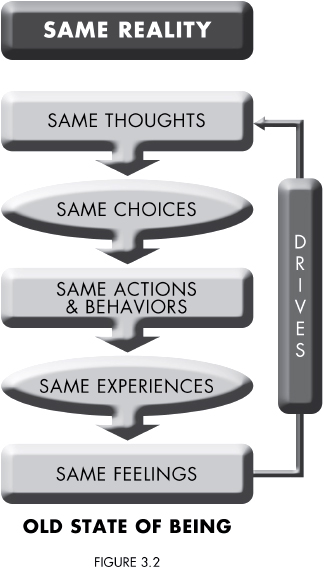
How we create the same reality by thought alone.
As a result of this conscious or unconscious process, your biology stays the same. Neither your brain nor your body changes at all, because you’re thinking the same thoughts, performing the same actions, and living by the same emotions—even though you may be secretly hoping your life will change. You create the same brain activity, which activates the same brain circuits and reproduces the same brain chemistry, which affects your body chemistry in the same way. And that same chemistry signals the same genes in the same ways. And the same gene expression creates the same proteins, the building blocks of cells, which keep the body the same (I’ll go into more on proteins later). And since the expression of proteins is the expression of life or health, your life and your health stay the same.
Now take a look at your life for a moment. What does this mean for you? If you’re thinking the same thoughts as yesterday, more than likely, you’re making the same choices today. Those same choices today are leading to the same behaviors tomorrow. The same habitual behaviors tomorrow are producing the same experiences in your future. The same events in your future reality are creating the same predictable emotions for you all the time. And as a result, you’re feeling the same every day. Your yesterday becomes your tomorrow—so in truth, your past is your future.
If you agree with me up to this point, then we could say that the familiar feeling I just described is “you”—your identity or your personality. It’s your state of being. And it’s comfortable, effortless, and automatic. It’s the known you who, quite frankly, is living in the past. When you keep this redundant process going on a daily basis (because you wake up in the morning and anticipate and remember the feeling of “you” every day), in time that known state of being can drive only the same thoughts that will influence you to crave the same automatic cycle of choices, behaviors, and experiences in order to arrive back at that familiar feeling that you think of as “you.” So everything stays the same about your personality.
If this is your personality, then your personality creates your personal reality. It’s that simple. And your personality is made up of how you think, how you act, and how you feel. So the present personality who is reading this page has created the present personal reality called your life; and that also means that if you want to create a new personal reality—a new life—then you have to begin to examine or think about the thoughts you’ve been thinking and change them. You must become conscious of the unconscious behaviors you’ve been choosing to demonstrate that have led to the same experiences, and then you must make new choices, take new actions, and create new experiences. Figure 3.3 shows how your personality influences your personal reality.
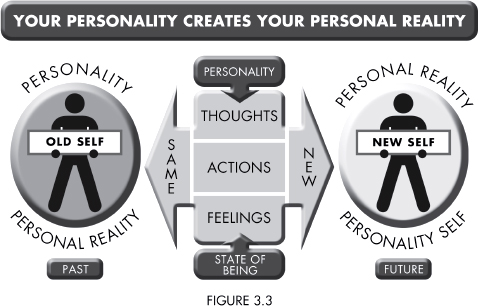
Your personality is made up of how you think, act, and feel. It is your state of being. Therefore, your same thoughts, actions, and feelings will keep you enslaved to the same past personal reality. However, when you as a personality embrace new thoughts, actions, and feelings, you will inevitably create a new personal reality in your future.
You must observe and pay attention to those emotions that you’ve memorized and that you live by on a daily basis, and decide if living by those emotions over and over again is loving to you. You see, most people try to create a new personal reality as the same old personality, and it doesn’t work. In order to change your life, you have to literally become someone else. Stay tuned for some sound science to support this process. Take a glance at Figure 3.4 and follow the sequence again.
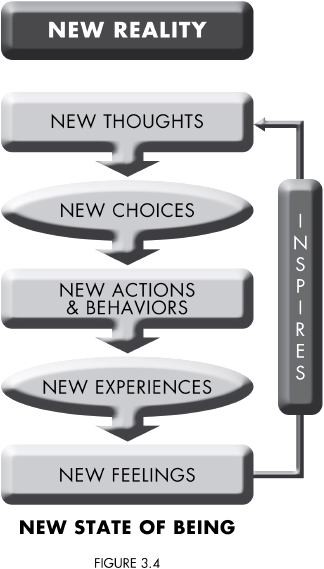
How we create a new reality by thought alone.
So if you understand this model, then you should agree with me that your new thoughts should lead to new choices. New choices should lead to new behaviors. New behaviors should lead to new experiences. New experiences should create new emotions, and new emotions and feelings should inspire you to think in new ways. That’s called “evolution.” And your personal reality and your biology—your brain circuitry, your internal chemistry, your genetic expression, and ultimately your health—should change as a result of this new personality, this new state of being. And it all seems to start with a thought.
A Quick Look at How the Brain Works
Up to this point, I’ve briefly mentioned terms like brain circuitry, neural networks, brain chemistry, and genetic expression without giving you much explanation of what they mean. So for the rest of the chapter, I want to outline some simple scientific understandings of how the brain and body work together in order to build a complete model of how you really can become your own placebo.
Your brain, which is at least 75 percent water and is the consistency of a soft-boiled egg, is made up of some 100 billion nerve cells, called neurons, that are seamlessly arranged and suspended in this aqueous environment. Each nerve cell resembles a leafless but elastic oak tree, with wiggly branches and root systems that connect and disconnect to other nerve cells. The number of connections a particular nerve cell might make can range from 1,000 to more than 100,000, depending on where in the brain the nerve cell resides. For example, your neocortex—your thinking brain—has about 10,000 to 40,000 connections per neuron.
We used to think of the brain as a computer, and while there are certainly some similarities, we now know there’s much more to the story. Each neuron is its own unique biocomputer, with more than 60 megabytes of RAM. It’s capable of processing enormous amounts of data—up to hundreds of thousands of functions per second. As we learn new things and have new experiences in our lives, our neurons make new connections, exchanging electrochemical information with each other. Those connections are called synaptic connections, because the place where the cells exchange information—the gap between the branch of one neuron and the root of another—is called a synapse.
If learning is making new synaptic connections, then remembering is keeping those connections wired together. So in effect, a memory is a long-term relationship or connection between the nerve cells. And the creation of these connections, and the ways they change over time, alters the physical structure of the brain.
As the brain makes these changes, our thoughts produce a blend of various chemicals called neurotransmitters (serotonin, dopamine, and acetylcholine are a few examples you may recognize). When we think thoughts, neurotransmitters at one branch of one neuron tree cross the synaptic gap to reach the root of another neuron tree. Once they cross that gap, the neuron fires with an electrical bolt of information. When we continue thinking the same thoughts, the neuron keeps firing in the same ways, strengthening the relationship between the two cells so that they can more readily convey a signal the next time those neurons fire. As a result, the brain shows physical evidence that something was not only learned, but also remembered. This process of selective strengthening is called synaptic potentiation.
When jungles of neurons fire in unison to support a new thought, an additional chemical (a protein) is created within the nerve cell and makes its way to the cell’s center, or nucleus, where it lands in the DNA. The protein then switches on several genes. Since the job of the genes is to make proteins that maintain both the structure and function of the body, the nerve cell then quickly makes a new protein to create new branches between nerve cells. So when we repeat a thought or an experience enough times, our brain cells make not only stronger connections between each other (which affects our physiological functions), but also a greater number of total connections (which affects the physical structure of the body). The brain becomes more enriched microscopically.
So as soon as you think a new thought, you become changed—neurologically, chemically, and genetically. In fact, you can gain thousands of new connections in a matter of seconds from novel learning, new ways of thinking, and fresh experiences. This means that by thought alone, you can personally activate new genes right away. It happens just by changing your mind; it’s mind over matter.
Nobel laureate Eric Kandel, M.D., showed that when new memories are formed, the number of synaptic connections in the sensory neurons that are stimulated doubles, to 2,600. However, unless the original learning experience is repeated over and over again, the number of new connections falls back to the original 1,300 in a matter of only three weeks.
Therefore, if we repeat what we learn enough times, we strengthen communities of neurons to support us in remembering it the next time. If we don’t, then the synaptic connections soon disappear and the memory is erased. This is why it’s important for us to continually update, review, and remember our new thoughts, choices, behaviors, habits, beliefs, and experiences if we want them to solidify in our brains.2 Figure 3.5 will help you become familiar with neurons and neural networks.
To get an idea of how vast this system really is, imagine a nerve cell connecting to 40,000 other nerve cells. Let’s say it’s processing 100,000 bits of information per second and sharing that information with other neurons that are also processing 100,000 functions per second. This network, formed from clusters of neurons working together, is called a neural network (or a neural net for short). Neural nets form communities of synaptic connections. We can also call them your neurocircuitry.
So as there are physical changes in the nerve cells that make up your brain’s gray matter, and as neurons are selected and instructed to organize themselves into these vast networks capable of processing hundreds of millions of bits of information, the physical hardware of the brain also changes, adapting to the information it receives from the environment. In time, as the networks—converging and diverging propagations of electrical activity like a crazy lightning storm in thick clouds—are repeatedly turned on, the brain will keep using the same hardware systems (the physical neural networks) but will also create a software program (an automatic neural network). That’s how the programs are installed in the brain. The hardware creates the software, and the software system is embedded into the hardware—and every time the software is used, it reinforces the hardware.
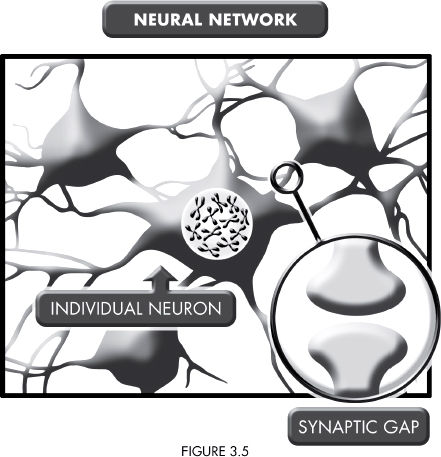
This is a simple graphic representation of neurons in a neural network. The minute space between the branches of individual neurons that facilitates communication between them is called the synaptic gap. About 100,000 neurons can fit into the same space as a grain of sand and will have more than a billion connections among them.
So when you’re thinking the same thoughts and having the same feelings all the time because you’re not learning or doing anything new, your brain is firing its neurons and activating the neural networks in exactly the same sequences, patterns, and combinations. They become the automatic programs that you unconsciously use every day. You have an automatic neural network to speak a language, to shave your face or put on makeup, to type on the computer, to judge your co-worker, and so on, because you’ve performed those actions so many times that they’ve become practically unconscious. You no longer have to consciously think about it. It’s effortless.
You’ve reinforced those circuits so often that they’ve become hardwired. The connections between neurons become more glued together, additional circuits are formed, and the branches actually expand and become physically thicker—just as we might strengthen and reinforce a bridge, build a few new roads, or widen a freeway to accommodate more traffic.
One of the most basic principles in neuroscience states, “Nerve cells that fire together wire together.”3 As your brain fires repeatedly in the same manner, you’re reproducing the same level of mind. According to neuroscience, mind is the brain in action or at work. Thus, we can say that if you’re reminding yourself of who you think you are on a daily basis by reproducing the same mind, you’re making your brain fire in the same ways and you’ll activate the same neural networks for years on end. By the time you reach your mid-30s, your brain has organized itself into a very finite signature of automatic programs—and that fixed pattern is called your identity.
Think of it as a box inside your brain. There’s no literal box inside your head, of course. But it’s safe to say that thinking inside the box means you’ve physically hardwired your brain into a limited pattern, as illustrated in Figure 3.6. By reproducing the same level of mind over and over again, the most commonly fired, neurologically wired set of circuits has predetermined who you are as a result of your own volition.
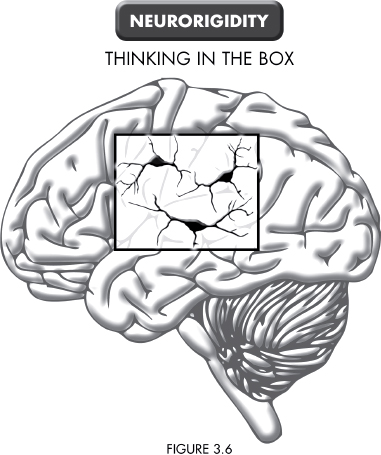
If your thoughts, choices, behaviors, experiences, and emotional states remain the same for years on end—and the same thoughts are always equal to the same feelings, reinforcing the same endless cycle—then your brain becomes hardwired into a finite signature. That’s because you are re-creating the same mind every day by making your brain fire in the same patterns. Over time, this biologically reinforces a specific limited set of neural networks, making your brain physically more prone to creating the same level of mind—you’re now thinking in the box. The totality of those hardwired circuits is called your identity.
Neuroplasticity
So our goal, then, needs to be thinking outside the box to make the brain fire in new ways, as Figure 3.7 illustrates. That’s what having an open mind means, because whenever you make your brain work differently, you’re literally changing your mind.
Research shows that as we use our brains, they grow and change, thanks to neuroplasticity—the brain’s ability to adapt and change when we learn new information. For example, the longer mathematicians study math, the more neural branches sprout in the area of the brain used for math.4 And after years of performing in symphonies and orchestras, professional musicians expand the part of their brains associated with language and musical abilities.5
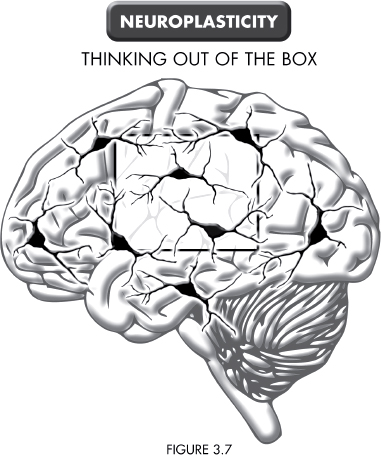
When you learn new things and begin to think in new ways, you are making your brain fire in different sequences, patterns, and combinations. That is, you are activating many diverse networks of neurons in different ways. And whenever you make your brain work differently, you’re changing your mind. As you begin to think outside the box, new thoughts should lead to new choices, new behaviors, new experiences, and new emotions. Now your identity is also changing.
The official scientific terms for how neuroplasticity works are pruning and sprouting, which mean exactly what they sound like: getting rid of some neural connections, patterns, and circuits and creating new ones. In a well-functioning brain, this process can happen in a matter of seconds. Researchers at the University of California at Berkeley demonstrated this in a study on laboratory rats. They found that rats living in an enriched environment (sharing a cage with siblings and offspring and having access to many different toys) had larger brains with more neurons and more connections between those neurons than did the rats in less-enriched environments.6 Again, when we learn new things and have new experiences, we’re literally changing our brains.
To break free from the chains of hardwired programming and the conditioning that keeps you the same takes considerable effort. It also requires knowledge, because when you learn vital information about yourself or your life, you stitch a whole new pattern into the three-dimensional embroidery of your own gray matter. Now you have more raw materials to make the brain work in new and different ways. You begin to think about and perceive reality differently, because you begin to see your life through the lens of a new mind.
Crossing the River of Change
At this point, you can see that in order to change, you have to become conscious of your unconscious self (which you now know is just a set of hardwired programs).
The hardest part about change is not making the same choices we made the day before. The reason it’s so difficult is that the moment we no longer are thinking the same thoughts that lead to the same choices—which cause us to automatically act in habitual ways so that we can experience the same events in order to reaffirm the same emotions of our identity—we immediately feel uncomfortable. This new state of being is unfamiliar; it’s unknown. It doesn’t feel “normal.” We don’t feel like ourselves anymore—because we’re not ourselves. And because everything feels uncertain, we no longer can predict the feeling of the familiar self and how it’s mirrored back to us in our lives.
As uncomfortable as that may be at first, that’s the moment we know we’ve stepped into the river of change. We’ve entered the unknown. The instant that we no longer are being our old selves, we have to cross a gap between the old self and the new self, which Figure 3.8 clearly shows. In other words, we don’t all just waltz into a new personality in a matter of moments. It takes time.
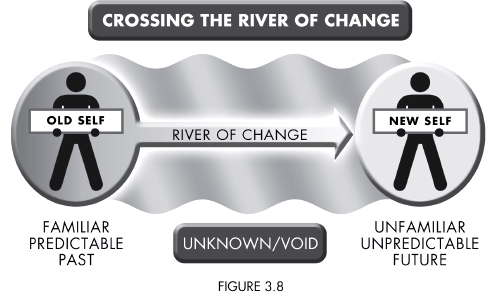
Crossing the river of change requires that you leave the same familiar predictable self—connected to the same thoughts, same choices, same behaviors, and same feelings—and step into a void or the unknown. The gap between the old self and the new self is the biological death of your old personality. If the old self must die, then you have to create a new self with new thoughts, new choices, new behaviors, and new emotions. Entering this river is stepping toward a new unpredictable, unfamiliar self. The unknown is the only place where you can create—you cannot create anything new from the known.
Usually when people step into the river of change, that void between the old self and the new self is so uncomfortable that they immediately slip back into being their old selves again. They unconsciously think, This doesn’t feel right, I’m uncomfortable, or I don’t feel so good. The moment they accept that thought, or autosuggestion (and become suggestible to their own thoughts), they will unconsciously make the same old choices again that will lead to the progression of the same habitual behaviors to create the same experiences that automatically endorse the same emotions and feelings. And then they say to themselves, This feels right. But what they really mean is that it feels familiar.
Once we understand that crossing the river of change and feeling that discomfort is actually the biological, neurological, chemical, and even genetic death of the old self, we have power over change and we can set our sights on the other side of the river. If we embrace the fact that change is the denaturing of the hardwired circuitry from years of unconsciously thinking the same way, we can cope. If we understand that the discomfort we feel is the dismantling of old attitudes, beliefs, and perceptions that have been repeatedly etched into our cerebral architecture, we can endure. If we can reason that the cravings we battle in the midst of change are real withdrawals from the chemical-emotional addictions of the body, we can ride it out. If we can comprehend that real biological variations are occurring from subconscious habits and behaviors in which our bodies are changing on a cellular level, we can forge on. And if we can remember that we are modifying our very genes from this life and from untold previous generations, we can stay focused and inspired to an end.
Some people call this experience the dark night of the soul. It’s the phoenix igniting itself and burning to ashes. The old self has to die for a new one to be reborn. Of course that feels uncomfortable!
But that’s okay, because that unknown is the perfect place to create from—it’s the place where possibilities exist. What could be better than that? Most of us have been conditioned to run from the unknown, so now we have to learn to become comfortable in the void or the unknown, instead of fearing it.
If you told me that you didn’t like being in that void because it’s so disorienting and that you can’t see what lies ahead because you can’t predict your future, I’d say that’s actually great, because the best way to predict the future is to create it—not from the known, but from the unknown.
As the new self is born, we must be biologically different, too. New neuronal connections must be sprouted and sealed by the conscious choice to think and act in new ways every day. Those connections must be reinforced by our repeatedly creating the same experiences until they become a habit. New chemical states must become familiar to us from the emotions of enough new experiences. And new genes must be signaled to make new proteins to alter our state of being in new ways. And if, as we’ve seen, the expression of proteins is the expression of life and the expression of life is equal to the health of the body, then a new level of structural and functional health and life will follow. A renewed mind and a renewed body must emerge.
Now, when a new day dawns for us after the long night of darkness and the phoenix rises regenerated from its ashes, we have invented a new self. And the physical, biological expression of the new self is literally becoming someone else. That’s true metamorphosis.
Overcoming Your Environment
Another way to look at the brain is to say that it’s organized to reflect everything you know and have experienced in your life. Now you can understand that each time you’ve interacted with your external world, those events have shaped and molded who you are today. The complex networks of neurons that have fired and wired together throughout your days on Earth formed trillions and trillions of connections, because you learned and formed memories. And since every place where one neuron connects with another neuron is called a “memory,” then your brain is a living record of the past. The vast experiences with every person and thing at different times and places in your external environment have been stamped into the recesses of your gray matter.
So by nature, most of us are thinking in the past, because we’re using the same hardware and software programs from our past memories. And if we’re living the same life every day by doing the same things at the same time, seeing the same people at the same place, and creating the same experiences from yesterday, then we’re enslaved to having our outer worlds influence our inner worlds. It’s our environment that is controlling how we think, act, and feel. We’re victims of our personal realities, because our personal realities are creating our personalities—and it’s become an unconscious process. Then that, of course, reaffirms the same thinking and feeling, and now there’s a tango or a match between our outer worlds and our inner worlds, and they merge and become the same—and so do we.
If our environment is regulating how we’re thinking and feeling every day, then in order to change, something about ourselves or our lives would have to be greater than the present circumstances in our environment.
Thinking and Feeling, and Feeling and Thinking
Just as thoughts are the language of the brain, feelings are the language of the body. And how you think and how you feel create a state of being. A state of being is when your mind and body are working together. So your present state of being is your genuine mind-body connection.
Every time you have a thought, in addition to making neurotransmitters, your brain also makes another chemical—a small protein called a neuropeptide that sends a message to your body. Your body then reacts by having a feeling. The brain notices that the body is having a feeling, so the brain generates another thought matched exactly to that feeling that will produce more of the same chemical messages that allow you to think the way you were just feeling.
So thinking creates feeling, and then feeling creates thinking that’s equal to those feelings. It’s a loop (one that, for most people, can go on for years). And because the brain acts on the body’s feelings by generating the same thoughts that will produce the same emotions, it becomes clear that redundant thoughts hardwire your brain into a fixed pattern of neurocircuitry.
But what happens in the body? Because feelings are the modus operandi of the body, the emotions you continually feel based on your automatic thinking will condition the body to memorize those emotions that are equal to the unconscious hardwired mind and brain. That means that the conscious mind isn’t really in charge. The body has subconsciously been programmed and conditioned, in a very real way, to become its own mind.
Eventually, when this loop of thinking and feeling and then feeling and thinking has been operating long enough, our bodies memorize the emotions that our brains have signaled our bodies to feel. The cycle becomes so established and ingrained that it creates a familiar state of being—one based on old information that keeps recycling. Those emotions, which are nothing more than the chemical records of past experiences, are driving our thoughts and are being played out over and over again. As long as this continues, we’re living in the past. No wonder it’s so hard for us to change our future!
If the neurons are firing the same way, they’re triggering the release of the same chemical neurotransmitters and neuropeptides in the brain and body, and then these same chemicals begin to train the body to further remember those emotions by altering it physically once again. The cells and tissues receive these very specific chemical signals at specific receptor sites. Receptor sites are akin to docking stations for chemical messengers. The messengers fit perfectly in place, like a child’s puzzle in which certain shapes, like a circle, a triangle, or a square, fit into specific openings.
Think of those chemical messengers, which are really molecules of emotion, as carrying bar codes that enable the cell receptors to read the messengers’ electromagnetic energy. When the exact match is made, the receptor site prepares itself. The messenger docks, the cell receives the chemical messages, and then the cell creates or alters a protein. The new protein activates the cell’s DNA within the nucleus. The DNA opens up and unwinds, the gene is read for that corresponding message from outside the cell, and the cell makes a new protein from its DNA (for example, a particular hormone) and releases it into the body.
Now the body is being trained by the mind. If this process continues for years and years because the same signals outside of the cell are coming from the same level of mind in the brain (because the person is thinking, acting, and feeling the same every day), then it makes sense that the same genes will be activated in the same ways, because the body is receiving the same data from the environment. There are no new thoughts ignited, no new choices made, no new behaviors demonstrated, no new experiences embraced, and no new feelings created. When the same genes are repeatedly activated by the same information from the brain, then the genes keep getting selected over and over again, and just like gears in a car, they start to wear out. The body makes proteins with weaker structures and lesser functions. We get sick and we age.
In time, one of two scenarios can occur. The intelligence of the cell membrane, which is consistently receiving the same information, can adapt to the body’s needs and demands by modifying its receptor sites so that it can accommodate more of those chemicals. Basically, it creates more docking stations to satisfy the demand—just as supermarkets open up additional checkout lanes when the lines get too long. If business stays good (if those same chemicals keep coming), then you’ll have to hire more employees and keep more lanes open. Now the body is equal to and has become the mind.
In the other scenario, the cell becomes too overwhelmed with the continual bombardment of feelings and emotions on a moment-to-moment basis to allow all the chemical messengers to dock. Because the same chemicals are more or less hanging around outside the cell’s docking-station doors day in and day out, the cell gets used to those chemicals being there. So only when the brain produces a lot more heightened emotions does the cell become willing to open its doors. Once you increase the intensity of the emotion, the cell is stimulated enough so that the docking-station doors open and the cell turns on. (You’ll hear more about the importance of emotion later—this is a key part of the placebo equation.)
In the first scenario, when the cell makes new receptor sites, the body will crave those specific chemicals when the brain doesn’t make enough, and consequently, our feelings will determine our thinking—our bodies will control our minds. That’s what I mean when I say the body memorizes the emotion. It has become biologically conditioned and altered to be a reflection of the mind.
In the second scenario, once the cell is overwhelmed by the bombardment and the receptors become desensitized, then just as a drug addict does, the body will require a greater chemical thrill to turn on the cell. In other words, in order for the body to become stimulated and get its fix, you’ll need to get angrier, more worried, guiltier, or more confused than last time. So you might feel the need to start a bit of drama by yelling at your dog for no reason, just to give the body its drug of choice. Or maybe you can’t help talking about how much you despise your mother-in-law just so the body has even more chemicals available with enough strength to arouse the cell. Or you start obsessing about some horrible imagined outcome just so the body can get a rush of adrenal hormones. When the body isn’t getting its emotional chemical needs met, it will signal the brain to make more of those chemicals—the body is controlling the mind. That sounds very much like an addiction. So now when I use the term emotional addiction, you’ll understand what I mean.
When feelings have become the means of thinking in this manner—or we can’t think greater than how we feel—then we’re in the program. Our thinking is how we feel, and our feelings are how we think. What we experience is like a merger of thoughts and feelings—we’re finking or theeling. Since we’re caught in this loop, then our bodies, as the unconscious mind, actually believe they’re living in the same past experience 24 hours a day, 7 days a week, 365 days a year. Our minds and bodies are one, aligned to a destiny predetermined by our unconscious programs. So to change requires being greater than the body and all its emotional memories, addictions, and unconscious habituations—that is, to no longer be defined by the body as the mind.
The repetition of the cycle of thinking and feeling and then feeling and thinking is the conditioning process of the body that the conscious mind delivers. Once the body becomes the mind, that’s called a “habit”—a habit is when your body is the mind. Ninety-five percent of who you are by the time you’re 35 years old is a set of memorized behaviors, skills, emotional reactions, beliefs, perceptions, and attitudes that functions like a subconscious automatic computer program.
So 95 percent of who you are is a subconscious or even an unconscious state of being. And that means your conscious mind’s 5 percent is working against the 95 percent of what you’ve memorized subconsciously. You can think positively all you want, but that 5 percent of your mind that’s conscious will feel as if it’s swimming upstream against the current of the other 95 percent of your mind—your unconscious body chemistry that has been remembering and memorizing whatever negativity you’ve been harboring for the past 35 years; that’s mind and body working in opposition. No wonder you don’t get very far when you try to fight that current!
That’s why I called my last book Breaking the Habit of Being Yourself, because that’s the greatest habit we have to break—thinking, feeling, and behaving in the same way that reinforces the unconscious programs that reflect our personalities and our personal realities. We can’t create a new future while we’re living in our past. It’s simply impossible.
What It Takes to Be Your Own Placebo
Here’s an example that will pull all of this together. I’m intentionally choosing a negative event, because these types of events tend to keep us limited, whereas more successful, empowering, and uplifting events usually help us create a better future. (That process will become clear soon.)
So let’s say that you had a horrific past experience with public speaking that scarred you emotionally. (Feel free to substitute any emotionally scarring experience of your choice here.) Because of that experience, you now fear standing up to talk in front of a group of people. It makes you feel insecure, anxious, and anything but confident. Just thinking about looking out over a meeting room of even 20 people causes your throat to close up, your hands to go cold and clammy, your heart to race, your face and neck to flush, your stomach to twist, and your brain to freeze.
All of these reactions come under the jurisdiction of your autonomic nervous system, the nervous system that functions subconsciously—below your conscious control. Think of autonomic as automatic—it’s the part of the nervous system that regulates digestion, hormones, circulation, body temperature, and so on without your having any conscious control over them. You can’t decide to change your heart rate, alter blood flow to your extremities to cool them off, heat up your face and neck, change the metabolic secretions of your digestive enzymes, or shut off millions of nerve cells from firing on command. Try as you might to consciously change any one of these functions, you’ll probably find that you won’t be able to do it.
So when your body makes these autonomic physiological changes, it’s because you have associated the future thought of standing in front of an audience delivering a presentation with the past emotional memory of your flawed public-speaking experience. And when that future thought, idea, or possibility is consistently associated with the past feelings of anxiety, failure, or embarrassment, in time the mind will condition the body to respond automatically to that feeling. This is how we continuously move into familiar states of being—our thoughts and feelings become one with the past because we can’t think greater than how we feel.
Now let’s take a closer look at how that works inside your brain. The particular event that was embossed and patterned neurologically as a past memory (remember, experience enriches brain circuitry) becomes physically wired in your brain just like a footprint. As a consequence, you can retrace your steps and recall the negative public-speaking experience as a thought. In order for you to remember it on command, the experience must have had a significant enough emotional charge as well. So you can also emotionally bring to mind all of the feelings related to your foiled attempt to be a successful orator, because it seems as though you were chemically altered from the experience.
I want to point out that feelings and emotions are the end products of past experiences. When you’re caught up in an experience, your senses capture the event and then relay all of that vital information back to your brain through five different sensory pathways. Once all of that new data reaches the brain, mobs of nerve cells organize into fresh networks to reflect the novel external event. The moment those circuits jell, the brain makes a chemical to signal the body and alter its physiology. That chemical is called a feeling or an emotion. Thus, we can remember past events, because we can remind ourselves of how they felt.
So when your lecture went amiss, all of the information that your five senses were picking up in your external environment changed how you were feeling in your inner environment. The information that your senses were processing—the sight of the faces in the audience, the expansiveness of the room, and the bright lights above your head; the echoing sound of the microphone and the deafening silence after your first attempted joke; the immediate rise in the room’s temperature the moment you started talking; the smell of your old cologne evaporating from your own perspiration—changed your inner state of being. And the moment you correlated this unique event in your outer world of the senses (the cause) with the changes going on in your inner world of thoughts and feelings (the effect), you created a memory. You associated a cause with an effect—and your own conditioning process began.
So after the self-inflicted torture of that day, which fortunately ended with no rotten fruits or vegetables being thrown in your direction, you drove home. On the ride, you kept recalling the event over and over again. And to varying degrees, every time you reminded yourself (which is exactly that: reproducing the same level of mind) of your experience, you produced the same chemical changes in your brain and body. In a sense, you repeatedly reaffirmed the past and continued the conditioning process further.
Because your body acts as your unconscious mind, it didn’t know the difference between the actual event in your life that created the emotional state and the emotions you created by thought alone when you remembered the event. Your body believed that it was living in the same experience over and over again, even though you were actually alone in the comfort of your car, and the body responded physiologically as though you were indeed reliving that experience in the present time. As you fired and wired the circuits in your brain that were derived from the thoughts related to that experience, you were physically maintaining the synaptic connections, and you were now creating even more lasting connections within those networks—you were creating a long-term memory.
Once you arrived home, you told your partner, your friends, and maybe even your mother about the events of that day. As you described the trauma in grievous detail, you were working yourself into an emotional froth. As you also relived the emotions of the incident, you chemically conditioned your body to the day’s past event. You physiologically trained your body to become your personal history—subconsciously, unconsciously, and automatically.
In the days that followed, you were moody. People couldn’t help noticing this, and every time someone asked you, “What’s wrong?” you just couldn’t resist. You opportunistically took them up on the invitation to become more addicted to the rush of chemistry from your past. The mood created from that experience was just one long emotional reaction lasting for days. When weeks of feeling the same way every time you remembered the event turned into months, even years, it became a prolonged emotional reaction. It’s now not only a part of your temperament, character, and nature, but also your personality. It’s who you are.
If someone else asks you to talk in front of a group again, you automatically cringe, shrink, and become anxious. Your external environment is controlling your internal environment, and you’re unable to be greater than it. As you expect the thought that your future (a public-speaking opening) will be more like the feeling of your past (unlivable torment), just like magic, your body, as the mind, automatically and subconsciously responds. Try as you might, it seems as if your conscious mind can gain no control over it. In a matter of seconds, a host of conditioned responses from your brain and body’s own pharmacy manifest—profuse sweating, dry mouth, weak knees, nausea, dizziness, shortness of breath, and uncontrollable fatigue—all from a single thought that changes your physiology. Sounds like the placebo to me.
If you could, you’d turn down the opportunity to do the talk, saying something like, “I am not a public speaker,” “I am insecure in front of people,” “I am a bad presenter,” or “I am too afraid to talk in front of large audiences.” Whenever you say, “I am . . .” (insert your own words here), what you are declaring is that your mind and body are aligned to a future or that your thoughts and feelings are one with your destiny. You’re reinforcing a memorized state of being.
If, by chance, you were then asked why you chose to be defined by your past, as well as your own limitation, I’m certain that you’d tell a story equal to your past memories and emotions—reaffirming yourself to be that way. You’d probably even embellish it a little. From a biological level, what you’d really be proclaiming is that you were altered physically, chemically, and emotionally from that event several years ago and haven’t changed much since then. You’ve chosen to be defined by your own limitation.
In this example, one could say that you’re enslaved by your body (because it has now become the mind), you’re trapped by the conditions in your environment (because the experience of people and things at a certain place and time are influencing how you think, act, and feel), and you’re lost in time (because by living in the past and anticipating the same future, your mind and body are never in the present moment). So in order to change your current state of being, you’d have to be greater than these three elements: your body, your environment, and time.
So, then, thinking back to the beginning of this chapter, where you read that the placebo is created from three elements—conditioning, expectation, and meaning—you can now see that you are your own placebo. Why? Because all three elements come into play in the previous example.
First, like a talented animal trainer, you’ve conditioned your body into a subconscious state of being where mind and body are one—your thoughts and feelings have merged—and your body has now been programmed to automatically, biologically, and physiologically be the mind by thought alone. And anytime a stimulus from your external environment is presented to you—like an opportunity to teach—you’ve conditioned your body, just as Pavlov conditioned his dogs, to subconsciously and automatically respond to the mind of the past experience.
Since most of the placebo studies show that a single thought could activate the body’s autonomic nervous system and produce significant physiological changes, then you’re regulating your internal world by simply associating a thought with an emotion. All of your subconscious, autonomic systems are being reinforced neurochemically by the familiar feelings and bodily sensations related to your fear—and your biology perfectly reflects it.
Second, if your expectation is that your future will be like your past, then you are not only thinking in the past, but also selecting a known future based only on your past and emotionally embracing that event until your body (as the unconscious mind) believes that it’s living in that future in the present moment. All of your attention is on a known, predictable reality, which causes you to limit any new choices, behaviors, experiences, and emotions. You’re unconsciously forecasting your future by physiologically clinging to the past.
Third, if you assign meaning or conscious intention to an action, the result is amplified. What you’re telling yourself on a daily basis (in this case, that you’re not a good speaker and that public speaking elicits a panic reaction) is what has meaning to you. You’ve become susceptible to your own autosuggestions. And if your present knowledge is based on your own conclusions from past experiences, then without any new knowledge, you’ll always keep creating the outcome that’s equal to your mind. Change your meaning and change your intention, and just as the hotel maids in the study from the last chapter did, you change the results.
So whether you’ve been trying to effect positive change to create a new state of being or you’ve been running on autopilot and staying stuck in the same old state of being, the truth is that you’ve always been your own placebo.
