

MEDITATION, DEMYSTIFYING THE MYSTICAL, AND WAVES OF YOUR FUTURE
In the previous chapter, I wrote about the need to bridge the space between who we really are and the image we present to the world. When we’re able to do that, we can take steps toward freeing up the necessary energy to become that ideal self, modeled after some of the great people in the history of the world, such as Gandhi and Joan of Arc.
And as I’ve said, one of the keys to breaking the habit of being yourself is working toward being more observant—whether that entails being more metacognitive (monitoring your thoughts), embracing stillness, or focusing more attention on your behaviors and how elements in your environment might trigger emotional responses. So the big question here is: How do you do all this?
In other words, how do you become more observant; break your emotional bonds with the body, the environment, and time; and close the gap?
The answer is simple: meditation. You may have noticed that up to this point in the book, I have teased you with brief allusions to meditation as the way to break the habit of being yourself and begin to create a new life as your ideal self. I told you that the information in Parts I and II of this book would prepare you to understand what you will be doing when you apply the meditative steps you will practice in Part III. Now it’s time to explain the inner workings of the process that I refer to as meditation.
When I use the term meditation, an image of a person seated cross-legged in front of a shrine at home, a bearded and gowned yogi sitting in a secluded cave in the Himalayas, or some other visual may come to mind. That individual may be a representation of what you understand is the way to “go quiet,” empty the mind, focus all of one’s attention on a thought, or engage in any of the other variations of the practice of meditation.
There are a lot of meditative techniques, but in this book, my wish is to help you produce the most desirable benefit of meditation—being able to access and enter the operating system of the subconscious mind so that you move away from simply being yourself and your thoughts, beliefs, actions, and emotions, to observing those things … and then once you’re there, to subconsciously reprogramming your brain and body to a new mind. When you move from unconsciously producing thoughts, beliefs, actions, and emotions and take control of them through the conscious application of your will, you can unlock the chains of being your old self to become a new self. How you get to the point at which you are able to access that operating system and bring the unconscious into your consciousness is the subject we’ll cover through the rest of this book.
One Definition of Meditation:
Becoming Familiar with Self
In the Tibetan language, to meditate means “to become familiar with.” Accordingly, I use the term meditation as a synonym for self-observation as well as self-development. After all, to become familiar with anything, we have to spend some time observing it. Again, the key moment in making any change is going from being it to observing it.
Another way to think of this transition is when you go from being a doer to a doer/watcher. An easy analogy I can use is that when athletes or performers—golfers, skiers, swimmers, dancers, singers, or actors—want to change something about their technique, most coaches have them watch videotape of themselves. How can you change from an old mode of operation to a new one unless you can see what old and new look like?
It’s the same with your old and your new self. How can you stop doing things one way without knowing what that way looks like? I frequently use the term unlearning to describe this phase of changing.
This process of becoming familiar with the self works both ways—you need to “see” the old and the new self. You have to observe yourself so precisely and vigilantly, as I’ve described, that you won’t allow any unconscious thought, emotion, or behavior to go unnoticed. Since you have the equipment to do this because of the size of your frontal lobe, you can look at yourself and decide what you want to change in order to do a better job in life.
Decide to Stop Being the Old You
When you can become conscious of those unconscious aspects of the old, habituated self, rooted in the operating system of the subconscious, you are beginning the process of changing anything about yourself.
What steps do you normally take when you get serious about doing something differently? You separate yourself from your external world long enough to think about what to do and not do. You start becoming aware of many aspects of the old self, and you begin to plan a course of action related to a new self.
For example, if you want to become happy, the first step is to stop being unhappy—that is, stop thinking the thoughts that make you unhappy; and stop feeling the emotions of pain, sorrow, and bitterness. If you desire to become wealthy, you’ll probably decide to stop doing the things that make you poor. If you want to be healthy, you’ll have to stop living an unhealthy lifestyle. These examples are to show you that first, you have to make the decision to stop being the old you, to such a degree that you make room for a new personality—thinking, acting, and doing.
Therefore, if you eliminated stimuli from your external world by closing your eyes and becoming quiet (decreasing your sensory input), putting your body in a state of stillness, and no longer focusing on linear time, you could become aware solely of how you are thinking and feeling. And if you began to pay attention to your unconscious states of mind and body and became “familiar with” your automatic, unconscious programs until they became conscious, would you be meditating?
The answer is yes. To “know thyself” is to meditate.
If you are no longer being that old personality but, instead, are noticing different aspects of it, wouldn’t you agree that you are the consciousness observing the programs of that past identity? In other words, if you consciously observe the old self, you are no longer being it. As you go from being unaware to being aware, you are beginning to objectify your subjective mind. That is, by your paying attention to the old habit of being you, your conscious participation begins to separate you from those unconscious programs and give you more control over them.
By the way, if you are successful in consciously restraining those routine states of mind and body, then “nerve cells that no longer fire together, no longer wire together.” As you prune away the neurological hardware of the old self, you also no longer signal the same genes in identical ways. You are breaking the habit of being you.
Contemplate a New, Greater Expression of Self
Now let’s take it one step further. Once you have become familiar with the old self to the extent that no thought, no behavior, and no feeling will cause you to fall unconsciously into previous patterns, you might agree that it would be a good idea to begin to become familiar with a new self. Accordingly, you may ask yourself, What is a greater expression of myself that I would like to be?
If you turn on your frontal lobe and contemplate those aspects of self, you will begin to make your brain work differently than your past self. As your frontal lobe (the CEO) entertains that new question, it looks out over the landscape of the rest of the brain and seamlessly combines all of your stored knowledge and experiences into a new model of thought. It helps create an internal representation for you to begin to focus on.
This contemplation process builds new neurological networks. As you ponder the fundamental question above, your neurons will begin to fire and wire in new sequences, patterns, and combinations because you are thinking differently. And whenever you make your brain work differently, you’re changing your mind. As you plan your actions, speculate on novel possibilities, conjure up innovative ways of being, and dream of new states of mind and body, there will be a moment that the frontal lobe will turn on and lower the volume to the Big Three. When this happens, the thought(s) you are thinking will become an internal experience; you will install new software and hardware programs into your nervous system, and it will appear that the experience of being your new self has already been realized in your brain. And if you repeat this process every day, your ideal will become a familiar state of mind.
One more point here. If you attend so well to the thought you are focusing on that it literally becomes an experience, then the end product of that is an emotion. Once that emotion is created, you begin to feel like your new ideal, and that new feeling will start to become familiar. Remember that when your body begins to respond as if the experience is already a present reality, you will signal your genes in new ways … and your body will commence to change now, ahead of the physical event in your life. Now you are ahead of time, and most important, you move into a state of being—mind and body working together. And if you repeat this process consistently, this state of being will become familiar to you as well.
If you can maintain that modified state of mind and body, independent of the external environment and the body’s emotional needs and greater than time, something should show up differently in your world. That’s the quantum law.
Let’s summarize here. According to our working model of meditation, all you have to do is remind yourself who you no longer want to “be” until this becomes so familiar that you know your old self—the thoughts, behaviors, and emotions connected to the old you that you want to change—to the extent that you “unfire” and “unwire” the old mind away and no longer signal the same genes in the same ways. Then, you repeatedly contemplate who you do want to “be.” As a result, you will fire and wire new levels of mind, to which you will emotionally condition the body until they become familiar and second nature to you. That’s change.
A Second Definition of Meditation:
Cultivating Self
Besides its meaning in Tibetan, to meditate in Sanskrit means “to cultivate self.” I especially like this definition because of the metaphorical possibilities it offers—for example, gardening or agriculture. When you cultivate the soil, you take the packed-down earth that has been lying fallow for a while and you churn it up with a spade or other implement. You expose “new” dirt and nutrients, making it easier for seeds to germinate and for tender shoots to take root. Cultivation may also require you to remove plants from the previous season, attend to weeds that went unnoticed, and remove any rocks that rose to the surface by natural sifting.
Thus, last season’s plants might represent your past creations derived from the thoughts, actions, and emotions that define the old, familiar you. Weeds could signify long-standing attitudes, beliefs, or perceptions about yourself that are subconsciously undermining your efforts, which you hadn’t noticed because you were too distracted by other things. And the rocks can symbolize your many layers of personal blocks and limitations (which naturally rise to the surface over time and block your growth). All these need tending to so you can make room to plant a new garden in your mind. Otherwise, if you planted a new garden or crop without proper preparation, it would yield little fruit.
My hope is that you understand by now that it is impossible to create any new future when you are rooted in your past. You have to clear away the old vestiges of the garden (of the mind) before you can cultivate a new self by planting the seeds of new thoughts, behaviors, and emotions that create a new life.
The other key thing is to ensure that this doesn’t happen haphazardly: we’re not talking about plants in the wild, which scatter seeds roughshod over the ground, with some tiny percentage of them eventually coming to fruition. Instead, to cultivate requires making conscious decisions—when to till the soil, when to plant, what to plant, how each of the items planted will work in harmony with the others, how much water and fertilizer to mix in, and so forth. Planning and preparation are essential to the success of the endeavor. This requires our daily “mindful attention.”
Similarly, when we talk about someone cultivating an interest in a particular subject, we mean that he has thoughtfully researched that area of interest. Also, a cultivated person is someone who has carefully chosen what to expose herself to and who has amassed a breadth of knowledge and experience. Again, none of this is done on a whim, and little is left to chance.
When you cultivate anything, you are seeking to be in control. And that’s what is required when you change any part of your self. Instead of allowing things to develop “naturally,” you intervene and consciously take steps to reduce the likelihood of failure. The purpose behind all of this effort is to reap a harvest. When you cultivate a new personality in meditation, the abundant yield you seek to create is a new reality.
Creating a new mind is like cultivating a garden. The manifestations you produce from the garden of your mind will be just like crops from the earth’s soil. Tend well.
The Meditative Process for Change:
Move from the Unconscious to the Conscious
To sum up the meditative process, you have to break the habit of being yourself and reinvent a new self; lose your mind and create a new one; prune synaptic connections and nurture new ones; unmemorize past emotions and recondition the body to a new mind and emotions; and let go of the past and create a new future.
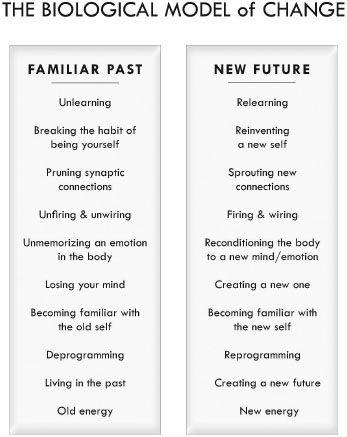
Figure 8A. The biological model of change involves transforming the familiar past to a new future.
Let’s look a bit more closely at a few elements of this process.
Obviously, to avoid letting any thought or feeling you don’t want to experience get past you unchecked, you have to develop powerful skills of observation and focus. We humans have a limited ability to focus and to absorb input—but we can be much better at it than we normally are in our more unconscious state.
To break the habit of being yourself, you would be wise to select one trait, propensity, or characteristic and focus your attention on that single aspect of your old self that you want to change. For example, you might begin by asking yourself: When I feel angry, what are my thought patterns? What do I say to others and myself? How do I act? What other emotions spring forth from my being angry? What does anger feel like in my body? How can I become conscious of what triggers my anger, and how can I change my reaction?
The process of change requires unlearning first, then learning. The latter is a function of firing and wiring in the brain; the former means that circuits are trimmed. When you stop thinking the same way, when you inhibit your habituations and interrupt those emotional addictions, the old self begins to be neurologically pruned away.
And if every connection between nerve cells constitutes a memory, then as those circuits are dismantled, memories of your old self will go with them. When you think about your former life and who you used to be, it will be like another lifetime. Where are those memories now stored? They will be given to the soul as wisdom.
When those thoughts and feelings that used to signal the body are stopped by your conscious efforts, the liberated energy from those limited emotions is released into the field. You now have energy with which to design and create a new destiny.
When we use meditation as a means to change, when we become conscious and aware, familiar with and willing to do what is necessary to eradicate an undesirable trait and cultivate a desired one, we’re doing what mystics have been doing for centuries.
Although I take a clearly biological approach to change, so did the mystics. They just used different terminology to describe the process. The end result is the same—breaking the addiction to the body, the environment, and time. Only when we make that separation can we change. Only when we think greater than the Big Three can we truly live independent of them, and reestablish dominion over how we think and feel on a daily basis.
For too long, we’ve been running unconscious programs that have been controlling us. Meditation allows us to reassert control.
Awareness comes first—recognizing when and how those programmed responses take over is essential. When you move from the unconscious to the conscious, you begin to close the gap between how you appear and who you are.
The Waves of Your Future
Since knowledge is, as we’ve seen, the precursor to experience, having a basic understanding of what happens in the brain during meditation will serve you well when you begin to learn and experience the meditative process coming up shortly in Part III.
You probably know that the brain is electrochemical in nature. When nerve cells fire, they exchange charged elements that then produce electromagnetic fields. Because the brain’s diverse electrical activity can be measured, these effects can provide important information about what we’re thinking, feeling, learning, dreaming, and creating and how we are processing information. The most common technology scientists use to record the brain’s changing electrical activity is an electroencephalograph (EEG).
Research has discovered a wide scope of brain-wave frequencies in humans, ranging from the very low levels of activity found in deep sleep (Delta waves); to a twilight state between deep sleep and wakefulness (Theta); to the creative, imaginative state (Alpha); to higher frequencies seen during conscious thought (Beta waves); to the highest frequencies recorded (Gamma waves), seen in elevated states of consciousness.1
To help you better understand your journey into meditation, I’m going to give you an overview of how each of these states relates to you. Once you know what all of these domains are, you will be more adept at knowing when you are in the brain-wave state where the ego tries in vain to change the ego (God knows, I’ve been there), and when you are in the brain-wave state that is the fertile ground of true change.
As children grow, the frequencies that predominate in their brains progress from Delta to Theta to Alpha and then to Beta. Our job in meditation is to become like a child, moving from Beta to Alpha to Theta to (for the adept or mystic) Delta. So understanding the progression of brain-wave changes during human development can help demystify the process of how we experience meditation.
Brain-Wave Development in Children:
From Subconscious to Conscious Mind
Delta. Between birth and two years old, the human brain functions primarily in the lowest brain-wave levels, from 0.5 to 4 cycles per second. This range of electromagnetic activity is known as Delta waves. Adults in deep sleep are in Delta; this explains why a newborn usually can’t remain awake for more than a few minutes at a time (and why even with their eyes open, young babies can be asleep). When one-year-olds are awake, they’re still primarily in Delta, because they function principally from their subconscious. Information from the outside world enters their brains with little editing, critical thinking, or judgment taking place. The thinking brain—the neocortex, or conscious mind—is operating at very low levels at this point.
Theta. From about ages two to five or six, a child begins to demonstrate slightly higher EEG patterns. These Theta-wave frequencies measure 4 to 8 cycles per second. Children functioning in Theta tend to be trancelike and primarily connected to their internal world. They live in the abstract and in the realm of imagination, and exhibit few of the nuances of critical, rational thinking. Thus, young children are likely to accept what you tell them. (P.S. Santa is real.) At this stage, phrases such as the following have a huge impact: Big boys don’t cry. Girls should be seen and not heard. Your sister is smarter than you. If you get cold, you’ll catch a cold. These types of statements go straight to the subconscious mind, because these slow brain-wave states are the realm of the subconscious (hint, hint).
Alpha. Between ages five and eight, brain waves change again, to an Alpha frequency: 8 to 13 cycles per second. The analytical mind begins to form at this point in childhood development; children start to interpret and draw conclusions about the laws of external life. At the same time, the inner world of imagination tends to be as real as the outer world of reality. Children in this age-group typically have a foot in both worlds. That’s why they pretend so well. For instance, you may ask a child to pretend that he is a dolphin in the sea, a snowflake in the wind, or a superhero coming to the rescue, and hours later, he is still in character. Ask an adult to do the same, and well … you already know the answer.
Beta. From ages 8 to 12 and onward, brain activity increases to even higher frequencies. Anything above 13 cycles per second in children is the frontier for Beta waves. Beta goes on and up to varying degrees from there throughout adulthood, and is representative of conscious, analytical thinking.
After age 12, the door between the conscious mind and the subconscious mind usually closes. Beta is actually divided into low-, mid-, and high-range Beta waves. As children progress into their teens, they tend to move from low-range Beta up into mid-and high-range Beta waves, as seen in most adults.
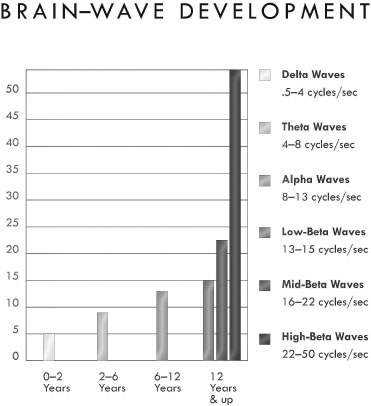
Figure 8B. The progression of brain-wave development from Delta in infancy to Beta in adulthood. Look at the difference in the three ranges of Beta: high-range Beta can be twice as high as mid-range Beta.
Brain-Wave States in Adults: An Overview
Beta. As you’re reading this chapter, most likely you are in the everyday waking state of Beta brain-wave activity. Your brain is processing sensory data and trying to create meaning between your outer and inner worlds. While you are engaged in this book’s material, you may feel the weight of your body on your seat, you may hear music in the background, you may glance up and see out a window. All of this data is being processed by your thinking neocortex.
Alpha. Now, let’s say that you close your eyes (80 percent of our sensory information derives from sight) and purposefully go inward. Since you are greatly reducing sensory data from the environment, less information is entering your nervous system. Your brain waves naturally slow down into the Alpha state. You relax. You become less preoccupied with the elements in your outer world, and the internal world begins to consume your attention. You tend to think and analyze less. In Alpha, the brain is in a light meditative state (when you practice the meditation in Part III, you’ll go into an even deeper Alpha state).
On a daily basis, your brain moves into Alpha without much effort on your part. For example, when you’re learning something new in a lecture, generally your brain is functioning in low- to mid-range Beta. You’re listening to the message and analyzing the concepts being presented. Then when you’ve heard enough or you particularly like something interesting that applies to you, you naturally pause and your brain slips into Alpha. You do this because that information is being consolidated in your gray matter. And as you stare into space, you are attending to your thoughts and making them more real than the external world. The moment that happens, your frontal lobe is now wiring that information into your cerebral architecture … and like magic, you can remember what you just learned.
Theta. In adults, Theta waves emerge in the twilight state or lucid state, during which some people find themselves half-awake and half-asleep (the conscious mind is awake, while the body is somewhat asleep). This is the state when a hypnotherapist can access the subconscious mind. In Theta, we are more programmable because there is no veil between the conscious and subconscious minds.
Delta. For most of us, Delta waves are representative of deep sleep. In this realm there is very little conscious awareness, and the body is restoring itself.
As this overview demonstrates, when we move into slower brain-wave states, we move deeper into the inner world of the subconscious mind. The reverse is also true: as we move into higher brain-wave states, the more we become conscious and attend to the external world.
With repeated practice, these terrains of the mind will begin to become familiar to you. Just like anything else you persist at, you will come to notice what each brain-wave pattern feels like. You’ll know when you are analyzing or thinking too much in Beta; you’ll observe when you are not present because you are swinging from the emotions of the past to trying to anticipate a known future. You’ll also sense when you are in Alpha or Theta, since you’ll feel its coherence. In time, you will know when you are there and when you are not.
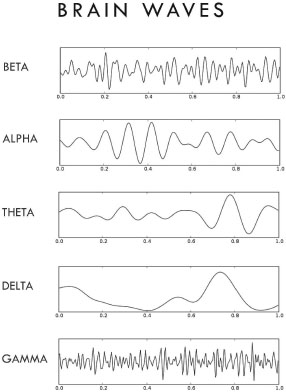
Figure 8C. A comparison of different brain-wave patterns in adults.

Gamma: The Fastest Brain Waves of All
The fastest documented brain-wave frequencies are Gamma waves, from 40 to 100 hertz. (Gamma waves are more compressed and have a smaller amplitude compared to the other four types of brain waves I have discussed, so although their cycles per second are similar to high-range Beta, there is not an exact correlation between them.) Having high amounts of coherent Gamma activity in the brain is usually linked to elevated states of mind such as happiness, compassion, and even increased awareness, which usually entails better memory formation This is a heightened level of consciousness that people tend to describe as “having a transcendent or peak experience.” For our purposes, think of Gamma as the side effect of a shift in consciousness.
Three Levels of Beta Waves Govern Our Waking Hours
Since we spend most of our conscious waking day with our attention on the external environment and functioning in Beta, let’s talk about the three levels of these brain-wave patterns.2 This understanding will facilitate moving from Beta to Alpha and ultimately to Theta in the meditative state.
1. Low-range Beta is defined as relaxed, interested attention ranging from 13 to 15 hertz (cycles per second). If you are enjoying reading a book and are familiar with the material, your brain would probably be firing in low Beta, because you are paying a certain degree of attention without any vigilance.
2. Mid-range Beta is produced during focused attention on sustained external stimuli. Learning is a good example: if I were to test you on what you read while enjoying that book in low Beta, you would have to perk up a bit, and thus there would be more neocortical activity such as analytical thinking. Mid-Beta operates between 16 and 22 hertz.
With mid-range Beta and even low-range Beta to some extent, these frequencies reflect our conscious or rational thinking and our alertness. They are a result of the neocortex taking in stimuli from the environment through all of our senses and assembling the information into a package to create a level of mind. As you can imagine, with this focus on what we’re seeing, hearing, tasting, feeling, and smelling comes a great deal of complexity and activity within the brain to produce that level of stimulation.
3. High-range Beta is characterized by any brain-wave pattern from 22 to 50 hertz. High-Beta patterns are observed during stressful situations where those nasty survival chemicals are produced in the body. Maintaining this sustained focus in such a high-arousal state is not the type of focused attention we use to learn, create, dream, problem solve, or even heal. In truth, we could say that the brain in high Beta is functioning with too much focused concentration. The mind is too amped up and the body is too stimulated to be in any semblance of order. (When you’re in high Beta, just know for now that you are probably focusing on something too much and it’s hard to stop.)
High Beta: A Short-Term Survival Mechanism, a Long-Term Source of Stress and Imbalance
Emergencies always create a considerable need for increased electrical activity in the brain. Nature has gifted us with the fight-or-flight response, to help us quickly focus in potentially dangerous situations. The strong physiological arousal of the heart, lungs, and sympathetic nervous system leads to a dramatic change in psychological states. Our perception, behaviors, attitudes, and emotions are all altered. This type of attention is very different from what we normally use. It causes us to act like a revved-up animal with a big memory bank. The scales of attention become tipped toward the external environment, causing an overfocused state of mind. Anxiety, worry, anger, pain, suffering, frustration, fear, and even competitive states of mind induce high-range Beta waves to predominate during the crisis.
In the short term, this serves all organisms well. There is nothing wrong with this narrow, overfocused range of attention. We “get the job done” because it affords us the ability to accomplish so many things.
However, if we remain in “emergency mode” for a long time, high Beta knocks us far out of balance, because maintaining it requires an immense amount of energy—and because this is the most reactive, unstable, and volatile of all brain patterns. When high Beta becomes chronic and uncontrolled, the brain gets juiced up beyond the healthy range.
Unfortunately, high Beta is terribly overutilized by the majority of the population. We are obsessive or compulsive, insomniac or chronically fatigued, anxious or depressed, forcibly pushing in all directions to be all-powerful or hopelessly holding on to our pain to feel utterly powerless, competing to get ahead or victimized by our circumstances.
Sustained High Beta Sends the Brain into Disorder
To put this into perspective, think about the normal functioning of the brain as part of the central nervous system, which controls and coordinates all other systems of the body: it keeps your heart beating, digests your food, regulates your immune system, maintains your respiratory rate, balances your hormones, controls your metabolism, and eliminates wastes, to name a few. As long as the mind is coherent and orderly, messages that travel from the brain to the body through the spinal cord will produce synchronized signals for a balanced, healthy body.
However, many people spend their waking days in a sustained high-frequency Beta state. To them, everything is an emergency. The brain stays constantly on a very fast cycle, which taxes the entire system. Living in this thin margin of brain waves is like driving a car in first gear while simultaneously stepping on the gas. These people “drive through” their lives without ever stopping to consider shifting gears into other brain states.
Their continual repetition of survival-based thoughts creates feelings of anger, fear, sadness, anxiety, depression, competition, aggression, insecurity, and frustration, among others. People become so caught up in these intoxicating emotions that they try to analyze their problems from within these familiar feelings, which only perpetuates more thoughts overfocused on survival. Also, recall that we can turn on the stress response by thought alone—the way we are thinking reinforces the very state of the brain and body, which then causes us to think the same way … and the loop goes on. It’s the serpent eating its tail.
Long-term high Beta produces an unhealthy cocktail of stress chemicals, which can tip the brain out of balance like a symphony orchestra out of tune. Parts of the brain may stop coordinating effectively with other areas; entire regions work separately and in opposition. Like a house divided against itself, the brain no longer communicates in an organized, holistic fashion. As stress chemicals force the thinking brain/neocortex to become more segregated, we may function like someone with multiple personality disorder, only we’re experiencing it all at once instead of one personality at a time.
Of course, when disorderly, incoherent signals from the brain relay erratic, mixed electrochemical messages through the central nervous system to the rest of the physiological systems, this puts the body out of balance, upsetting its homeostasis or equilibrium, and setting the stage for disease.
If we live in this high-stress mode of chaotic brain function for extended periods, the heart is impacted (leading to arrhythmias or high blood pressure), digestion begins to fail (causing indigestion, reflux, and related symptoms), and immune function weakens (resulting in colds, allergies, cancer, rheumatoid arthritis, and more).
All of these consequences stem from an unbalanced nervous system that is operating incoherently, due to the action of stress chemicals and high-range Beta brain waves reaffirming the outer world as the only reality.
Sustained High Beta Makes It Hard to
Focus on Our Inner Self
The stress I’ve been discussing is a product of our addiction to the Big Three. The problem isn’t that we are conscious and aware, but that our focus in high Beta is almost exclusively on our environment (people, things, places), our bodies’ parts and functions (I’m hungry … I’m too weak … I want a better nose … I’m fat compared to her …), and time (Hurry up! The clock is winding down!).
In high Beta, the outer world appears to be more real than the inner world. Our attention and conscious awareness primarily focus on everything that makes up the external environment. Thus, we identify more readily with those material elements: we criticize everyone we know, we judge the way our bodies look, we’re overfocused on our problems, we cling to things we own out of fear that we might lose them, we busy ourselves with places we have to go, and we’re preoccupied with time. That leaves us little processing power to pay attention to the changes that we truly want to make—to go inward … to observe and monitor our thoughts, behavior, and emotions.
It’s difficult for us to focus on our inner reality when we are overfixating on our outer world. In general, we can’t concentrate on anything other than the Big Three, we can’t open our minds beyond the boundaries of our narrow focus, and we obsess about problems rather than thinking about solutions. Why does it take such effort to let go of the external and go within? The brain in high Beta can’t easily shift gears into the imaginary realm of Alpha. Our brain-wave patterns keep us locked into all those elements of our outer world as if they are real.
When you are stuck in high Beta, it’s hard to learn: very little new information can enter into your nervous system that is not equal to the emotion you are experiencing. The truth is, the problems you’re so busy analyzing can’t be resolved within the emotion you are analyzing them in. Why not? Well, your analysis is creating higher and higher frequencies of Beta. Thinking in this mode causes your brain to overreact; you reason poorly and think without clarity.
In view of the emotions that grip you, you’re thinking in the past—and trying to predict the next moment based on the past—and your brain can’t process the present moment. There’s no room for the unknown to show up in your world. You’re feeling separate from the quantum field, and can’t even entertain new possibilities for your circumstances. Your brain isn’t in creative mode; it’s fixated on survival, preoccupied with possible worst-case scenarios. Again, not much information will be encoded into the system that is not equal to that emergency state. When everything feels like a crisis, your brain makes survival the priority, not learning.
The answer lies outside the emotions you’re wrestling with and the thoughts you’re overanalyzing, because they keep you connected to your past—the familiar and the known. Solving your problems begins with getting beyond those familiar feelings and replacing your scattered focus on the Big Three with a more orderly mode of thinking.
High Beta’s Incoherent Signals
Produce Scattered Thoughts
As you can imagine, when the brain is in high Beta and you’re processing sensory information—involving the environment, your body, and time—that activity can create a bit of chaos. Along with understanding that the electrical impulses in your brain occur in a certain quantity (cycles per second), it’s also important to be aware of the quality of the signal. Just as the discussion of quantum creating showed how vital it is to send a coherent signal into the field to indicate your intended future outcome, the same coherence is essential to your thinking and your brain waves.
At any one time when you’re in the Beta range of frequencies, one of the Big Three will have more of your attention. If you’re thinking about being late, your emphasis is on time—that thought is sending a higher-frequency wave through your neocortex. Of course, you’re also aware of, and therefore sending electromagnetic impulses related to, your body and the environment. It’s just that in the case of the latter two, you’re sending different wave patterns with a lower frequency through the neocortex.
Your time-focused brain waves might look like this:

Your environment-focused brain waves might look like this:

Your body-focused brain waves might look like this:

Your fractured attention, caused by trying to focus simultaneously on all of the Big Three, would then produce a brain-wave pattern that might look like this:

As you can see, those three different patterns together during stress produce an incoherent signal in high-Beta mode. If you’re anything like me, you’ve had experiences when that last drawing represents how your thoughts felt: scattered.
When we are plugged into all three dimensions—the environment, the body, and time—the brain tries to integrate their varied frequencies and wave patterns. That takes up an enormous amount of processor time and space. If we can eliminate our focus on any one of those, the patterns that emerge will be more coherent, and we’ll be better able to process them.
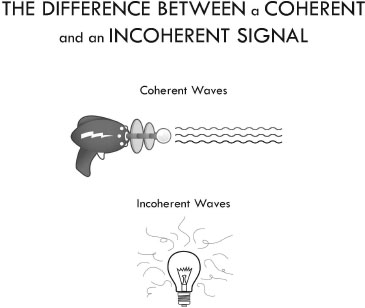
Figure 8D. In the first picture, the energy is orderly, organized, and rhythmic. When energy is highly synchronous and patterned, it is profoundly more powerful. The light emitted by a laser is an example of coherent waves of energy all moving together in unison. In the second picture, the energy patterns are chaotic, disintegrated, and out of phase. An example of an incoherent, less powerful signal is the light from an incandescent lightbulb.
Awareness, Not Analysis,
Permits Entry into the Subconscious
Here is a way for you to know if you’re in Beta state: if you’re constantly analyzing (I call this “being in analytical mind”), you are in Beta and you’re not able to enter into the subconscious mind.
The expression “paralysis by analysis” is an apt one here. Well, that’s what is happening to us when we live most of our lives in that Beta range. The only time we aren’t there is when we’re sleeping (then we’re in the Delta range of brain-wave activity).
Now you might be thinking, But you said that we needed to be aware. We need to become familiar with our thoughts, feelings, patterns of responses, and so forth. Doesn’t that require analysis?
Actually, awareness can exist outside of analysis. When you are aware, you may think, I’m feeling angry. When you are analyzing, you go beyond that simple observation to add: Why is this page taking so long to load? Who designed this stupid website? Why is it that whenever I’m in a hurry, like now when I’m trying to get a movie listing, the Internet connection is so slow! Awareness, as I mean it to be practiced here, is simply noting (watching) a thought or feeling and moving on.
A Working Model of Meditation
Now that we’ve covered some basics about brain waves in children and adults, this foundation will provide a working model (see the next five figures) to help you understand the meditative process.3
Let’s start with Figure 8E on the next page. Thanks to the research into children’s brain-wave patterns, we know that when we are born, we are completely in the realm of the subconscious.

Figure 8E. Let this circle represent the mind. When we are born, we are totally subconscious mind.
Next, take a look at Figure 8F. Those plus and minus signs represent how the developing child’s mind learns from positive and negative identifications and associations that give rise to habits and behaviors.
Here’s an example of a positive identification: When an infant is hungry or uncomfortable, she cries out, making an effort to communicate in order to get her mother’s attention. As the nurturing parent responds by feeding the child or changing her diaper, the infant makes an important connection between her inner and outer worlds. It only takes a few repetitions before she learns to associate crying out with being fed or becoming comfortable. It becomes a behavior.
A good example of a negative association is when a two-year-old puts his finger on a hot stove. He learns very quickly to identify the object he sees externally—the stove—with the pain he is feeling internally, and after a few tries, he learns a valuable lesson.
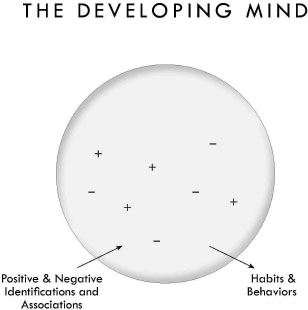
Figure 8F. In time, we begin to learn by association through different interactions between our inner world and our outer world, through our senses.
In both examples, we could say that the moment the child notices an internal chemical change in the body, the brain perks up and pays attention to whatever it was in the outer environment that caused this alteration, be it pleasure or pain. These types of identifications and associations begin to slowly develop many habits, skills, and behaviors.
As you learned, somewhere around the age of six or seven, as brain waves change into Alpha, the child begins to develop the analytical or critical mind. For most children, the analytical mind usually finishes developing between ages 7 and 12.
Meditation Takes Us Beyond Analytical
Mind and into the Subconscious
In Figure 8G, the line that runs across the top of the circle is the analytical mind, which acts as a barrier to separate the conscious from the subconscious mind. In adults, this critical mind loves to reason, evaluate, anticipate, forecast, compare what it knows to what it’s learning, or contrast knowns and unknowns. For the most part, when adults are conscious, their analytical minds are always working, and thus they are functioning in some realm of Beta waves.
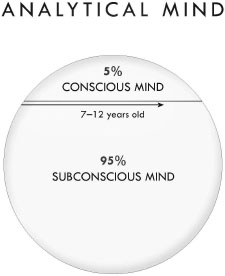
Figure 8G. Between the ages of six and seven, the analytical mind begins to form. It acts as a barrier to separate the conscious mind from the subconscious mind, and it usually finishes developing somewhere between 7 and 12 years old.
Now take a look at Figure 8H. Above that line representing the analytical mind is the conscious mind, which is 5 percent of the total mind. This is the seat of logic and reasoning, which contributes to our will, our faith, our intentions, and our creative abilities.
The subconscious mind, which makes up about 95 percent of who we are, consists of those positive and negative identifications and associations that give rise to habits and behaviors.
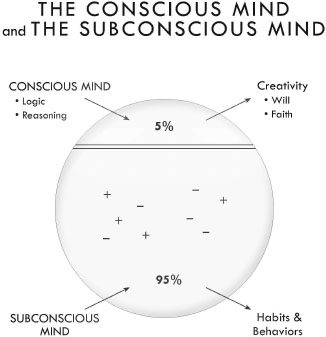
Figure 8H. The total mind is made up of 5 percent conscious mind and 95 percent subconscious mind. The conscious mind primarily operates using logic and reasoning, which gives rise to our will, faith, creative abilities, and intentions. The subconscious mind comprises our myriad positive and negative identifications, which give rise to habits, behaviors, skills, beliefs, and perceptions.
Figure 8I illustrates the most fundamental purpose of meditation (represented by the arrow): to get beyond the analytical mind. When we are in this mind, we cannot truly change. We can analyze our old self, but we cannot uninstall the old programs and install new ones.
Meditation opens the door between the conscious and subconscious minds. We meditate to enter the operating system of the subconscious, where all of those unwanted habits and behaviors reside, and change them to more productive modes to support us in our lives.
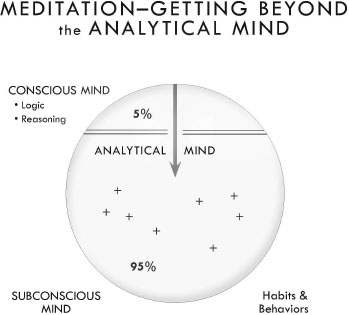
Figure 8I. One of the main purposes of meditation is to go beyond the conscious mind and enter the subconscious mind, in order to change self-destructive habits, behaviors, beliefs, emotional reactions, attitudes, and unconscious states of being.
Meditation Takes Us from Beta into
Alpha and Theta Brain-Wave States
Let’s examine how you can learn to change gears and access other brain-wave states so you can go beyond your association with the body, the environment, and time. You can naturally slow down the high-speed vigilance of the brain and body into a more relaxed, orderly, systemized pattern of brain waves.
Thus, it is quite possible to consciously alter your brain waves from that high-frequency Beta state into Alpha and Theta (you can train yourself to move up and down the scale of brain waves). As you do, you will open doors to true personal change. You trespass beyond the common type of thinking that is fueled by reactions to being in survival mode; you are entering the realm of the subconscious mind.
During meditation, you transcend the feelings of the body, are no longer at the mercy of the environment, and lose track of time. You forget about you as an identity. As you close your eyes, the input from the outside world is reduced, and your neocortex has less to think about and analyze. As a result, the analytical mind begins to become subdued, and electrical activity in the neocortex quiets down.
Then when you restfully pay attention, concentrate, and focus in a relaxed manner, you automatically activate the frontal lobe, which reduces synaptic firing in the rest of the neocortex. Therefore, you lower the volume to the circuits in the brain that process time and space. This allows your brain waves to naturally slow down to Alpha. Now you are moving from a state of survival into a more creative state, and your brain naturally recalibrates itself to a more orderly, coherent brain-wave pattern.
One of the later steps of meditation, if you keep practicing, is to move into the Theta-wave frequency, when your body is asleep but your mind is awake. This is a magical land. You are now in a deeper system of the subconscious and able to immediately change those negative associations to more positive ones.
It’s important to remember that if you have conditioned the body to become the mind and your body is somewhat asleep while your mind is awake, you could say that there is no more resistance from the body-mind. In Theta, the body is no longer in control, and you are free to dream, change subconscious programs, and finally create from a totally unobstructed place.
Once the body is no longer running the mind, the servant is no longer the master and you are working in a realm of true power. You are like a child again, entering the kingdom of heaven.
To Sleep, Perchance to Go Down,
Then Up, the Ladder … Naturally
When you go to sleep, you pass though the spectrum of brain-wave states, from Beta to Alpha to Theta to Delta. Likewise, when you wake up in the morning, you naturally rise from Delta to Theta to Alpha to Beta, returning to conscious awareness. When you “come to your senses” from the netherworld, you remember who you are, the problems in your life, the person sleeping next to you, the house you own, where you live … and presto! By association, you’re back in Beta as the same you.
Some people fall very quickly through these levels like a steel ball dropping from the top of a building. Their bodies are so fatigued that the natural progression down the ladder to the subconscious states happens too rapidly.
Others cannot shift gears to naturally progress down the ladder into sleep; they are hyperfocused on the cues in their lives that reinforce their addictive mental and emotional states. They become insomniacs, and may take drugs to chemically alter the brain and sedate the body.
Either way, sleep problems may indicate that the brain and the mind are out of sync.
The Best Times to Meditate: Morning and Evening,
When the Door to the Subconscious Opens
As a result of normal daily changes in brain chemistry (alternately, the brain produces serotonin, primarily a daytime neurotransmitter that makes you alert; and melatonin, the nighttime neurotransmitter that begins to relax you for sleep), there are two times when the door to the subconscious mind opens—when you go to bed at night and when you wake up in the morning. So it is a good idea to meditate in the morning or evening, because it will be easier to slip into a state of Alpha or Theta.
I like to wake up early to begin the process, because while I’m still a bit dreamy, I’m still in Alpha. I personally like to create from a clean slate.
Others prefer the late evening. They know that the body (which was in control during the day) is now too tired to “be” the mind. They can create without any effort by drawing out the Alpha phase, and even entering into Theta, while they are still awake.
Meditation during the middle of the day might be difficult, especially if you work in a busy office, manage a houseful of kids who demand your undivided attention, or are involved in activities that require heightened concentration. At such times you might be in middle to high Beta, and it may take more effort to slip through the door.
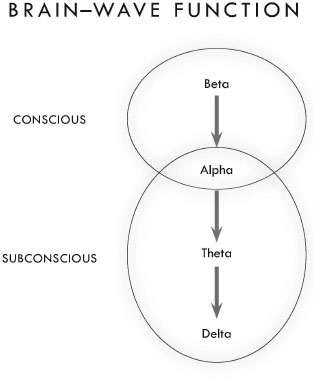
Figure 8J. This diagram shows how our brain-wave functions move from the highest and fastest state of activity (Beta) to the lowest and slowest (Delta). Please take note that Alpha serves as the bridge between the conscious mind and the subconscious mind. The lower/slower the brain waves, the more we are in the subconscious mind; the higher/faster the brain waves, the more we are in the conscious mind.
Taking Control of the Progression into Meditation
Inward contemplative practices retrain the mind, body, and brain to become present, instead of being stressed in anticipation of some future event you are obsessing about. Meditation also lifts the anchor of the body-mind out of the past and frees you from the emotions that keep you hooked to the same familiar life.
The object in meditation is to fall like a feather down from the top of a building, slowly and steadily. You first train yourself to let your body initially relax, but keep your mind focused. Once you begin to master the skill, the ultimate goal is to let your body fall asleep while your mind stays awake or active.
Here is the progression. If waking consciousness is Beta (from low to high, depending on your levels of stress), once you sit up straight to keep your spine erect, close your eyes, take a series of conscious breaths, and go inward, you will naturally switch from the sympathetic nervous system to the parasympathetic nervous system. You will change your physiology from the emergency protection system (fight/fright/flight) to the internal protection system for long-term building projects (growth and repair). As the body relaxes, your brain-wave patterns will naturally begin to move to Alpha.
If done properly, meditation will shift your brain to a more coherent and orderly wave pattern. You will go from focusing on the Big Three to becoming no body, no thing, and no time. Now you begin to feel connected, whole, and balanced; and you experience healthier, elevated emotions of trust, joy, and inspiration.
Orchestrating for Coherence
If our definition of mind is the brain in action or the brain’s activity when it processes different streams of consciousness, then meditation naturally produces more synchronized, coherent states of mind.4
On the other hand, when the brain is stressed, its electrical activity will be like an entire orchestra of musical instruments playing badly. The mind will be out of rhythm, out of balance, and out of tune.
Your job is to play a masterpiece. If you persist with this band of disorderly, egocentric, self-important members who think that their individual musical instruments need to be heard above all others—and if you insist that they work together and follow your lead—there will come a moment when they will surrender to you as their leader and will act as a team.
This is the moment when brain waves become more synchronized, moving from Beta into Alpha and Theta. More individual circuits start communicating in an orderly fashion and process a more coherent mind. Your awareness shifts from narrow-minded, over-focused, obsessive, compartmentalized, survival thinking to thoughts that are more open, relaxed, holistic, present, orderly, creative, and simple. This is the natural state of being we are supposed to live by.
Take a look at coherence or what is also called synchrony, the state when the brain is working in harmony.
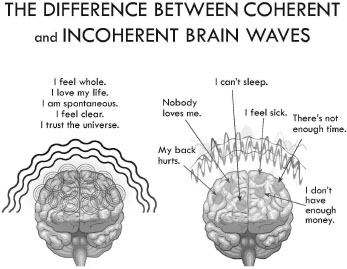
Figure 8K. In the first picture, the brain is balanced and highly integrated. Several different areas are synchronized, forming a more orderly, holistic community of neural networks working together. In the second picture, this brain is disorderly and imbalanced. Many diverse compartments are no longer working as a team, and thus the brain is “dis-eased” and disintegrated.
The Coherent Brain Sets the Stage for Healing
This orderly, new, synchronized signal to the body from the brain organizes all of the diverse systems into homeostasis—the cardiovascular system, digestive system, immune system, and so on all move into coherence as well. As the nervous system recalibrates itself, all of the enormous energy that was needed for survival can now be used for creation. The body begins to heal.
For example, Jose, a man at one of my lectures, told me about one of his first times doing a meditation back in his 20s. In those days, he’d had ten olive-sized warts on his left hand. He was so embarrassed by them that he often hid that hand in his pocket.
One day someone gave Jose a book on meditation. The book instructed him to simply focus on his breath and allow his mind to expand beyond the barriers of his body. One night before bed, he decided to try the process. In a matter of moments he went from an overfocused, contracted state to a more expanded, open, focused state. As he vacated his familiar personality and became something other than his typical thoughts and feelings, he went from the habitual random thought patterns driven by the familiar ego to a more expanded sense of self. When this occurred, something shifted.
The next morning when Jose woke up, all ten warts had completely vanished. Shocked and overjoyed, he looked under the sheets for evidence of them, but found nothing. He explained that he didn’t know where the warts went. I told him that they returned to the quantum field where they came from. I suggested to him that the universal intelligence that keeps order in his body naturally had done what it always does—create more order to reflect a more coherent mind. When his new subjective, coherent mind matched the objective, coherent higher mind, that greater power within did the healing for him.
All of this happened because when he got out of the way and became no body, no thing, outside time—when he forgot about himself—his focus went from sustained disorder to sustained order … survival to creation … contraction to expansion … incoherence to coherence. Then the unlimited consciousness restored order in his body, and he was healed.
Meditation Plus Action: One Woman’s Path Out of Lack
At my workshops, I frequently ask participants to share their surprising stories of life changes. Monique, a therapist from Montreal, Quebec, recently described her own remarkable experience.
For most of her adult life, Monique had lived unconsciously in a near-constant state of lack. Not enough money. Not enough energy. Not enough time to do the things she wanted. Now she was going through a particularly rough patch: her office rent had risen considerably (her house couldn’t accommodate an office), she and her husband couldn’t afford to send their son to the college of his choice, their washer needed replacing, and the shaky economy had forced several clients to stop seeing her.
One day, while doing the meditation you will learn in this book and pondering her life choices, Monique realized that she couldn’t keep doing what she normally did—hunker down and weather the storm with a pseudopositive, woe-is-me-but-things-could-be-worse mentality. She recognized that she’d always made decisions or sought solutions to problems from a perspective of lack—lack of time, of money, and of energy. She had memorized that state of being; lack became her personality. The epitome of inertia, she tended to “let the chips fall where they may.” Ironically, Monique had worked with her clients to overcome these very traits, and to be more proactive and less reactive.
With great resolve, she decided to change her personality. No longer would she let life trample her and allow things to just happen to her.
Next, Monique created a template of who she wanted to be, how she wanted to think, and what she wanted to feel. She imagined herself as a woman who made all of her choices with an abundance of energy, time, and money. Most important, her goal to become this person was as firm as her vision was precise. She knew who she no longer wanted to be; and she had definitive plans for how her new self would think, feel, and behave.
When we make a decision that strongly and have a clear intention for what our new reality will be like, the clarity and coherence of those thoughts produces corresponding emotions. As a result, our internal chemistry changes, our neurological makeup is altered (we prune old synaptic connections and sprout new ones), and we even express our genetic code differently.
Monique began to live her life from the perspective of someone who had plenty of money, who had abundant energy, and whose every need was met. She felt wonderful. Certainly, not all the problems from her catalog of worries went away, but she was becoming better at living from a different mind-set.
Several weeks after making that firm decision, Monique was working with her last client of the day. This woman, who had grown up in France, reminisced how every month, her parents had purchased a ticket in the French lottery, a tradition that she had continued.
As Monique drove home that evening, she wasn’t thinking about the lottery. She’d never played it, believing that with her limited financial resources, such an expenditure was frivolous. Stopping for gas, she went inside to pay, and there on the counter were lottery cards for various games. On impulse, recognizing that the new Monique who lived in abundance could afford to take a chance on winning, she purchased a ticket.
By the time Monique had stopped at a local pizzeria for a carryout dinner and arrived home, the lottery had slipped her mind. Grabbing the pizza, she discovered that some grease had soaked through the box, stuck to the lottery card, and stained the passenger seat. She set the box on the dining table, with the ticket alongside it. She told her family to start eating without her and that she’d be in the garage tending to the grease stain. While she was scrubbing away, her husband came running out.
“You won’t believe it! Your lottery ticket was a winner!”
Now, you’ll recall that when the quantum field responds, it does so in a way that one couldn’t predict. Perhaps you are thinking, Of course she won millions and lived happily ever after.
Not exactly.
Monique won $53,000. Was she happy? Astounded is more like it. The couple owed exactly $53,000 in credit-card and auto-loan debt.
Monique relayed her excitement in telling us that story, but she slyly admitted that next time, instead of holding the intention that all her needs were met, she’d choose to imagine they were met—and then some.

What Monique’s story illustrates is the power of creating a new state of being. She couldn’t do that just by imagining that she was a new person; she had to put that new self into action. The old Monique wouldn’t have bought a lottery ticket; her new personality aligned her behavior to match her objective, and the field responded in an entirely unexpected yet perfectly appropriate way.
Because Monique developed a new personality who seized opportunities and acted differently, she experienced new and better results in her life. New personality, new personal reality.
You don’t have to win the lottery to change your life, of course. But you do have to make the decision to stop being your old self, enter into the operating system where those unconscious programs exist, and then formulate a clear design for a new one.
The Coherent Brain: Takin’ It to the Streets
Before I wrap up this chapter, I want to bring up a subject I referenced in Evolve Your Brain—namely, Buddhist monks who were studied at the University of Wisconsin at Madison. These “super-meditators” could go into a state of coherent brain waves well beyond what most of us are capable of. When they meditated on thoughts of loving-kindness and compassion, the coherence of the signal they were putting out was nearly off the charts.
Every morning during the study, they meditated while researchers monitored their brain-wave activity. After that, they were sent out onto the campus and into the town to do what they wished—visit museums, go to shops, or what have you. After they returned to the research center, they underwent brain scans again without first going back into meditation. Amazingly, despite not meditating throughout the day, and being subjected to the incoherent, chaotic signals that the external world exposes us all to, they maintained the same coherent brain pattern they had achieved in meditation.5
Most of us, when faced with the profusion and confusion of stimuli that the external world produces, retreat into survival mode and manufacture the chemicals of stress. Those stress reactions are like disruptors that scramble the brain’s signals. Instead, our goal is to become more like those monks. If we can produce coherent signal patterns—those synchronous waves—every day, we’ll find that this coherence of signal manifests into something tangible.
In time, if you can repeatedly create internal coherence like those monks did, you too may walk into the external environment and no longer suffer the self-limiting effects of its disruptive stimuli. And because of that, you won’t experience the knee-jerk reactions that formerly forced you to return to the old, familiar self that you are so eager to change.
By persisting with meditation and creating coherence within, you will not only remove a lot of the negative physical conditions that plague your body, but you can also progress toward that ideal self you’ve envisioned. Your inner coherence can counteract negative reactionary emotional states and allow you to unmemorize the behaviors, thoughts, and feelings that make them up.
Once you’ve gotten to a neutral/empty state, it is far easier to engage a heightened one like compassion; it is easier to bring in pure joy or love or gratitude or any of the elevated emotional states. That’s true because those emotions are already profoundly coherent. And when you’ve moved through the meditative process and produce a brain-wave state that reflects this purity, then you will begin to overcome the body, the environment, and time, which once produced your self-limiting emotional states. They will no longer control you; instead, you will control them.
Having Embodied Knowledge,
You Are Prepared for Experience
You have now equipped yourself with the knowledge necessary to move on to the meditation discussed in Part III, with full understanding of what you will be doing and why.
Remember that knowledge is the forerunner to experience. All the information you have read has been put there to prepare you for an experience. Once you learn to meditate and apply this to your life, you should begin to see feedback. In the following section you will learn how to put all of this into practice and begin to make measurable changes in any area of your life.
I’m reminded of the two-stage journey that many climbers make when they ascend Washington State’s Mount Rainier, the highest volcano in the contiguous U.S. (14,410 feet). Leaving their car at the Paradise Jackson Visitor Center (5,400 feet), they first trek to Camp Muir (10,080 feet). Stopping at this base camp affords them the opportunity to look back at all the ground they’ve covered, assess what they learned from the preparation and experience of that hike, receive additional practical training, and rest overnight. This overview can make all the difference when they continue on to undertake the climb to Rainier’s majestic peak.
The knowledge you’ve gained has allowed you to ascend to this point. Now you’re ready to apply everything you’ve learned. And your newfound wisdom should inspire you to forge ahead to Part III, where you can master the skills to change your mind, and thus your life.
So I invite you to pause briefly, take a look back with appreciation for the information you acquired in Parts I and II, and if you need to, review any areas you may feel are important … then join me as you make your final preparation for the meditative journey to your own personal summit.
