

In the last chapter, I purposely used the example of my writing to illustrate my point about transcending the Big Three, because when you write, you are creating words (whether on the physical page or in a digital document). The same creativity is operating when you paint, play a musical instrument, turn wood on a lathe, or engage in any other activity that has the effect of breaking the bonds that the Big Three hold over you.
Why is it so hard to live in these creative moments? If we focus on an unwanted past or a dreaded future, that means that we live mostly in stress—in survival mode. Whether we’re obsessing over our health (the survival of the body), paying our mortgage (the survival need for shelter from our external environment), or not having enough time to do what we need to do to survive, most of us are much more familiar with the addictive state of mind we’ll call “survival” than we are with living as creators.
In my first book, I went into great detail about the difference between living in creation versus living in survival. So for a fuller explanation of this difference, you may want to read Chapters 8 through 11 in Evolve Your Brain. In the pages that follow, I’m going to briefly outline the difference between the two.

Think of life in survival mode by picturing an animal, such as a deer contentedly grazing in the forest. Let’s assume that it is in homeostasis, in perfect balance. But if it perceives some danger in the outside world—say, a predator—its fight-or-flight nervous system gets turned on. This sympathetic nervous system is part of the autonomic nervous system, which maintains the body’s automatic functions such as digestion, temperature regulation, blood-sugar levels, and the like. To prepare the animal to deal with the emergency it has detected, the body is chemically altered—the sympathetic nervous system automatically activates the adrenal glands to mobilize enormous amounts of energy. If the deer is chased by a pack of coyotes, it utilizes that energy to flee. If it is nimble enough to get away unharmed, then perhaps after 15 to 20 minutes when the threat is no longer present, the animal resumes grazing, its internal balance restored.
We humans have the same system in place. When we perceive danger, our sympathetic nervous system is turned on, energy is mobilized, and so on, in much the same way as the deer. During early human history, this wonderfully adaptive response helped us confront threats from predators and other risks to our survival. Those animal qualities served us well for our evolution as a species.
Thought Alone Can Trigger the Human Stress Response—
and Keep It Going
Unfortunately, there are several differences between Homo sapiens and our planetary cohabitants in the animal kingdom that don’t serve us as well. Every time we knock the body out of chemical balance, that’s called “stress.” The stress response is how the body innately responds when it’s knocked out of balance, and what it does to return back to equilibrium. Whether we see a lion in the Serengeti, bump into our not-so-friendly ex at the grocery store, or freak out in freeway traffic because we’re late for a meeting, we turn on the stress response because we are reacting to our external environment.
Unlike animals, we have the ability to turn on the fight-or-flight response by thought alone. And that thought doesn’t have to be about anything in our present circumstances. We can turn on that response in anticipation of some future event. Even more disadvantageous, we can produce the same stress response by revisiting an unhappy memory that is stitched in the fabric of our gray matter.
So either we anticipate stress-response-producing experiences or we recollect them; our bodies are either existing in the future or in the past. To our detriment, we turn short-term stressful situations into long-term ones.
On the other hand, as far as we can tell, animals don’t have the ability (or should I say disability) to turn on the stress response so frequently and so easily that they can’t turn it off. That deer, back to happily grazing, isn’t consumed with thoughts about what just happened a few minutes ago, let alone the time a coyote chased it two months ago. This kind of repetitive stress is harmful to us, because no organism was designed with a mechanism to deal with negative effects on the body when the stress response is turned on with great frequency and for long duration. In other words, no creature can avoid the consequences of living in long-term emergency situations. When we turn on the stress response and can’t turn it off, we’re headed for some type of breakdown in the body.
Let’s say you keep turning on the fight-or-flight system due to some threatening circumstance in your life (real or imagined). As your racing heart pumps enormous amounts of blood to your extremities and your body is knocked out of homeostasis, you’re becoming prepared by the nervous system to run or fight. But let’s face it: you can’t flee to the Bahamas, nor can you throttle your fellow employee—that would be primitive. So as a consequence, you condition your heart to race all the time, and you may be headed for high blood pressure, arrhythmias, and so on.
And what’s in store when you keep mobilizing all that energy for some emergency situation? If you’re putting the bulk of your energy toward some issue in your external environment, there will be little left for your body’s internal environment. Your immune system, which monitors your inner world, can’t keep up with the lack of energy for growth and repair. Therefore, you get sick, whether it be from a cold, cancer, or rheumatoid arthritis. (All are immune-mediated conditions.)
When you think about it, the real difference between animals and ourselves is that although we both experience stress, humans reexperience and “pre-experience” traumatic situations. What is so harmful about having our stress response triggered by pressures from the past, present, and future? When we get knocked out of chemical balance so often, eventually that out-of-balance state becomes the norm. As a result, we are destined to live out our genetic destiny, and in most cases that means suffering from some illness.
The reason is clear: The domino effect from the cascade of hormones and other chemicals we release in response to stress can dysregulate some of our genes, and that may create disease. In other words, repeated stress pushes the genetic buttons that cause us to begin to head toward our genetic destiny. So what was once very adaptive behavior and a beneficial biochemical response (fight or flight) has become a highly maladaptive and harmful set of circumstances.
For instance, when a lion was chasing your ancestors, the stress response was doing what it was designed to do—protect them from their outer environment. That’s adaptive. But if, for days on end, you fret about your promotion, overfocus on your presentation to upper management, or worry about your mother being in the hospital, these situations create the same chemicals as though you were being chased by a lion.
Now, that’s maladaptive. You’re staying too long in emergency mode. Fight-or-flight is using up the energy your internal environment needs. Your body is stealing this vital energy from your immune, digestive, and endocrine systems, among others, and directing it to the muscles that you’d use to fight a predator or run from danger. But in your situation, that’s only working against you.
From a psychological perspective, overproduction of stress hormones creates the human emotions of anger, fear, envy, and hatred; incites feelings of aggression, frustration, anxiety, and insecurity; and causes us to experience pain, suffering, sadness, hopelessness, and depression. Most people spend the majority of their time preoccupied with negative thoughts and feelings. Is it likely that most of the things that are happening in our present circumstances are negative? Obviously not. Negativity runs so high because we are either living in anticipation of stress or re-experiencing it through a memory, so most of our thoughts and feelings are driven by those strong hormones of stress and survival.
When our stress response is triggered, we focus on three things, and they are of highest importance:
Living in survival is the reason why we humans are so dominated by the Big Three. The stress response and the hormones that it triggers force us to focus on (and obsess about) the body, the environment, and time. As a result, we begin to define our “self” within the confines of the physical realm; we become less spiritual, less conscious, less aware, and less mindful.
Put another way, we grow to be “materialists”—that is, habitually consumed by thoughts of things in the external environment. Our identity becomes wrapped up in our bodies. We are absorbed by the outer world because that is what those chemicals force us to pay attention to—things we own, people we know, places we have to go, problems we face, hairstyles we dislike, our body parts, our weight, our looks in comparison to others, how much time we have or don’t have … you get the picture. And we remember who we are based primarily on what we know and the things we do.
Living in survival causes us to focus on the .00001 percent instead of the 99.99999 percent of reality.
Survival: Living as a “Somebody”
Most of us embrace the traditional notion of ourselves as a “somebody.” But who we really are has nothing to do with the Big Three. Who we are is a consciousness connected to a quantum field of intelligence.
When we become this somebody, this materialistic physical self living in survival, we forget who we truly are. We become disconnected and feel separate from the universal field of intelligence. The more we live impacted by stress hormones, the more their chemical rush becomes our identity.
If we fancy ourselves solely physical beings, we limit ourselves to perceiving only with our physical senses. The more we use our senses to define our reality, the more we allow our senses to determine our reality. We slip into that Newtonian mode of thinking, which locks us into trying to predict the future based on some past experience. If you recall, the Newtonian model of reality is all about predicting an outcome. Now we are trying to control our reality instead of surrendering to something greater. All we’re doing is trying to survive.
If the quantum model of reality ultimately defines everything as energy, why do we experience ourselves more as physical beings than as beings of energy? We could say that the survival-oriented emotions (emotions are energy in motion) are lower-frequency or lower-energy emotions. They vibrate at a slower wavelength and therefore ground us into being physical. We become denser, heavier, and more corporeal, because that energy causes us to vibrate more slowly. The body quite literally becomes composed of more mass and less energy … more matter, less mind.1
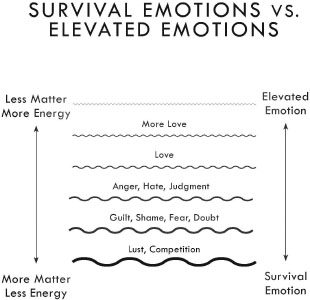
Figure 5A. The higher-frequency waves at the top are vibrating faster and therefore are closer to the vibratory rate of energy and less to that of matter. Moving down the scale, you can see that the slower the wavelength, the more “material” the energy becomes. Thus, the survival emotions ground us to be more like matter and less like energy. Emotions such as anger, harted, suffering, shame, guilt, judgment, and lust make us feel more physical, because they carry a frequency that is slower and more like that of physical objects. However, the more elevated emotions such as love, joy, and gratitude are higher in frequency. As a result, they are more energy-like and less physical/material
So it might make sense that if we inhibit our more primitive survival emotions and begin to break our addiction to them, our energy will be higher in frequency, and less likely to root us to the body. In a way, we can liberate energy from the body, when the body has “become” the mind, into the quantum field. As our emotions become more elevated, we will naturally ascend to a higher level of consciousness, closer to Source … and feel more connected to universal intelligence.
Addicted to Being a Somebody
When the stress response is turned on, whether in response to a real or conjured-up threat, a powerful cascade of chemicals rushes into our system and gives us a strong jolt of energy, momentarily “waking up” our bodies and certain parts of the brain to put all of our attention on the Big Three. This is very addictive to us because it’s like drinking a triple espresso—we get turned “on” for a few moments.
In time, we unconsciously become addicted to our problems, our unfavorable circumstances, or our unhealthy relationships. We keep these situations in our lives to feed our addiction to survival-oriented emotions, so that we can remember who we think we are as a somebody. We just love the rush of energy we get from our troubles!
Moreover, we also associate this emotional high with every person, thing, place, and experience in our outer world that is known and familiar. We become addicted to these elements in our environment as well; we embrace our environment as our identity.
If you agree that we can turn on the stress response just by thinking, then it stands to reason that we can get the same rush of addictive stress chemicals as if we were being chased by a predator. As a consequence, we become addicted to our very thoughts; they begin to give us an unconscious adrenaline high, and we find it very hard to think differently. To think greater than how we feel or to think outside of the proverbial box becomes just too uncomfortable. The moment we begin to deny ourselves the substance we are addicted to—in this case, the familiar thoughts and feelings associated with our emotional addiction—there are cravings, withdrawal pains, and a host of inner subvocalizations urging us not to change. And so we remain chained to our familiar reality.
Thus, our thoughts and feelings, which are predominantly self-limiting, hook us back to all the problems, conditions, stressors, and bad choices that produced the fight-or-flight effect in the first place. We keep all these negative stimuli around us so that we can produce the stress response, because that addiction reinforces the idea of who we are, only serving to reaffirm our own personal identity. Simply put, most of us are addicted to the problems and conditions of our lives that produce stress. No matter whether we’re in a bad job or a bad relationship, we hold our troubles close to us because they help reinforce who we are as a somebody; they feed our addictions to low-frequency emotions.
Most harmful of all, we live in fear that if those problems were taken away, we wouldn’t know what to think and how to feel, and we wouldn’t get to experience the rush of energy that causes us to remember who we are. For most of us, God forbid we not be a somebody. How awful would it be to be a “nobody,” to not have an identity?
The Selfish Self
As you can see, what we identify as our self exists within the context of our collective emotional association with our thoughts and feelings, our problems, and all those elements of the Big Three. Is it any wonder that people find it so hard to go within and leave this self-produced reality behind? How would we know who we are if it weren’t for our environment, our bodies, and time? That’s why we are so dependent upon the external world. We limit ourselves to using our senses to define and cultivate emotions, so that we can receive the physiological feedback that reaffirms our own personal addictions. We do all this to feel human.
When our survival response is way out of proportion to what is happening in our outer world, that excess of stress-response hormones causes us to become fixated within the parameters of self. So we become overly selfish. We obsess about our bodies or a particular aspect of our environment, and we live enslaved to time. We’re trapped in this particular reality, and we feel powerless to change, to break the habit of being ourselves.
These excessive survival emotions tip the scales of a healthy ego (the self we consciously refer to when we say “I”). When the ego is in check, its natural job is to make sure we are protected and safe in the outer world. As an example, the ego makes sure we stay far away from a bonfire or a few steps away from the cliff’s edge. When the ego is balanced, its natural instinct is self-preservation. There’s a healthy balance between its needs and those of others, its attention to itself and to others.
When we’re in survival mode in an emergency situation, it makes sense that the self should take priority. But when chronic, long-term stress chemicals push the body and brain out of balance, the ego becomes overfocused on survival and puts the self first, to the exclusion of anything else—we’re selfish all the time. Thus, we become self-indulgent, self-centered, and self-important, full of self-pity and self-loathing. When the ego is under constant stress, it’s got a “me first” priority.
Under those conditions, the ego is primarily concerned with predicting every outcome of every situation, because it is overfocused on the outer world and feels completely separated from the 99.99999 percent of reality. In fact, the more we define reality through our senses, the more this reality becomes our law. And material reality as law is the very opposite of the quantum law. Whatever we place our awareness on is our reality. Consequently, if our attention is focused on the body and our physical realm, and if we become locked into a particular line of linear time, then this becomes our reality.
To forget about the people we know, the problems we have, the things we own, and the places we go; to lose track of time; to go beyond the body and its need to feed its habituations; to give up the high from emotionally familiar experiences that reaffirm the identity; to detach from trying to predict a future condition or review a past memory; to lay down the selfish ego that is only concerned with its needs; to think or dream greater than how we feel, and crave the unknown—this is the beginning of freedom from our present lives.
If Our Thoughts Can Make Us Sick,
Can They Make Us Well?
Let’s go one step further. I explained earlier that we can turn on the stress response by thought alone. I also mentioned the scientific fact that the chemicals associated with stress pull the genetic trigger by creating a very harsh environment outside of our cells and thus creating disease. So by pure reason, our thoughts can actually make us sick. If our thoughts can make us sick, might they also make us well?
Let’s say that a person had some experiences within a short time frame that caused him to feel resentful. As a result of his unconscious reactions to those occurrences, he held on to his bitterness. Chemicals corresponding to this emotion flooded his cells. Over weeks, his emotion turned into a mood, which continued for months and changed into a temperament, which was sustained for years and formed a strong personality trait called resentment. In fact, he memorized this emotion so well that the body knew resentment better than the conscious mind, because he remained in a cycle of thinking and feeling, feeling and thinking, that way for years.
Based on what you learned about emotions as the chemical signature of an experience, wouldn’t you agree that as long as this person clings to resentment, his body will react as though it is still experiencing the long-ago events that first caused him to embrace this emotion? Moreover, if the body’s reaction to those chemicals of resentment disrupted the function of certain genes, and this sustained reaction kept signaling the same genes to respond in the same way, might the body eventually develop a physical condition such as cancer?
If so, is it possible that once he unmemorized the emotion of continuous resentment—by no longer thinking the thoughts that created the feelings of resentment, and vice versa—his body (as the unconscious mind) would be free from that emotional enslavement? In time, would he stop signaling the genes the same way?
And finally, let’s say he began thinking and feeling in new ways, to such a degree that he invented a new ideal of himself related to a new personality. As he moved into a new state of being, might he signal his genes in beneficial ways and condition the body into an elevated emotional state, ahead of the actual experience of good health? Could he do this to the extent that the body would begin to change by thought alone?
What I just described in simple terms happened to a student in one of my seminars, who overcame cancer.
Bill, 57, was a roofing contractor. A lesion had appeared on his face, and a dermatologist diagnosed malignant melanoma. Although Bill underwent surgery, radiation, and chemotherapy, the cancer recurred in his neck, then his side, and finally his calf. Each time, he underwent a similar course of treatment.
Naturally, Bill experienced “Why me?” moments. He understood that his excessive sun exposure was a risk factor, but he knew others who had been similarly exposed and didn’t develop cancer. He fixated on that unfairness.
After treatment for the same cancer on his left flank, Bill pondered whether his own thoughts, emotions, and behaviors had contributed to his condition. In a moment of self-reflection, he realized that for more than 30 years, he had been stuck in resentment, thinking and feeling that he always had to give up what he wanted for the sake of others.
For example, he had wanted to become a professional musician after high school. But when an injury left his father unable to work, Bill had to join his family’s roofing company. He habitually reexperienced his feelings upon being told he had to give up his aspirations, to the extent that his body still lived in that past. This also set up a pattern of dreams deferred. Whenever something didn’t go his way, such as the housing market collapsing just after he expanded the business, he always found someone or something to blame.
Bill had so memorized the emotional response pattern of bitterness that it dominated his personality and became an unconscious program. His state of being had signaled the same genes for so long that they had created the disease that now afflicted him.
No longer could Bill allow his environment to control him: the people, places, and influences in his life had always dictated how he thought, felt, and behaved. He sensed that to break the bonds with his old self and reinvent a new one, he would have to leave his familiar environment. So for two weeks in Baja, Mexico, he retreated from his familiar life.
The first five mornings, Bill contemplated how he thought when he felt resentment. He became a quantum observer of his thoughts and feelings; he became conscious of his unconscious mind. Next, he paid attention to his previously unconscious behaviors and actions. He decided to halt any thought, behavior, or emotion that was unloving toward himself.
After the first week of this vigilance, Bill felt free, because he had liberated his body from its emotional addiction to resentment. By inhibiting the familiar thoughts and feelings that had driven his behaviors, in a sense he impeded the signals of the survival emotions from conditioning his body to the same mind. His body then released energy, which was available to use to design a new destiny for himself.
For the next week, Bill became so uplifted that he thought about the new self he wanted to be, and how he would respond to the people, places, and influences that previously controlled him. For instance, he decided that whenever his wife and kids expressed a wish or need, he would respond with kindness and generosity instead of making them feel like a burden. In short, he focused on how he wanted to think, act, and feel when presented with situations that had challenged him in the past. He was creating a new personality, a new mind, and a new state of being.
Bill began to put into practice what he’d placed in his mind while sitting on that Baja beach. Shortly after his return, he noticed that the tumor on his calf had fallen off. In a week or so, when he went to his doctor, he was cancer free. He has remained that way.
By firing his brain in new ways, Bill changed biologically and chemically from his previous self. As a result, he signaled new genes in new ways; and those cancer cells couldn’t coexist with his new mind, new internal chemistry, and new self. Once trapped by the emotions of the past, he now lives in a new future.
Creation: Living as a Nobody
At the end of the previous chapter, I briefly described what it is like to live in creative mode. Those are the moments of being fully engaged and in flow so that the environment, the body, and time all seem immaterial and don’t invade our conscious thoughts.
Living in creation is living as a nobody. Ever notice that when you’re truly in the midst of creating anything, you forget about yourself? You dissociate from your known world. You are no longer a somebody who associates your identity with certain things you own, particular people you know, certain tasks you do, and different places you lived at specific times. You could say that when you are in a creative state, you forget about the habit of being you. You lay down your selfish ego and become self-less.
You have moved beyond time and space and become pure, immaterial awareness. Once you’re no longer connected to a body; no longer focused on people, places, or things in your external environment; and beyond linear time, you’re entering the door of the quantum field. You cannot enter as a somebody, you must do so as a nobody. You have to leave the self-centered ego at the door and enter the realm of consciousness as pure consciousness. And as I said in Chapter 1, in order to change your body (to foster better health), something in your external circumstances (a new job or relationship, perhaps), or your timeline (toward a possible future reality), you have to become no body, no thing, no time.
Thus, here is the grand hint: to change any aspect of your life (body, environment, or time), you must transcend it. You must leave behind the Big Three in order to control the Big Three.
The Frontal Lobe: Domain of Creation and Change
When we are in creation, we are activating the brain’s creative center, the frontal lobe (part of the forebrain and comprising the prefrontal cortex). This is the newest, most evolved part of our human nervous system and the most adaptable part of the brain. It tends to be the creative center of who we are, and the brain’s CEO or decision-making apparatus. The frontal lobe is the seat of our attention, focused concentration, awareness, observation, and consciousness. It is where we speculate on possibilities, demonstrate firm intention, make conscious decisions, control impulsive and emotional behaviors, and learn new things.
For the sake of our understanding, the frontal lobe performs three essential functions. These will all come into play as you learn and practice the how-to meditative steps for breaking the habit of being yourself in Part III of this book.
1. Metacognition: Becoming Self-Aware to Inhibit
Unwanted States of Mind and Body
If you want to create a new self, you first have to stop being the old self. In the process of creation, the first function of the frontal lobe is to become self-aware.
Because we have metacognitive capabilities—the power to observe our own thoughts and self—we can decide how we no longer want to be … to think, act, and feel. This ability to self-reflect allows us to scrutinize ourselves and then make a plan to modify our behaviors so we can produce more enlightened or desirable outcomes.2
Your attention is where you place your energy. To use attention to empower your life, you will have to examine what you’ve already created. This is where you begin to “know thyself.” You look at your beliefs about life, yourself, and others. You are what you are, you are where you are, and you are who you are because of what you believe about yourself. Your beliefs are the thoughts you keep consciously or unconsciously accepting as the law in your life. Whether you are aware of them or not, they still affect your reality.
So if you truly want a new personal reality, start observing all aspects of your present personality. Since they primarily operate below the level of conscious awareness, much like automatic software programs, you’ll have to go within and look at these elements you probably haven’t been aware of before. Given that your personality comprises how you think, act, and feel, you must pay attention to your unconscious thoughts, reflexive behaviors, and automatic emotional reactions—put them under observation to determine if they are true and whether you want to continue to endorse them with your energy.
To become familiar with your unconscious states of mind and body takes an act of will, intention, and heightened awareness. If you become more aware, you will become more attentive. If you become more attentive, you will be more conscious. If you grow to be more conscious, you will notice more. If you notice more, you have a greater ability to observe self and others, both inner and outer elements of your reality. Ultimately, the more you observe, the more you awaken from the state of the unconscious mind into conscious awareness.
The purpose of becoming self-aware is so that you no longer allow any thought, action, or emotion you don’t want to experience to pass by your awareness. Thus, in time, your ability to consciously inhibit those states of being will stop the same firing and wiring of the old neural networks that are related to the old personality. And as a result of no longer re-creating the same mind on a daily basis, you prune away the hardware that is related to the old self. In addition, by interrupting the feelings that are associated with those thoughts, you are no longer signaling genes in the same way. You are stopping the body from reaffirming itself as the same mind. This process is whereby you quite simply begin to “lose your mind.”
So as you develop the skill of becoming familiar with all aspects of your old self, you will ultimately become more conscious. Your goal here is to unlearn who you used to be, so that you can free up energy to create a new life, a new personality. You can’t create a new personal reality as the same personality. You have to become someone else. Metacognition is your first task in moving from your past to creating a new future.
2. Creating a New Mind to Think about
New Ways of Being
The second function of the frontal lobe is to create a new mind—to break out of the neural networks produced by the ways that your brain has been firing for years on end, and influence it to rewire in new ways.
When we set aside time and private space to think about a new way of being, that is when the frontal lobe engages in creation. We can imagine fresh possibilities and ask ourselves important questions about what we really want, how and who we want to be, and what we want to change about ourselves and our circumstances.
Because the frontal lobe has connections to all other parts of the brain, it is able to scan across all the neural circuits to seamlessly piece together stored bits of information in the form of networks of knowledge and experience. Then it picks and chooses among those neural circuits, combining them in a variety of ways to create a new mind. In doing that, it creates a model or internal representation that we see as a picture of our intended result. It makes sense, then, that the more knowledge we have, the greater the variety of neural networks we’ve wired, and the more capable we are of dreaming of more complex and detailed models.
To initiate this step of creation, it is always good to move into a state of wonder, contemplation, possibility, reflection, or speculation by asking yourself some important questions. Open-ended inquiries are the most provocative approach to producing a fluent stream of consciousness:
The answers that come will naturally form a new mind, because as you sincerely respond to them, your brain will begin to work in new ways. By beginning to mentally rehearse new ways of being, you start rewiring yourself neurologically to a new mind—and the more you can “re-mind” yourself, the more you’ll change your brain and your life.
Whether you want to be wealthy or a better parent—or a great wizard, for that matter—it might not be a bad idea to fill your brain with knowledge on your chosen subject, so you have more building blocks to make a new model of the reality you want to embrace. Every time you acquire information, you’re adding new synaptic connections that will serve as the raw materials to break the pattern of your brain firing the same way. The more you learn, the more ammo you have to unseat the old personality.
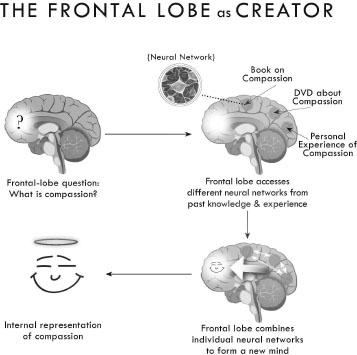
Figure 5B. When the frontal lobe is working in creative mode, it looks out over the landscape of the entire brain and gathers all of the brain’s information to create a new mind. If compassion is the new state of being that you want to create, then once you ask yourself what it would be like to be compassionate, the frontal lobe would naturally combine different neural networks together in new ways to create a new model or vision. It might take stored information from books you read, DVDs you saw, personal experiences, and so forth to make the brain work in new ways. Once the new mind is in place, you see a picture, hologram, or vision of what compassion means to you.
3. Making Thought More Real Than Anything Else
During the creative process, the frontal lobe’s third vital role is to make thought more real than anything else. (Stay tuned for the how-to in Part III.)
When we’re in a creative state, the frontal lobe becomes highly activated and lowers the volume on the circuits in the rest of the brain so that little else is being processed but a single-minded thought.3 Since the frontal lobe is the executive that mediates the rest of the brain, it can monitor all of the “geography.” So it lowers the volume on the sensory centers (responsible for “feeling” the body), motor centers (responsible for moving the body), association centers (where our identity exists), and the circuits that process time … in order to quiet them all down. With very little neural activity, we could say that there is no mind to process sensory input (remember that mind is the brain in action), no mind to activate movement within the environment, and no mind to associate activities with time; then we have no body, we have become “no thing,” we are no time. We are, in that moment, pure consciousness. With the noise shut off in those areas of the brain, the state of creativity is one in which there is no ego or self as we have known it.
When you are in creation mode, the frontal lobe is in control. It becomes so engaged that your thoughts become your reality and your experience. Whatever you’re thinking about in those moments is all there is for the frontal lobe to process. As it “lowers the volume” from other areas of the brain, it shuts out distractions. The inner world of thought becomes as real as the outer world of reality. Your thoughts are captured neurologically and branded into your brain’s architecture as an experience.
If you effectively execute the creative process, this experience produces an emotion, as you know, and you begin to feel like that event is actually happening to you in the present. You are one with the thoughts and feelings associated with your desired reality. You are now in a new state of being. You could say that in that moment, you are now rewriting the subconscious programs by reconditioning the body to a new mind.
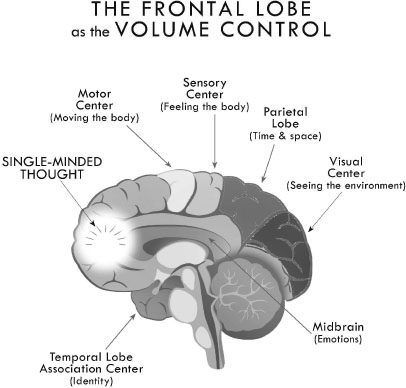
Figure 5C. When the thoght that you are attending to becomes the experience, the frontal lobe quiets down the rest of the brain so that nothing else is being processed but that single-minded thought. You become still, you no longer feel your body, you no longer perceive time and space, and you forget about yourself.
Lose Your Mind, Liberate Your Energy
In the act of creation, when we become that nobody or no thing in no time, we no longer create our customary chemical signature, because we are not the same identity; we don’t think and feel in the same way. Those neural networks our survival thinking had wired are turned off, and the personality that was addicted to continually signaling the body to produce stress hormones is … gone.
In short, the emotional self that lived in survival mode is no longer functioning. The moment that happens, our former identity, the “state of being” bound by survival-based thinking and feeling, is no more. Since we are no longer “being” the same being, emotional energy that had been bound to the body is now free to move.
So where does the energy go that once fed that emotional self? It has to go somewhere, so it moves to a new place. That energy in the form of emotion moves up the body from the hormonal centers to the heart area (on its way to the brain) … and all of a sudden we feel great, joyful, expanded. We fall in love with our creation. That’s when we experience our natural state of being. Once we stop energizing that emotional self powered by the stress response, we have moved from being selfish to selfless.4
With that old energy transmuted into a higher-frequency emotion, the body is liberated from its emotional bondage. We are lifted above the horizon to behold a whole new landscape. No longer perceiving reality through the lenses of those past survival emotions, we see new possibilities. We are now quantum observers of a new destiny. And that release heals the body and frees the mind.
Let’s revisit the chart of energy and frequencies from the survival emotions to the elevated emotions (see Figure 5A). When anger or shame or lust are released from the body, they will be transmuted into joy, love, or gratitude. On this journey to broadcasting higher energy, the body (which we conditioned to be the mind) becomes less “of the mind” and becomes more coherent energy; the matter that makes up the body expresses a higher vibratory rate, and we feel more connected to something greater. In short, we are demonstrating more of our divine nature.
When you’re living in survival, you’re trying to control or force an outcome; that’s what the ego does. When you’re living in the elevated emotion of creation, you feel so lifted that you would never try to analyze how or when a chosen destiny will arrive. You trust that it will happen because you have already experienced it in mind and body—in thought and feeling. You know that it will, because you feel connected to something greater. You are in a state of gratitude because you feel like it’s already happened.
You may not know all the specifics of your desired outcome—when it will take place, where, and under what circumstances—but you trust in a future that you can’t see or otherwise perceive with your senses. To you it has already occurred in no space, no time, no place, from which all things material spring forth. You are in a state of knowingness; you can relax into the present and no longer live in survival.
To anticipate or analyze when, where, or how the event will occur would only cause you to return to your old identity. You are in such joy that it’s impossible to try to figure it out; that’s only what human beings do when they are living in limited states of survival.
As you linger in this creative state where you are no longer your identity, the nerve cells that once fired together to form that old self are no longer wiring together. That’s when the old personality is being biologically dismantled. Those feelings connected to that identity, which conditioned the body to the same mind, are no longer signaling the same genes in the same ways. And the more you overcome your ego, the more the physical evidence of the old personality is changed. The old you is gone.
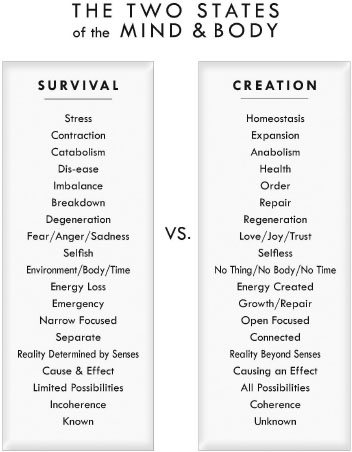
Figure 5D. Survival mode versus creation mode.
By completing Part I of this book, you have intentionally acquired a knowledge base that will help you create your new self. Now let’s build on that base.
We’ve covered a lot of possibilities: the concept that your subjective mind can affect your objective world; your potential to change your brain and body by becoming greater than your environment, your body, and time; and the prospect that you can move out of the reactive, stressful mode of living in survival, as though only the outer world is real, and enter the inner world of the creator. It is my hope that you can now view these possibilities as possible realities.
If you can, then I invite you to continue on to Part II, where you will gain specific information about the role of your brain and the meditative process that will prepare you to create real and lasting change in your life.