

I was sitting on my couch one day, thinking about what it means to be happy. As I contemplated my utter lack of joy, I thought about how most people who were important to me would have given me a pep talk right on the spot. I imagined it verbatim: You’re so incredibly lucky. You have a wonderful family, which includes beautiful kids. You are a successful chiropractor. You lecture to thousands of people, you travel the world going to unusual places, you were featured in What the BLEEP Do We Know!?, and many people loved your message. You even wrote a book, and it is doing well. They would have hit all of the right emotional and logical notes. But to me, something wasn’t right.
I was at a point in my life where I was traveling from city to city every weekend doing lectures; sometimes I was in two cities within three days. It occurred to me that I was so busy that I had no time to actually practice what I was teaching.
This was an unnerving moment, because I began to see that all of my happiness was created from outside of me, and that the joy I experienced when I was traveling and lecturing had nothing to do with real joy. It appeared to me that I needed everyone, everything, and everyplace outside of me in order to feel good. This image that I was projecting to the world was dependent on external factors. And when I was not out lecturing or doing interviews or treating patients, and I was home, I felt empty.
Don’t get me wrong; in some ways those things outside of me were great. If you had asked anyone who saw me lecturing, deeply engrossed in working on a presentation during a flight, or answering dozens of e-mails while in an airport or hotel lounge, such an observer would have said that I appeared to be pretty happy.
The sad truth is that if you had asked me at one of those moments, I would have probably responded in much the same way: Yes, things are great. I’m doing well. I’m a lucky guy.
But if you had caught me in a quiet moment, when all those other stimuli weren’t bombarding me, I would have responded in a completely different manner: Something’s not right. I feel unsettled. Everything feels like the same old, same old. Something is missing.
On the day I recognized the core reason for my unhappiness, I also realized that I needed the external world to remember who I was. My identity had become the people I talked to, the cities I visited, the things I did while I was traveling, and the experiences I needed in order to reaffirm myself as this person called Joe Dispenza. And when I wasn’t around anyone who could help me recall this personality that the world might know as me, I wasn’t sure who I was anymore. In fact, I saw that all of my perceived happiness was really just a reaction to stimuli in the external world that made me feel certain ways. I then understood that I was totally addicted to my environment, and I was dependent on external cues to reinforce my emotional addiction. What a moment for me. I had heard a million times that happiness comes from within, but it never hit me like this before.
As I sat on the couch in my house that day, I looked out the window and an image came to me. I envisioned my two hands, one above the other, separated by a gap.

HOW WE APPEAR
• The identity I project to the outer environment
• Who I want you to think I am
• The facade
• Ideal for the world
WHO WE REALLY ARE
• How I feel
• Who I really am
• How I am an the inside
• Ideal for self

Figure 7A. The gap between “who we really are” and “how we appear.”
The top hand represented how I appeared on the outside, and the bottom was how I knew myself to be on the inside. In my self-reflection, it dawned on me that we human beings live in a duality, as two separate entities—“how we appear” and “who we really are.”
How we appear is the image or the façade that we project to the world. That self is everything we do in order to show up looking a certain way and to present to others a consistent exterior reality. This first aspect of the self is a veneer of how we want everyone to see us.
How we really are, represented by that bottom hand, is how we feel, especially when we are not distracted by the external environment. It is our familiar emotions when we are not preoccupied by “life.” It’s what we hide about ourselves.
When we memorize addictive emotional states such as guilt, shame, anger, fear, anxiety, judgment, depression, self-importance, or hatred, we develop a gap between the way we appear and the way we really are. The former is how we want other people to see us. The latter is our state of being when we are not interacting with all of the different experiences, diverse things, and assorted people at various times and places in our lives. If we sit long enough without doing anything, we begin to feel something. That something is who we really are.
THE LAYERS of EMOTION
WE MEMORIZE that
CREATE the GAP
Unworthiness

Anger
Fear
Shame
Self-doubt
Guilt
PAST EXPERIENCES WITH REFRACTORY PERIOD
Figure 7B. The size of the gap varies from person to person. “Who we really are” and “how we appear” are separated by the feelings we memorize throughout different points in our lives (based on past experiences). The bigger the gap, the greater the addiction to the emotions we memorize.
Layer by layer, we wear various emotions, which form our identity. In order to remember who we think we are, we have to re-create the same experiences to reaffirm our personality and the corresponding emotions. As an identity, we become attached to our external world by identifying with everyone and everything, in order to remind us of how we want to project ourselves to the world.
How we appear becomes the façade of the personality, which relies on the external world to remember who it is as a “somebody.” Its identity is completely attached to the environment. The personality does everything it can to hide how it really feels or to make that feeling of emptiness go away: I own these cars, I know these people, I’ve been to these places, I can do these things, I’ve had these experiences, I work for this company, I am successful. … It is who we think we are in relation to everything around us.
But that is different from who we are—how we feel—without the stimulation of our outer reality: Feelings of shame and anger about a failed marriage. Fear of death and uncertainty about the afterlife, related to the loss of a loved one or even a pet. A sense of inadequacy due to a parent’s insistence on perfectionism and achievement at all costs. A sense of stifled entitlement from having grown up in circumstances barely above poverty. A preoccupation with thoughts of not having the right body type in order to look a certain way to the world. These kinds of feelings are what we want to conceal.
This is who we truly are, the real self hiding behind the image we are projecting. We can’t face exposing that self to the world, so we pretend to be someone else. We create a set of memorized automatic programs that work to cover the vulnerable parts of us. Essentially, we lie about who we are because we know that societal mores do not have room for that person. That is the “nobody.” That is the person whom we doubt others will like and accept.
Particularly when we are younger and are forming our identity, we are more likely to engage in this kind of masquerade. We see young people trying on identities like they try on clothes. And in truth, what teens wear is often a reflection of who they want to be, more than it reflects who they really are. Ask any mental-health professional who specializes in working with young people, and she will tell you that one word defines what it is like to be an adolescent: insecurity. As a result, teens and preteens seek comfort in conformity and in numbers.
Rather than let the world know what you are really like, adopt and adapt (because everyone knows what happens to those who are perceived to be different). The world is complex and scary, but make it less frightening and much simpler by lumping everyone into groups. Pick your group. Pick your poison.
Eventually, that identity fits. You grow into it. Or at least that’s what you tell yourself. Along with the insecurity comes a great deal of self-consciousness. Questions abound: Is this who I really am? Is this who I really want to be? But it’s so much easier to ignore those questions than to answer them.
Life Experiences Define Our Identity …
Staying Busy Keeps Unwanted Emotions at Bay
All of us have been emotionally scarred from traumatic or difficult experiences as young people. Early in life, we experienced defining events, the emotions of which contributed, layer by layer, to who we became. Let’s face it: we all have been branded by emotionally charged events. As we mentally reviewed the experience repeatedly, the body began to relive the event over and over, just by thought alone. We kept the refractory period of emotion running for so long that we journeyed from a mere emotional reaction to a mood, to a temperament, and ultimately, to a personality trait.
While we are young, we keep busy doing things that, for a while, stave off those old, deep emotions, sweeping them under the rug. It is intoxicating to make new friends, travel to unknown places, work hard and achieve a promotion, learn a new skill, or take up a new sport. We seldom suspect that many of these actions are motivated by feelings left over from certain earlier events in life.
Then we really get busy. We go to school, then possibly college; we buy a car; we move to a new town, state, or country; we begin a career; we meet new people; we get married; we buy a house; we have kids; we adopt pets; we may get divorced; we work out; we start a new relationship; we practice a skill or a hobby…. We use everything that we know in the external world to define our identity, and to distract us from how we really feel inside. And since all of these unique experiences produce myriad emotions, we notice that those emotions seem to take away any feelings that we are hiding. And it works for a while.
Don’t get me wrong. We all reach greater heights from applying ourselves throughout different periods in our growing years. In order to accomplish many things in our lifetimes, we have to push ourselves outside our comfort zones and go beyond familiar feelings that once defined us. I am certainly aware of this dynamic in life. But when we never overcome our limitations and continue carrying the baggage from our past, it will always catch up with us. And this usually happens starting around our mid-30s (this can vary greatly from one person to another).
Midlife: A Series of Strategies
to Make Buried Feelings Stay Buried
By our mid-30s or 40s, when the personality is complete, we have experienced much of what life has to offer. And as a result, we can pretty much anticipate the outcome of most experiences; we already know how they’re going to feel before we engage in them. Because we’ve had several good and bad relationships, we’ve competed in business or settled into our career, we’ve suffered loss and encountered success, or we know what we like and dislike, we know the nuances of life. Since we can predict the likely emotions ahead of an actual experience, we determine whether we want to experience that “known” event before it actually occurs. Of course, all of this is happening behind the scenes of our awareness.
Here is where it gets sticky. Because we can predict the feelings that most events will bring, we already know what will make our feelings about who we really are go away. However, when we reach midlife, nothing can completely take away that feeling of emptiness.
You wake up every morning and you feel like the same person. Your environment, which you relied on so heavily to remove your pain or guilt or suffering, is no longer taking away those feelings. How could it? You already know that when the emotions derived from the external world wear off, you will return to being the same leopard who hasn’t changed its spots.
This is the midlife crisis that most people know about. Some try really hard to make buried feelings stay buried by diving further into their external world. They buy the new sports car (thing); others lease the boat (another thing). Some go on a long vacation (place). Yet others join the new social club to meet new contacts or make new friends (people). Some get plastic surgery (body). Many completely redecorate or remodel their homes (acquire things and experience a new environment).
All of these are futile efforts to do or try something new so that they can feel better or different. But emotionally, when the novelty wears off, they are still stuck with the same identity. They return to who they really are (that is, the bottom hand). They are drawn back to the same reality they have been living for years, just to keep the feeling of who they think they are as an identity. The truth is, the more they do—the more they buy and then consume—the more noticeable the feeling of who they “really are” becomes.
When we’re trying to escape this emptiness, or when we’re running from any emotion whatsoever that is painful, it is because to look at it is too uncomfortable. So when the feeling starts to get a bit out of control, most people turn on the TV, surf the Internet, or call or text someone. In a matter of moments we can alter our emotions so many times … we can view a sitcom or a YouTube video and laugh hysterically, then watch a football game and feel competitive, then watch the news and be angered or fearful. All of these outer stimuli can easily distract us from those unwanted feelings inside.
Technology is a great distraction and a powerful addiction. Think about it: You can immediately change your internal chemistry and make a feeling go away by changing something outside of you. And whatever it was outside of you that made you feel better inside of you, you will rely on that thing in order to sidetrack yourself over and over again. But this strategy doesn’t have to involve technology; anything momentarily thrilling will do the trick.
When we keep that diversion up, guess what eventually happens? We grow more dependent on something outside of us to change us internally. Some people unconsciously delve deeper and deeper into this bottomless pit, using different aspects of their world to keep themselves preoccupied—in an effort to re-create the original feeling from the very first experience that helped them escape. They become overstimulated so that they can feel different from how they really are. But sooner or later, everyone realizes that they need more and more of the same to make them feel better. This becomes an all-consuming search for pleasure and ways to avoid pain at all costs—a hedonistic life unconsciously driven by some feeling that won’t seem to go away.
A Different Midlife: A Time for Facing
Feelings and Letting Go of Illusions
At this time of life, other people who don’t strive to keep their feelings buried ask some big questions: Who am I? What is my purpose in life? Where am I going? Who am I doing all of this for? What is God? Where do I go when I die? Is there more to life than “success”? What is happiness? What does all this mean? What is love? Do I love myself? Do I love anyone else? And the soul begins to wake up….
These types of questions begin to occupy the mind because we see through the illusion and suspect that nothing outside of us can ever make us happy. Some of us ultimately realize that nothing in our environment is going to “fix” the way we feel. We also recognize the enormous amount of energy it takes to keep up this projection of self as an image to the world, and how exhausting it is to keep the mind and body constantly preoccupied. Eventually we come to see that our futile attempt to maintain an ideal for others is really a strategy to make sure that those impending feelings we’ve been running from never capture us. How long can we juggle, keeping so many balls in the air, just so our lives don’t come crashing down?
Instead of buying a bigger TV or the latest smart phone, these people stop running from the feeling that they’ve been trying to make go away for so long, face it head-on, and intently look at it. When this happens, the individual begins to wake up. After some self-reflection, she discovers who she really is, what she has been hiding, and what no longer is working for her. So she lets go of the façade, the games, and the illusions. She is honest about who she really is, at all costs, and she is not afraid to lose it all. This person stops expending the energy she had been putting into keeping an illusory image intact.
She gets in touch with her feelings and then turns to people in her life and says: You know what? It doesn’t matter if I don’t make you happy any longer. I’m through obsessing about how I look or what other people think about me. I am finished living for everyone else. I want to be free from these chains.
This is a profound moment in a person’s life. The soul is waking up and nudging her to tell the truth about who she really is! The lie is over.
Change and Our Relationships:
Breaking the Ties That Bind
Most relationships are based on what you have in common with others. Think about this: You meet a person, and immediately the two of you compare your experiences, as if you both are checking to see whether your neural networks and emotional memories are aligned. You say something like this: “I know these ‘people.’ I am from this ‘place,’ and I lived in these places at these different ‘times’ in my life. I went to this school and studied this subject. I own and do these ‘things.’ And most important, I’ve had these ‘experiences.’”
Then the other person responds: “I know those ‘people.’ I’ve lived in those ‘places’ during those ‘times.’ I do these ‘things,’ too. I had those same ‘experiences.’”
Thus, you can relate to each other. A relationship is then formed based on neurochemical states of being, because if you share the same experiences, you share the same emotions.
Think of emotions as “energy in motion.” If you share the same emotions, you share the same energy. And just like two atoms of oxygen that share an invisible field of energy beyond space and time in order to bond together in a relationship to form air, you are bonded in an invisible field of energy to every thing, person, and place in your external life. Bonds between people are the strongest, though, because emotions hold the strongest energy. As long as either party doesn’t change, things will be just fine.
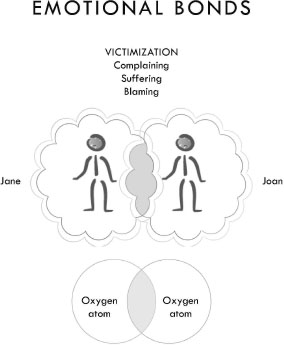
Figure 7C. If we share the same experiences, we share the same emotions and the same energy. Just like two atoms of oxygen bond to form the air we breathe, an invisible field of energy (beyond space and time) bonds us emotionally.
So when our friend in the example in the last section begins to tell the truth about how she really feels, things begin to get very uncomfortable. If her friendships have been based upon complaining about life, then she is bonded energetically in her relationships by the emotions of victimization. If, in a moment of enlightenment, she now decides to break from that habit of being herself, she is no longer showing up as that familiar person to whom everyone could relate. People in her life are using her to remind themselves of who they are emotionally as well. Friends and family respond: “What is wrong with you today? You’ve hurt my feelings!” Which translates to: I thought we had a good thing going here! I used you to reaffirm my emotional addiction in order to remember who I think I am as a “somebody.” I liked you better the other way.
When it comes to change, our energy is connected to everything that we’ve had an experience with in our outer world. When we break the addiction of emotion we’ve memorized, or when we tell the truth about who we really are, doing that takes some real energy. Just as it takes energy to separate two atoms of oxygen that are bonded together, it takes energy to break the bonds with the people in our lives.
So the individuals in this person’s life who have shared the same emotional bonds with her rally together and say, “She hasn’t been herself lately. Maybe she’s lost her mind. Let’s get her to a doctor!”
Now remember that they have been people she shared the same experiences with; hence, they shared the same emotions. But now she’s breaking the energetic bonds with everyone and everything—and even every place—familiar. This is a threatening moment for everyone who has been playing the same game with her for years. She’s getting off the train.
So they bring her to the doctor, who gives her Prozac or some other drug, and in a short time, the person’s former personality returns. And there she is, projecting her old image to the world, right back to shaking hands on others’ emotional agreements. Once more she’s numb and smiling—anything to take the feeling away. The lesson goes unlearned.
Yes, the person wasn’t being herself—not the “top-hand” self that everyone had grown accustomed to. Instead, briefly, she was the “bottom-hand” self—the one with the past and the pain. And who can blame those loved ones who insisted on the return to her former numbed self that “went along to get along”? That new self emerged as unpredictable, even radical. Who wants to be around that person? Who wants to be around the truth?
What Really Matters in the End
If you need the environment in order to remember who you are as a somebody, what happens when you die and the environment rolls up and disappears? Do you know what goes with it? The somebody, the identity, the image, the personality (top hand) that has identified with all of the known and predictable elements in life, who was addicted to the environment. You could have been the most successful, popular, or beautiful person, and you could have had all the wealth you ever needed … but when your life ends and your external reality is taken away, everything outside of you can no longer define you. It all goes.
What you’re left with is who you really are (bottom hand), not how you appear. When your life is over and you cannot rely on your external world to define you, you will be left with that feeling you never addressed. You would not have evolved as a soul in that lifetime.
For instance, if you had certain experiences 50 years prior that marked you as insecure or weak and you felt that way about yourself ever since, then you stopped growing emotionally 50 years ago. If the soul’s purpose is to learn from experience and gain wisdom, but you stayed stuck in that particular emotion, you never turned your experience into a lesson; you didn’t transcend that emotion and exchange it for any understanding. While that feeling still anchors your mind and body to those past events, you are never free to move into the future. And if a similar experience shows up in your present life, that event will trigger the same emotion and you will act as that person you were 50 years ago.
So your soul says: Pay attention! I’m letting you know that nothing is bringing you joy. I’m sending you urges. If you keep playing this game, I’m going to stop trying to get your attention, and you will go back to sleep. Then I’ll see you when your life is over. …
It Always Takes More and More
Most people who do not know how to change think, How can I make this feeling go away? And if the novelty of accumulating new things wears off and stops working, what do they do? They look to bigger things, a whole other layer above where they were, and their avoidance strategies become addictions: If I take a drug or drink enough alcohol, that’s going to make this feeling go away. This external thing will produce an internal chemical change and make me feel great. I’ll shop a lot, because shopping—even if I don’t have the money—makes that emptiness go away. I’ll watch pornography … I’ll play video games … I’ll gamble … I’ll overeat….
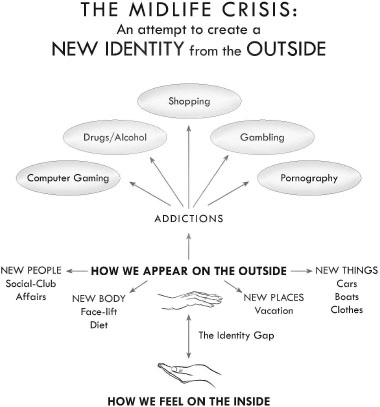
Figure 7D. When the same people and things in our lives create the same emotions, and the feeling we are trying to make go away no longer changes, we look for new people and things, or try going to new places, in an attempt to change how we feel emotionally. If that doesn’t work, we go to the next level—addictions.
Whatever the addiction, people are still thinking that some external thing is going to take that internal feeling away. And remember: we have this natural propensity to associate an external thing that’s making that feeling go away with our internal chemical change. And we like that external thing if it makes us feel good. So we run away from what feels bad or painful, and we move toward what feels good and comfortable or brings us pleasure.
As the excitement people get from their addiction continually stimulates the pleasure centers in the brain, they get a flood of chemicals from the thrill of the experience. The problem is that each time they gamble, binge, or stay up late playing online games, they need a little bit more the next time.
The reason why people need more drugs or more shopping or more affairs is that the chemical rush that’s created from those activities activates the receptor sites on the outside of their cells, which “turns on” the cells. But if receptor sites are continually stimulated, they get desensitized and shut off. So they need a stronger signal, a bit more stimulation, to turn them on the next time—it takes a bigger chemical high to produce the same effects.
So now you’ve got to bet $25,000 instead of $10,000 because otherwise, there’s no thrill. Once a $5,000 shopping spree does nothing for you, you’ve got to max out two credit cards so you can feel that same rush again. All of this is to make the feeling of who you really are go away. Everything you do to get the same high, you have to keep doing more of, with increasing intensity. More drugs, more alcohol, more sex, more gambling, more shopping, more TV. You get the idea.
Over time, we become addicted to something in order to ease the pain or anxiety or depression we live by on a daily basis. Is this wrong? Not really. Most people do these things because they just don’t know how to change from the inside. They are only following the innate drive to get relief from their feelings, and unconsciously they think their salvation comes from the outside world. It has never been explained to them that using the outer world to change the inner world makes things worse … it only widens the gap.
And let’s say that our ambition in life is to become successful and to accumulate more things. When we do, we reinforce who we are, without ever addressing how we really feel. I call this being possessed by our possessions. We become possessed by material objects, and those things reinforce the ego, which needs the environment to remind itself of who it is.
If we wait for anything outside us to make us happy, then we are not following the quantum law. We are relying on the outer to change the inner. If we are thinking that once we have the wealth to buy more things, then we will be overjoyed, we’ve got it backward. We have to become happy before our abundance shows up.
And what happens if addicts can’t get more? They feel even angrier, more frustrated, more bitter, more empty. They may try other methods—add gambling to drinking, add shopping to TV and movie escapism. Eventually, though, nothing is ever enough. The pleasure centers have recalibrated to such a high level that when there is no chemical change from the outer world, it seems the addict now cannot find joy in the simplest things.
The point is, true happiness has nothing to do with pleasure, because the reliance on feeling good from such intensely stimulating things only moves us further from real joy.
The Bigger Gap—Emotional Addiction
I don’t intend to diminish the severity of the damage caused by what I’ll loosely refer to here as material addictions—to drugs, alcohol, sex, gambling, consumerism, and so forth. Those problems cause great harm to the numerous people who suffer from them and to those who love and work with such “addicts.” While many people who experience these and other addictions can use the steps in these pages to overcome them—since they are a part of the Big Three—it’s beyond the scope of this book to deal with these kinds of addictions specifically. But it is imperative to realize that behind every addiction, there is some memorized emotion that is driving the behavior.
What is not beyond the scope of this book and is, in fact, its central purpose is helping people break the habit of being themselves, whether they view that self as being an alcoholic; a sexaholic; a gambler; a shopaholic; or someone who is chronically lonely, depressed, angry, bitter, or physically unwell.
In thinking about the gap, possibly you said to yourself: Well, of course we hide from other people our fears, insecurities, weaknesses, and dark side. If we gave those things free rein to be fully expressed, we’d likely be beyond anyone else’s caring about us, let alone our caring about ourselves. In a sense, that’s true. But if we are to break free, it means we have to confront that true self and bring out into the light that shadow side of our personality.
The advantage of the system I employ is that you can confront those darker aspects of yourself without bringing them into the light of your everyday reality. You don’t have to walk into your place of work or a family gathering and announce: “Hey, listen up, everyone! I’m a bad person because for a long time I resented my parents for having to spend a lot of time with my younger sibling, while I felt my needs were being neglected. So now I’m a really selfish person who craves attention and needs instant gratification in order to stop feeling unloved and inadequate.”
Instead, in the privacy of your own home and your own mind, you can work on extinguishing negative aspects of self and replacing those characteristics (or at least, metaphorically, cutting way back on the role they play and allowing them only an occasional, brief appearance) with more positive and productive ones.
I want you to forget about past events validating the emotions you’ve memorized that have become part of your personality. Your problems will never be resolved by analyzing them while you are still caught up in the emotions of the past. Looking at the experience or reliving the event that created the problem in the first place will only bring up the old emotions and a reason to feel the same way. When you try to figure out your life within the same consciousness that created it, you will analyze your life away and excuse yourself from ever changing.
Instead, let’s just unmemorize our self-limiting emotions. A memory without the emotional charge is called wisdom. Then we can look back objectively upon the event and see it and who we were being, without the filter of that emotion. If we take care of unmemorizing the emotional state (or eliminating it to the best of our ability), then we gain the freedom to live and think and act independent of the restraints or constraints of that feeling.
So if a person relinquished unhappiness and got on with his life—entered into a new relationship, got a new job, moved to a new place, and made new friends—and then he looked at that past event, he would see that it provided the adversity he needed in order to overcome who he was and become a new person. His perspective would change, just by seeing that he could actually overcome the problem.
Closing and even eliminating the gap between who we are and who we present to the world is likely the greatest challenge we all face in life. Whether we term this living authentically, conquering ourselves, or having people “get” us or accept us for who we are, this is something that most of us desire. Changing—-closing the gap—must begin from within.
Yet far too often, most of us change only when we are faced with a crisis, trauma, or discouraging diagnosis of some sort. That crisis commonly comes in the form of a challenge, which may be physical (an accident, say, or an illness), emotional (the loss of someone we love, for example), spiritual (for instance, an accumulation of setbacks that has us questioning our worth and how the universe operates), or financial (a job loss, perhaps). Note that all of the above are about losing something.
Why wait for trauma or loss to occur and have your ego get knocked off balance due to that negative emotional state? Clearly, when a calamity befalls you, you have to act—you can’t take care of business as usual when you’ve been knocked, as the expression goes, to your knees.
At those critical moments when we’ve really, really grown tired of being beaten down by circumstances, we’ll say: This can’t go on. I don’t care what it takes or how I feel [body]. I don’t care how long it takes [time]. No matter what’s going on in my life [environment], I’m going to change. I have to.
We can learn and change in a state of pain and suffering, or we can do so in a state of joy and inspiration. We don’t have to wait until we are so uncomfortable that we feel forced to move out of our resting state.
Side Effects of Closing the Gap
As you know, one of the key skills you need to develop is self-awareness/self-observation. That’s a shortcut definition of what I mean when I talk about meditation in the next chapter. In meditation, you’re going to look at the negative emotional state that has had such an impact on your life. You’re going to recognize the primary state of your personality that drives your thoughts and behaviors so that you become intimately familiar with every nuance of them. Over time, you’re going to use those powers of observation to help you unmemorize that negative emotional state. By doing so, you will surrender that emotion to a greater mind, closing the gap between who you are and who you have presented to the world in the past.
Picture yourself standing in a room with arms outstretched, pushing the opposite walls apart. Do you have any idea how much energy you would consume if you were trying to keep those walls from crushing you? Instead of doing that, what if you released those two walls, took a couple of steps forward (after all, that gap is kind of like a door, isn’t it?), and walked out of that room and into a completely new one. What about that other room you left behind? Well, the walls have come together in such a way that you can’t ever get back inside it. That gap has closed, and the separate parts of you have become unified. And what’s going to happen to all that energy you were expending? Physics states that energy can’t be created or destroyed; it can only be transferred or transformed. That’s exactly what’s going to happen to you when you get to the point that no thought, no emotion, no subconscious behavior goes unnoticed.
You can think of this another way: You’ll be going into the operating system of the subconscious and bringing all that data and those instructions into your conscious awareness, to truly see where those urges and proclivities that have taken control of your life are located. You become conscious of your unconscious self.
When we break the chains of that bond, we liberate the body. It is no longer the mind, living in the same past day after day. When we liberate the body emotionally, we close the gap. When we close the gap, we release the energy that was once used to produce it. With that energy, we now have the raw material we can use to create a new life.
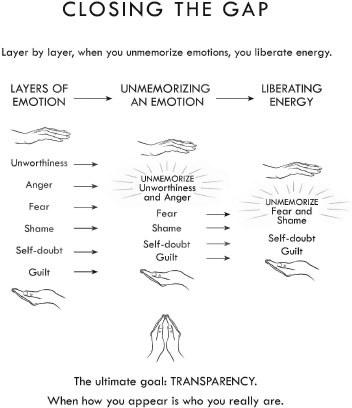
Figure 7E. As you unmemorize any emotion that has become part of your identity, you close the gap between how you appear and who you really are. The side effect of this phenomenon is a release of energy in the form of a stored emotion in the body. Once the mind of that emotion is liberated from the body, energy is freed up into the quantum field for you to use as a creator.
Another side effect of breaking the bonds of your emotional addictions is that this release of energy is like a healthy shot of some wonderful elixir. Not only are you energized, but you feel something you likely haven’t felt in quite a while—joy. When you liberate the body from the chains of an emotional dependency, you will feel uplifted and inspired. Have you ever taken a long car trip? When you get out of your vehicle and finally stretch a bit and breathe fresh air, and the sound of the car’s tires on the pavement or the heater’s fan or the air conditioner’s whir falls silent, that’s a great feeling. Imagine how much better those new sensations would feel if you’d been locked in the trunk for 2,000 miles! For a lot of us, that’s exactly how we’ve been feeling for a significant stretch of time.
Keep in mind that it’s not enough merely to notice how you’ve been thinking, feeling, and behaving. Meditation requires you to be more active than that. You also have to tell the truth about yourself. You have to come clean and reveal what you’ve been hiding in that shadow part of the gap. You have to drag those things out into the bright light of day. And when you really see what you’ve been doing to yourself, you have to look at that mess and say, This is no longer serving my best interests. This is no longer serving me. This has never been loving to myself. Then you can make a decision to be free.
From Victimization to Unexpected Abundance:
How One Woman Closed the Gap
One person who reaped the rewards of facing her life with the courage of a quantum observer is Pamela, a participant in one of my seminars. Pamela struggled financially because for two years, her unemployed ex-husband hadn’t paid the mandated child support. Frustrated, angry, and feeling victimized, she even reacted negatively to unrelated situations.
The meditation we did that day was about how the end product of any experience is an emotion. Because so many of our experiences involve family and friends, we share the resultant emotions with them. That’s usually a good thing: bonds related to places we’ve been, things we’ve done—even objects we’ve shared—can strengthen our connection with people. But the flip side is that we also share the emotions associated with negative experiences.
We bond energetically with one another in a place beyond time and space. Because we are entangled with others (to use quantum terms) and frequently bond through survival-oriented emotions, it is almost impossible for us to change when we are still connected by negative experiences and emotions. Thus, reality stays the same.
In Pamela’s case, her ex-husband’s anxiety, guilt, and feelings of inferiority about not being able to support his children were interwoven into the fabric of her state of being, along with her own emotions of victimization, resentment, and lack. Whenever opportunity knocked, her victimhood reared its ugly head and produced an undesirable outcome. Her destructive emotions and the energy associated with them had virtually frozen her in a stagnant state of thinking, doing, and being. No matter what she did to try to change this situation, she and her ex-husband were bonded together by their mutual negative experiences, emotions, and energies; and thus none of her efforts ever changed her circumstances with him.
The workshop helped Pamela realize that she had to break this bond. She had to let go of the emotions that defined her in her present reality. She also learned how a cycle of thinking, feeling, and acting in the same way for years could produce a cascade effect that might trigger genes for disease—and she didn’t want that to happen. Something had to give.
I like that phrase, because as Pamela told me afterward, during the meditation she recognized the injurious emotions that her victimization had set in motion—impatience with her kids, complaining and blaming, and feelings of desperation and lack. She let go of those emotions associated with past experiences, simultaneously releasing her self-involved state of being, and gave them up to the greater mind.
In so doing, Pamela released all of that frozen energy into the quantum field, closing the gap between who she thought she was and who she presented to the world. She did this so well—she started to feel so overjoyed and grateful—that she wanted abundance for everyone, not just herself. She moved from selfish emotions to selfless emotions. She got up from that meditation a different person from who she was before it.
Pamela’s energy release signaled the field to begin organizing outcomes that were just right for the new self she was in the process of becoming. Almost immediately, she received evidence of this in two forms.
The first involved her Internet business. When she had previously tried a promotion, she fretted about the response to it, constantly checking her website, and saw only mediocre results. She initiated her second promotion the morning of the workshop, but was too busy to think about the results during the day. That evening, she was feeling the positive effects of having let go of the past. She felt even better when she discovered that she had earned nearly $10,000 that day from the promotion she’d run!
Pamela received the second piece of evidence three days later when her caseworker called to report that her ex had sent a check not just for that month, but for the full $12,000 in back support payments that he owed. She was beyond pleased to have “made” nearly $22,000 after doing that meditation. She did nothing in the physical realm to bring about those results, and couldn’t have predicted how that money would find its way to her, but she was enormously grateful that it had.
What Pamela’s story illustrates is the power of letting go of negative emotions. When we are mired in our timeworn mind-set and habitual behaviors and perceptions, there’s no way for us to find solutions to problems rooted in the past. And those problems (experiences, really) produce powerful energetic emotions. Once we relinquish those, we experience an enormous release of energy, and reality magically rearranges itself.
By Moving Out of the Past,
We Can Set Our Sights on the Future
Think about how much of your creative energy is tied up in guilt, judgment, fear, or anxiety related to people and experiences from your past. Imagine how much good you could do by converting any destructive energy to productive energy. Contemplate what you could accomplish if you weren’t focused on survival (a selfish emotion), but instead worked to create out of positive intentions (a selfless emotion).
Ask yourself: What energy from past experiences (in the form of limited emotions) am I holding on to that reinforces my past identity and emotionally attaches me to my current circumstances? Could I use this same energy and transform it into an elevated state from which to create a new and different outcome?
Meditating will help you peel away some of the layers, remove some of the masks you’ve worn. Both of those things have blocked the flow of that grand intelligence within you. As a result of shedding those layers, you will become transparent. You are transparent when how you appear is who you are. And when you live your life that way, you will experience a state of gratitude, of elevated joy, which I believe is our natural state of being. As you do this, you begin to move out of the past so that you can set your sights on the future.
As you remove the veils that block the flow of this intelligence within you, you become more like it. You become more loving, more giving, more conscious, more willful—because that is its mind. The gap closes.
At that stage, you feel happy and whole. You no longer rely on the external world to define you. The elevated emotions you are feeling are unconditional. Nobody else and no event can make you feel that way. You are happy and feel inspired just because of who you are.
You no longer live in a state of lack or want. And do you know the funny thing about not wanting or lacking for anything? That’s when you can really begin to manifest things naturally. Most people try to create in a state of lack, unworthiness, separation, or some other limited emotion rather than from a state of gratitude, enthusiasm, or wholeness. That’s when the field responds most favorably to you.
All this starts with recognizing that the gap exists, and meditating on the negative emotional states that have produced that gap and dominated your personality. Unless you are prepared to look closely at yourself, and assess your propensities with tender honesty (not beating yourself up for your failings), you will forever be mired in some past event and the negative emotions it produced. See it. Understand it. Release it. Create with the energy available to you by taking the mind out of the body and releasing it into the field.

The Advertising Connection
Please understand that advertising agencies and their corporate clients fully understand the notion of lack and how it plays a commanding role in our behavior. They want us to believe that they have the answers to take away that emptiness, by our identifying with their product.
Advertisers even put famous faces in their ads to subconsciously plant the seed that the consumer can surely relate to this person as the “new you.” Feeling bad about yourself? Buy something! Don’t fit in socially? Buy something! Feeling a negative emotion because of some sense of loss, separation, or longing? This microwave/big-screen TV/car/cell phone … whatever … is just the ticket. You’ll feel better about yourself, be accepted by society, and have 40 percent fewer cavities as well! We are all controlled emotionally by this notion of lack.
How My Transformation Began …
and Perhaps Some Inspiration for Your Own
I started this chapter by telling you of that moment when I was sitting on my couch and realized that there was quite a gap between who I really was and the identity I presented to the world. So I’d like to close this chapter by telling you the rest of the story….
Around the time this happened, I was traveling frequently, lecturing to people who had seen me in the movie What the BLEEP Do We Know!? When I was speaking in front of groups, I felt really alive, and I’m sure I came across as happy. But in that moment, I was feeling numb. That’s when it hit me. I had to show up being how everybody expected me to be, based on how I appeared in the movie. I’d started believing I was somebody else, and I needed the world to remind me of who I thought I was. I was actually living two different lives. No longer did I want to be trapped by that.
As I sat alone that morning, I felt my heart beating, and I started thinking about who was beating my heart. I realized in one instant that I had distanced myself from this innate intelligence. I closed my eyes and put all of my attention on it. I started to admit who I’d been, what I’d been hiding, and how unhappy I was. I began to surrender some aspects of myself to a greater mind.
I then reminded myself of who I no longer wanted to be. I decided how I no longer wanted to live based on that same personality. Next, I observed my unconscious behaviors, thoughts, and feelings that reinforced my old self and reviewed them until they became familiar to me.
Then I thought about who I did want to be as a new personality … until I became it. Suddenly I began to feel different—joyful. This had nothing to do with all of those things outside of me; it was part of an identity that was independent of any of that external stuff. I knew that I was on to something.
I had an immediate reaction after that first meditation on the couch, and it caught my attention, because I didn’t get up as the same person who had sat down. I stood up and I felt so aware and so alive. It was like I was seeing so many things for the first time. Some mask was removed from me, and I wanted more of that.
So I retreated from my life for about six months. I kept up my clinical practice to some degree, but I canceled all my lectures. My friends thought I was losing my mind (I was), because What the BLEEP was at its height, and they reminded me about how much money I could have been making. But I said I would never walk onstage again until I was no longer living an ideal for the world, but one for myself. I didn’t want to lecture again until I was the living example of everything that I was talking about. I needed to take time for my meditations and to make true change in my life, and I wanted to have joy from within me and not from outside of me. And I wanted that to come across when I lectured.
My transformation wasn’t immediate. I meditated every day, looking at my unwanted emotions, and one by one, I began to unmemorize them. I started my meditative processes of unlearning and relearning, and I worked for months to change myself. In the process, I was intentionally dismantling my old identity and breaking the habit of being myself.
That’s when I began to feel joyful for no reason. I became happier and happier, and it had nothing to do with anything outside me. Today, I make time to meditate every morning because I want more of that state of being.

Whatever has drawn you to this book, when you make up your mind to change, you have to move to a new consciousness. You must become very clear about what you’re doing, how you’re thinking, how you’re living, how you’re feeling, and how you’re being … to the point that it isn’t you, and you don’t want to be it any longer. And that shift has to reach you on a gut level.
What you’re about to learn is what I did, the steps I took in making my own personal changes. But take heart—you very well may have done something similar in your life already. There is just a little more knowledge to come, related to the meditative process, in order for you to make this method of change a skill. So let’s get to it.
