Reality can be a bit of a moving target—literally. We’re used to thinking of reality as something fixed and certain, but as you’ll soon see in this chapter, the way we’ve always been taught to see it isn’t the way it really is. And if you’re going to learn how to be your own placebo by using your mind to affect matter, it’s vital that you understand the true nature of reality, how mind and matter are related, and how reality can shift—because if you don’t know how and why those shifts occur, you won’t be able to direct any outcomes according to your intentions.
Before we dive into the quantum universe, let’s take a look at where our ideas about reality came from and where they’ve brought us so far. Thanks to René Descartes and Sir Isaac Newton, for centuries the study of the universe was divided into two categories: matter and mind. The study of matter (the material world) was declared the realm of science, because for the most part, the laws of the universe that govern the objective outer world could be calculated and therefore predicted. But the inner realm of the mind was considered too unpredictable and complicated, so it was therefore left to the auspices of religion. Over time, matter and mind became separate entities, and dualism was born.
Newtonian physics (also known as classical physics) deals with the mechanics of how objects function in space and time, including their interactions with each other in the material, physical world. Because of Newton’s laws, we can measure and predict what path planets take around the sun, how quickly an apple accelerates when it falls from a tree, and how long it takes to go from Seattle to New York by plane. Newtonian physics is about the predictable. It looks at the universe as if it functioned like an enormous machine or a huge timepiece.
But classical physics has its limitations when it comes to the study of energy, the actions of the immaterial world beyond space and time, and the behavior of atoms (the building blocks of everything in the physical universe). That realm belongs to quantum physics. And it turns out that this very tiny subatomic world of electrons and photons doesn’t behave anything like the much larger world of planets, apples, and airplanes that we’re more familiar with.
When quantum physicists began to look at the smaller and smaller aspects of an atom, like what makes up the nucleus, the closer they looked, the less distinct and clear the atom became, until eventually it just completely disappeared. Atoms, they tell us, appear to be 99.999999999999 percent empty space.1 But that space isn’t really empty. It’s actually filled with energy. More specifically, it’s made up of a vast array of energy frequencies that form a kind of invisible, interconnected field of information. So if every atom is 99.999999999999 percent energy or information, that means that our known universe and every thing in it—no matter how solid that matter may appear to us—is essentially just energy and information. That’s a scientific fact.
Atoms do contain a smattering of matter, but when the quantum physicists tried to study it, they discovered something really strange: Subatomic matter in the quantum world doesn’t behave anything at all like the matter we’re used to dealing with. Instead of adhering to the laws of Newtonian physics, it appears somewhat chaotic and unpredictable, completely disregarding the boundaries of time and space. In fact, on the subatomic quantum level, matter is a momentary phenomenon. It’s here one moment, and then it disappears. It exists only as a tendency, a probability, or a possibility. In the quantum, there are no absolute physical things.
That wasn’t the only strange discovery that scientists made about the quantum universe. They also found that when they observed particles of subatomic matter, they could affect or change their behavior. The reason they’re here and gone (and then here and gone again all the time) is that all of these particles actually exist simultaneously in an infinite array of possibilities or probabilities within the invisible and infinite quantum field of energy. It’s only when an observer focuses attention on any one location of any one electron that the electron actually appears in that place. Look away, and the subatomic matter disappears back into energy.
So according to this “observer effect,” physical matter can’t exist or manifest until we observe it—until we notice it and give it our attention. And when we’re no longer paying attention to it, it vanishes, going back from whence it came. So matter is constantly transforming, oscillating between manifesting into matter and disappearing into energy (about 7.8 times per second, as a matter of fact). And so because the human mind (as the observer) is then intimately connected to the behavior and appearance of matter, you could say that mind over matter is a quantum reality. Another way to look at it is this: In the tiny world of the quantum, the subjective mind has an effect on objective reality. Your mind can become matter; that is, you can make your mind matter.
Since subatomic matter makes up everything we can see and touch and experience in our macro world, then in a sense we—along with everything in our world—are also doing this disappearing and reappearing act all the time. And so if subatomic particles exist in an infinite number of possible places simultaneously, then in some way, so do we. And just as these particles go from existing everywhere simultaneously (wave, or energy) to existing precisely where the observer looks for them at the moment the observer is paying attention (particle, or matter), we’re also potentially capable of collapsing an infinite number of potential realities into physical existence.
In other words, if you can imagine a particular future event that you want to experience in your life, that reality already exists as a possibility somewhere in the quantum field—beyond this space and time—just waiting for you to observe it. If your mind (through your thoughts and feelings) can affect when and where an electron appears out of nowhere, then theoretically, you should be able to influence the appearance of any number of possibilities that you can imagine.
From a quantum perspective, if you observed yourself in a particular new future that was different from your past, expected that reality to occur, and then emotionally embraced the outcome, you’d be—for a moment—living in that future reality, and you’d be conditioning your body to believe it was in that future in the present moment. So the quantum model, which states that all possibilities exist in this moment, gives us permission to choose a new future and observe it into reality. And because the entire universe is made of atoms, with more than 99 percent of an atom being energy or possibility, that means that there’s a lot of potentials out there that you and I might be missing.
However, this also means that you create by default as well. If you, as the quantum observer, look at your life from the same level of mind every day, then according to the quantum model of reality, you’re causing infinite possibilities to collapse into the same patterns of information day in and day out. Those patterns, which you call your life, never change, so they never allow you to effect change.
So the mental rehearsal I talked about earlier is certainly not idle daydreaming or wishful thinking. It is, in a very real sense, the way you can intentionally manifest your desired reality, including a life without pain or disease. By focusing more on what you do want and less on what you don’t want, you can call into existence whatever you desire and simultaneously “fade away” what you don’t want by no longer giving it your attention. Where you place your attention is where you place your energy. Once you fix your attention or your awareness or your mind on possibility, you place your energy there as well. As a result, you’re affecting matter with your attention or observation. The placebo effect is not fantasy, then; it’s quantum reality.
Energy on the Quantum Level
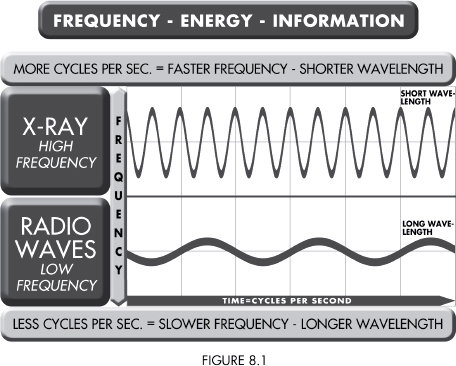
All atoms in the elemental world emit various electromagnetic energies. For example, an atom can give off invisible fields of energy at different frequencies that include x-rays, gamma rays, ultraviolet rays, and infrared rays, as well as visible light rays. And just as invisible radio waves carry a frequency with specific information encoded into it (whether it’s 98.6 or 107.5 hertz), each different frequency likewise carries specific diverse information, as shown in Figure 8.1. For example, x-rays carry very different information than infrared rays do, because they are different frequencies. All of these fields are different energy patterns that are always giving off information at the atomic level.
This chart shows two different frequencies that each carry different information and therefore have different qualities. X-rays behave differently from radio waves and thus have different inherent characteristics.
Think of atoms as vibrating fields of energy or small vortices that are constantly spinning. To better understand how that works, let’s use the analogy of a fan. Just like a circular fan creates wind (a vortex of air) when it’s turned on, each atom, as it spins, radiates a field of energy in a similar fashion. And just like a fan can spin at different speeds and so create stronger or weaker wind, atoms also vibrate at different frequencies that create stronger or weaker fields. The faster the atom vibrates, the greater the energy and frequency it emits. The slower the speed of the atom’s vibration or vortex, the less energy it creates.
The slower a fan’s blades spin, the less wind (or energy) is created and the easier it is to see the blades as material objects in physical reality. On the other hand, the faster the blades spin, the more energy is created and the less you see of the physical blades; the blades appear to be immaterial. Where the fan blades can potentially appear (like the subatomic particles the quantum scientists were trying to observe that kept popping in and out of view) depends on your observation—where and how you look for them. And so it is with atoms. Let’s look at this in a little more depth.
In quantum physics, matter is defined as a solid particle, and the immaterial energetic field of information can be defined as the wave. When we study the physical properties of atoms, like mass, atoms look like physical matter. The slower the frequency that an atom is vibrating, the more time it spends in physical reality and the more it appears as a particle that we can see as solid matter. The reason physical matter appears solid to us, even though it’s mostly energy, is that all of the atoms are vibrating at the same speed we are.
But atoms also display many properties of energy or waves (including light, wavelengths, and frequency). The faster an atom vibrates and the more energy it generates, the less time it spends in physical reality; it’s appearing and disappearing too fast for us to see it, because it’s vibrating at a much faster speed than we are. But even though we can’t see the energy itself, we can sometimes see physical evidence of certain frequencies of energy, because the force field of atoms can create physical properties, such as the way infrared waves heat things up.
If you compare Figure 8.2A to Figure 8.2B, you can see how slower frequencies spend more time in the material world and thus appear as matter.
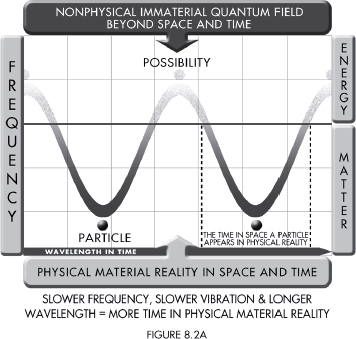
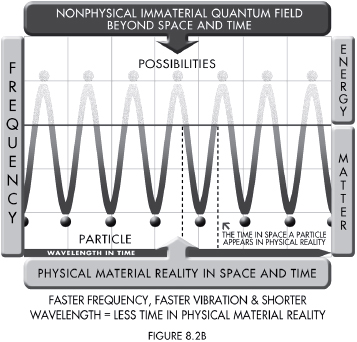
When energy vibrates slower, particles appear in physical reality for longer periods of time and thus appear as solid matter. Figure 8.2A shows how matter manifests from a slower frequency with a longer wavelength. Figure 8.2B depicts particles spending less time in physical reality, therefore they are more energy and less matter. That’s because they have shorter wavelengths, faster frequency, and a faster vibration.
So the physical universe may look as if it’s made up of only material matter, but in truth, it shares a field of information (the quantum field) that unifies matter and energy so intimately that it’s impossible to consider them as separate entities. That’s because all particles are connected in an immaterial invisible field of information beyond space and time—and that field is made of consciousness (thought) and energy (frequency, the speed at which things vibrate).
Because each atom has its own specific field of energy or energy signature, when atoms assemble collectively to form molecules, they share their fields of information and then radiate their own unique combined energy patterns. If everything material in the universe radiates a specific unique energy signature because everything is made of atoms, then you and I radiate our own specific energy signatures as well. You and I are always broadcasting information as electromagnetic energy—based on our states of being.
So when you change your energy to alter a belief or perception about yourself or your life, you’re actually increasing the frequency of the atoms and molecules of your physical body so that you’re amplifying your energy field (as shown in Figure 8.3). You’re turning up the speed on the atomic fans that make up your body. As you embrace a heightened, emotional creative state like inspiration, empowerment, gratitude, or invincibility, you’re causing your atoms to spin faster, just like the fan blades, and to broadcast a stronger energy field around your body, which affects your physical matter.
So the physical particles that make up your body are now responding to an elevated energy. You’re becoming more energy and less matter. You’re now more wave and less particle. Using your consciousness, you’re creating more energy so that matter can be lifted to a new frequency, and your body responds to a new mind.
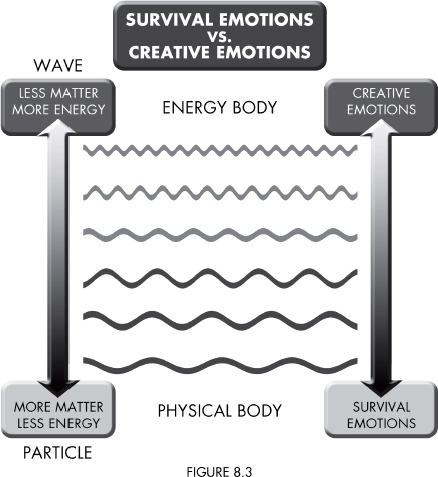
When you change your energy, you lift matter to a new mind, and your body vibrates at a faster frequency. You become more energy and less matter—more wave and less particle. The more elevated the emotion or the higher the creative state of mind, the more energy you have to rewrite the programs in the body. Your body then responds to a new mind.
Receiving the Right Energetic Signal
So how does matter become lifted to a new mind? Think of the preacher who moves into a state of religious ecstasy and drinks strychnine, with no biological effects. How did he overcome that chemistry that would normally poison the average person? It was his level of energy that transcended the effects of matter. He made a decision with such firm intention that his choice carried an amplitude of energy that transcended the laws of the environment, the effects on the body, and linear time. In that moment, he was more energy and less matter, and as a result, it was a new energy that rewrote the circuitry in his brain, the chemistry in his body, and his genetic expression. In that present moment, he wasn’t his identity that was connected to his familiar environment, nor was he his physical body, nor was he living in linear time. His elevated consciousness and energy were the epiphenomenon of matter. In other words, it’s both information and frequency that give rise to the blueprints of matter. And when we’re demonstrating an elevated level of awareness and energy, it’s these elements that influence matter—because matter is created from a lowering of frequency and information.
It’s entirely possible that the preacher’s cell-receptor sites weren’t selectively open for the strychnine; the cells’ doors were closed to poison and so were suspended from its effects. By being moved by the spirit—that is, moved by energy—he instantly upregulated the cells in his body for immunity and downregulated the cells in his body for poison. The same thing is at work with the firewalkers; once they change their state of being, their cell receptors are no longer open to the effects of heat. This is also what allowed the teenage girls to lift the 3,000-pound tractor to free their father, as you read about in Chapter 1. When they saw their father trapped and almost certain to die, their heightened state of energy turned off the cell receptors that normally would tell their bodies that the tractor was too heavy to lift and turned on the muscle-cell receptors to bear a greater load so that when they tried, their muscles responded and they were able to free their dad. It wasn’t matter (body) that was moving matter (tractor); it was energy that was influencing matter.
You’d have to agree with me that your body is made up of a vast array of atoms and molecules and that these atoms and molecules form chemicals. Those chemicals organize into cells, which form tissues that further organize into organs, which create various systems within your body. For example, a muscle cell is made of different chemicals (proteins, ions, cytokines, growth factors), which are made of the different interactions of molecules, which are made of various atomic bonds; those atoms share an invisible field of information to form molecules.
The chemicals that make up a cell also share a field of information. It’s that invisible field of information that orchestrates the hundreds of thousands of functions of the cell at any given second. Scientists are beginning to realize that a field of information exists that’s responsible for myriad cellular functions existing beyond the boundaries of matter.
It’s this invisible field of consciousness that orchestrates all of the functions of the cells, tissues, organs, and systems of the body. How do certain chemicals and molecules of your cells know what to do and interact with such precision? There’s an energetic field surrounding the cell that’s the summation of energy from atoms, molecules, and chemicals working together in balance that gives birth to matter, and it’s that vital field of information that matter draws from.
For instance, the muscle cells in the previous example can further organize and specialize into tissues called “muscle tissue.” Let’s say that the particular type of muscle tissue in this example is called “cardiac muscle.” Cardiac muscle tissue forms an organ called the “heart.” The tissues, which are made of cells, share a field of information that allows the heart to function in a coherent manner. The heart is part of the cardiovascular system of the entire body. As it shares this field of information, it organizes matter to function in a harmonic, holistic way. So the field that’s created that gives birth to matter is what controls matter. The greater the field, the faster the atoms vibrate—or the faster your subatomic fan blades spin.
The Newtonian model of biology is based on linear events in which chemical reactions occur in a sequence of steps. But that’s not actually how biology works; you can no longer explain something even as simple as how a cut heals without the understanding of the interconnected coherent information pathways you just read about. Cells share an intercommunication of information in a nonlinear way. The universe and all the biological systems within it share an integration of independent, entangled energy fields that, in turn, share information beyond space and time on a moment-to-moment basis.
Research confirms that most interactions between cells happen faster than the speed of light2—and since the limit of this physical reality is the speed of light, that means that cells must communicate via the quantum field. The interactions between atoms and molecules form an intercommunication that unifies the physical, material world and the energy fields that make up the whole. In the quantum, the linear, predictable characteristics of the Newtonian world do not exist. Things interact in a holistic, cooperative manner.
So according to the quantum model of reality, we could say that all disease is a lowering of frequency. Think about stress hormones. When your nervous system is under the control of fight-or-flight mode, the chemicals of survival cause you to be more matter and less energy. You become a materialist, because you’re defining reality with your senses; you overuse the vital energy surrounding the cell by mobilizing it for an emergency; and all of your attention goes toward the outer world of the environment, the body, and time. If you keep the stress response turned on for extended periods of time, the long-term effects keep slowing down the frequency of the body such that it becomes more and more particle and less and less wave. That means that there’s less consciousness, energy, and information available for atoms, molecules, and chemicals to share. As a result, you become matter trying futilely to change matter—you are a body trying without success to change a body.
All of the individual subatomic fans making up your body start spinning not only slower, but also out of rhythm with one another. This creates incoherence among the body’s atoms and molecules, which causes a weakened signal of communication such that the body begins to break down. The more your body is matter and the less it is energy, the more you’re at the mercy of the second law of thermodynamics—the law of entropy—where material things in the universe tend to move toward disorder and breakdown.
Think what would happen if you had hundreds of fans in one enormous room, all working together and spinning in harmony, humming away in unison. That coherent humming would be like music to your ears, because it would be rhythmic and consistent. That’s what it’s like in our bodies when the signals between our atoms, molecules, and cells are strong and coherent.
Now imagine how different it would be if there weren’t enough electricity (energy) getting to each of the fans, resulting in their spinning at different speeds or frequencies. The room would then be filled with a cacophony of incoherent clanking, wobbling, stopping, and starting. That’s what it’s like when the signals between our bodies’ atoms, molecules, and cells are weaker and incoherent.
When you change your energy because you made a decision with firm intention, you increase the frequency of your atomic structure and create a more intentional, coherent electromagnetic signature (as depicted in Figure 8.4). You’re now affecting the physical matter of your body. By increasing your energy, you increase the electricity flowing to your atomic fans. The elevated frequency begins to entrain or to organize the cells of your body to become less particle (matter) and more wave (energy). Or to put it another way, all of your matter has more energy—or more information. Think of coherence as rhythm or orderliness, and incoherence as the lack of rhythm, lack of orderliness, or lack of synchrony.
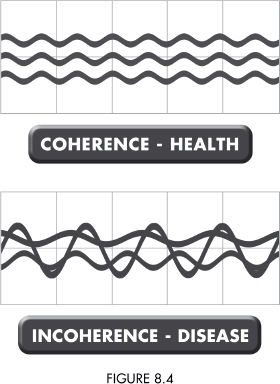
From a quantum perspective, a higher, more coherent frequency is called health, and a slower, more incoherent frequency is called disease. All disease is a lowering of frequency, as well as the expression of incoherent information.
Imagine a group of a hundred drummers with no rhythm banging on drums all at the same time. That’s incoherence. Now imagine that a group of five professional drummers shows up among the mob of wannabe drummers, spreads out to different locations in the crowd, and starts to create a very rhythmic beat. In time, the five would entrain the entire hundred other drummers into perfect rhythm, orderliness, and synchrony.
That’s exactly what happens when your body responds to a new mind, when the hair on the back of your neck stands up because you feel more like energy and less like matter. In that moment, you’re lifting matter to a new mind. You’re entraining the disease that exists as a lowering of frequency to an elevated frequency. At the same time, you’re also causing the incoherent information that existed among the atoms and molecules, chemicals and cells, tissues and organs, and systems of the body to instead function from a field of more organized information.
It’s like hearing static on your radio and then tuning in to a clear signal where, all of a sudden, the static disappears and you can hear the music. Your brain and nervous system do the same by tuning in to higher, more coherent frequencies. Once that occurs, you’re no longer subject to the law of entropy. You experience reverse entropy, and the coherent signature of the energy field around your body causes you to be immune to the typical laws of physical reality. Now all of the atomic fans are spinning at a faster coherent frequency, and the physical molecules, chemicals, and cells that make up your body are receiving new information so that your energy is having a positive effect on your body.
Figures 8.5A, 8.5B, and 8.5C on the following page illustrate how a higher, more coherent frequency of energy entrains a slower, more incoherent frequency of matter, lifting matter to a new mind.
The more organized and coherent your energy, the more you entrain matter at an organized frequency, and the faster that frequency, the better and the more profound the electromagnetic signal the cell receives. (Remember, as you learned in the previous chapter, cells are a hundred times more sensitive to electromagnetic signals—energy—than to chemical signals, and it’s these signals that change DNA expression.) The more incoherent and unsynchronized your energy is, on the other hand, the less able your cells are to communicate with one another. You’ll learn the science of how to create coherence very shortly.
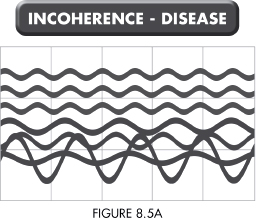
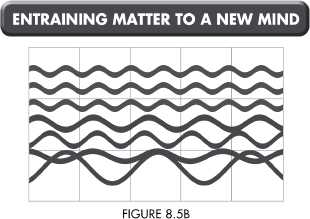
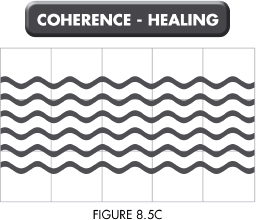
When higher, more coherent energy interacts with slower, more incoherent energy, it begins to entrain matter to a more organized state.
Beyond the Quantum Doorway
Since the quantum field is an invisible field of information, is frequency beyond space and time that all things material come from, and is made of consciousness and energy, then everything physical in the universe is unified within and connected to this field. And since all things material are made of atoms, which are connected beyond space and time, then you and I, along with all things in the universe, are connected by this field of intelligence—personal and universal, both within us and all around us—that gives life, information, energy, and consciousness to all things.
Call it what you will, but this is the universal intelligence that’s giving you life right now. It organizes and orchestrates the hundreds of thousands of notes in the harmonious symphony that is your physiology—those things that are part of your autonomic nervous system. This intelligence keeps your heart beating more than 101,000 times a day to pump more than two gallons of blood per minute, traveling more than 60,000 miles in each 24-hour period. As you finish reading this sentence, your body will have made 25 trillion cells. And each of the 70 trillion cells that make up your body execute somewhere between 100,000 to 6 trillion functions per second. You’ll inhale 2 million liters of oxygen today, and each time you inhale, that oxygen will be distributed to every cell in your body within seconds.
Do you consciously keep track of all that? Or does something that has a mind so much greater than your mind, and a will so much greater than your will, do it for you? That’s love! In fact, that intelligence loves you so much that it loves you into life. It’s the same universal mind that animates every aspect of the material universe. This invisible field of intelligence exists beyond space and time, and it’s where all things material come from.
It causes supernovas to be born in distant galaxies and roses to bloom in Versailles. It keeps the planets revolving around our sun and the tides rising and falling at Malibu. Because it exists in all places and at all times, and it’s both within you and all around you, this intelligence must be both personal and universal. So there’s a subjective, freewill consciousness (the individual awareness) called “you,” and there’s an objective consciousness (the universal awareness) that’s responsible for all life.
If you were to close your eyes and take your attention off your body and all of the people, things, and events arising at different times and places in your external environment, letting go of time for a moment, you, as the quantum observer, would be removing your energy from your familiar life and investing your awareness into the unknown field of possibilities. Since where you place your attention is where you place your energy, then if you keep placing your awareness on your known life, your energy is invested in that familiar life. But if you were to invest your energy in the unknown field of possibilities beyond space and time, and you instead became a consciousness (a thought in quantum potential), you’d be drawing a new experience to yourself. As you enter a meditative state, your subjective, freewill consciousness would merge with the objective, universal consciousness, and you’d be planting a seed in possibility.
The self-organizing autonomic nervous system is your connection to that innate intelligence I mentioned that performs all of those automatic functions for you. It’s certainly not your thinking neocortex that’s responsible for the functions mentioned previously. Instead, it’s the lower brain centers below the neocortex that subconsciously run the show. This loving intelligence is what you merge with in meditation when you lay down the ego and go from selfish to selfless, when you become pure consciousness—no longer a body in the environment or in linear time but, instead, no body, no one, no thing, in no place and no time. That’s when you become simply an awareness in an infinite field of possibility.
You’re in the unknown. And from the unknown, all things are created. You’re in the quantum field. And you and I already have all the biological machinery we need to accomplish this feat of becoming pure consciousness.
