Attitudes, Beliefs, and Perceptions
A 12-year-old Indonesian boy with a vacant stare opens his mouth to willingly accept shards of broken glass from people in a crowd gathered in a Jakarta park to watch traditional Javanese trance dancing called “kuda lumping.” The boy chews on the glass and swallows it, as if it were nothing more than a handful of popcorn or pretzels, and he shows no ill effects. As a third-generation kuda lumper, this youth has been ingesting glass in similar mystical performances since he was nine. The boy and the other 19 members of his traditional dance troupe recite a Javanese spell before every performance, summoning the spirits of the dead to reside in one of them for the duration of that day’s dance, protecting that dancer from pain.1
The boy and his fellow dancers are no different, in certain respects, from the Appalachian snake-handling preachers described in Chapter 1 who become anointed with the spirit and enthusiastically dance around the pulpit with venomous snakes coiled around their arms and shoulders. Bringing them dangerously close to their faces, they are seemingly immune to the venom if bitten. The dancers are also similar to the Fijian firewalkers from the Sawau tribe on the island of Beqa, who unflinchingly walk across white-hot stones that have been covered in flaming logs and glowing red coals for hours, an ability said to have been given to one of the tribe’s ancestors by a god and then passed down within the tribe.
The glass-eating boy, the snake-handling preacher, and the Fijian firewalker never pause even for a moment to think, I wonder if it will work this time? There isn’t an ounce of wishy-washiness in any of them. The decision to chew glass or handle copperheads or tread on searing stones transcends their bodies, the environment, and time, altering their biology to allow them to do the seemingly impossible. Their rock-solid belief in the protection of their gods leaves no room for second-guessing.
The placebo effect is similar in that very strong beliefs are part of the equation. Yet this component hasn’t been examined much, because up to this point in mind-body research, most scientific studies have measured only the effects of the placebo instead of looking for the cause. Whether the shift in one’s internal state has been the product of faith healing, conditioning, the release of suppressed emotions, a belief in symbols, or a specific spiritual practice, the question still remains: What has happened to create such profound alterations in the body—and if we discover what that is, can we cultivate it?
Where Our Beliefs Come From
Our beliefs aren’t always as conscious as we think they are. We may very well accept an idea on the surface, but if deep down, we don’t really believe it’s possible, then our acceptance is just an intellectual process. Because calling upon the placebo effect requires us to truly change our beliefs about ourselves and what’s possible for our bodies and our health, we need to understand what beliefs are and where they come from.
Let’s suppose a person goes to the doctor with certain symptoms and is diagnosed with a condition based on the physician’s objective findings. The doctor gives the patient a diagnosis, prognosis, and treatment options based on the average outcome. The moment the person hears the doctor say “diabetes,” “cancer,” “hypothyroidism,” or “chronic fatigue syndrome,” a series of thoughts, images, and emotions is conjured up based on his or her past experience. That experience could be that the patient’s parents had the condition, that he or she saw a show on TV in which one of the characters died of that disease, or even that something the person read on the Internet scared him or her about the diagnosis.
Once the patient sees the doctor and hears a professional opinion, the patient automatically accepts the condition, then believes what the confident doctor has said, and finally surrenders to the treatment and possible outcomes—and this is done without any real analysis. The patient is suggestible (and susceptible) to what the doctor says. If the person then embraces the emotions of fear, worry, and anxiety, along with sadness, then the only possible thoughts (or autosuggestions) are those that are equal to how he or she feels.
The patient can try to have positive thoughts about beating the disease, but his or her body still feels bad because the wrong placebo has been given, resulting in the wrong state of being, the signaling of the same genes, and the inability to see or perceive any new possibilities. The patient is pretty much at the mercy of his or her beliefs (and the beliefs of the doctor) about the diagnosis.
So when people like the folks you’ll read about in the next few chapters healed themselves using the placebo effect, what did they do differently? First, they didn’t accept the finality of their diagnosis, prognosis, or treatment. Nor did they believe in the most probable outcome or future destiny that their doctors had authoritatively outlined. Finally, they didn’t surrender to the diagnosis, prognosis, or suggested treatment. Because they had a different attitude from those who did accept, believe, and surrender, they were in a different state of being.
They weren’t suggestible to the doctors’ advice and opinions, because they didn’t feel fearful, victimized, or sad. Instead they were optimistic and enthusiastic, and those emotions drove a new set of thoughts, which enabled them to see new possibilities. Because they had different ideas and beliefs about what was possible, they didn’t condition their bodies to the worst-case scenario, they didn’t expect the same predictable outcome as others who’d received the same diagnosis, and they didn’t assign the same meaning to the diagnosis as everyone else with the same condition. They assigned a different meaning to their future, so they had a different intention. They understood epigenetics and neuroplasticity, so instead of passively seeing themselves as victims of the disease, they used that knowledge to become proactive, fueled by what they’d learned in my workshops and events. As a result, these folks also got different and better results than other people who’d received the same diagnosis—just as the hotel maids got better results after the researchers gave them more information.
Now think about the average person who receives a diagnosis and promptly announces, “I’m going to beat this.” Someone may not accept the condition and the outcome the doctor outlines, but the difference is that most people haven’t truly changed their beliefs about not being sick. Changing a belief requires changing a subconscious program—since a belief, as you’ll soon learn, is a subconscious state of being.
Folks who use only their conscious minds to change never come out of the resting state to reprogram their genes, because they don’t know how to do that. This is where their healing stops. They’re unable to surrender to possibility, because they’re not truly able to become suggestible to anything different from what the doctor tells them.
Is it possible that, whenever people don’t respond to treatment or when their health stays the same, they’re living by the same emotional state every day, accepting, believing, and surrendering to the medical model without too much analysis, based on the social consciousness of millions of other people who’ve done exactly the same thing? Does a doctor’s diagnosis become the modern-day equivalent of a voodoo curse?
So now, let’s dissect belief a little further, backing up just slightly to begin with the following idea: When you string a succession of thoughts and feelings together so that they ultimately become habituated or automatic, they form an attitude. And since how you think and feel creates a state of being, attitudes are really just shortened states of being. They can fluctuate from moment to moment as you alter how you think and feel. Any particular attitude can last for minutes, hours, days, or even a week or two.
For example, if you have a series of good thoughts that are aligned with a series of good feelings, you might say, “I have a good attitude today.” And if you have a sequence of negative thoughts that’s connected to a sequence of negative feelings, then you might say, “I have a bad attitude today.” If you revisit the same attitude enough times, then it becomes automatic.
If you repeat or maintain certain attitudes long enough and you string those attitudes together, that’s how you create a belief. A belief is just an extended state of being—essentially, beliefs are thoughts and feelings (attitudes) that you keep thinking and feeling over and over again until you hardwire them in your brain and emotionally condition them into your body. You could say that you become addicted to them, which is why it’s so hard to change them and why it doesn’t feel good on a gut level when they’re challenged. Because experiences are neurologically etched into your brain (causing you to think) and chemically embodied as emotions (causing you to feel), most of your beliefs are based on past memories.
So when you revisit the same thoughts over and over by thinking about and analyzing what you remember from your past, these thoughts will fire and wire into an automatic unconscious program. And if you cultivate the same feelings based on past experiences and you feel the same as you did when the event originally occurred, you’ll condition your body to subconsciously be the mind of that emotion—and your body will unconsciously be living in the past.
And if the redundancy of how you think and feel over time conditions your body to become the mind, and it becomes programmed subconsciously, then beliefs are subconscious and also unconscious states of being derived from the past. Beliefs are also more permanent than attitudes; they can last for months or even years. And because they last longer, they become more programmed within you.
A case in point is a story from my childhood that’s stamped in my memory. I grew up in an Italian family, and when I was going into fourth grade, we moved to another city that had a mixture of both Italian and Jewish residents. On my first day of school that year, the teacher assigned me to a seat in a group of six desks along with three Jewish girls. That was the day the girls broke the news to me that Jesus wasn’t Italian. It was one of the most memorable days of my life.
When I came home that afternoon, my little Italian mother kept asking me how my first day of school went, and I wouldn’t talk to her. After I ignored her enough times, she finally grabbed me by the arm and insisted I tell her what was wrong.
“I thought Jesus was Italian!” I blurted out angrily.
“What are you talking about?” she responded. “He’s Jewish!”
“Jewish?” I shot back. “What do you mean? He looks Italian in all those pictures, doesn’t he? Grandma talks in Italian to him all day long. And what’s the deal with the Roman Empire? Isn’t Rome in Italy?”
So the belief that I had—that Jesus was Italian—was based on my past experiences, and how I thought and felt about Jesus had become my automatic state of being. This belief took some getting over, because changing deep-seated beliefs isn’t easy. Needless to say, I succeeded.
Now let’s move the concept forward a little further. If you string a group of related beliefs together, they form your perception. So your perception of reality is a sustained state of being that’s based on your long-standing beliefs, attitudes, thoughts, and feelings. And since your beliefs become subconscious and also unconscious states of being (that is, you don’t even know why you believe certain things, or you aren’t really conscious of your beliefs until they’re tested), your perceptions—how you subjectively see things—for the most part, become your subconscious and unconscious view of your reality from the past.
In fact, scientific experiments have shown that you don’t see reality as it truly is. Instead, you unconsciously fill in your reality based on your memories of the past, which is what’s neurochemically maintained in your brain.2 When perceptions become implicit or nondeclarative (as was discussed in the last chapter), they become automatic or subconscious so that you automatically edit reality subjectively.
For example, you know your car is your car, because you’ve driven it so many times. You have the same experience of your car daily, because nothing much changes about it. You think and feel the same way about it most every day. Your attitude about your car has created a belief about it, which has formed a particular perception about your vehicle—that it’s a good car, say, because it rarely breaks down. And although you automatically accept that perception, it’s actually a subjective perception, because someone else may have the same make and model of car as you do, and that person’s car may break down all the time, causing him or her to have a different belief and different perceptions about the same vehicle based on personal experience.
In fact, if you’re like most people, you probably don’t pay attention to several aspects of your car unless something goes wrong. You expect it to run as it did the day before; you naturally expect your future experience of driving your car to be like your past experience, yesterday and the day before—that’s your perception. But when it malfunctions, you have to pay more attention to it (like listening to the sound of the motor more closely) and become conscious of your unconscious perception of your car.
Once your perception of your car is altered because something has changed about the way it drives, you’ll now perceive your car differently. The same is true of relationships with your spouse and your co-workers, your culture and your race, and even your body and your pain. Actually, this is the way most perceptions about reality function.
Now, if you want to change an implicit or subconscious perception, you must become more conscious and less unconscious. In truth, you’d have to increase your level of attention to all of the aspects of yourself and your life that you’ve previously stopped paying much attention to. Better yet, you’d have to wake up, change your level of awareness, and become conscious of what you were once unconscious about.
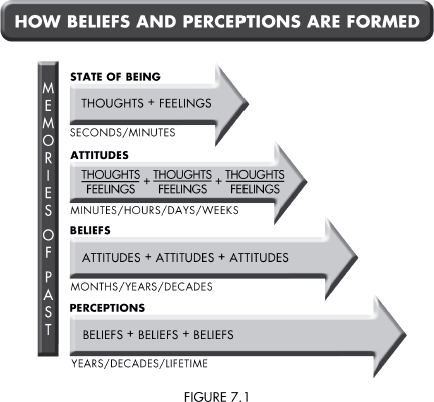
But it’s rarely that easy, because if you experience the same reality over and over again, then the way you think and feel about your current world will continue to develop into the same attitudes, which will inspire the same beliefs, which will expand into the same perceptions (as shown in Figure 7.1).
Your thoughts and feelings come from your past memories. If you think and feel a certain way, you begin to create an attitude. An attitude is a cycle of short-term thoughts and feelings experienced over and over again. Attitudes are shortened states of being. If you string a series of attitudes together, you create a belief. Beliefs are more elongated states of being and tend to become subconscious. When you add beliefs together, you create a perception. Your perceptions have everything to do with the choices you make, the behaviors you exhibit, the relationships you chose, and the realities you create.
When your perception becomes so second nature and so automatic that you really don’t pay attention to the way reality truly is (because you automatically expect everything to be the same), you’re now unconsciously accepting and agreeing to that reality—the way most people unconsciously accept and agree to what the medical model tells them about a diagnosis.
So the only way to change your beliefs and perceptions in order to create a placebo response is to change your state of being. You have to finally see your old, limited beliefs for what they are—records of the past—and be willing to let go of them so that you can embrace new beliefs about yourself that will help you create a new future.
Changing Your Beliefs
So then ask yourself: What beliefs and perceptions about you and your life have you been unconsciously agreeing to that you’d have to change in order to create this new state of being? This is a question that requires some thought, because as I said, with many of these beliefs, we aren’t even aware that we believe them.
Often, we accept certain cues from our environment that then prime us to accept certain beliefs, which may or may not be true. Either way, the moment we accept the belief, it has an effect not only on our performance, but also on the choices we make.
Remember the study from Chapter 2 about the women taking the math test who first read fake research reports about men being better than women in math? Those who’d read that the advantage was due to genetics scored lower than those who’d read that the advantage was due to stereotyping. Although both reports were false—men are no better at math than women—the women in the group who’d read that they had a genetic disadvantage believed what they’d read and then scored lower. It was the same with the white men who were told that Asians score slightly better than whites on a test they were about to take. In both cases, when the students were primed to unconsciously believe they wouldn’t score as well, they in fact didn’t—even though what they were told was totally false.
With this in mind, take a look at this list of some common limiting beliefs and see which ones you may be harboring without being fully aware that you’re doing so:
I’m not good at math. I’m shy. I’m short-tempered. I’m not smart or creative. I’m a lot like my parents. Men shouldn’t cry or be vulnerable. I can’t find a partner. Women are lesser than men. My race or culture is superior. Life is serious. Life is difficult, and no one cares. I’m never going to be a success. I have to work hard to make it in life. Nothing good ever happens to me. I’m not a lucky person. Things never go my way. I never have enough time. It’s someone else’s responsibility to make me happy. When I own this particular thing, then I’ll be happy. It’s hard to change reality. Reality is a linear process. Germs make me sick. I gain weight easily. I need eight hours of sleep. My pain is normal, and it’ll never go away. My biological clock is ticking. Beauty looks like this. Having fun is frivolous. God is outside of me. I’m a bad person, so God doesn’t love me. . . .
I could go on forever, but you get the idea.
Since beliefs and perceptions are based on past experiences, then any of these beliefs that you happen to hold about yourself came from your past. So are they true, or did you just make them up? Even if they were true at some point in time, that doesn’t necessarily mean that they’re true now.
We don’t look at it that way, of course, because we’re addicted to our beliefs; we’re addicted to the emotions of our past. We see our beliefs as truths, not ideas that we can change. If we have very strong beliefs about something, evidence to the contrary could be sitting right in front of us, but we may not see it because what we perceive is entirely different. We’ve in fact conditioned ourselves to believe all sorts of things that aren’t necessarily true—and many of these things are having a negative impact on our health and happiness.
Certain cultural beliefs are a good example. Remember the story about the voodoo curse from Chapter 1? The patient was convinced he was going to die, because the voodoo priest had put a hex on him. The hex only worked because he (and others in his culture) believed voodoo to be true—it wasn’t the voodoo that had hexed him; it was the belief in the voodoo.
Other cultural beliefs can cause premature deaths. For instance, Chinese Americans who have a disease, combined with a birth year that Chinese astrology and Chinese medicine consider to be ill fated, die up to five years early, according to researchers at the University of California at San Diego who studied the death records of almost 30,000 Chinese Americans.3 The effect was stronger in those who were more attached to Chinese traditions and beliefs, and the results also held consistent for nearly all major causes of death studied. For example, Chinese Americans born in years associated with susceptibility to diseases involving lumps and tumors died of lymphatic cancer four years younger than Chinese Americans born in other years or than non—Chinese Americans with similar cancers.
As these examples demonstrate, we’re suggestible only to what we consciously or unconsciously believe to be true. An Eskimo who doesn’t believe in Chinese astrology is no more suggestible to the idea that he’s vulnerable to a certain disease because he was born in the year of the tiger or the year of the dragon than an Episcopalian would be suggestible to the idea that a hex from a voodoo priest could kill him or her.
But once any of us accepts, believes, and surrenders to an outcome without consciously thinking about it or analyzing it, then we’ll become suggestible to that particular reality. In most people, such a belief is planted well beyond the conscious mind into the subconscious system, which is what creates the disease. So now let me ask you another question: How many personal beliefs based on cultural experiences do you have that may not be true?
Changing beliefs may be difficult, but it’s not impossible. Just think what would happen if you were able to successfully challenge your unconscious beliefs. Instead of thinking and feeling, I never have enough time to get everything done, what if you instead thought and felt, I live in “no-time,” and I accomplish everything? What if instead of believing, The universe is conspiring against me, you believed, The universe is friendly and works in my favor? What a great belief! How would you think, how would you live, and how would you walk down the street if you believed the universe works in your favor? How do you think that would change your life?
When you change a belief, you have to start by first accepting that it’s possible, then change your level of energy with the heightened emotion you read about earlier, and finally allow your biology to reorganize itself. It’s not necessary to think about how that biological reorganization will happen or when it’s going to happen; that’s the analytical mind at work, which pulls you back into a beta brain-wave state and makes you less suggestible. Instead, you just have to make a decision that has finality. And once the amplitude or energy of that decision becomes greater than the hardwired programs in your brain and the emotional addiction in your body, then you are greater than your past, your body will respond to a new mind, and you can effect real change.
You already know how to do this. Think about a time in your past when you made up your mind to change something about yourself or your life. If you recall, a moment came when you probably said to yourself, I don’t care how I feel [body]! It doesn’t matter what’s going on in my life [environment]! And, I’m not concerned how long it will take [time]! I’m going to do this!
Instantly, you got goose bumps. That’s because you moved into an altered state of being. The moment you felt that energy, you were sending your body new information. You felt inspired, and you came out of your familiar resting state. That’s because, by thought alone, your body moved from living in the same past to living in a new future. In reality, your body was no longer the mind; you were the mind. You were changing a belief.
The Effect of Perception
Like beliefs, our perceptions of past experiences—whether positive or negative—directly affect our subconscious state of being and our health. In 1984, Gretchen van Boemel, M.D., then associate director of clinical electrophysiology at Doheny Eye Institute in Los Angeles, uncovered a striking example of this when she noticed a disturbing trend among Cambodian women referred to Doheny. The women, all between the ages of 40 and 60 and living in nearby Long Beach, California (known as Little Phnom Penh because of its roughly 50,000 Cambodian residents), were having severe vision problems, including blindness, in disproportionately high numbers.
Physically, the women’s eyes were perfectly healthy. Dr. van Boemel did brain scans on the women to evaluate how well their visual systems were functioning and compared them to how well their eyes were seeing. She found that each of the women had perfectly normal visual acuity, often 20/20 or 20/40, although when they tried to read an eye chart, their vision tested at legally blind. Some of the women had absolutely no light perception and couldn’t even detect any shadows—even though there wasn’t anything physically wrong with their eyes.
When Dr. van Boemel teamed up with Patricia Rozée, Ph.D., of California State University, Long Beach, to do research on the women, they found that those who had the worst vision had spent the most time living under the Khmer Rouge or in refugee camps when communist dictator Pol Pot was in power.4 The genocide perpetrated by the Khmer Rouge was responsible for the deaths of at least 1.5 million Cambodians between 1975 and 1979.
Of the women studied, 90 percent had lost family members (some as many as ten) during that time, and 70 percent were forced to watch their loved ones—sometimes even their entire families—being brutally murdered. “These women saw things that their minds just could not accept,” Rozée told the Los Angeles Times.5 “Their minds simply closed down, and they refused to see anymore—refused to see any more death, any more torture, any more rape, any more starvation.”
One woman was forced to watch her husband and four children be killed right in front of her, and she lost her sight immediately afterward. Another woman had to watch a Khmer Rouge soldier beat her brother and his three children to death, which included seeing her three-month-old nephew being thrown against a tree until he died. She started losing her eyesight right after that.6 The women also suffered beatings, starvation, untold humiliations, sexual abuse, torture, and 20-hour days of enforced labor. Although now they were safe, many of these women told the researchers that they preferred to stay in their homes, where they had to relive their memories of the atrocities over and over through recurring nightmares and intrusive thoughts.
Documenting a total of 150 cases of psychosomatic blindness in Cambodian women in Long Beach—the largest known group of such victims anywhere in the world—van Boemel and Rozée presented their research at the 1986 American Psychological Association annual meeting in Washington, D.C. The audience was riveted.
The women in this study became blind or nearly blind not because of some eye disease or physical malfunction, but because the events they lived through had such an emotional impact that they literally “cried until they could not see.”7 The heightened emotional amplitude from being forced to bear witness to the unbearable left them not wanting to see anymore. The event created physical changes in their biology—not in their eyes, but most likely in their brains—which altered their perception of reality for the rest of their lives. And because they kept replaying the traumatizing scenes over and over in their minds, their vision never improved.
While this is certainly an extreme example, our past traumatic experiences probably have similar effects on us. If you’re having vision challenges, what things might you have chosen not to see because of painful or frightening past experiences? Similarly, if you’re having hearing challenges, what in your life might you be unwilling to hear?
Figure 7.2 charts how all of this happens. The line in the chart reflects a relative measurement of a person’s state of being, which starts out at a more or less normal or baseline level before the event occurs. When the line spikes, it indicates a strong emotional reaction to an event—such as when the women experienced the atrocities of the Khmer Rouge soldiers. That horrific experience neurologically branded their brains and chemically changed their bodies, as well as altered their state of being—their thoughts, their feelings, their attitudes, their beliefs, and ultimately their perceptions. Specifically, the women no longer wished to look at the world anymore, so through neurological rewiring and chemical resignaling, their biology complied.
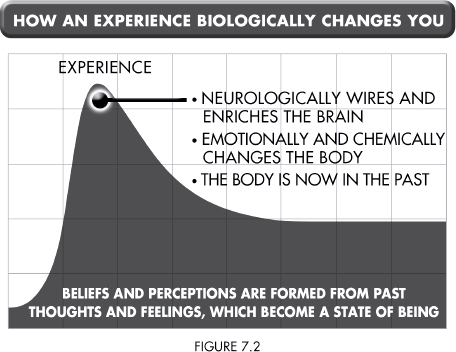
A highly charged experience in our external reality will impress itself upon the circuitry of the brain and emotionally brand the body. As a result, the brain and body live in the past, and the event alters our state of being, as well as our perception of reality. We are no longer the same personality.
Although the line in the graph eventually falls and levels off, the place where it ends up is a different place from where it began—indicating that the person remains chemically and neurologically altered by the experience. At that point for the Cambodian women, they were effectively living in the past, because they remained affected by the neurological and chemical branding that had come from the experience. They were no longer the same women; the event changed their state of being.
The Power of the Environment
Just changing your beliefs and perceptions once isn’t enough. You have to reinforce that change over and over. To see why, let’s return for a moment to the Parkinson’s patients mentioned earlier who improved their motor skills after receiving a saline injection that they thought was a powerful drug.
As you’ll recall, the moment they moved into a state of better health, their autonomic nervous systems started to endorse this new state by producing dopamine in their brains. That didn’t happen because they were praying or hoping or wishing their bodies would make dopamine; it happened because they became people who made dopamine.
Unfortunately, however, the effect doesn’t stick for everyone. In fact, for some, the placebo effect only lasts for a certain amount of time, because they go back to who they were before: their old states of being. In this case, when the Parkinson’s patients went back home and saw their caregivers, saw their spouses, slept in the same beds, ate the same food, sat in the same rooms, and maybe played chess with the same friends who complained about their pains, their same old environments reminded them of their same old personalities and their same old states of being. All of the conditions in their familiar lives reminded them of who they were before, so they just slipped right back into those identities, and their various motor problems recurred.8 They reidentified with their environments. The environment is that strong.
The same thing happens with drug addicts who’ve been clean for many years. If you put them back in their same environments where they used to do drugs, even without their ingesting any drug, being there turns on the same receptor sites in their cells that the drugs did when they were using—and that in turn creates physiological changes in their bodies as if they’ve taken the drugs, increasing their cravings.9 Their conscious minds have no control over that. It’s automatic.
Let’s examine this concept a bit further. You’ve learned that the conditioning process creates strong associative memories. You’ve also learned that associative memories stimulate subconscious automatic physiological functions by activating the autonomic nervous system. Think of Pavlov’s dogs again. Once Pavlov conditioned the dogs to associate the bell with getting fed, the dogs’ bodies were immediately physiologically changed, without much control from the conscious mind. It was the cue from the environment that (via associative memory) automatically, autonomically, subconsciously, and physiologically changed the dogs’ internal states. They began to salivate and their digestive juices turned on, because they were anticipating a reward. The dogs’ conscious minds couldn’t do that. It was the stimulus from the environment that created the associative memory from the conditioned response.
Now let’s revisit the Parkinson’s patients and the former drug users. We could say that the instant any one of these individuals returned to the familiar environment, the body would automatically and physiologically return back to the old state of being—without the conscious mind having much control over it. In fact, that past state of being, which has been thinking and feeling the same way for years on end, has conditioned the body to become the mind. That is, the body is the mind that responds to the environment. That’s why it’s so hard for anyone in this situation to change.
And the greater the addiction to the emotion, the greater the conditioned response is to the stimulus in the environment. For example, let’s say you were addicted to coffee and wanted to break your addiction to it. If you were visiting my house and I started making a java, and you heard the blast of the espresso machine, smelled the coffee brewing, and saw me drinking it, here’s what would happen: The moment your senses picked up those cues from the environment, your body, as the mind, would subconsciously, automatically respond without much help from your conscious mind—because you conditioned it to be that way. Your body-mind would then be craving its physiological reward, waging a war against your conscious mind, trying to convince you to take a sip or two.
But if you truly broke the addiction to coffee and then I made a cup in front of you, you could have some or not, because you wouldn’t have the physiological response you had previously. You’d no longer be conditioned (your body would no longer be the mind), and the associative memory of your environment would no longer have the same effect on you.
The same holds true for emotional addictions. For instance, if you have memorized guilt from your past experiences and unconsciously live that way every day in the present, then like most people, you’ll use someone or something at someplace in your external environment to reaffirm your addiction to guilt. Try as you might to be consciously greater than it, the moment you see your mother (whom you use to feel guilty) at the house where you grew up, your body will autonomically, chemically, and physiologically return to the same past state of guilt in the present moment, without your conscious mind being involved. Your body, which has been subconsciously programmed to be the mind of guilt, is already living in the past in that present moment. So it’s more natural to feel guilty when you’re with your mother than to feel any other way. And just as in the drug addict, a conditioned response has altered your internal state based on your association with your present-past external reality. Break the addiction to guilt by changing the subconscious programming, and you can be in the presence of the same conditions and remain free from your present-past reality.
Researchers from the Victoria University of Wellington in New Zealand examined the effect of environment using a group of 148 college students who were invited to take part in a study set in a bar-like atmosphere.10 The researchers told half the students that they would get vodka and tonic and told the rest they’d receive just tonic water. In reality, the bartenders in the study didn’t pour a single drop of vodka; all the students got just plain tonic. The bar-like atmosphere the researchers fashioned looked very realistic, right down to the resealing of the vodka bottles that had been cleverly filled with flat tonic water. The bartenders rimmed glasses with limes dunked in vodka for a more realistic effect, before proceeding to mix and pour drinks as though they were serving the real thing.
The subjects became tipsy and acted drunk, with some even showing physical signs of intoxication. They didn’t get drunk because they drank alcohol; they got drunk because the environment, by associative memory, cued their brains and bodies to respond in the same old, familiar way.
When the researchers eventually told the students the truth, many were amazed and insisted that they really did feel drunk at the time. They believed they were drinking alcohol, and those beliefs translated into neurochemicals, which altered their states of being.
In other words, their beliefs alone were sufficient to fire up a biochemical change in their bodies that was equal to being drunk. That’s because the students conditioned themselves enough times to associate alcohol with a change in their internal chemical states. As the subjects expected or anticipated the future change in their inner states based on their past associative memories of drinking, they were cued by the environment to physiologically change, just as did Pavlov’s dogs.
There’s a flip side, too, of course. The environment can also signal healing. Hospital patients in Pennsylvania who recovered from surgery in a room with a view of a stand of trees in a natural suburban setting needed less-potent pain medications and were released seven to nine days earlier than patients in rooms facing a brown brick wall.11 Our states of mind, created from the environment, can most definitely contribute to healing our brains and our bodies.
So, then, do you need a sugar pill or a saline injection or a sham procedure or a picture window—something or someone or someplace in your external environment—to move into a new state of being? Or can you do it just by changing how you think and feel? Can you simply believe in a new possibility of health, without relying on any external stimulus, and make the thought in your brain a new emotional experience to the degree that it changes your body and you become greater than the conditioning in your external environment?
If so, what you’ve just read suggests that it would be a good idea to change your internal state every day—before you get up and face your same old environment so that it won’t pull you, as it did the Parkinson’s patients, back to your old state of being. Remember Janis Schonfeld, from Chapter 1, who made physical changes in her brain by thinking she was taking an antidepressant? Part of the reason the placebo worked so well for her was that taking that inert pill was a daily reminder to change her state of being (because she associated taking the pill with her optimistic thoughts and feelings about getting better—as do more than 80 percent of people who take an antidepressant placebo).
If you could access a new state of being through meditation by combining a clear intention with getting in touch with that heightened state of emotion that was mentioned earlier, and you got up jazzed and on fire about what you were creating every day, you’d finally start coming out of your resting state. You’d then be in a new state of being, with a different attitude, belief, and perception, no longer reacting to the same things in the same way, because now your environment would no longer control how you think and feel. You’d then be making new choices and demonstrating new behaviors, which would lead to new experiences and new emotions. And so you’d then turn into a new and different personality—a personality that doesn’t have the arthritic pain or the Parkinson’s motor issues or the infertility or whatever other condition you want to change.
I want to take a moment to point out here that not all sickness and disease starts in our minds, of course. Certainly, babies are born with genetic defects and conditions that clearly couldn’t have been triggered by their thoughts, feelings, attitudes, and beliefs. And trauma and accidents do indeed happen. Furthermore, exposure to environmental toxins can definitely wreak havoc in the human body. My point is not that when these things come up, we’ve somehow asked for them—although it’s true that our physical bodies can be weakened by stress hormones and made more susceptible to disease when our immune systems shut down. My point is that no matter what the source of our ills, there’s a possibility that we can change our condition.
Changing Your Energy
So now we can see that if we want to change our beliefs and create a placebo effect to improve our health and our lives, we have to do the exact opposite of what the Cambodian women did by default. By holding a clear and firm intention and heightening our emotional energy, we have to create a new internal experience in our minds and bodies that’s greater than the past external experience. In other words, when we decide to create a new belief, the amplitude or energy of that choice must be high enough that it’s greater than the hardwired programs and emotional conditioning in the body.
To see what happens when we do just this, take a look at Figure 7.3 on the following page. Here, the energy of the choice in this new experience is greater than the energy of the trauma in the past experience (as we saw in Figure 7.2), which is why the peak in this graph is higher than the peak in the first graph. And as a result, the effects of this new experience override the residue of the neural programming and emotional conditioning from the past experience.
This process, if we do it right, actually repatterns our brains and changes our biology; the new experience will reorganize the old programming, and in so doing, it will remove the neurological evidence of that past experience. (Think of how a bigger wave breaking farther up on the beach erases any sign of whatever shell, seaweed, sea foam, or sand pattern was there before.) Strong emotional experiences create long-term memories. So this new internal experience creates new long-term memories that override our past long-term memories, thus the choice becomes an experience that we never forget. There should be no evidence of our pasts in our brains and bodies any longer, and the new signal then rewrites the neurological program and genetically changes the body.
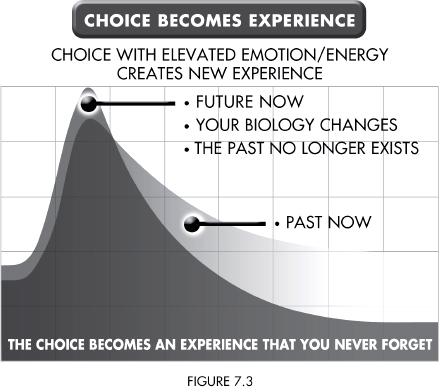
In order to change a belief or perception about yourself and your life, you have to make a decision with such firm intention that the choice carries an amplitude of energy that is greater than the hardwired programs in the brain and the emotional addiction in the body, and the body must respond to a new mind. When the choice creates a new inner experience that becomes greater than the past outer experience, it will rewrite the circuits in your brain and resignal your body emotionally. Since experiences create long-term memories, when the choice becomes an experience that you never forget, you are changed. Biologically, the past no longer exists. We could say that your body in that present moment is in a new future.
Now look at Figure 7.3 again and notice how the slope of the line in the graph goes all the way back down (whereas in Figure 7.2, it descended but still remained higher than it was at the point where it started). That shows there’s no trace left of the past experience; it no longer exists in this new state of being.
In addition to reorganizing your neurocircuitry, this new signal also begins to rewrite the body’s conditioning by breaking the emotional attachment to the past. When that happens, in that second, the body is living fully in the present; it is no longer a prisoner of the past. That heightened energy is felt within the body and translated as a new emotion (which is just another way of saying “energy in motion,” or “e-motion”), whether that emotion is feeling invincible, courageous, empowered, compassionate, inspired, or whatever. And it’s energy that’s changing our biology, our neurocircuitry, and our genetic expression—not chemistry.
A similar process happens with the firewalkers, the glass chewers, and the snake handlers. They get clear that they’re going to move into a different state of mind and body. And when they hold that firm intention to make that shift, the energy of that decision creates internal changes in their brains and bodies that make them immune to the external conditions in the environment for an extended period of time. Their energy now is protecting them in a way that, in that moment, transcends their biology.
As it happens, our neurochemistry isn’t the only thing that responds to heightened states of energy. The receptor sites on the outside of the body’s cells happen to be a hundred times more sensitive to energy and frequency than they are to the physical chemical signals, like neuropeptides, that we know gain access to our cells’ DNA.12 Research consistently reveals that invisible forces of the electromagnetic spectrum influence every single aspect of cellular biology and genetic regulation.13 Cell receptors are frequency-specific to incoming energy signals. The energies of the electromagnetic spectrum include microwaves, radio waves, x-rays, extremely low-frequency waves, sound harmonic frequencies, ultraviolet rays, and even infrared waves. Specific frequencies of electromagnetic energy can influence the behavior of DNA, RNA, and protein synthesis; alter protein shape and function; control gene regulation and expression; stimulate nerve-cell growth; and influence cell division and cell differentiation, as well as instruct specific cells to organize into tissues and organs. All of these cellular activities influenced by energy are part of the expression of life.
And if that’s true, then it has to be true for some reason. Remember the 98.5 percent of our DNA that scientists call “junk DNA” because it doesn’t seem to serve much of a useful purpose? Surely Mother Nature wouldn’t place all of this encoded information in our cells, waiting to be read, without giving us the ability to create some type of signal to unlock it; after all, nature doesn’t waste anything.
Could it be that your own energy and consciousness is what creates the right kind of signal outside of the cells to enable you to tap into that vast “parts list” of potentials? And if that was true, if you changed your energy the way you read about earlier in this chapter, could that help you access your true ability to authentically heal your body? When you change your energy, you change your state of being. And the rewiring in the brain and the new chemical emotions in the body trigger epigenetic changes, and the result is that you become quite literally a new person. The person you were before is history; a part of that person simply vanished along with the neurocircuitry, chemical-emotional addictions, and genetic expression that supported your old state of being.
