How Thoughts Change the Brain and the Body
Now you can understand that whether it’s joyful or stressful, with every thought you think, every emotion you feel, and every event you experience, you’re acting as an epigenetic engineer of your own cells. You control your destiny. So this raises another question: If your environment changes and you then program new genes in new ways, is it possible—based on your perceptions and beliefs—to program the gene ahead of the actual environment? Feelings and emotions are normally the end products of experiences, but can you combine a clear intention with an emotion that begins to give the body a sampling of the future experience before it’s been made manifest?
When you’re truly focused on an intention for some future outcome, if you can make inner thought more real than the outer environment during the process, the brain won’t know the difference between the two. Then your body, as the unconscious mind, will begin to experience the new future event in the present moment. You’ll signal new genes, in new ways, to prepare for this imagined future event.
If you continue to mentally practice enough times this new series of choices, behaviors, and experiences that you desire, reproducing the same new level of mind over and over again, then your brain will begin to physically change—installing new neurological circuitry to begin to think from that new level of mind—to look as if the experience has already happened. You’ll be producing epigenetic variations that lead to real structural and functional changes in the body by thought alone—just as do those who respond to a placebo. Then your brain and body will no longer be living in the same past; they’ll be living in the new future that you created in your mind.
This is possible through mental rehearsal. This technique is basically closing your eyes and repeatedly imagining performing an action, and mentally reviewing the future you want, all the while reminding yourself of who you no longer want to be (the old self) and who you do want to be. This process involves thinking about your future actions, mentally planning your choices, and focusing your mind on a new experience.
Let’s go over this sequence in greater detail so we can more thoroughly understand exactly what’s happening in mental rehearsal and how it works. As you mentally rehearse a destiny or dream about a new outcome, you imagine it over and over again until it becomes familiar to you. The more knowledge and experience you have wired in your brain about the new reality you desire, the more resources you have to create a better model of it in your mental picturing, and so the greater your intention and expectation are (as with the hotel maids). You are “reminding” yourself of what your life will look like and feel like once you get what you want. Now you are putting an intention behind your attention.
Then you consciously marry your thoughts and intentions with a heightened state of emotion, such as joy or gratitude. (More on heightened states of emotion is coming up.) Once you can embrace that new emotion and you get more excited, you’re bathing your body in the neurochemistry that would be present if that future event were actually happening. It could be suggested that you’re giving your body a taste of the future experience. Your brain and body don’t know the difference between having an actual experience in your life and just thinking about the experience—neurochemically, it’s the same. So your brain and body begin to believe they’re actually living in the new experience in the present moment.
By keeping your focus on this future event and not letting any other thoughts distract you, in a matter of moments, you turn down the volume on the neural circuits connected to the old self, which begins to turn off the old genes, and you fire and wire new neural circuits, which initiates the right signals to activate new genes in new ways. Thanks to the neuroplasticity discussed previously, the circuits in your brain begin to reorganize themselves to reflect what you’re mentally rehearsing. And as you keep coupling your new thoughts and mental images with that strong, positive emotion, then your mind and body are working together—and you’re now in a new state of being.
At this point, your brain and body are no longer a record of the past; they are a map to the future—a future that you’ve created in your mind. Your thoughts have become your experience, and you just became the placebo.
A Few Mental-Rehearsal Success Stories
Maybe you heard that story a while back about a major who was imprisoned in a concentration camp in Vietnam who mentally practiced playing golf on a particular course every day to keep himself sane—only to shoot a perfect score when he was finally released and returned home. Or perhaps you’ve heard the account of Soviet human-rights activist Anatoly Shcharansky, later known as Natan Sharansky, who spent more than nine years imprisoned in the Soviet Union after being falsely accused of spying for the United States in the 1970s. Sharansky—who spent 400 days of his prison term in a small, darkened, freezing-cold punishment cell—played a game of mental chess against himself every day, keeping track of the board coordinates and the positions of each piece in his mind. This enabled Sharansky to maintain many of his neural maps (which normally require external stimulation to stay intact). After his release, he immigrated to Israel and eventually became an Israeli cabinet minister. When world chess champion Gary Kasparov came to Israel in 1996 to play a simultaneous chess match against 25 Israelis, Sharansky beat him.1
Aaron Rodgers, quarterback for the Green Bay Packers, also imagines moves in his head that he often later executes with precision on the field. Leading up to the Packers’ 2011 Super Bowl win, in a play-off game that the sixth-seeded Packers won 48 to 21 against the top-seeded Atlanta Falcons, Rodgers completed 31 of 36 passes (86.1 percent), the fifth-best postseason completion percentage of all time.
“In the sixth grade, a coach taught us about the importance of visualization,” Rodgers told a sports reporter for USA Today.2 “When I’m in a meeting, watching film, or [lying] in bed before I go to sleep, I always visualize making those plays. A lot of those plays I made in the game, I had thought about. As I [lay] on the couch, I visualized making them.” Rodgers was also able to successfully spin out of three potential sacks in that game, later noting about those plays, “I visualized the majority before I made them.”
Countless other professional athletes have also used mental rehearsal to stunning effect, including golfer Tiger Woods; basketball stars Michael Jordan, Larry Bird, and Jerry West; and baseball pitcher Roy Halladay. Champion golfer Jack Nicklaus wrote in his book Golf My Way:
I never hit a shot, even in practice, without having a very sharp, in-focus picture of it in my head. It’s like a color movie. First, I “see” the ball where I want it to finish, nice and white and sitting up high on the bright-green grass. Then the scene quickly changes, and I “see” the ball going there: its path, trajectory, and shape, even its behavior on landing. Then there’s sort of a fade-out, and the next scene shows me making the kind of swing that will turn the previous images into reality. Only at the end of this short, private, Hollywood spectacular do I select a club and step up to the ball.3
As we can see from these examples alone (and there are many, many more just like them), plenty of evidence shows that mental rehearsal is extremely effective for learning a physical skill with minimal physical practice.
I can’t resist adding one more example, this time from Jim Carrey, who tells an amazing story about what he did when he first came to Los Angeles in the late 1980s as a struggling actor looking for work. He’d written a paragraph-long affirmation on a piece of paper about meeting the right type of people, getting the right types of acting jobs, working on the right movie with the right casting, and being successful and contributing something worthwhile and making a difference in the world.
He would go up to Mulholland Drive in the Hollywood Hills every night and lean back in his convertible and look up at the sky. He’d say that paragraph to himself, committing it to memory, as he imagined that what he was describing was actually happening. And he wouldn’t drive back down from that Hollywood overlook until he felt as though he was the person he’d been imagining, until it felt real for him. He even wrote a check to himself for $10 million, penning “for acting services rendered” on it and dating it “Thanksgiving 1995.” He carried the check in his wallet for years.
Finally, in 1994, three movies were released that made Carrey a star. First, Ace Ventura: Pet Detective came out in February, followed by The Mask in July. And for his role in the third movie, Dumb and Dumber, released in December, Carrey received a check for exactly $10 million. He created exactly what he had envisioned for himself.
What all of these individuals have in common is that they eliminated the external environment, got beyond their bodies, and transcended time so that they could make significant neurological changes within. When they presented themselves to the world, they were able to get their minds and bodies to work together, and they created in the material world what they’d first conceived in the mental realm.
Scientific studies back this up. To start with, many experiments on mental rehearsal prove that when you concentrate on a particular region of the body, your thoughts stimulate the region in the brain that governs that part4—and if you keep doing it, physical changes in the brain’s sensory area will then follow. It makes sense, because if you keep placing your awareness in the same place, you are firing and wiring the same networks of neurons. And as a result, you’ll build stronger brain maps in that area.
In a Harvard study, research subjects who’d never before played the piano mentally practiced a simple, five-finger piano exercise for two hours a day for five days—and made the same brain changes as the subjects who physically practiced the same activities, but without ever lifting a finger.5 The region of their brains that controls finger movements increased dramatically, allowing their brains to look as though the experience they’d imagined had actually happened. They installed the neurological hardware (circuits) and software (programs), thereby creating new brain maps by thought alone.
In another study of 30 people over a 12-week period, some regularly exercised their little fingers, while others just imagined doing the same thing. While the group that actually did the physical exercises increased the strength of their little fingers by 53 percent, the group that only imagined doing the same thing also increased the strength of their little fingers—by 35 percent.6 Their bodies had changed to look as if they were having the physical experience in external reality over and over again—but they only experienced it in their minds. Their minds changed their bodies.
In a similar experiment, ten volunteers each imagined flexing one of their biceps as hard as they could five times a week. Researchers recorded the subjects’ electrical brain activity during the sessions and measured their muscle strength every two weeks. Those who only imagined flexing increased their bicep muscle strength by 13.5 percent in just a few weeks, and they maintained the gain for three months after the training stopped.7 Their bodies responded to a new mind.
A final example is a French study that compared subjects who either lifted or imagined lifting dumbbells of different weights. Those who imagined lifting heavier weights activated their muscles more than did those who imagined lifting lighter weights.8 In all three of these studies on mental rehearsal, the subjects were able to measurably increase their body strength using only their thoughts.
You may well wonder if studies exist showing what happens when we follow the entire sequence—when we not only imagine what we want to create, but also connect with strong positive emotion. As a matter of fact, they do. And you’ll be reading about them soon enough.
Signaling New Genes in the Body with a New Mind
To understand more fully why mental rehearsal works, we need to look at just a few points of brain anatomy for a moment and then briefly add some neurochemistry. Let’s start by explaining that your frontal lobe, located right behind your forehead, is your creative center. This is the part of the brain that learns new things, dreams of new possibilities, makes conscious decisions, sets your intentions, and so on. It’s the CEO, so to speak, and even more to the point, the frontal lobe also allows you to observe who you are and evaluate what you’re doing and how you’re feeling. It’s the home of your conscience. This is important, because once you become more aware of your thoughts, ultimately you can better direct them.
As you practice mental rehearsal and truly concentrate and focus on the outcome you want, the frontal lobe is your ally, because it also lowers the volume on the outside world so that you’re not as distracted by information coming in from your five senses. Brain scans show that in a highly focused state, such as mental rehearsal, the perception of time and space diminishes.9 This happens because your frontal lobe dials down the input from your sensory centers (which allow you to “feel” your body in space), your motor centers (responsible for your physical movement), and your association centers (where your thoughts about your identity and who you are live), as well as your parietal-lobe circuits (where you process time). Because you can get beyond your environment, beyond your body, and even beyond time, you’re better able to make the thought you’re thinking more real than anything else.
The moment you imagine a new future for yourself, think about a new possibility, and start to ask specific questions—such as What would it be like to live without this pain and limitation?—your frontal lobe snaps to attention. In a matter of seconds, it creates both an intention to be healthy (so you can get clear on what you want to create and what you no longer wish to experience) and a mental picture of being healthy so that you can imagine what it will be like.
As the CEO, the frontal lobe has connections to all the other parts of the brain. So it starts selecting networks of neurons to create a new state of mind as an answer to that question. You might say it becomes a symphony conductor, silencing your old hardwiring (the pruning function of neuroplasticity) and selecting different networks of neurons from different parts of the brain and wiring them together to create a new level of mind to reflect what you were imagining. It’s your frontal lobe that changes your mind—that is, it makes the brain work in different sequences, patterns, and combinations. Once the frontal lobe can select different networks of neurons and seamlessly turn them on in tandem to create a new level of mind, a picture or internal representation appears in your mind’s eye, or frontal lobe.
Now let’s bring in some more neurochemistry. If your frontal lobe is orchestrating enough of these neural nets to fire in unison as you focus on a clear intention, there will come a moment when the thought will become the experience in your mind—that’s when your inner reality is more real than your outer reality. Once the thought becomes the experience, you begin to feel the emotion of how the event would feel in reality (remember, emotions are the chemical signatures of experiences). Your brain makes a different type of chemical messenger—a neuropeptide—and it sends it out to the cells in your body. The neuropeptide looks for the appropriate receptor sites, or docking stations, on various cells so that it can deliver its message to the body’s hormonal centers and, ultimately, the cells’ DNA—and the cells get a new message that the event has occurred.
When the DNA in a cell gets this new information from the neuropeptide, it responds by turning on (or upregulating) some genes and turning off (or downregulating) others, all to support your new state of being. Think of the upregulating and downregulating as lights either heating up and getting brighter or cooling off and getting dimmer. When a gene lights up, it’s activated to make a protein. When a gene turns off, it becomes deactivated and gets dimmer or weaker—and it doesn’t produce as many proteins. And we see the effects with measurable changes in our physical bodies.
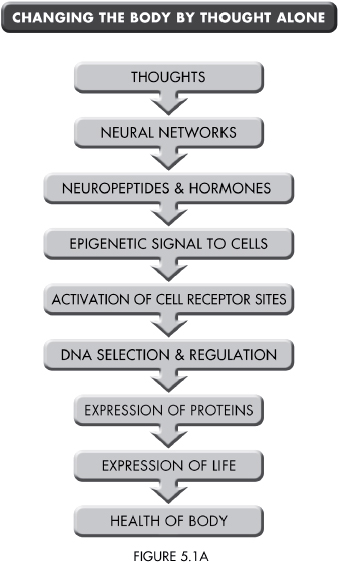
Take a look at Figure 5.1A and Figure 5.1B. They will help you follow the entire sequence of how to change your body by thought alone.
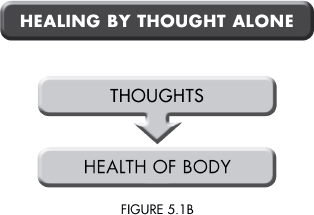
In Figure 5.1A, the flowchart demonstrates how thoughts progress through a cascade of simple mechanisms and chemical reactions in a downward causation to change the body. By deduction, if new thoughts can create a new mind by activating new neural networks, creating healthier neuropeptides and hormones (which signal the cells in new ways and epigenetically activate new genes to make new proteins), and if the expression of proteins is the expression of life and is equal to the health of the body, then Figure 5.1B illustrates how thoughts can heal the body.
Stem Cells: Our Potent Pool of Potentials
Stem cells are the next layer we need to understand in the puzzle. They’re at least partially responsible for how the seemingly impossible becomes possible. Officially, these are undifferentiated biological cells that become specialized. They’re raw potential. When these blank slates are activated, they morph into whatever kind of cell the body needs—including muscle cells, bone cells, skin cells, immune cells, and even nerve cells in the brain—in order to replace injured or damaged cells in the body’s tissues, organs, and systems. Think of stem cells as scoops of shaved snow-cone ice before the flavored syrup is pumped on top; lumps of clay waiting on the potter’s wheel for their turn to be fashioned into plates, bowls, vases, or mugs; or maybe even a roll of silver duct tape that can fix a leaking pipe one day and be cleverly fashioned into a prom dress the next.
Here’s an example of how stem cells work. When you cut your finger, the body needs to repair the break in the skin. The local physical trauma sends a signal to your genes from outside the cell. The gene turns on and makes the appropriate proteins, which then instruct stem cells to turn into healthily functioning skin cells. The traumatic signal is the information the stem cell needs to differentiate into a skin cell. Millions of processes like this occur all over our bodies all the time. Healing attributable to this type of gene expression has been documented in the liver, muscles, skin, intestines, bone marrow, and even the brain and the heart.10
In wound-healing studies where the subject is in a highly emotional, negative state like anger, the stem cells don’t get the message clearly. When there’s interference in the signal, as with static on the radio, the potential cell doesn’t get the right stimulation in a coherent fashion to turn itself into a useful cell. As you know from reading the section about the stress response and living in survival mode, the healing will take longer because most of the body’s energy is busy dealing with the angry emotion and its chemical effects. It’s just not the time for creation, growth, and nurturing—it’s the time for an emergency.
So when the placebo effect is at work, and you create the right level of mind with a clear intention and combine it with a nurturing, elevated emotion, the right type of signal can reach the cell’s DNA. The message will not only influence the production of healthy proteins for better structure and function of the body, but also make brand-new, healthy cells from latent stem cells that are just waiting to be activated by the right message.
You could even think of these stem cells as “get out of jail free” cards, as in the game Monopoly, because once they’re picked up or activated, they replace cells in damaged areas of the body, allowing for a fresh, clean start. In fact, stem cells help explain how healing occurs in at least half the placebo cases involving sham surgery, whether it’s for an arthritic knee or a coronary bypass (as described in Chapter 1).
How Intention and Elevated Emotion Change Our Biology
We’ve already mentioned emotions and how they play a vital role in healing the body, but now let’s take a deeper look at the subject. If we have a heightened emotional response to the new thoughts we’re concentrating on in mental rehearsal, it’s like turbocharging our efforts, because the emotions help us make epigenetic changes much faster. We don’t need the emotional component; after all, the subjects who strengthened their muscles by imagining they were lifting weights didn’t need to get blissed out to change their genes. However, they inspired themselves by using their imaginations with each mental lift, saying, “Harder! Harder! Harder!” The consistent emotion was the energetic catalyst that truly enhanced the process.11 Maintaining such an elevated emotion allows us to get far more dramatic results much more quickly—the same kind of amazing results as we see in the placebo response.
Remember the laughter study from Chapter 2? Japanese researchers found that watching an hour-long comedy show upregulated 39 genes, 14 of which were related to natural killer cell activity in the immune system. Several other studies have shown increases in various antibodies after subjects watched a humorous videotape.12 Research at the University of North Carolina at Chapel Hill further showed that increased positive emotions produced increases in vagal tone, a measure of the health of the vagus nerve, which plays a major part in regulating the autonomic nervous system and homeostasis.13 In a Japanese study, when baby rats were tickled for five minutes a day for five days in a row to stimulate positive emotion, the rats’ brains generated new neurons.14
In each of these cases, strong positive emotions helped the subjects trigger real physical changes that improved their health. Positive emotions cause the body and brain to flourish.
Now look at the pattern of many of the placebo studies: The moment someone starts getting a clear intention of a new future (wanting to live without pain or disease) and then combines it with a heightened emotion (excitement, hope, and anticipation of actually living without pain or disease) is the moment the body is no longer in the past. The body is living in that new future, because as we’ve seen, the body doesn’t know the difference between an emotion created by an actual experience and one created by thought alone. So that heightened state of emotion in response to the new thought is a vital component of that process, because it’s new information coming from outside the cell—and to the body, the experience from the outer environment or inner environment is the same.
Remember Mr. Wright from Chapter 1? He got very excited when he thought about taking the powerful new drug he’d heard about and imagined how it might cure him. He was so excited that he badgered his doctor to allow him to take it. When he actually did, he had no idea that it was inert. But because his brain didn’t know the difference between his highly emotionally charged mental images of being well and actually being well, his body emotionally responded as if what he had imagined had already happened. His mind and his body were then working together to signal new genes in new ways, and that, rather than the “powerful new drug” he took, was what shrank his tumors and restored his health. That’s what created his new state of being.
Then, when Mr. Wright learned that the drug trials showed that the drug didn’t work, he reverted back to his old thoughts and old emotions—to his old programming—and not surprisingly, his tumors returned. His state of being changed once again. But when his doctors told him that he could get an improved version of the drug that had worked before, he got excited all over again. He really believed that this new version of the drug could work, because he’d seen it do so before (or at least that’s what he thought he’d seen).
Naturally, when he reembraced the intention of health and started thinking new thoughts about possibility again, his brain went back to firing and wiring new neural connections, and he created a new mind. All his excitement and hope returned, and that emotion created the very chemicals in his body that supported his new thoughts. And so once more, his body didn’t know the difference between his thoughts and feelings about being well and actually being well. And once more, his brain and body responded as if what he’d imagined had already happened—and his tumors disappeared again.
Once he read in the news that his “miracle drug” truly was a bust, he reverted to his old thinking and old emotions one final time—and his old personality-self, along with his tumors, returned. There was no miracle drug—he was the miracle. And there was no placebo—he was the placebo.
So it makes sense that we should concentrate not merely on avoiding negative emotions, like fear and anger, but also on consciously cultivating heartfelt, positive emotions, such as gratitude, joy, excitement, enthusiasm, fascination, awe, inspiration, wonder, trust, appreciation, kindness, compassion, and empowerment, to give us every advantage in maximizing our health.
Studies show that getting in touch with positive, expansive emotions like kindness and compassion—emotions that are our birthright, by the way—tends to release a different neuropeptide (called oxytocin), which naturally shuts off the receptors in the amygdala, the part of the brain that generates fear and anxiety.15 With fear out of the way, we can feel infinitely more trust, forgiveness, and love. We move from being selfish to selfless. And as we embody this new state of being, our neurocircuitry opens the door to endless possibilities that we never could have even imagined before, because now we’re not expending all our energy trying to figure out how to survive.
Scientists are finding areas in the body—like the intestines, the immune system, the liver, and the heart, as well as many other organs—that contain receptor sites for oxytocin. These organs are highly responsive to oxytocin’s major healing effect, which has been linked to growing more blood vessels in the heart,16 stimulating immune function,17 increasing gastric motility,18 and normalizing blood-sugar levels.19
Let’s return to mental rehearsal for a moment. Remember how the frontal lobe is our ally in mental rehearsal? That’s true because, as we established earlier, the frontal lobe helps us unplug from the body, the environment, and time—the three main focuses of someone who’s living in survival mode. It helps us get past ourselves to a state of pure consciousness, where we have no ego.
In this new state, as we envision what we desire, our hearts are more open, and positive emotion can flood through us so that now the loop of feeling what we’re thinking and thinking what we’re feeling is finally working in our favor. The selfish mind-set we were in when we were in survival mode no longer exists, because the energy we channeled toward survival needs has now been freed up for us to create. It’s as though someone paid our rent or mortgage payment for the month so that we have extra cash to play with.
Now we can understand exactly why it is that if we hold a clear intention of a new future; marry it to a state of expansive, elevated emotion; and repeat that over and over until we’ve created a new state of mind and a new state of being, these thoughts will seem more real to us than our previous, limited view of reality. We’re finally free. And once we truly embrace that emotion, we can more easily fall in love with the possibility that we’ve been envisioning.
The symphony conductor (frontal lobe) feels like a kid in a candy store—excitedly and joyfully seeing all sorts of creative possibilities for new neural connections that can combine to form new neural nets. And as the conductor unplugs us from the old state of being and switches on the circuits in this new state of being, our neurochemicals begin delivering new messages to our cells, which are now prepared to make epigenetic changes that signal new genes in new, empowering ways—and because we’ve used heightened emotions to make it seem as though it’s already happened, we’re signaling the gene ahead of the environment. Now we’re no longer waiting for the change and hoping for the change—we are the change.
Back to the Monastery
Let’s revisit the study from the beginning of the last chapter, where the elderly men pretended to be younger and actually got physically younger. The question of how they did it has now been answered, and we’ve solved the mystery.
When these men arrived at the monastery, they retreated from their familiar lives. They were no longer reminded of who they thought they were based on their external environments. Then they began their retreat by holding a very clear intention: to pretend they were young again (using physical and mental rehearsal, because both change the brain and the body) and to make it as real as possible. As they watched the movies, read the magazines, and listened to radio and television programs from when they were 22 years younger, without modern-day interruptions, they were able to let go of the reality of being in their 70s and 80s.
They actually started living as though they were young again. As they experienced new thoughts and feelings about being younger, their brains started firing neurons in new sequences, new patterns, and new combinations—some of which hadn’t been fired for 22 years. Because everything around the men, as well as their own excited imaginations, joyfully supported them in making the experience feel real, their brains couldn’t tell the difference between actually being 22 years younger and just pretending that they were. So the men, in a matter of days, were able to start signaling the exact genetic changes to reflect who they were being.
In doing that, their bodies produced neuropeptides to match their new emotions, and when the neuropeptides were unleashed, they delivered new messages to the cells in their bodies. As the appropriate cells allowed those chemical messengers in, they ushered them straight to the DNA deep inside each cell. Once they arrived there, new proteins were created, and these proteins looked for new genes according to the information they were carrying. When they found what they were looking for, the proteins unwrapped the DNA, switching on the gene that was lying in wait and triggering epigenetic changes. These epigenetic changes resulted in the production of new proteins that resembled the proteins of men 22 years younger. If the men’s bodies didn’t happen to have the necessary parts to create whatever the epigenetic changes required, the epigenome simply called upon stem cells to make what was needed.
A cascade of physical improvements ensued as the men made more epigenetic changes and switched on more genes, until finally, the men who waltzed back out through the monastery gates were no longer the same men who had shuffled through those gates just one week earlier.
And if the process worked for these guys, I assure you that it can work for you, too. What reality do you choose to live in, and who are you pretending to be (or not be)? Could it be that simple?
