ANXIETY AND THE DEVELOPMENT OF THE SELF
. . . it is silly
To refuse the tasks of time
And, overlooking our lives,
Cry—“Miserable wicked me,
How interesting I am.”
We would rather be ruined than changed,
We would rather die in our dread
Than climb the cross of the moment
And let our illusions die.
—W. H. Auden, THE AGE OF ANXIETY
WHAT HAPPENS WHEN A PERSON CHOOSES OR FEELS forced to choose to limit his personality, chooses to construct a wall around himself as a protection from anxiety? A patient of mine, for example, had developed a phobia of open spaces which made it impossible for her to go outside of her house alone or go shopping or drive a car or go to any of the openings of her husband (who was an actor). She had to be chauffeured to my office for her consultations. She literally limited her world, her sphere of activity and her arena for stimulation and development. Neurosis may be called a negating of possibilities; it is the shrinking up of one’s world. The development of the self is thus radically curtailed. In Tillich’s terms, the person has been forced (or has chosen) to accept a greater degree of nonbeing in order to preserve some modicum of being.
ANXIETY AND THE IMPOVERISHMENT OF PERSONALITY
The study of Phyllis demonstrates that impoverishment of personality can block off any conflicts that would lead to anxiety. Phyllis submitted entirely to the demands of her environment (especially in the person of her mother), accepted the impoverishment of personality this entailed, and exhibited practically no anxiety. We noted in our discussion of her (in Chapter 8) that Phyllis was glad that the obstetrician would not tell her about her condition, that she placed a positive value on “not knowing,” and that she used her irrational “faith in science” as a magical incantation to allay anxiety in the same way superstitious persons in other historical periods used a prayer-wheel. Her situation illustrates the effect of structuralized constriction of personality. She accepted constriction and had so thoroughly systematized her activity that (in contrast to Dolores and Brown) her capacities for expansion and development were largely atrophied. The price paid for this avoidance of conflict and anxiety was the surrender of her autonomy, the impoverishment of her thinking and feeling capacities, and a radical and progressive curtailing of her capacity to relate to other people.
Interestingly enough the same thing is seen in an unsuccessful form in the case of Frances, who attempted to constrict her personality and suppress her feelings and her originality as a means of avoiding anxiety-creating situations. But her originality tended to break through the constrictive process. When she was successful in suppressing her originality, anxiety was not present. But when the constrictive processes were unsuccessful—when, for example, her originality emerged—anxiety likewise emerged.
Severe anxiety also tends to impoverish personality. We noted that Brown’s first Rorschach, taken while he was in a relatively severe anxiety state, showed a low degree of productivity. There was no originality, very little use of either feeling or thinking capacities, a predominance of vagueness of response, and a lack of capacity for relating to concrete realities. These characteristics can be seen as the direct effects of his anxiety. It was, in general, the picture of one whose relation to himself and to his environment is “blurred.” His behavioral symptom of very rapid talking was like the “revving” of a car motor: much noise and activity but no motion or productivity. But the second Rorschach, taken when he was not in anxiety, showed much greater productivity, some originality, marked increase in the use of thinking and feeling capacities, and much greater capacity to deal with concrete, specific realities. The vagueness and blurred relation to reality had vanished.
Another example is Dolores, whose anxiety panic literally paralyzed her productivity on the first Rorschach as well as rendered her in large measure incapable of relating to the other persons at Walnut House.
These instances demonstrate that anxiety involves a paralyzing, to a greater or lesser degree, of the productive activities of the individual on various fronts—his thinking and feeling capacities as well as his capacity to plan and act. This impoverishing effect of anxiety underlies the common dictum that “anxiety cancels out work.” The “blurred” relation to one’s self and to others, as well as to other aspects of reality, is an illustration of my point that anxiety destroys the capacity to evaluate stimuli realistically or to distinguish between subject and object. This amounts, in Goldstein’s phrase, to an experience of the “dissolution of the self,” which is the radical opposite of self-realization. Of course, as we saw in the last chapter, if one can work productively the reverse is true: the work tends to cancel out the anxiety.
There is another means of avoiding unbearable conflict which involves some distortion of reality as well as impoverishment of personality. This is psychosis. We noted that in the mildly psychotic state of Charlotte no present problems seemed to exist. If topics arose in the interviews which might touch upon possible conflicts, Charlotte assumed an artificially gay attitude or retreated into periods of vacant silence. In her case the psychotic development covered over any possible conflicts. With respect to those forms of psychosis which are the end result of subjective conflict that is too great to be borne and at the same time insoluble on any other level, the psychotic development represents at one extreme a way out of the conflict and anxiety. In cases like that of Charlotte, this is effected at the price of distortion of her relation to reality, as shown in her attitude toward her pregnancy as well as in the distorted responses in her Rorschach. We have remarked that the presence of anxiety is an indication that severe deterioration has not yet set in. In terms of the present discussion, the presence of anxiety indicates that the individual has not yet been forced to capitulate in the conflict. Charlotte had lost this battle. The healthy state for her would involve the regaining of some anxiety.
Thus, constriction and impoverishment of personality make it possible to avoid subjective conflict and concomitant anxiety. But the person’s freedom, originality, capacity for independent love, as well as his other possibilities for expansion and development as an autonomous personality are renounced in the same process. By accepting impoverishment of personality, one can buy temporary freedom from anxiety, to be sure. But the price for this “bargain” is the loss of those unique and most precious characteristics of the human self.
CREATIVITY, INTELLIGENCE, AND ANXIETY
Another phase of the problem may be stated in a question: Are more creative personalities more frequently confronted with anxiety-creating situations? We have seen that impoverished personalities have relatively little neurotic anxiety. Is the converse of this true? One thesis was set by Kierkegaard in his contention that since anxiety arises as one confronts possibility in his own development as well as in his communicativeness with others, the more creative persons are the ones who confront more situations of possibility; hence they are more often in anxiety-creating situations. In similar vein, Goldstein has held that the more creative person ventures into many situations which expose him to shock and hence is more frequently confronted with anxiety. In our day, Paul Torrance describes how creative children continually seek out anxiety-creating situations to further their own self-realization.1
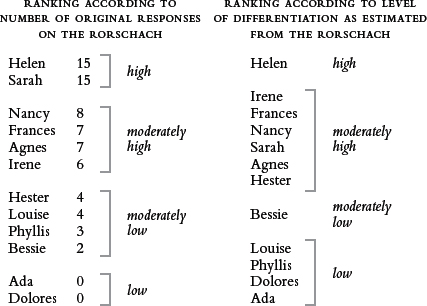
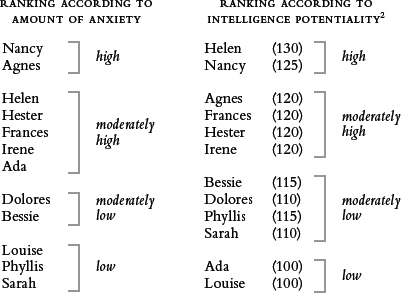
I shall approach this problem by citing the parallel rankings of the young women in this study according to amount of anxiety on the one hand and potential intelligence, originality, and level of differentiation on the other. I am entirely aware that this method leaves much to be desired; the rankings are necessarily a gross method of judgment. Furthermore, it is doubtful whether the factors of potential intelligence, originality, and level of differentiation are adequate as descriptions of what Kierkegaard, for example, meant by “creative.” His term was, in German, Geist, by which he meant the capacity of human beings, as distinguished from animals, to conceive of possibility and actualize possibility. Or, as Goldstein phrases it in his studies of the brain-injured, the capacity to transcend the immediate, concrete situation in the light of “the possible.” Granted the shortcomings of our method, however, I believe the following approach may at least yield suggestive indications.
A glance at the comparative rankings for anxiety and for intelligence potentiality shows that the young women who are in the high or moderately-high categories in anxiety are all (except Ada, one of the two young black women) in either the high or moderately-high categories for intelligence potentiality. Conversely, the young women who are in the lower two categories in one list are also in the lower two categories on the other (again, Ada is the one exception). The suggested indication is, therefore, that the girls with the greater intelligence potentiality do have the greater degree of anxiety.
I do not mean that they will necessarily exhibit overtly greater anxiety; more intelligent persons presumably have also developed more effective ways of managing and controlling their anxiety. Some readers would prefer to speak of “potential anxiety,” but the insertion of that term would not change the above point. Potential anxiety is still anxiety.3
When comparing the number of original responses with degree of anxiety, (as shown in the chart on page 367) we note that all of the young women except one in high and moderately-high categories with respect to number of original responses are in the high or moderately-high categories in anxiety. The one exception is Sarah, the other black in this study.
All of the young women except one in the high or moderately-high categories according to level of differentiation are also in the upper two categories with respect to anxiety. The one exception is again Sarah.4 As far as the present methods go, the results are on the side of the hypothesis that personalities of higher intelligence, originality, and level of differentiation likewise have more anxiety. As Liddell put it, “anxiety accompanies intellectual activity as its shadow.”5 In proportion to the intellect, I add, there will be anxiety present.6
Here are the rankings according to originality (which is simply the number of original responses on the Rorschach) and the level of differentiation.
In the cases in our study, to sum up, impoverishment of personality is related to the absence of anxiety. Anxiety tends to impoverish and constrict the personality, and where impoverishment is accepted and structuralized in the personality—i.e., once one has become impoverished—subjective conflicts and neurotic anxiety are avoided. The thesis of Kierkegaard, Goldstein, and others is confirmed by this and many other studies that the more creative and productive the personality, the more anxiety-creating situations it confronts. Students who do especially well in their studies and are, presumably, particularly gifted, have more anxiety, i.e., respond to all types of stress with anxiety. Students who are less competitive blame themselves or others for their poor performance, relieving them of anxiety.7 Furthermore, anxiety can either inhibit or facilitate performance, depending on its strength and the individual’s creative potential. Highly creative individuals perform cognitive tasks under stress better than those who are less creative.8 Many psychologists believe that anxiety facilitates performance up to a point, then as the anxiety rises and tends to become overwhelming, it is debilitating. We agree with J. P. Denny, that perhaps the difficulty of the task itself caused anxiety in the less able.9 Other persons, presumably the more intelligent and creative, seek anxiety to arouse them to achieve higher quality performances.
There are, likewise, lessons to be drawn from the oft-scorned studies of rats. In a report in Science, researchers at Cambridge University found that any general arousal, including pain and anxiety, stimulates learning.10 It was also found that rats in a crowded pen, which assumedly puts them under stress, warded off disease (tuberculosis) better than those who were not crowded. When the organism, in other words, is put on its mettle, aroused even by pain and inconvenience, it functions better. The carry-over to this work could be stated simply: a moderate amount of anxiety has a constructive effect on the organism. Simple contentment, in other words, is not the aim of life. Such things as vitality, commitment to values, breadth of sensitivity, I propose, are more adequate goals. Probably this is why parachutists11 and soldiers who are not “anxiety-free” but experience a realistic degree of anxiety do better than the nonanxious at their respective tasks.
I NOW wish to present a conceptualization which may draw together some loose ends of the theory of anxiety. We have pointed out in earlier sections of this chapter that neurotic anxiety results from a cleavage or contradiction between expectations and reality, a contradiction which occurred originally in the person’s early relations with and attitudes toward his parents. We need now to emphasize that the cleavage between expectations and reality has its normal and healthy form as well as its neurotic form.
This cleavage, indeed, is present as one condition of all creative activity. The artist conceives a landscape in his imagination that has significant form. This is always partially in the way he sees the natural scene and partially produced by his own imagination. His painting is the result of his capacity to wed his own expectations—in this case, his artistic conception—with the reality of the scene before him. The man-created picture then has beauty which is richer and more gripping than the inanimate nature from which it was painted. Similarly, every scientific endeavor consists of the scientist’s bringing to bear his own expectations—in this case, his hypotheses—upon reality, and when this process is successful he uncovers some reality which was not known in that way before. In ethics, the person brings to bear his expectations—in this case, ideals of more desirable relations—upon the reality of his immediate relations with other people, and by this means some transformation of his interpersonal relations occurs.
This capacity to experience a gap between expectations and reality and, with it, the capacity to bring one’s expectations into reality, is the characteristic of all creative endeavor. We have seen this capacity of the human being as the capacity to deal with the “possible” and as the human ability to “plan.”12 In this context the human being may be described as the mammal with imagination.
Now this capacity, however it may be defined, is the condition both for anxiety and for creativity. The two are bound together; as Liddell has put it, anxiety is the shadow of intellect and it is the milieu in which creativity occurs. So our discussion now comes full circle. We see that man’s creative abilities and his susceptibility to anxiety are two sides of the same capacity, uniquely possessed by the human being, to become aware of gaps between expectations and reality.
But there is a radical difference between neurotic and the healthy manifestations of this capacity. In neurotic anxiety, the cleavage between expectations and reality is in the form of a contradiction. Expectation and reality cannot be brought together, and since nobody can bear the constant tension of the experience of such a cleavage, the individual engages in a neurotic distortion of reality. Though this distortion is undertaken for the purpose of protecting the individual from neurotic anxiety, in the long run it makes the contradiction between the individual’s expectations and reality more rigid and hence sets the stage for greater neurotic anxiety.
In productive activity, on the other hand, the expectations are not in contradiction to reality, but are used as a means of creatively transforming reality. The cleavage is constantly being resolved by the individual’s bringing expectations and reality progressively into greater accord. This, as we have endeavored to show at many points throughout this book, is the sound way to overcome neurotic anxiety. Thus our human power to resolve the conflict between expectation and reality—our creative power—is at the same time our power to transcend neurotic anxiety and to live with normal anxiety.
The term “self” is used in two senses by writers on anxiety. In its broader meaning, “self” refers to the sum total of the individual’s capacities, which is the way Goldstein uses it. In its more limited sense, “self” refers to the capacity of the human organism to have conscious awareness of its activities and, through this awareness, to exercise a measure of freedom in directing these activities. This is the way Kierkegaard, Sullivan, and Fromm use the term. Anxiety is involved in the development of the self in both of these meanings of the word.
Self-realization—i.e., expression and creative use of the individual’s capacities—can occur only as the individual confronts and moves through anxiety-creating experiences. The freedom of the healthy individual inheres in his capacity to avail himself of new possibilities in the meeting and overcoming of potential threats to his existence. By moving through anxiety-creating experiences, one seeks and partially achieves realization of himself. He enlarges the scope of his activity and, at the same time, measure of selfhood. It is also a prerequisite to working through the anxiety. This capacity to tolerate anxiety is found least of all in the brain-injured patient, more in the child, and most of all in the creative adult.
Using the term “self” in its more limited sense—namely, the function of awareness of one’s experience and activities—Sullivan has made a significant contribution. He holds that it is in anxiety experiences in the young child that the self comes into being. The infant in its early relations with its mother learns which activities will receive approbation and reward and which will receive disapproval and possible punishment. The latter activities arouse anxiety. The “self-dynamism,” as Sullivan terms it, develops as a process by which the anxiety-creating experiences are excluded from activity and awareness and the approved activities are incorporated into the child’s awareness and behavior. In this sense, the self comes into being to preserve the individual’s security, to protect him from anxiety. This view emphasizes the integrative function of anxiety in the development of the self and illuminates the very common phenomenon, which we have seen above, that anxiety experiences which are dealt with unconstructively lead to a constriction of the self. Sullivan also indicates—pointing toward the constructive use of anxiety—that the areas in the personality marked by anxiety often become the areas of significant growth when, as in psychotherapy or favorable human relationships, the individual can deal with his anxiety constructively.
Consider now the positive aspects of selfhood—freedom, enlarged self-awareness, responsibility. The emergence of individual freedom is very closely connected with anxiety; indeed, the possibility of freedom always arouses anxiety, and how the anxiety is met will determine whether the freedom is affirmed or sacrificed by the individual. The child’s need to break the original ties of dependence on its parents always involves anxiety. In the healthy child this anxiety is overcome by new relatedness to his parents and others on the basis of a larger degree of self-direction and autonomy. But if independence from parents brings with it an insupportable degree of anxiety (as in the case of the child of hostile or excessively anxious parents), and if the price in increased feelings of helplessness and isolation is too great, the child retreats into new forms of dependency. That particular possibility of enlarged selfhood is sacrificed and the way is set for the later emergence in this person of neurotic anxiety. This means that the capacities for independence and human freedom are necessary if one is to confront anxiety constructively.
An enlarging of self-awareness occurs whenever one confronts and moves through new possibilities. Whereas the first anxiety of the infant is without content, a change occurs in the child after the emergence of self-awareness. Kierkegaard terms this emergence of self-awareness a “qualitative leap”; it is described in a different context in modern dynamic psychology as the emergence of the ego. Now the child becomes aware that freedom involves responsibility. The responsibility is to “be one’s self” as well as to be responsible to others. The converse side of this responsibility is guilt feeling. To the extent that individuals seek to avoid anxiety, responsibility, and guilt feeling by refusing to avail themselves of their new possibilities, by refusing to move from the familiar to the unfamiliar, they sacrifice their freedom and constrict autonomy and self-awareness.
“To venture causes anxiety, but not to venture is to lose oneself,” Kierkegaard puts it pithily. Availing oneself of possibilities, confronting the anxiety, and accepting the responsibility and guilt feeling involved result in increased self-awareness, freedom, and enlarged spheres of creativity.
So it is too that in the eyes of the world it is dangerous to venture. And why? Because one may lose. But not to venture is shrewd. And yet, by not venturing, it is so dreadfully easy to lose that which it would be difficult to lose in even the most venturesome venture, and in any case never so easily, so completely as if it were nothing—one’s self. For if I have ventured amiss—very well, then life helps me by its punishment. But if I have not ventured at all—who then helps me? And, moreover, if by not venturing at all in the highest sense (and to venture in the highest sense is precisely to become conscious of oneself) I have gained all earthly advantages . . . and lose my self! What of that? 13
The more creative the individual, the more possibilities he or she has and the more they are confronted with anxiety and its concomitant responsibility and guilt feeling. Or, as Kierkegaard again phrases it: “The more consciousness, the more self.” Increased self-awareness means increased selfhood. We conclude: the positive aspects of selfhood develop as the individual confronts, moves through, and overcomes anxiety-creating experiences.