GLEANINGS FROM THE CASE STUDIES
The threat of irrational material in the unconscious explains why people are afraid of becoming conscious of themselves. There might really be something behind the screen—one never knows—and thus people “prefer to take into account and to observe carefully” factors external to their consciousness.
—Carl Jung
WHAT CRUCIAL ISSUES ARE TOUCHED UPON IN THE CASE studies in the last two chapters? What ideas can we get from them which will aid us in the understanding of anxiety?
It was observed in the first case above that Brown’s fear that he had cancer was presented by him as a “realistic” and “rational” fear. He denied that it was in any way related to any underlying anxiety. But we noted that this cancer fear appeared regularly as the first step in a progression toward an anxiety spell. We noted also that as long as the cancer fear remained as the focus of his attention, conscious anxiety did not appear, but that when anxiety dreams and conscious anxiety did emerge (as they regularly did after several days), the cancer fear vanished. We cannot avoid the conclusion that the cancer fear was thus both the first form of an emerging anxiety spell and also a means of covering the underlying anxiety by displacement on a threat which could be called rational and realistic.
The anxiety spell, of which, as we have said, the cancer fear was the initial sign, was regularly related to some aspect of the conflict which underlay Brown’s neurotic anxiety—namely, his conflict with his mother. If he had been able to hold consistently to his cancer fear (or if, to put the matter hypothetically, he really had had cancer), his underlying conflict and anxiety would have been obviated. For he would have been able to remain in a hospital and be taken care of without feeling guilty about it, and he would also have gotten even with his mother since she would have had to support him. Thus, despite superficial and apparent differences in content between the cancer fear and the conflict with his mother, I propose that a logical and subjectively consistent relationship existed between the former (the neurotic fear) and the latter (the underlying neurotic anxiety). For was not this mother problem, in a symbolic sense, a “cancer” for Harold Brown?
In the case of Helen we hypothesized that the fear of parturition was an objectification of her underlying anxiety arising from repressed guilt feeling associated with her pregnancy. In my judgment this was borne out. So long as her apprehension could be attached to the possible sufferings in childbirth—a focus of fear which could easily be construed by Helen as “rational”—she was not faced with the much more difficult problem of confronting the underlying guilt feelings. Even the admission of these guilt feelings would have threatened her whole structure of psychological protective strategies and thrown her into profound conflict.
These cases illustrate that fears are the objectified, particularized foci of underlying anxiety. A neurotic fear has its exaggerated quality by virtue of the neurotic anxiety underlying it. It is also to be noted that (a) the content of the particular neurotic fear is not fortuitously or accidentally selected by the subject, but bears a consistent and subjectively logical relation to that particular subject’s pattern of underlying conflict and neurotic anxiety; and (b) the neurotic fear performs the function of covering up the underlying conflict of anxiety.
At the outset of the study of unmarried mothers, I proposed that neurotic fears would shift, as the practical issues and problems confronting the individual shifted, but that the neurotic anxiety would remain relatively constant. As stated earlier, one of the purposes of the second Rorschach and the anxiety check-lists after parturition was to determine if possible the shifts in the foci of anxiety after the birth of the baby. Some few data emerged bearing on this hypothesis. In the cases—Helen, Agnes, Charlotte, Frances, Dolores—in which it was possible to continue the study and administer a second Rorschach after parturition, the results indicated that (a) the neurotic anxiety had decreased slightly, but (b) the particular anxiety pattern remained the same. Some slight change of foci was evidenced—e.g., Helen’s focus of anxiety on parturition had largely vanished, and there was a slight increase of anxiety about her relations with men over that in the preparturition Rorschach. In Frances there was a shift from a rigid defense (constriction) against the anxiety-creating situation of relations with men to a greater acceptance of the possibilities of these relations, with more overt signs of anxiety. But the data in the present study bearing on this hypothesis are scanty.
The case of Brown throws some light on why it was not possible in the study of unmarried mothers (in addition to the fact that we could not study a very large number of the women after parturition) to get more data on the shifts of foci of neurotic anxiety. In his case, studied over a period of two and one-half years, the shifts of foci of anxiety were very evident, and the above hypothesis could be clearly demonstrated. An interesting phenomenon, however, was noticed: after his severe anxiety attacks, a respite from anxiety often occurred for a week or several weeks, despite the fact that his underlying conflicts were not radically nearer solution than at the time of the anxiety.
This phenomenon—that after a period of severe anxiety there is a respite for a time, despite the fact that the underlying conflict is not radically clarified—obviously raises a perplexing problem. One explanation which suggests itself is based upon the guilt feeling involved in the anxiety. It is my observation that there is generally a considerable amount of guilt feeling, often very subtle but generally pervasive, involved in the inner conflict which underlies neurotic anxiety. In Brown’s case it was clearly evident that he experienced much guilt toward his mother in the instances when the occasion for his anxiety was his own achievement, and much guilt toward himself when the occasion was his dependency. Now, perhaps this guilt feeling is temporarily allayed by the person’s having endured the painful experience of anxiety. And hence the anxiety which was caused by the guilt feeling would also be temporarily allayed. It was as though the person were saying, “I’ve paid the price; now I’ve earned a little peace.”
After this respite period the neurotic anxiety then re-emerged, generally around new foci. It would seem, therefore, that the study of the group of unmarried mothers did not continue long enough after the parturition to discover the new foci of anxiety which presumably would emerge, let us say, when the young woman got into a work situation or initiated relations with a new man friend. We can conclude that the data in the present study point toward an affirmation of the hypothesis that the foci of neurotic fears will shift while the underlying pattern of neurotic anxiety remains constant. But the data are not definite enough for this hypothesis to be termed demonstrated.
IT HAS been illustrated in the cases in this study that anxiety and hostility (covert or overt) rise and fall together. When the subjects (say, Brown and Agnes) were relatively more anxious, more covert or overt hostility was evidenced, and when the anxiety abated, the hostility did likewise.
We have seen that one reason for this interrelation is that the intense pain and helplessness of the experience of anxiety arouses hostility toward those other persons whom the individual holds responsible for placing him in such a state. We have observed that another reason underlying this interrelation is that hostility (particularly repressed hostility) leads to anxiety. Brown’s repressed hostility toward his mother, if expressed, would alienate the very person he is dependent upon, and hence its existence generates more anxiety. Thus, when hostility arises in persons with neurotic anxiety, the hostility is generally repressed and may take the reactive form of an increased striving to please and placate other people. This can be seen most vividly in the situation of Nancy, the most anxious woman in this study, who had trained her personality in great detail to please and placate other people.
One case, however, was presented (Agnes, whose character structure was sado-masochistic) in which hostility and aggression were employed as defenses against the anxiety-creating situation. By hostile and aggressive behavior she endeavored to force her boy friend not to make her more anxious by abandoning her.
Whenever neurotic anxiety was found in the above cases, subjective conflict was likewise found.1 On the surface this seems a relationship easy enough to see and demonstrate. In the cases in which neurotic anxiety was not found in any pronounced degree—Bessie, Louise, Sarah, Phyllis, Charlotte—subjective conflict in any pronounced form was not present either. But the more interesting question is, “What is the conflict about?”
The conflict took many different forms, depending on the individual case. To cite only three examples, the subjective conflict in the case of Brown lay in his need to achieve some autonomy and use of his own powers on one hand, but in his conviction at the same time that if he did appropriate his own power he would be killed by his mother. Hence his behavior was characterized by great dependence on his mother (and mother surrogates) and hostility toward her at the same time. Whenever this conflict was activated, profound and extensive feelings of inadequacy, helplessness, and concomitant anxiety occurred, with paralysis of capacity for acting. For Helen, the conflict lay between guilt feelings on one hand and the need (upon the achieving of which her self-esteem depended) to appear amoral and intellectually sophisticated. In Nancy the conflict appeared in the need to depend entirely upon others for her security, while at the same time she believed all others to be undependable.
The situations which cued off this conflict in the case of each person—e.g., for Brown, situations of dependency on one hand or occasions of his individual success on the other; for Helen, the guilt associated with her pregnancy; for Nancy, her relation to her fiancé—these were the anxiety-creating situations. In these studies, inner conflict was always present with pronounced anxiety, and it was the activation of this conflict which cued off the neurotic anxiety.
The question arises, moreover, as to the relation between the threat the individual anticipates and the conflict. The commonly accepted statement that anxiety—both normal and neurotic—always involves some anticipated threat is not contradicted by the data in the present study. In normal anxiety and fear, the description of the threat may account relatively inclusively for the existence of the apprehension. Anxiety about death is one example. It will be recalled that we made the distinction between anxiety and fear: when the threat is to an essential value, the reaction is anxiety; when the threat is to a peripheral value, the reaction is fear.
But in neurotic anxiety, two conditions are necessary: (1) the threat must be to a vital value; and (2) the threat must be present in juxtaposition with another threat so that the individual cannot avoid one threat without being confronted by another. In patterns of neurotic anxiety, the values held essential to the individual’s existence as a personality are in contradiction with each other. If Brown uses his powers, he is threatened with death, but he can remain dependent upon his mother only at the price of continued feelings of worthlessness and complete helplessness, which is a threat almost as serious as being killed. For another example, Nancy confronted the threat of being rejected by the others (mother and fiancé) whom she believed to be undependable, but her incapacity to exist without the care of these other persons confronted her with an opposite threat. The essence of the “trapped” feeling in neurotic anxiety is that the individual is threatened whichever way he turns. Thus an inquiry into the nature of the threat anticipated by an individual in neurotic anxiety reveals the fact that threat is present on both sides of the conflict.
A corollary problem has also been raised and illustrated in the above cases—namely the distinction between the occasion and the cause in neurotic anxiety. (The term “occasion” is here used to mean the event which precipitated the anxiety.) It was observed that the occasions of Brown’s neurotic anxiety were frequently situations which he could and did handle adequately, such as performing his academic assignments. Thus the occasion in those instances could not be identified with the cause of the anxiety. We also recall that the more severe his anxiety, the more he insisted that the occasion had nothing to do with it, that he was “afraid of everything,” “afraid of life.” While it is true that the particular occasion which cued off the anxiety spell could in retrospect be shown to have a psychologically consistent relation to the anxiety, there is none the less some logic in his insistence on the distinction between occasion and cause. In neurotic anxiety, the occasion is significant in the respect that it cues off the underlying conflict, but the cause of the anxiety is the conflict. As was demonstrated by Harold Brown, the occasions, no matter how significant they may seem to be objectively, always bear a subjectively logical relation to the particular inner conflict in the given individual. That is to say, the occasions are significant for the anxiety of the subject because they, and not other occasions, cue off his particular neurotic conflict.
It seems to me that a hypothesis may be formulated as follows: The more nearly normal an experience of anxiety is, the more the occasion (precipitating event) and the cause of the anxiety are identical; but the more neurotic the anxiety, the more the occasion and the cause can be distinguished. For example, a passenger on a ship in submarine-infested waters is anxious lest his ship be torpedoed. Such anxiety may be realistic and proportionate to the situation, and the occasion—the threat of being torpedoed—may conceivably be a relatively sufficient explanation of the anxiety. But at the other extreme, persons with severely neurotic anxiety may be precipitated into an anxiety spell by a chance word from an acquaintance, a lack of greeting from someone on the street, or a fleeting memory. Thus the more neurotic the anxiety, the less adequate becomes the objective occasion as an explanation, and the more we are driven to understand how the person interprets the situation to find the adequate cause of the anxiety. This is generally described as anxiety which is disproportionate to the situation. It is disproportionate to the occasion, but it is not disproportionate to the cause—namely, the inner conflict which the occasion has activated. In my experience in dealing with cases of the most severe anxiety—borderline psychotics for one example—the occasion, viewed objectively, is almost entirely inadequate as an explanation for the degree of anxiety, and the cause may be almost entirely subjective.
I have been speaking above chiefly about neurotic anxiety and the conflicts behind it. But are we not at the point where we can no longer make the distinction between normal and neurotic? Do we not all have these conflicts, in greater or lesser degree? And do not all conflicts move into contradiction at some point? When all is said and done, all anxiety arises from conflicts, with its origin in the conflict between being and nonbeing, between one’s existence and that which threatens it. All of us, no matter how “neurotic” or “normal,” experience the gap between our expectations and reality. This distinction becomes less important, and I believe we must look at all anxiety, preferably without special labels, as part of the human condition.
REJECTION BY PARENTS AND ANXIETY
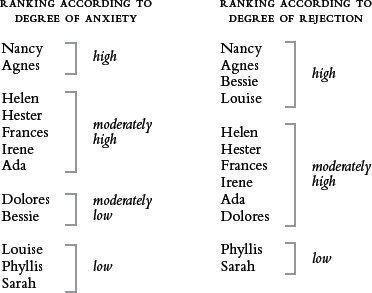
This question is considered in the light of the study of the thirteen unmarried mothers. In these interviews particular emphasis was placed on inquiring into the relationship of the degree of rejection the young woman experienced at the hands of her parents (especially her mother) and the degree of her present neurotic anxiety. The parallel tables of the rankings according to degrees of anxiety and rejection by parents present immediately two phenomena: (1) For the majority of the girls there is a clear correspondence between rejection and anxiety; but (2) for several girls there is no correspondence whatever.
In nine cases—Nancy, Agnes, Helen, Hester, Frances, Irene, Ada, Phyllis, Sarah—the degree of anxiety falls in the same category as that of rejection. In this group, whenever there was evidenced rejection by parents, there was present neurotic anxiety, and in a roughly corresponding degree. The indications in these cases are on the side of the classical hypothesis: rejection by parents (especially by the mother) predisposes the individual to neurotic anxiety. But in two cases—Louise and Bessie—a radically different picture was presented. These two young women experienced profound and extensive parental rejection, and yet they did not have a corresponding degree of anxiety. Dolores falls in this group, though the rejection she received was not as severe and unrelieved as that which the other two experienced.
The key to this perplexing but fascinating problem is to be found by inquiring into the psychological meaning of the rejection. We shall, therefore, ask, with reference first to the cases of the young women in whom rejection was found with anxiety and then to the cases in which it was not: How did the person subjectively interpret her rejection? And what was the relation between her expectations of life and reality?
The chief characteristic of those who fit the hypothesis is that they always interpreted the rejection against the background of high expectations of their parents. They exhibited what I term a contradiction between expectations and reality in their attitudes toward their parents. They were never able to accept the rejection as a realistic, objective fact. In one breath Nancy described how her mother flagrantly left her alone, caring “more for going out to bars than for her child,” but in the next breath she added, “She could have been such a good mother.” Similarly, Nancy needed constantly to repeat that the mother was “good” at certain special periods in her childhood, despite the objective indications that the mother was consistently unstable and irresponsible in her relations with the child. In Nancy, a point was also demonstrated that may presumably hold for the other cases as well—namely, that the idealized expectations on one hand and the feelings of rejection on the other reinforce each other. One specific function of the idealization in Nancy’s case (as in others) was to cover up the reality of the rejection, but in the light of her idealized expectations her feelings of rejection became the more painful.
We see the same contradiction between expectations and reality in the other young women as well. Helen spoke of her mother’s “disloyalty” to her, implying the expectation that the mother could and should have been different. Frances idealized her parents by describing them as “wonderful” and “sweet,” preserved the idealization under the “fairy-tale” motif, and endeavored to suppress her considerable feelings of hostility toward them and her feelings of isolation as an adopted child. These young women exhibited, furthermore, what might be termed a nostalgia about their relations with their parents, dwelling on pictures of what “might have been” if their parents had been different. This nostalgia seemed both to be part of the idealized expectations toward the parent and a way of avoiding the reality situation of their relations with their parents. Hester exhibited a nostalgia in a somewhat different form, “If my father had not died, I wouldn’t have gotten into these difficulties.”
These young women, moreover, still cherished hopes and expectations of changing the parent, utterly unrealistic as this would appear to be. Hester was engaged continually in rebellious behavior designed to force her mother to pay attention to her. Though Agnes knew that her father had never showed genuine concern for her in the past, and that there was no realistic hope of his now changing, she nonetheless at her present age made another trip to see him in some vague hope that he might be different. These young women seemed to be still fighting old battles with their parents.
To summarize: in these cases which fit the classical hypothesis, where rejection is present with neurotic anxiety, we found a certain constellation always present: The rejection was never accepted as an objective fact, but was held in juxtaposition with idealized expectations about the parent. The young woman was unable to appraise the parent realistically, but always confused the reality situation with expectations of what the parent should have been or might yet become.2
We now ask, What is the genesis of this subjective conflict? We have seen, for example, that Nancy’s anxiety appeared in the form of a conflict between her need to depend utterly on the love of her fiancé and her ever-present doubt as to whether his love was dependable. This is the same conflict which occurred in early years in her relation with her mother. We have seen that Frances viewed her boy friend with the same combination of idealization and repressed hostility which she exhibited in her relations with her parents. Without citing more examples here, we note that the conflict which appeared in later excessive anxiety was the same general conflict which was and is existent in the young woman’s relation with her parents.3
In these cases the original conflict with parents became introjected, internalized (i.e., became subjective conflict), resulting in inner trauma and a fundamental psychological disorientation of the young woman in her attitude toward herself and toward other people. It not only remained as the source of persistent resentment toward the parents, but was the source likewise of persistent self-condemnation. This is not to say merely that it is the original conflict with parents which is reactivated in the young woman’s later anxiety. It is to say, more inclusively and more accurately, that the original conflict in relating to the parents sets the character structure of the individual with regard to interpersonal relations and that the individual meets future situations on the basis of this same character structure. For example, it is clear that a confusion of reality and expectations in relating to the parents would render the individual unprepared to appraise her future relations with other people realistically. She would, therefore, be subject to recurrent subjective conflict and concomitant anxiety.
A SHARPLY contrasting constellation—indeed, the reverse—is seen in those young women who experienced rejection but did not exhibit any pronounced neurotic anxiety—namely Bessie, Louise, and, in some respects, Dolores. The difference between the reactions of these young women to rejection and those of the former group is shown graphically in Dolores’ surprise that the psychologist would raise the question of whether she had regretted as a child that her father never played with her. For any of the young women in the first group, such a question would have made entire sense, and would in most cases have been used by her as a springboard for getting out her resentment toward the parent. For Dolores, however, such a question had apparently never entered her head. These young women did not entertain idealized expectations about their parents; they appraised their parents realistically. Louise and Bessie accepted their mothers as the punitive, hating persons they actually were. Neither girl cherished any illusions that the parent had been “good” at some particular date, or that the parent might become loving the next day. Louise and Bessie accepted rejection as an objective fact; Louise impersonally termed it “hard luck,” and Bessie took steps to obtain her affection in relations with persons other than her parents. Neither girl permitted the parental rejection to change her behavior. Bessie went ahead playing with the siblings, in the childhood example, despite her father’s flagrant rejection at her approach, and Louise refused to engage in hypocritical expressions of affection to a mother she did not love.
In these young women there was no gap, no contradiction between expectation and reality in their relations with their parents. The conflicts these women experienced in their relations to others as well as their parents were on a conscious, objective basis. The essential point in their freedom from neurotic anxiety was that their rejection was not internalized; it was not made a source of subjective conflict, and it therefore did not psychologically disorient them in their self-appraisal or appraisal of others.
CLEAVAGE BETWEEN EXPECTATIONS AND REALITY
While the present study supports the hypothesis that the conflict underlying neurotic anxiety has its origin in the individual’s relation to his parents, it does not support the statement that rejection as such predisposes to neurotic anxiety. Rather, the origin of the predisposition to neurotic anxiety lies in that particular constellation in the child’s relation to the parent in which the child cannot appraise the parent’s attitude realistically and cannot accept the rejection objectively. Neurotic anxiety arises not out of the fact of having had a “bad” mother, to use Sullivan’s phrase, but out of the fact that the child is never sure whether the mother is “good” or “bad.”4
What causes the conflict underlying neurotic anxiety, looking at the parent’s behavior toward the child, is rejection covered over with pretenses of love and concern. In the cases of Louise and Bessie, the parents—punitive and cruel as they were—at least did not endeavor to cover up their hatred for their children. Contemporary psychoanalyst Melitta Schmideberg asks why it is that children of modern parents, who obviously are more lenient toward them, still have as much or more anxiety than children of the stern, severe, Victorian parents. She believes the reason is that modern parents do not permit the child to be afraid of them, and, therefore, the child must displace his fear and hostility and suffer consequent anxiety. If parents cannot refrain from punishing the child, she adds, at least they should give the child the right to be afraid of them (see her Anxiety states, Psychoanal. Rev., 1940, 27:4, 439–49). Without going into the historical question of the relative anxiety in these different periods or the complicated reasons for it, we nonetheless feel that Dr. Schmideberg’s emphasis on permitting the child to appraise the relation realistically is sound. Louise and Bessie could, therefore, accept the rejection at face value—and, as illustrated in Bessie’s case, seek love and affirmative relations elsewhere. Thus, when the mothers of Louise and Bessie rejected them in later childhood and adolescence, no vital essential value was threatened; they had not expected anything better from the parents anyway. Louise’s statement, “As a child you don’t suffer, you take things as they come” may be taken to mean that you don’t suffer in the most basic way—i.e., experiencing a threat to your vital values—if you can, as she did, call the attitude of the mother by its right name. But in the cases of the young women with subjective conflict, the rejection tended to be covered over by idealized expectations (presumably existent in the parent’s earlier pretenses to the child), and hence the child never could adjust to it as a reality.5
In the light of these observations, one could roughly differentiate three types of parental relationships. First, the parent rejects the child but the rejection is in the open and admitted on both sides. Second, the parent rejects the child, but covers up the rejection with pretenses of love. Third, the parent loves the child and behaves toward him or her on that basis. The data in this study affirm that it is the second kind of relationship which predisposes to neurotic anxiety.6
The point we are here discussing is so significant that I wish to quote some remarkably similar findings from the studies of children by Anna Hartoch Schachtel. Describing one child whose mother rejected her but pretended love and exhibited possessive jealousy of the child’s love for the grandmother, Mrs. Schachtel states: “This child lives in a make-believe situation; she has to avoid facing the real situation of not being loved; she lives in a wishful expectancy and bases her whole interests, fears, expectations and wishes on this shaky basis.” This child corresponds very closely to the young women in the first group we have been describing. Mrs. Schachtel describes another child who was fatherless, was frequently beaten at home and told what a nuisance she was. “To her it is a fact that she is not loved, but this in no way impairs her own capacity to love.” She was an independent, rather tough, aggressive, cooperative, and reliable child who “does not minimize or beautify inhuman and hostile things that happen to her.” This child seems to me to be remarkably like Bessie. As was the case with Bessie, this child found love in friends and siblings despite the parental rejection. Mrs. Schachtel points out that “not being loved is better than the experience of a pseudo-love for a child.” The findings of the present study would indicate that this is very true with respect to the predisposition to anxiety.7
Can anxiety in general be described in the form in which we have discovered it in the relations of these young women to their parents—namely as a subjective disorientation arising from a fundamental contradiction between expectations and reality? Is it a fundamental disorientation, an inability to orient one’s self to the world, an incapacity to see the world as it is?
These questions would lead beyond the scope of this immediate discussion. But I suggest them as fruitful hypotheses, having both psychological and philosophical promise. Donald MacKinnon has presented a description of anxiety which, apart from its topological features (which may be open to question), is similar to the above hypothesis:
A person troubled by anxiety . . . simultaneously sees things as both better and worse than they are. . . . His positive irreality distorts the structure of his level of reality in accordance with his hopes, while at the same time his negative irreality distorts it in accordance with his fears. . . . This means that psychologically the individual stands on unfirm ground, for the level of reality of his life space lacks clear cognitive structure since it has simultaneously the conflicting meanings of probable success and probable failure.”8
NEUROTIC ANXIETY AND THE MIDDLE CLASS
A final question arises from the fact that the young women in the first group—i.e., with neurotic anxiety—were all from the middle-class, and those in the second group, who were rejected but accepted it without neurotic anxiety, were all from the proletarian class. Indeed, of the four proletarians in this study—Bessie, Louise, Sarah, and Dolores—not one exhibits any pronounced neurotic anxiety. It may be noted that the child Mrs. Schachtel described as accepting rejection as a realistic fact was also proletarian.
This raises the important problem of whether, in our culture, the contradiction between expectations and reality underlying the predisposition to neurotic anxiety is especially a characteristic of the middle class and, likewise, whether neurotic anxiety is predominantly a middle-class phenomenon. The classical hypothesis concerning rejection and predisposition to neurotic anxiety is based upon clinical and psychoanalytic work with subjects who are almost exclusively of the middle or upper middle class. This is true of the patients of Freud and of most all the patients of psychoanalysts in private practice since. Perhaps the hypothesis is true for the middle classes but not for other classes.
There is much a priori reason, and some a posteriori data, for the contention that neurotic anxiety is especially a middle-class phenomenon in our culture. The cleavage between reality and expectations is particularly in evidence, psychologically as well as economically, in the middle class. Karl Marx described the proletarian class as the class which had no expectations short of revolution. It has earlier been indicated (Chapter 4) that individual competitive ambition, a trait in our culture intimately associated with contemporaneous anxiety, is chiefly a middle-class trait. The proletarian women in this study showed definitely less competitive ambition than the middle-class women. Sarah had worked out an ingenious system by which her ambition would not be competitive, “I arrange to be not on the top, or not on the bottom, but in the middle.” Fascism, a prominent cultural anxiety symptom in our day, begins as a lower-middle-class movement. Totalitarianism, a prominent cultural anxiety symptom in our day, begins as a lower-middle-class movement. The burden of anxiety falls most heavily on the middle class, caught as its members are, between difficult standards of behavior and the awareness that the values supporting the standards are defunct. This is surely an enticing topic for both sociologists and psychologists to explore.