
Theory is all well and good, but you’ve gotta learn how to put this into practice.
We’ve covered miles of ground to help you develop healthy habits that you actually look forward to. Now that you’re all schooled up and well on your way to becoming the healthiest person you know, I want to give you some pretty handy tricks that you can use to stick with your new practice.
If your old habits rear their Twinkie-loving, two-pizza-eating heads, it doesn’t mean that you are failing. Building a healthy lifestyle can be a two steps forward, one step back kind of process. But guess what? That’s still progress, and as long as you’re consistent, you can still meet your goals.
If you have a misstep, or just lack motivation on any given day, instead of feeling blue or berating yourself, remember that negative self-talk can have the same unhealthy side effects inside your body that fast food and artificially colored blue icing create.
Be gentle with yourself, take a deep breath, then get back on track. Recommit to your morning and evening routines—good health really does start and end there—and use the following tools to help stay the course.
This small tweak to your internal language is scientifically proven to yield better results. Instead of saying, “I can’t have ice cream for dinner,” tell yourself, “I don’t have ice cream for dinner.” You can even add a qualifier and reframe, because hey, it’s okay to have a serving of a good-quality ice cream after a healthy dinner one night each week. Something like, “I don’t have ice cream for dinner, and I don’t have ice cream after dinner unless it’s Friday night.”
Repeating “I don’t” statements versus “I can’t” statements can retrain your neural pathways to help you make better decisions over time.
A few “I don’t” statements that help me:
I don’ t put any type of sweetener in my coffee.
I don’ t have wine on “school nights” (Sunday through Thursday).
I don’ t eat highly processed bread.
And trust me, I still very much enjoy myself. I love a high-quality flatbread with a glass of wine on the weekends, and I cook with things like almond flour tortillas and brown rice tortillas. There’s so much good food out there to enjoy—when you crowd out unhealthy items with healthier options, you’ll start to find that you like the healthier options even more.
Which leads me to . . .
Rather than imposing strict rules on yourself, a gentle way to introduce new healthy habits is to add them in and allow them to crowd out the bad stuff. For example, instead of thinking, I can’t have any pizza on pizza night, shift to I always have a big, healthy green salad before pizza.
Let the salad crowd out some of the pizza. Trust me, if you have a big, vibrant green salad (a good one—not a sad, boring one) you’ll most likely be completely satisfied with one or two slices of pizza instead of six. Let a big bowl of fresh, real food crowd out a few slices of pizza or a pot of mac and cheese.
Crowding out is often a first, best step to making healthier choices. Once you’ve developed the habit of crowding out, you can experiment with new types of food and ways of eating that can change your life and health forever. Let home-cooked food you love crowd out unhealthy choices.
We covered this extensively in Chapter 6, so you’re already well on your way to bookending your day with self-care that supports your healthy lifestyle. Inspirational speaker Alexander den Heijer says, “When a flower doesn’t bloom, you fix the environment in which it grows, not the flower.” Your morning and evening rituals create the environment that allows you to grow.
The daily actions you incorporate into your morning and evening routines can also serve as a source of pleasure (often the reward part of the habit loop), which can replace less desirable sources of pleasure like a jumbo muffin, an entire bag of chips, or a pint of rocky road with whipped topping. Pleasurable morning and evening routines will reduce the urge to use food as your only source of pleasure.
There’s a saying, “The easiest thing to do is the easiest thing not to do,” and it speaks to the simple yet powerful act of writing things down. Putting pen to paper solidifies your commitments by engaging a group of cells in your temporal lobe known as the reticular activating system. Your brain intensifies the amount of focus on the information you are writing down.1
If you ever feel stuck, get out a piece of paper and write down your health commitments. It’s better to use real pen and paper instead of typing if possible as the kinesthetic movement of your thoughts adds another layer of learning to your brain. Use “I don’t” instead of “I can’t” statements where needed.
Even better, tape what you wrote down to your bathroom mirror, refrigerator, or vision board. Make it your phone or computer screen saver, or keep it next to your bed on a note card. Seeing your commitments and affirmations regularly creates micro visioning sessions to aid your efforts.
Which leads me to . . .
I’ve written about this before: Vision boards aren’t woo-woo, airy-fairy exercises. Visualization is scientifically proven to work. Olympic athletes have been using visualization for decades to improve performance, and Psychology Today reported that the brain patterns activated when a weightlifter lifts heavy weights are also similarly activated when the lifter just imagines (visualizes) lifting weights.2
A vision board is one of the easiest ways to constantly remind yourself of what you want to create. In recent years, I’ve also adopted the idea of what I call a Spirit Corner to sit in front of as I journal and practice mindfulness and visualization exercises (see Chapter 6 for more on this).
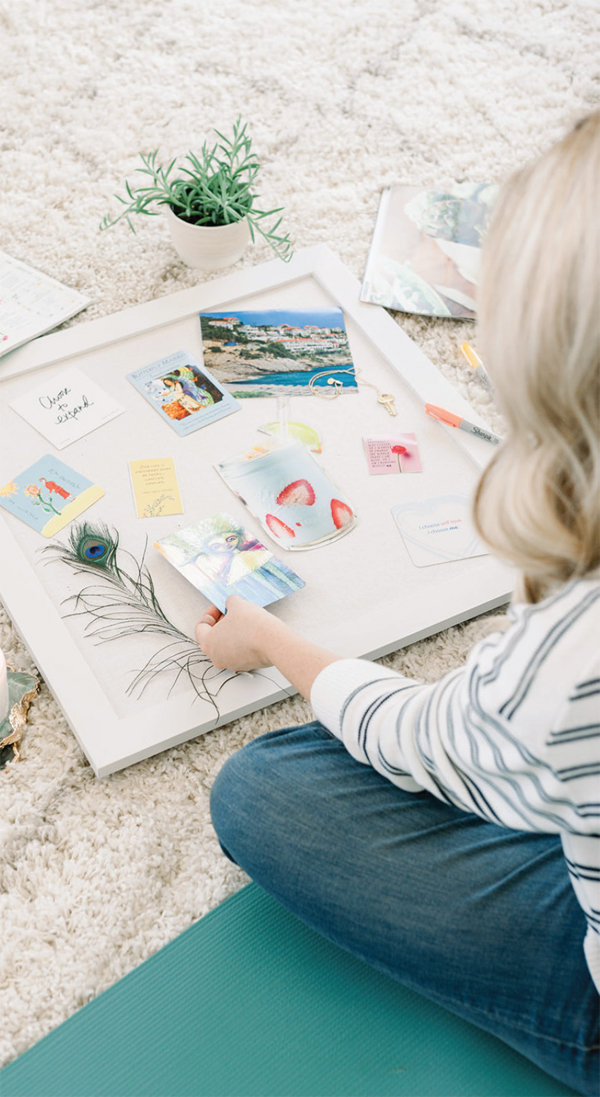
Whether you decide to make an actual board or Spirit Corner or not, whenever you feel yourself making excuses and losing enthusiasm, take a moment to visualize what you want to achieve. Having a clear view of what you want will get you through confusing moments.
If you’ve been doing a brilliant job of eating clean and then experience a moment of weakness, you’re not back at square one. Healthy habits and willpower are just like muscles; they will get stronger and stronger the more you work them, and they will get weaker if neglected.
If you fall off the wagon, take a deep breath and hop back on without making yourself feel guilty. Neglecting the muscle once isn’t what makes it weak. Neglecting it over time is the issue. Be proud of yourself for the progress you’ve made thus far. You’re human, not a robot. Maintain your mindset of progress, not perfection.
Thinking, saying, and writing affirmations on sticky notes to be placed around your living and working space also creates mini visualizations that work. Affirmations help train your brain to make better decisions. If you’re new to affirmations, check out the work of the late and beloved Louise Hay. Her book You Can Heal Your Life is a must-read, even if you don’t think you need “healing.”
Here are a few affirmations to get you started:
Healthy choices come easily to me.
I attract what I desire.
There are no roadblocks to what I want to achieve.
Good health is my nature.
I am filled with love, light, and good health.
Follow healthy living accounts on Instagram or Facebook and subscribe to wellness-focused blogs and e-mail newsletters. However, really check in with yourself and see how you feel when you read the posts.
Last year I realized that I was following a bunch of healthy-looking accounts, but every time I saw the posts I felt like I wasn’t good enough. It was a strange realization: I thought I was reading these for inspiration, but instead they were making me feel bad about myself.
Unfollow accounts that trigger feelings of unworthiness or comparison. Even if that’s not the goal of the account owner (I’d say it just about never is), you have to determine how it affects you. If it doesn’t leave you feeling inspired and happy, then unfollow. You are in charge of your social media feed; stay diligent on how you curate it.

Make your best effort to surround yourself with people who are like-minded, supportive, and inspiring as often as possible. This might mean joining a new group in your community or online.
Take a look at the five people you are around most often and evaluate if they enable your good habits or steer you to bad choices. It doesn’t mean getting rid of friends, it just means making an effort to hang with people who also get excited about lunch at a local healthy cafe or with whom you can share your latest personal growth revelation.
Goals worth achieving take effort over time. In her book 9 Things Successful People Do Differently, Heidi Grant Halvorson writes:
Albert Bandura, one of the founding fathers of scientific psychology, discovered decades ago that perhaps the best predictor of individuals’ success is whether or not they believe they will succeed—something optimists do naturally. Thousands and thousands of experiments later, he has yet to be proven wrong. But there is an important and often overlooked caveat: to be successful, you need to understand the very vital difference between believing you will succeed, and believing you will succeed easily. Put another way, it’s the difference between being a realistic optimist, and an unrealistic optimist.
Don’t let realistic optimism deter you, though. It’s a good thing and aids your self-awareness. Being a realistic optimist simply means shifting from looking for quick fixes and overnight success to appreciating and enjoying your journey, and having a realistic expectation that there will be times when it doesn’t feel easy.
And finally—and potentially most important—be gentle with yourself. It’s pretty hard to make good choices when someone is constantly talking down to you.
Negative self-talk and holding grudges against yourself works against you, never for you. Same goes for forgiveness, grace, and compassion toward others. Hurtful things that have happened to you in the past are most likely not your fault, but it’s your responsibility to heal them.
I call this Radical Responsibility for Self in one of the online courses I teach and it’s the most popular section of the entire class. We have to take responsibility for how we handle everything that comes our way: the good, the bad, and the ugly. No one gets through life unscathed, and while many circumstances may not be in your control, how you react is. No one else lives inside your head.
Show yourself forgiveness, grace, and compassion and remember to look forward, not backward. You’re not going that way.
As we wrap up, I want to leave you with this: Happiness from the inside out catalyzes actions that improve your physical health. Just like good health, happiness isn’t something you achieve once, it’s something you choose to work on every day of your life. Both health and happiness are more of a sliding scale than a black-and-white switch. Choose actions each day to slide both of them more toward the positive side. Be kind to yourself, be gentle with yourself, and allow for more flow and ease. Your Health Habit will follow.