
Don’t let these sneaky tricksters defeat your healthy habits.
If I had a dollar for the number of clients who have said, “Just tell me what to do and I’ll do it,” then I’d have enough money to have fresh green juice delivered to my house every day for the rest of my life, with enough to spare for all the bath salts and lavender drops I go through faster than toilet paper.
Women have a tremendous amount of will, and ultimately we can stick to anything for a period of time. Show up for a gut-wrenching exercise class five days a week with the intention of rocking a bathing suit over spring break? Yes, we can! Follow an elimination diet to a T and eat celery while watching our family and friends gorge on creamy artichoke dip with perfectly toasted crusty bread right in front of us? Yep! We will not break. Starve ourselves while diligently following a tough intermittent fasting schedule? Most can will it into existence.
So why, if we can do these things as we’re told and not cheat, do so many of us still not reach our health goals? Or worse, slide backward? I’ve got news for you: It’s not that you don’t want it badly enough (I know you do) or that you’re not strong enough (I know you are) or that you’re doing it wrong (you’re not). It’s that there is something intangible affecting your health goals, and it ain’t gonna uncover itself on its own.
This is the part of creating healthy habits that people like to skip. It’s like hiking up a 14,000-foot mountain and taking the trolley for the last 500 feet because that steep, jagged terrain at the top looks tough and you might get hurt. But if you do that, you’ll miss out on the best part of the journey, the one that teaches you the most.
For many, uncovering the intangibles is the hardest part of the process, because even seeing the connection between what we’re about to talk about and your health is a leap of faith. But don’t fret, I’m going walk you through it so it feels easy peasy. Okay, I kind of lied here because I want you to keep reading.
Truthfully, this might be hard; but trust me, don’t skip ahead. This step might just create the breakthrough you need to finally meet your goals and kick your bad habits to the curb. However, it’s way less hard than ignoring this stuff forever and not achieving your goals. That part is truer than true.
It’s time to meet the intangibles. The intangibles are the nonphysical, not-so-evident aspects of your life that affect your health and trigger healthy—and unhealthy—habits. They’re similar to everyone’s favorite superhero family, the Incredibles, in that they are powerful and can come out of nowhere, although they don’t wear cool costumes and you don’t always look forward to seeing them.
The intangibles affect our health just as much as the food we eat. You can have the best of intentions and a “diet plan” all set up, but the stress from non-food sources can knock the wind right out of you and force a bag of Cheetos and a dozen cupcakes down your throat.
Remember way back in Chapter 1 when we talked about the habit loop? As a refresher, the habit loop consists of the cue (aka trigger), the action (aka routine), and the reward. The intangibles are often buried in understanding the reward of why we partake in certain habits. If you still find yourself eating that pint of ice cream every night, seek to understand what type of emotional, or intangible, reward that behavior is delivering. Perhaps it’s pleasure or comfort. Perhaps it’s your way of checking out for 20 minutes to avoid frustration.
Uncovering the intangible cues and rewards you experience may be the final piece of the puzzle that you’ve been looking for. While each of these non-food sources deserve their own books—and there are thousands on each—here I’ll simply set you in the right direction, then let you continue to work with them in the best way for you.
There are four intangible areas of life that I notice affect my clients’ health the most (in no particular order):
When these things work in harmony, our health flows in harmony. But when awareness around these things has been brushed under the rug for years, our health suffers.
Emotions are chemical expressions of thought. We experience emotions as physical sensations. The feeling of a tickling stomach on a first date. The knife in our hearts when we go through a breakup. The holy-cow-I’m-gonna-throw-up sensation before walking onstage.
When we experience any emotion, it starts with a thought. Thoughts spark a chemical reaction in our brains, then we feel the emotion. Once that physical process is in place, it can affect any system or cell in your body.
For instance, you have the thought of seeing your new husband for the first time after being away for a week on a business trip. That thought sparks a chemical reaction in your brain that you perceive as joy, or maybe even sexual excitement. Feel-good neurotransmitters such as serotonin are released and along with the feeling of joy, your cortisol level is lowered and your body benefits from the fresh release of the happy thoughts.
On the flip side, the thought of getting through another day of a job you hate sends the stress hormone cortisol through the roof, affecting not only your ability to sleep well, but your motivation to exercise, eat right, and so on. It also causes your brain to look for food as pleasure, which might be the reason you have an overwhelming need for a pint of mint chocolate chip ice cream every night.
Even a happy relationship or successful career can cause these unhealthy stress levels. Your physical body can’t distinguish between the stress of running from a tiger versus the stress of signing your first book deal and then realizing you’ve agreed to work for someone else for the first time in 10 years when you cash their check, then further realizing they like to use words like deadlines and due dates (hi, Hay House!).
That’s right, stress is stress to your body, no matter where it comes from. I’ve met countless über-successful entrepreneurs who can’t seem to stop binge eating; and how many brides are stressed out of their minds on what’s supposed to be one of the happiest days of their lives?
Negativity doesn’t just come from bad situations. As we learned in Chapter 6, negative thoughts—and their subsequent emotions expressed as chemical patterns—show up when your cup is empty, not necessarily because the circumstance is bad.
In no particular order, these are the most common intangible areas in which my clients and program participants have had major breakthroughs:
Relationships come in all shapes and sizes, and include your significant other if you have one, family, friends, social acquaintances, workmates, and others. For our purposes, let’s concentrate on the relationships that affect your health goals.
Think about the five people you’re closest to or spend the most time with. Do healthy habits flow when you’re around them? Do you feel supported in your choices? If the answers to those questions are no, that’s okay. You don’t have to ditch your close personal relationships, but finding new social groups with like-minded people can go a long way to feeling more content and connected.
Expressing your truth and desire to feel more supported in your healthy habits to those closest to you is another step you can take to improve this area of your life.
Don’t mistake career and purpose for believing you have to have society’s version of a dream job to be healthy. Your purpose generally comes from how you spend your days; it doesn’t matter if you’re a CEO or stay-at-home parent.
Feeling that your time is being well spent goes a long way to creating an environment to allow your Health Habits to thrive.
And then there’s the most important relationship you’ll ever have you in your life. Nope, it’s not your current or future spouse or children. It’s your relationship with yourself and your ability to recognize negative self-talk, stop it, and reframe it.
It’s pretty hard to make good decisions and stick to your Health Habits when someone is constantly saying mean things to you (and that mean person might be you!).
Belief systems encompass everything from spiritual and religious beliefs to what we believe is possible for our lives and the world around us. When you’re unwilling to change your belief systems and make a change if needed, you’re living in fear. When you’re willing to let your beliefs evolve based on new life experiences, you’re living in love.
Living in fear keeps your body in a constant state of stress, which lets unhealthy habits thrive. Living in love frees your emotions and lets you accept life as it is, which allows healthy habits to form.
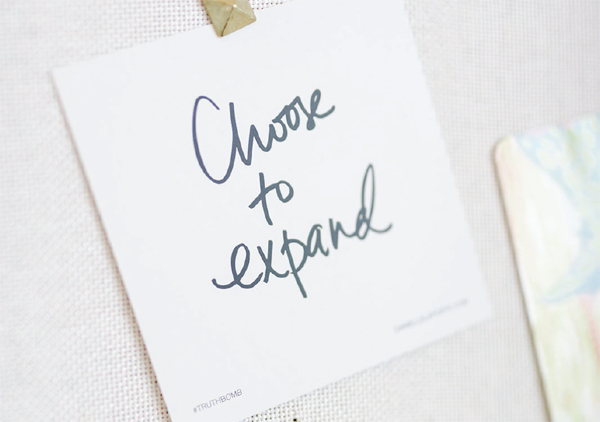
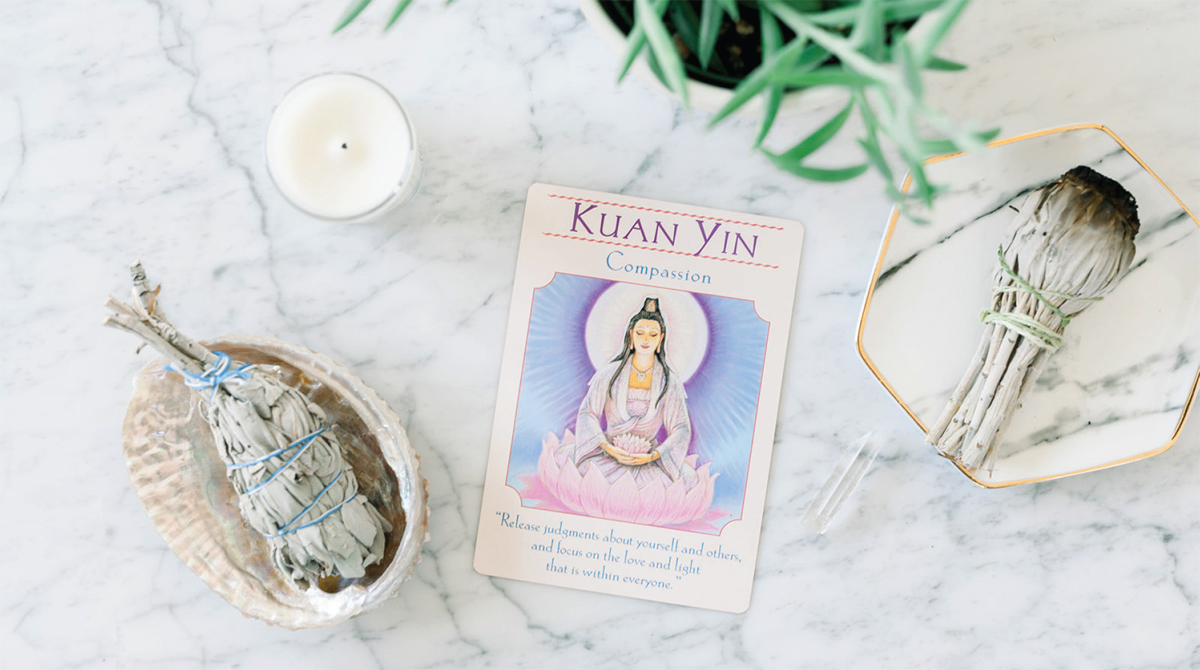
Card by Danielle LaPorte
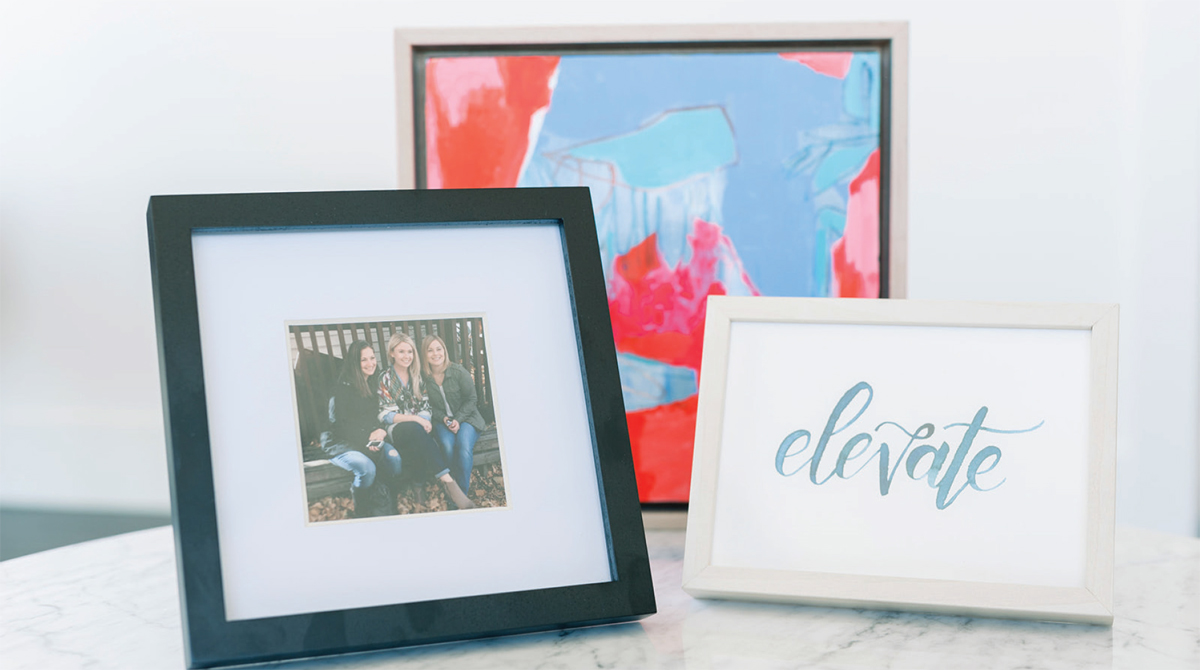
Elizabeth with her sisters, Angela (left) and Kara (right); painting by Cherlyn Wilcox
For each of these areas, do a check-in by completing the exercises I give you for your journal, and revisit them often. Just like muscles don’t stay fit if you don’t work them, these areas of your life don’t work for you if you don’t give them attention.
The biggest mistake people make when starting on a personal discovery path is that they think they only have to do the work once. That if they break through a fear or work through an issue, it’s fixed forever.
The truth is that, just as we can’t just change our eating or exercise for one day a year and expect it to become a habit, we can’t evaluate this stuff once and then never think about it again. But the more you give these areas attention, the easier it gets.
And just as with the tangible things such as goals, food, and numbers, the aim with the intangibles is consistency, not perfection; you don’t have to strive for perfection in every area of your life. (Remember, perfection doesn’t exist—at least not in the long term.)
Awareness is what you’re looking for. Self-awareness will help you decide to do what’s next. Progress over perfection wins with the intangibles.
If you want to meet your health goals, check in with each of these areas and look for ways to make progress toward feeling more content and at peace in each. The best way I can help you is to give you journal prompts so you can check in and discover the intangibles on your own.
You’re the only one who lives in your head, so you have to be the one to do the work to uncover them. Journaling more, engaging in mindfulness practices, and the guidance of a licensed therapist, health coach, or life coach can also be beneficial in this process.
Up until a few years ago my inner dialogue about how I ate and how I took care of my health was downright MEAN. I knew what to do—how to eat right, exercise, breathe, and focus on personal growth—but it was all so external.
I was so nice to everyone around me, but I never looked at how nasty my inner dialogue was, even when I was doing things right. I would berate myself for not being perfect, eating perfect, looking perfect, and anything else my inner brat could find wrong with me.
It wasn’t until a few years ago that I finally started to focus on being kinder to myself instead of being what I thought as “perfect.” Then something amazing happened. Everything changed.
Before, no matter how well I did things, I never had that overall sense that everything would be okay, that everything IS okay. But when I started putting more effort into being kinder to myself, that huge weight of negative self-talk and inner meanness was lifted, and it was way heavier than any external stress.
Being kind to yourself is a daily practice—it’s so easy to slip into old habits—but it’s genuinely the most important step I’ve ever taken to feeling content on a daily basis.
Before we get to the journaling exercise, I want to give you a useful tool to implement in these areas that will help you improve any area of life. Meet my friend and most favorite word of all time: boundaries.
I discovered the concept of healthy boundaries while I was going through divorce. It was the single most effective concept that kept me sane and helped me move forward. Healthy boundaries seem simple at first glance, but they expand far beyond learning to say no and not being nosy.
Healthy boundaries are a two-way street, but you don’t need the other person’s buy-in to make them work. It’s the awareness not to allow people to cross your boundaries, and not to encroach on other people’s boundaries yourself.
For example, if you’re in the middle of a breakup, healthy boundaries help keep other people’s opinions or external gossip from swaying you into a decision you know isn’t right for you. On the flip side, if one of your close family members or friends is going through an upheaval, telling them what they “need to” or “should” do may be overstepping boundaries (if they didn’t ask point-blank, and even then, proceed with caution).
Developing healthy boundaries can be more of an art than a science. It doesn’t mean that you don’t care or offer support, and it doesn’t mean that you should alienate people. Having healthy boundaries means knowing how to draw a firm line between what emotions, thoughts, and feelings are yours, and what emotions, thoughts, and feelings are theirs.
A few years ago I hosted a health retreat in Mexico with a group of 14 women from around the world. This was the first time I’d met any of them in person, and naturally it took everyone a while to warm up to each other. We spent the first three days and nights learning about physical health, like digestion, detoxing, and meal planning.
I always open the last and final night to the intangibles. One woman who I’ll call Tracy mentioned, “Well, I hadn’t thought about it until now, but maybe my eczema is coming from stress, not from diet?” Now, Tracy is one of those people most women aspire to be. She follows a no-sugar, clean-eating lifestyle diligently, exercises regularly, and reads every health book under the sun. She pulled up her sleeve so I could see it: horrible eczema. “I follow every eczema diet protocol to a T and use all of the natural remedies, but it keeps getting worse. I’ve literally tried it all.”
I asked, “So what’s going on at home?” She took a long pause, then replied, “My daughter is getting divorced and we threw her a $25,000 wedding less than a year ago. She is making the biggest mistake of her life! If I could just help her see that she is doing the wrong thing, our family would be back to normal. She came from parents who have been married 25 years, we have no idea where this came from. We are so embarrassed.”
“That sounds stressful,” I said, then followed with “What’s your relationship like with your spouse right now?” “We hardly talk,” she said. “He goes to the TV room every night and I shut the door because the news is so biased and depressing, so I just do my own thing.” “When did the eczema start getting worse like this?” I asked.
It finally dawned on her. “About six months ago when this all began.” Now, it’s not that Tracy shouldn’t show concern for her daughter, or that this situation doesn’t sound great for anyone involved. It’s that Tracy was so wrapped up in her daughter’s decisions—which ultimately she has no control over—she was making herself sick. Not to mention possibly ruining her relationship with her daughter, and allowing friction with her own husband. Tracy hadn’t drawn a boundary between what was hers and what was her daughter’s. I suspect the flip side was also true if her daughter wasn’t able to draw a healthy boundary with her mom.
Look, we can only set intentions and work toward what we want. Life can be messy and beautiful at the same time. The script we write for it rarely works out as planned, but that doesn’t mean it’s not good. In fact, once the trauma of change is past, what happens next might be even better, for all involved.
Learning to identify what you can control, and letting what you cannot control be, is often the first, biggest step toward freeing up some space in your mind to create healthier habits. Trust that change—even unexpected change—will work out in your favor.
If you need some direction for healthier boundaries, helpful words to say in a situation like this include, “What can I do?”; “I’m here to listen without judgment”; or “I care about you and I’m concerned that perhaps you have not thought about this consequence” (then genuinely listening without judgment). These are examples of support with healthy boundaries.
Examples of unhealthy statements include, “You should not get divorced”; “You suck and are making the worst decision of your life if you follow your instincts”; or, “God won’t love you if you do that.” These happen when you are without boundaries and project your own emotions onto someone else.
You can’t control how other people treat your boundaries, but you can control your own boundaries and what you do or do not let in. Establishing healthy boundaries will set you that much closer to meeting your Health Habit and achieving vibrant health for good. It also frees up space to make better decisions throughout your day.
Carrying other people’s issues around weighs you down more than a hundred pints of chocolate brownie ice cream ever will.
When you begin to establish boundaries, you will start to realize how much of other people’s stuff you’ve been carrying. I don’t mean stuff like when your significant other carries your lip gloss because your dress doesn’t have pockets and a jacket ruins the outfit. I’m referring to your judgments and views of other people’s life choices and decisions (or the judgments and views that other people have imposed on you).
Letting go of other people’s “stuff” is the difference between being the woman in the airport with 18 suitcases—including one just for her hair dryer that she cannot live without à la Princess Vespa in Spaceballs—who is frazzled by trying to load them onto a cart, or being the sleek business traveler walking effortlessly through security with just one rolling carry-on, slip-off shoes, and a pass for the fast lane. One of these women is making life way more difficult than she needs to by carrying stuff she thinks she needs but ultimately doesn’t serve her, and the other has made the decision to dump the excess stuff and glide through life.
Likewise, distinguishing what’s yours versus what’s someone else’s baggage is something you can do on your own as you grow, or seek a life coach or licensed therapist to help you identify these things. True, therapy used to be a taboo topic, but I’m going to go out on a limb here and hope that by now we all know that a neutral third-party expert (e.g., a licensed therapist or skilled life coach) is useful to anyone.
Your friends and family can also give you a useful perspective, but their views are always skewed by personal feelings, and you need to make sure they’re not imposing beliefs on you that ultimately do not serve you. Gaining perspective from a neutral third-party expert is one of the most valuable things I’ve ever done to feel content in life, and I hope you consider it, too.
While detoxing your home environment helps you create a physical container to allow your Health Habits to thrive, clear boundaries create a mental container that puts you in a position to make decisions that put your health first.
Making healthy choices is always done in the present moment. If you’re constantly living in the past or future, making healthy choices is unnecessarily hard. There’s a saying that “worry is a prayer for what you don’t want” and I’ll extend that to mean worry sabotages your healthy habits.

Think about the five people you spend the most time with.
Worry comes from being in the past, which you cannot change, or the future, which hasn’t happened yet. In order to shift to healthy habits, you have to drop the stories that you’ve already told yourself about the past and release worry about how things will turn out in the future.
Worry doesn’t change the outcome of anything, it only sabotages your good intentions. If you often find yourself worrying, take a deep breath and come back to the present moment. When you live in a state of thinking about the past or present—constantly reliving a conversation with an ex, or wondering how your proposal presentation at work tomorrow will turn out—you won’t have the mindfulness to make good choices in the current moment.
Does that mean you shouldn’t learn from past interactions or not plan and prepare? Of course not. It simply means that good decisions are made in the present moment, and your ability to catch yourself living in the past or future and come back to the present is another useful tool in your toolbox of healthy habits. The Bookend Method and self-care practices we discussed in Chapter 6 are your best tools for staying in the present moment.
As you go through your intangibles check-ins, consider the boundaries and expectations that need to be evaluated in each. Remember, the goal of this exercise is awareness, not perfection. As Arianna Huffington says, “Life is a dance between making it happen and letting it happen.” Work for progress in the intangible areas of your life, but don’t forget to live.
Work on the big stuff, and don’t sweat the small stuff.