
THE NEXT STAGE OF HUMAN DEVELOPMENT
We are not human beings having a spiritual experience. We are spiritual beings having a human experience.
PIERRE TEILHARD DE CHARDIN1
Over the past thirty years as a practicing psychotherapist and meditation teacher, I’ve had the privilege of listening to thousands of people share their inner journeys with me. I’ve seen the full range of people’s development unfold before my eyes. Folks from diverse nationalities, socioeconomic groups, races, genders, and ages have given me the opportunity to work with them. My clients have included graduate students, individuals in psychiatric halfway houses, college professors, corporate CEOs, homeless people, firemen, doctors, recovering alcoholics, full-time parents, artists, actors, ministers, plumbers, yoga teachers, and a tugboat captain.
Over the six years I worked at a community mental health clinic in Brooklyn, I discovered that clients with challenging brain chemistry, or those who lacked early sufficient nurturing, could still have a direct experience of awake awareness as their ground of Being. This experience of recognizing who they are at the root—a kind of basic goodness or original innocence—proved deeper and more impactful on my clients than the equally important work of helping them grow up in areas in which they were stunted. They realized their true nature had never been damaged, and they were able to see that the traumatic events of the past were no longer occurring in the here and now. One client reported: “Now that I know the normal me, I don’t care if people think I’m not normal.” Another announced: “I feel so great these days. Trying to be ‘a somebody’ was exhausting. It was driving me crazy.” Many of the people I worked with immediately recovered their sense of humor and lightness of being. They still had some disabilities, but once an individual has glimpsed and connected with the ground of Being, she or he can better deal with the many unresolved emotional issues that accumulated all throughout life.
Many private-practice clients who came to me for awareness-based psychotherapy were sometimes outwardly successful in their careers, family lives, and communities. Most were baffled about the cause of their pain. Though they all had the same underlying reason for their suffering, each one presented different symptoms: depression, anxiety, addiction, despair, alienation, fear, worthlessness, self-loathing, or resentment. They all had grown up in most areas of their lives. Some had done years of psychotherapy, meditation, or other forms of self-improvement, but most had reached a place of unbearable dissatisfaction. Even with all their success and ego strength, they would report: “I can’t figure it out,” “I can’t bear it,” “I can’t go on like this,” “Nothing that worked before is working now,” “I’m overwhelmed and can’t handle so much pain,” or, “Is this all there is?” These clients felt as if they’d hit some sort of wall: an emotional bottom or, more likely, a ceiling of growth. Most people discover by midlife, if not sooner, that even the most successful, well-maintained ego-identity will end up feeling dissatisfied because it’s not capable of living a fully intimate human life.
Many of my clients had already tried to fix their problems by altering external situations and behaviors or by changing internal thoughts and attitudes. Having given up on escape, they tried to make the best of their situations by decorating the walls of the ruts in which they were stuck. This particular population had reached the limit of their current operating system: their ego-based identity. To grow up further, they needed to begin the process of awakening beyond ego-identification.
If we don’t wake up out of ego-identification and grow up psychologically, we may find ourselves caught in a midlife or quarter-life crisis. Current research shows that people in their twenties are reaching higher levels of stress and depression than in any previous generation.2 Unless we grow up into a new identity, we may regress back to adolescentlike behaviors, settle for a false persona, shut down into depression, or feel continually overwhelmed with anxiety. We may act out or try to medicate ourselves with an addiction. We can intentionally begin shifting out of ego-identification and learn to rely on the ground of Being before a crisis occurs. Then if a life crisis happens—one that might otherwise have led to a dark night of the soul—it can be experienced as beneficial growing pains, emotional detoxification, and rewiring to live from open-hearted awareness.
I began to notice that many of my clients and students were beginning to awaken beyond conventional developmental models. I’ve seen people move into another stage of awakening right before my eyes. For some, the shift happens unintentionally and spontaneously, often born out of crisis. These people may experience a breakdown before they can shift and break through. A few make this shift simply by opening to the light of awake awareness, but many have already been going through their dark night of the soul when I meet them. Some people simply surrender, stop searching and struggling, and allow themselves to open. Others kick and scream, leaving fingernail marks as they try to hold on. Some people need to feel the fire at their backsides—the sting of heat and the fear of getting burned—before they’re willing to let go of old ego defenses and shift into a new sense of being. Yet more and more people I currently work with intentionally take a leap into the unknown, allowing themselves to rest there, letting go of whatever they were holding onto, while continuing to show up and grow up in their lives.
The question that emerges today is: Can the average individual access the potential for a new stage of adult human development that previously seemed limited to only a few wise women and men? Can we choose to do this before a breakdown or without joining a monastery? As we combine modern psychology, neuroscience, and ancient wisdom, we can start mapping the particular changes needed to initiate and support the next stage of growth. To expand the potential of our full human development, we need to explore and study this new stage of life together.
When my nephew Justin was five years old, we went fishing together for the first time. That summer, he was so excited about fishing with his uncle that he talked about it every day for weeks before I arrived. When we finally stood side by side at the pond with a single fishing pole, Justin wouldn’t—and developmentally couldn’t—share the pole with me.
“One more fish, and I’ll share it.” His five-year-old voice was full of determination. “Ten more minutes of my turn, and then you can try.” But my nephew couldn’t let go. The following year, when Justin was six, he was delighted to share. What a difference a year can make! We all know, from our experience and from observing others, how radically we change as we grow throughout our early lives.
In the early 1900s, anthropologists and developmental psychologists began to realize that children worldwide, regardless of their culture or environment, tend to reach developmental milestones in the same order. Using careful, scientific observation, these social scientists were able to delineate common stages and transitions as people grow up.
Stages and levels of human development have been observed in many areas. Psychologist Jean Piaget famously worked with cognitive development; physician Margaret Mahler researched early-childhood development. Psychoanalyst Erik Erikson mapped the stages of life from infancy through adulthood. Lawrence Kohlberg explored stages of moral development, while Carol Gilligan researched ethical development in the context of the female gender. More recently, Ken Wilber extended the concept of developmental studies into areas such as spirituality, meditation, and consciousness.
When we refer to normal human development, we’re discussing the mammal called Homo sapiens, and like all other animals, we humans have a natural development that’s typical within our species. Both “nature” (our biological, genetic makeup) and “nurture” (our relationship with caregivers, environment, and social learning) contribute to normal human development. A unique thing about human development is a type of consciousness that allows us to observe the internal contents of our minds and the external patterns in the world. However, this self-reflective ability of human consciousness, called “self-awareness,” may have become overdeveloped and creates a limited sense of self, which is what we need to awaken from.
Early psychological descriptions of the full human development have ended in the stage of ego-identification based on conceptual thinking. Western psychologists tell us that infants do not come into the world with a sense of self. We develop a sense of self at the same time we develop conceptual or representational thinking: from age eighteen months to two years. At this age, we develop self-representations, which are mental images of one’s self, and object-representations, which are internalized images of other people. Conceptual thinking and self-awareness are important developments that move us toward independence, allow us to function, and help us relate with others. Self-awareness is also the way we create a distinct self-image that’s important for ego function. This normal way of distinguishing “me” (as in “my body”) from surroundings is important for surviving and thriving. We’ve all watched two year olds exercise this new development: “My toy,” “My mommy,” and, “I do by myself!”
Discovering a new foundation for identity is necessary to grow up. In fact, the later stages of emotional and psychological work that lead to essential wellbeing cannot be done until after awakening begins. To achieve this next stage, we must extend the developmental models and create new ways of growing into these next stages. Just as parents support a child’s progress through each level, we also need to support each other’s awakening and growth.
Although awakening is different for everyone, there seems to be an unfolding process with common principles and stages. Many spiritual traditions acknowledge that there are stages of development after the initial shift of awakening. For example, even in traditions like Zen, which emphasizes sudden initial awakening (kensho or satori), there’s an acknowledgement of the need for maturation. Zen teacher Tozan identifies five stages of development after the initial recognition. The Dzogchen tradition refers to four progressive stages of recognition, realization, stabilization, and expression. Christian mysticism discusses the movement through purgation, illumination, and union. The Mahamudra tradition describes four stages: one-pointedness, same taste, nondiscrimination, and nonmeditation. Contemporary teacher of awakening, Adyashanti, describes stages of “head awakening, heart awakening, gut awakening, and root awakening.” Although each of these is described in different cultural languages, they all agree that there are stages of unfolding after initial awakening.
In order to continue developing past a certain point of adulthood, we need to shift our identity into the awareness to which all lines of development appear. We can bring together psychological knowledge and ancient wisdom about awakening to reach a new stage of development. Most people reading this book are already at a level that’s mature enough to begin the awakening training discussed here.
This new model of human development is built on the previous one. Although no model can be static because people do not grow in the same cookie-cutter way, there are general principles that can be very helpful to recognize. I propose a consciousness model that describes three traditional stages of psychological growth—dependence, independence, and socialization—and three parallel stages of awakening—transcendence, embodiment, and interconnectedness. I’ll refer to transcendence as “waking-up,” embodiment as “waking-in,” and interconnectedness as “waking-out.”
EGO-DEVELOPMENT STAGES |
AWAKENING STAGES |
Dependence |
Waking-up (transcendence) |
Independence |
Waking-in (embodiment) |
Socialization |
Waking-out (interconnectedness) |
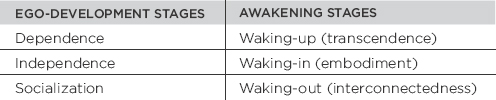
When we come into the world as infants, we’re unable to take care of ourselves and are dependent upon adults for survival. In the first stage of life, we form strong bonds with our caregivers. As we grow older and are able to fend for ourselves, we develop independence. As we get older still, it’s important that our ego functions continue to develop, that we continually internalize new levels of information, and that we continue to grow emotionally so that we’re ultimately able to live independently. Socialization requires children to begin sharing and cooperating with others. By young adulthood, we’ve learned to interact with others at work and take on roles in our communities. In order to develop empathy and compassion, we learn to see another person’s point of view and to feel what it would be like to be in their shoes.
It is possible to recognize and describe these stages in contemporary, accessible language. Awakening begins with waking-up by transcending ego-identification to abide in awake awareness, continues with waking-in to our body and emotions, and then moves to waking-out to relationships and functioning in the world. Waking-up knows from awake awareness. Waking-in knows from awake awareness embodied. Waking-out knows from open-hearted awareness.
WAKING-UP
There are two parts to this stage: the first is waking-up out of ego-identification, and the second is waking-up into awake awareness as our new operating system. When we’re looking from awake awareness, we’re immediately free of the suffering of greed and fear. We have shifted our identity from ego-identification to witnessing self and knowing from nonconceptual awareness.
In waking-up, what we’re transcending is not our ego functions, not our bodies, not our personalities, but our ongoing process of ego-identification. One of the main reasons we don’t naturally develop into the first stage of awakening is that our ego strengths and defenses, which were so vital for early development, are now keeping us from developing further. Like kindergarteners who have a hard time letting go of their parents’ hands on the first day of school, it can be difficult for us to let go of our familiar ego-identification. Developing healthy ego function is important for getting through school, learning a job skill, building a career, and raising a family. But because we’ve created a limited ego-identification out of conceptual thinking and ego functions, we’ve created a defense against our next stage of growth! In fact, it seems the smarter we get, the more complex our defenses against letting go of an old identity become. We will discover that we do go through rewiring of ego functions like memory and language when we shift into awake awareness as the ground of our Being.
Waking-up is an important but dramatic change in life. As we go through the initial phase of letting go, it might seem like we’re going backward or falling into a void—and it can feel dangerous and frightening. One student reported that transitioning through not-knowing “feels like I’m letting go of all I know, letting go of solid ground—and moving into a gap of not-knowing.” If we stop with the first part of waking-up out of ego-identification, fear of the unknown can paralyze us. Our strong ego defenses tell us to “avoid the void.” We need to continue to the second part: waking-up into awake awareness.
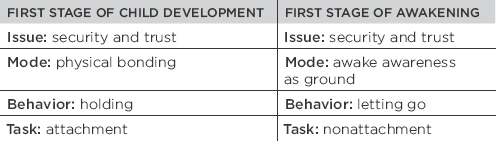
Although it may seem strange or esoteric to the average person on the street, waking-up is actually natural and can become the new natural. For both a baby and a person in an early stage of awakening—a “baby being”—a sense of safety and trust are essential. For the baby, safety is found in physical contact and healthy bonding with caregivers, which is known as attachment. A solid sense of the physical body contacting other bodies, of being held and comforted, leads to a healthy, secure psychological foundation.
Instead of finding identity in attachment to another person, a baby being’s identity is founded first through nonattachment: the letting go of holding onto the physical world, his or her own body, other people, and mental self-images. Then the baby being finds security and trust in nonphysical awake awareness and changing aliveness. Here’s a table that illustrates the commonality and differences between the first stage of growing up and the first stage of awakening.
FIRST STAGE OF AWAKENING |
|
Issue: security and trust |
Issue: security and trust |
Mode: physical bonding |
Mode: awake awareness as ground |
Behavior: holding |
Behavior: letting go |
Task: attachment |
Task: nonattachment |
WAKING-IN
We begin to wake in as we experience that formless awake awareness is not separate from energy and forms. Waking-in brings the formless awake awareness together with our human body. Our identity moves from witnessing self to Being. The early stages of a child’s development unfold by themselves, but later stages need training, support, and reinforcement in order to reach these potential higher stages. For instance, the stage called school-age development does not occur by itself. Children at this age have the natural capacity to read and write, but they won’t develop to the next stage unless they actually train those skills. Waking-in works in a similar way. We have the capacity to wake in and live from an embodied, awareness-based knowing and identity. As we grow up and awaken, we need to be actively involved and learn how to intentionally participate in the unfolding process.
Upon initially waking-up, we are free of much of the internal suffering of egoic craving, aversion, worry, and depression. However, we can get spaced out, remaining detached from the ability to live a fully embodied human life. Until you can continue to wake in and wake out, you can remain ethically relative and emotionally detached.
Waking-in is where waking-up meets growing up. In order to continue to wake in, we learn how to remain grounded in awareness inherent within physical form. When awake awareness becomes embodied, we discover natural qualities of courage, compassion, and acceptance that help us grow relationally, ethically, and emotionally. Awake awareness is our common ground of Being. When we wake in, we discover our individual human being as an innocent and wise “Being.” From here, the core stories and the old feelings of shame—“I’m not good enough,” “Something’s wrong with me,” “I’m unlovable”—are no longer convincing.
On the ultimate level, unfolding happens by itself. The learning required to embody Being is not done by the conceptual thinking mind, but by the new knowing. Awake awareness unfolds by itself, and local awareness is active and has curiosity, intentionality, and creativity.
WAKING-OUT
Waking-in naturally leads to a realization of our unity with all people and all creation so that we feel a spontaneous, compassionate motivation and begin to wake out. The big shift is in the experience of our identity. When we shift, we’re no longer limited to feeling like only a separate, individual, physical person. Instead, we’re also interconnected with all life, the same way a wave is inseparable from the ocean. From open-hearted awareness, we feel love and sensitivity toward others and ourselves, yet we’re not overwhelmed by our vulnerability because we also feel a fearless support. When we begin to wake out, we discover heart mindfulness, which is the ability to connect to others and rewire so we can live from a flow state—as we learn to do from Being.
It’s important to develop psychologically and to progress through levels of consciousness. Ken Wilber says, “Stages are how we grow up; states are how we wake up.”3 Wilber calls the way we progress through levels of consciousness “state-stages,” and the way of moving through our developmental stages “structure-stages.” We know the enormous difference when we grow from one stage to another, the way my nephew did when he matured enough to share his fishing rod. We also can see the dramatic difference between the everyday-mind state and seeing from awake awareness.
You can be more developed in psychological structure-stages or consciousness-based state-stages, and many people focus on either meditation or psychology, as if one will somehow include the other naturally. We cannot see our structures of psychological development by focusing on internal meditation states. Your meditation experience will be interpreted through the lens of the structure of your current level of development. However, without meditation and awareness training, you will not naturally develop subtle levels of consciousness simply by growing up.
During the state-stage development, using inquiry and meditation, we’re not just having restful meditative states; we’re also changing the structure of our brains and shifting our identity. Through recent studies using the fMRI, we know now that meditation changes our brain not only in the short term, but also long term. Using meditation to change the way the brain processes emotions, information, and identity is one of the most important discoveries of modern times. When we use meditation to shift our identity, we can continue to grow up in new ways.
Identity moves from ego to self to Being. This awake-identity process is only available when growing up and waking-up meet. The awake-identity stage of development allows us to detox our repressed emotional storehouses and rewire our brains so that we can respond to life rather than merely reacting.
Two things have become clear to me from years of observing people as they go through the process of growing up and awakening. First, no ego-identity—no matter how strong—can live a fully intimate, happy human life. If we don’t wake up, we’ll experience perpetual dissatisfaction. Second, in this day and age, it’s actually more difficult and dangerous to try “holding it together” and “doing the best we can” from the level of ego-identification than it is to begin the journey of awakening. We just need to know it’s possible to awaken, and we need a sense of how to proceed. Our choice today is to break down, shut down, act out—or break through and wake up.
Awake awareness itself never develops or grows up. At its essence, awake awareness is always the same. It’s inherent within all changing dimensions of our experience, just the way space exists within atoms. Awake awareness is similar to physical space in that it is within us, invisible and pervasive, but different from physical space because it is a knowing space. When this unconditioned awake awareness becomes primary and includes our human conditioning, then there is the potential for a new, higher stage of human development. Meditation training, study, and preliminary spiritual practices are part of the spiritual and meditation lines of development. But you can glimpse awake awareness at any time, regardless of your developmental level. You can awaken with no prior meditation training or spiritual practice. Awake awareness does not go through any developmental process. Whether it is recognized or unrecognized, awareness is always already awake. Ultimately, no ego-identified person can awaken; the one who starts the journey does not arrive. Ego-identification, as who we take ourselves to be, is what we awaken from. Awakening is when awake awareness becomes the primary dimension of our consciousness, the ground of our Being.
You can wake up, but still not grow up. Making progress in meditation skills or mystical states alone will not lead to full human development. In fact, you can initially awaken from your ego-identification and remain in a detached, nonjudgmental witness location. From this location of a spacious awareness, we are free of much of the internal suffering of egoic craving, aversion, worry, and depression. However, until we continue to wake in and wake out, we may remain ethically neutral, emotionally detached, and spaced out.
We have examples of spiritual teachers from all countries who had initial awakenings. Some of these teachers act in immature ways: abusing people, power, money, sex, drugs, and alcohol, while claiming they’ve transcended basic ethical behavior. In Toward a Psychology of Awakening, John Welwood points out this potential trap: “There is a tendency to use spiritual practice to try to rise above our emotional and personal issues—all those messy, unresolved matters that weigh us down. I call this tendency to avoid or prematurely transcend basic human needs, feelings, and developmental tasks spiritual bypassing.”4
You can grow up, but only to a certain level, without waking-up. Our thought-based ego-identification is an operating system that, like a computer’s operating system, has a limited capacity. There is a limit to our human development unless we wake up out of our ego-identified sense of self and begin to live in awake awareness. Even if we’re progressing well in our psychological growth, we eventually hit a wall because the small sense of self has limited capacity. An ego-based sense of self can only get us so far. If we want to continue developing, we’re going to have to shift out of ego-identification—which in turn requires waking-up. Living an awakened life also requires waking-in, waking-out, and growing up.
You do not have to wait until you’re fully mature, have your life “together,” or reach old age before you begin to wake up. In fact, many of the opportunities for initial awakening come during periods of transition, crisis, loss, and chaos in people’s external and internal lives. This is a time when the ego-identification collapses because it can’t maintain control or handle life’s intensity. You can begin awakening now, before you get your life completely together or before it falls apart.
WHERE GROWING UP AND AWAKENING MEET
While the stages of early adulthood are culturally supported with rituals and celebrations—graduations, weddings, first jobs, children’s births, housewarming parties, promotions, and so on—the subtler awakening stages of life remain culturally unacknowledged. The meeting place of awakening and growing up is the shift of our identity, or sense of who we are. Only by shifting from ego-identification to ground of Being do we have the capacity to handle a fully emotional, intimate life and function with compassion. Open-hearted awareness allows us to feel life fully, without becoming overwhelmed and anxious, depressed or addicted. Only from open-hearted awareness can we bear what seems unbearable.
Now that we live in a time of global access to information and dialogue between cultures and spiritual traditions, my hope is that our understanding of the way awakening and growing up combine and unfold will support people proceeding to these next stages of human development.
GLIMPSE 1 The Memory Door
One of the helpful pointers often used by meditation teachers is to tell a student not to attempt to recreate a positive meditation experience or chase after a good state. Instead, the instruction is to simply let everything arise naturally without hope, fear, or expectation. This is good advice. However, here is a way to use memory to open a door to what is here now.
A first-time student came up to me during a break at a daylong introduction to open-hearted awareness. She said, “I’m very frustrated. I don’t get the spaciousness or the peace or the wellbeing that everyone else seems to be experiencing.” I asked her, “Can you think of a time when you did feel peace, spaciousness, and wellbeing?”
She looked perplexed, but then said, “Oh yeah. A couple of weeks ago, when I went hiking with my friends and we walked to the top of a hill and looked at the view.”
“Great,” I said. “Let’s use that past experience to help you realize that the same capacity is here now.” I did the following exercise with her, which took just a few minutes.
Please adapt this exercise to a particular remembered experience of your own. Try it now after you read this example:
1. Close your eyes. Now remember when you were hiking. In your mind, see and feel every detail of that day. Hear the sounds, smell the smells, and feel the air on your skin. Notice the enjoyment of being with your friends. Feel yourself hiking that last stretch as you get toward the top of the hill.
2. Now, visualize and feel yourself as you have reached your goal and are looking out over the wide-open vista. Feel that openness, your connection to nature, your sense of peace and wellbeing. Having reached your goal, feel what it’s like when there’s no more seeking and nothing to do. See that wide-open sky with no object to think about, and fully feel this deep sense of wellbeing.
3. Now begin to slowly but completely let go of the visualization, the past, and all associated memories. Remain connected to the joy and freedom of being that is here now. Slowly open your eyes. Realize that the wellbeing that was experienced then is also here now, and it does not require you to go to any particular place in the past or the future once it’s discovered to be within.

GLIMPSE 2 Cave of the Heart
This practice is similar to the yogic meditation practice called nirvikalpa samadhi, a practice of absorption without any self-referencing, and what Tibetans call the practice of “the mind of black near attainment.” It’s also similar to yoga nidra (“yogic sleep”), a practice of deep rest. You may be familiar with the yoga nidra practice called shavasana, commonly done at the end of yoga class, which has great benefits for resting the entire nervous system on a very deep level. It is like an even higher-powered “power nap.”
This practice is one in which you can experience no-self in a way that’s more restful than sleep, yet you remain wide awake without content or a self. Most glimpse practices have revealed a pristine, infinite day-sky view. In the Cave of the Heart practice, the experience of no-self is like the infinite night sky: an experience of black-velvet awareness.
Ramana Maharshi, the great modern sage, often recommended two practices. One was self-inquiry that directly looks into “Who am I?” The second practice, which is less well known, is what Ramana called “resting in the cave of the heart on the right side of the chest.” He never described in much detail how to do this practice, but I played around with it to see what it felt like. In using local awareness to go within the cave of the heart, it seemed to open up a profound dimension of awareness. Here’s a version that makes sense to me and that seems to work for many others. Many of my students say this is one of their favorite practices.
On the left side of your chest is your biological heart. People feel that their emotional heart is at the top of their chests near their throats. The heart chakra—or energy center—has been described as being in the lower middle part of the chest. On the right side of the chest is the cave of the heart—the safe space of the heart. It’s where the physical heart would be if it were on the right side of your chest—but instead there is a space.
In this exercise, you unhook local awareness from thought and drop it down to the safe, restful place that is the cave of the heart. It’s a way of resting deeper than sleep, though you are wide awake. When your body rests deeply, the normal tendency is for our minds to fall asleep. Here, when you allow your body and brain to rest deeply, see if there’s also an awareness that remains wide awake—a kind of black-velvet clarity, like the night sky.
Some people report that a short period of resting in the cave of the heart makes them feel like they’ve had the equivalent of the best full-night’s sleep of their lives. Enjoy.
1. Sit comfortably or lie on your back. Close your eyes, and take a full breath or two so that you feel alert, alive, and awake.
2. Now allow local awareness to unhook from thought. Let it slowly drift down like a leaf below your neck and find a safe, restful place inside your upper body on the ride side of your chest. This safe space may feel like it has a little light, or pinpoints of light—or it may be completely dark, like black velvet.
3. Allow your awareness to rest in this black-velvet silence without falling asleep. Feel each cell drinking in this rest and renewal. Let awake awareness surrender into the cave of the heart and rest as this deep, dazzling darkness, deeper than sleep, yet wide awake. Remain here for ten to fifteen minutes, or until you naturally arise or open your eyes.