
OPEN-HEARTED AWARENESS
When I look inside and see that I am nothing, that is wisdom. When I look outside and see that I am everything, that is love. And between these two, my life turns.
SRI NISARGADATTA MAHARAJ1
On a crisp autumn day in New York City, I headed downtown for a meeting. Arriving at the entrance of my neighborhood subway station on 116th Street and Broadway, I heard the train pull in below. I reached for my MetroCard, passed through the turnstile, and hurried downstairs, reaching the platform just in time to see the subway doors slide shut and the train pull away.
I stood there, looking at my watch, feeling frustrated because I’d probably be late for my meeting. The subway station was completely empty. As I walked toward the back of the platform, I felt disappointment arise as a physical contraction in my stomach. Then I noticed I’d begun to worry, and those thoughts were sending me up into my head, where I was starting to think up future worst-case scenarios. Then it occurred to me: “Oh, I’m caught in my thoughts, but there is another way to be.” I realized my current situation was an opportunity to shift into embodied awake awareness.
As I shifted out of ego-identification and into embodied awake awareness, I began to feel safe, grounded, open, and joyously alive. My emotions and thoughts about missing the train and being late were naturally included in the luscious unified feeling and clarity of seeing from awake awareness. It was clear to me that awake awareness was not something I’d created, but an existing dimension of reality that was always already here. With a small shift, awake awareness had become spontaneously and immediately available to me, changing my feeling of myself and the whole situation for the better.
Waiting in a subway station, an activity I’d thought of as boring, had transformed into a mini-retreat, the most precious opportunity of the day. After a few minutes, I was so relaxed and open that I mused: “This is great. What could be better than this?” So I didn’t expect what happened next.
The train arrived, the doors opened, and I stepped inside. Looking to my right for a seat, I felt stunned when my eyes met those of the few people who looked up. It seemed as if a veil between us had been lifted; our masks had dropped away. I felt vulnerable, yet safe, and connected to everyone and everything. It was as if I truly understood—for the first time—the saying “our eyes are the windows to our souls.” It was as though the other subway riders and I were seeing each other heart to heart. This new kind of knowing is what I now call open-hearted awareness. There seemed to be no separation between the other subway riders and me. I had a profound sense of both the awakeness and imperfection in all of us. Taken aback, I gasped in awe at this new way of seeing and being. Then I started to laugh because, in some ways, this mode of seeing from open-hearted awareness felt so simple and ordinary—and it was such a relief!
The philosopher Jiddu Krishnamurti said, “There is no intelligence without compassion.”2 Open-hearted awareness is that compassionate intelligence so greatly needed in our world today. However, open-hearted awareness is not a far-off ideal. It’s a natural capacity within each of us, and we’re all capable of discovering and familiarizing ourselves with open-hearted awareness until it becomes the new normal in our lives. Open-hearted awareness is the meeting of mind and heart, wisdom and love, contemplation and action. It’s a shift from head to heart, from conceptual thinking to a new way of knowing from nonconceptual heart-mind. It’s a different way of seeing and relating to the world and other people. When we operate from open-hearted awareness, we have the ability to see how we are all the same and act with courage.
We shift out of thought-based knowing into awake awareness. As Anam Thubten says, “An open heart can only be experienced when we go beyond the realm of the intellectual mind.”3 Our first experience of awake awareness may be as spacious awareness, which is free of thought, but also a detached witness of emotions and sensations. Then we may feel we shift into an embodied presence, which knows from within rather than from outside our experience. Open-hearted awareness is awake awareness that is embodied and also feels connected to everyone and everything. It’s not possible to experience open-hearted awareness from an ego-identified sense of self. We can’t just do open-hearted awareness from where we start. It’s not an attitude, an emotional feeling, or positive thinking. It’s a natural capacity within each of us that requires that we shift levels of mind.
Recognized and valued since ancient times, the reality of open-hearted awareness has many names, among them: “heart wisdom,” “sacred heart,” and “heart-mind.” The early Catholic theologian St. Augustine used the term oculus cordis, “eye of the heart,” and recommended finding it by “returning within yourself.” As the writer G. K. Chesterton said, “There is a road from the eye to the heart that does not go through the intellect.”4 In modern times, Brother Wayne Teasdale called this way of knowing “the mystic heart,” and spiritual teacher Adyashanti calls it the “spiritual heart.”
In the Bön Dzogchen tradition, open-hearted awareness is known as the “sphere of knowing.” In the Sufi tradition, it is the “heart of hearts.” Tibetan Buddhist teacher Tsoknyi Rinpoche calls it “essence love.” A number of spiritual traditions have called this way of knowing “the diamond heart,” emphasizing its preciousness, clarity, and indestructible nature. In Tibetan Buddhism, the word that corresponds to open-hearted awareness is bodhicitta. In Sanskrit, bodhi means “awake,” and citta can be translated literally as “consciousness,” so it is describing when our consciousness is awake. But interestingly, the translation of bodhicitta is not “awake consciousness” but “heart-mind,” “awakened heart,” or “the wisdom that leads to compassionate activity.”
There is “relative” bodhicitta, which is having positive intentions such as doing loving-kindness meditation to benefit all living creatures. Then there is “ultimate” bodhicitta: open-hearted awareness that is living from your natural awakened heart. Those who live from open-heartedness are sometimes called bodhisattvas, because they dedicate their lives to increased awakening, love, and wellbeing in all they meet.
Open-hearted awareness is not physical heart, nor is it our heart chakra or our emotional heart. It is more like an open door of love and wisdom in the middle of your chest that goes out to connect to others and to receive support from our loving ground of Being. This new mode of awareness requires a shift into a different type of consciousness that, fortunately, is always already available—once we know where and how to look. Open-hearted awareness is a modern term for a reality that has been recognized by the world’s ancient wisdom traditions.
When we shift our consciousness, we discover that our biology is capable of adapting to the new way of seeing and being. At a 2014 talk at the Education of the Heart symposium in the Netherlands, Daniel J. Siegel, MD, described the potential of the mind as “fully embodied and relational.”5 He spoke about how the mind is not enclosed in a skull, but is distributed across the nervous system within the body, and through relationships links us with other people and the environment. He described our neural networks as weblike configurations around the heart and stomach, explaining that they engage—along with the brain—in what neuroscience calls “parallel distributed processing.” Among the things that parallel distributed processing does is making human intelligence more efficient than computers in some significant ways.
Siegel reported that recent neuroscience research suggests knowing from a full body-mind network actually moves from cells in the heart and gut and travels up through the spine into the brain. These neural structures use “mirror” neurons to perceive other people’s subtle communications, whether or not we’re conscious of it. These neurons literally mirror the behavior of others, causing emotional resonance in the observer and providing a sense of the other’s felt experience. When you see someone smile, for example, your mirror neurons for smiling fire, causing a sensation in your own brain that is the feeling of smiling.
Although the brain is in the head, recent scientific studies demonstrate that “the mind” is fully embodied and relational, requiring a new, more holistic definition—similar to the description of open-hearted awareness given here. One man recently told me that when he shifted into open-hearted awareness, he felt as though his head dropped down into his heart, and his heart dropped down into his belly. A woman told me that her heart had opened, and she could feel a connection to others “heart to heart.” Another person reported: “My awareness, which has always seemed located behind my eyes, is now equally distributed throughout my body, as if every cell in my body is lit up.” This description is reminiscent of the image of the Bodhisattva of Great Compassion, who is depicted as having eyes on every part of her body.
Most of us remember times when we’ve gone beyond our normal, self-centered fear to help someone else in need. When we think about it later, we might say to ourselves, “I can’t believe I did that, but I’m glad I did.” In these moments when we transcend personal fear, we are spontaneously operating from open-hearted awareness—even though we may not recognize it as such. From open-hearted awareness, we can see when others are acting out of fear or self-preservation, and we can respond to them with empathy and compassion instead of defensiveness. Open-hearted awareness has natural qualities like strength, safety, and courage that arise when we learn how to shift into it.
There seem to be two ways humans suffer when we haven’t yet learned to live from open-hearted awareness. Being overly mental is one way: trying to avoid feelings by being “rational,” “objective,” and focused on worldly achievements. The suffering here arises from detachment, dissociation, and living trapped in our heads. Being overly emotional is the second way we suffer: by taking everything “personally” and by feeling overwhelmed, anxious, fearful, and/or depressed. This happens when we’re sensitive and vulnerable but lacking the support of awake awareness, as our ego-identified system is too small to handle full emotional life.
Having a closed heart is as painful as going through our day with an overwhelmed emotional heart. Like Scrooge in Charles Dickens’s A Christmas Carol, we can live most of our lives with a closed heart and even be successful in the world without knowing there is an alternative. However, the opportunity for transformation and a shift into open-hearted awareness is available to each one of us—no matter where we’re located in the journey of our lives.
When we don’t shift into open-hearted awareness, our hearts can be painfully closed, or they can be too open so that we’re frequently overwhelmed. Then we end up looking to our thoughts to create a sense of self. The result is a small, mental sense of self that makes us fearful and unworthy. Sadly, a thought-based identity cuts us off from our greatest resources for connection, loving-kindness, and wellbeing. While identified solely with a mental self, we may not be able to hear the call of open-hearted awareness. No wonder we become confused about our own heart’s desire and end up looking for love in all the wrong places.
Some people are caught in their emotional heart: feeling everything, worrying, and feeling wounded and unsupported most of the time. Shifting into open-hearted awareness has transformed many people who say they “pick up every feeling and are too sensitive to others’ emotions.” These people don’t have to shut down. They can continue to feel others’ emotions, but instead of holding them in their bodies, they can let emotions continue back through the open heart’s door to the support of the field of awake awareness within and behind them.
Open-hearted awareness builds on emotional intelligence, which is the ability to recognize, distinguish, and articulate our emotions. It’s also the capacity for understanding and appreciating the emotions of others and the way they communicate with us. Open-hearted awareness does not have to defend against emotions. From open-hearted awareness, we’re able to “be with” emotions that formerly would have been overwhelming. From open-hearted awareness, we need not consider ourselves underdeveloped or weak if we go through what St. Teresa of Ávila called the “gift of tears.”
Even when we’ve awakened from ego-identification, we still need to unlearn and relearn about love. What we call love, or what we think is love, is often mixed with a lot of early personal conditioning, old belief systems, and emotional attachments. When the heart doesn’t go out to look for love, but looks instead back to its source—the ground of Being—we can discover unconditional love as who we have always been. Then this new experience of love can become the foundation from which relationships are formed. A whole different emotional way of being and seeing gives rise to a new, vastly more compassionate and connected way of relating.
Open-hearted awareness, which is operating from our heart-mind, begins to include necessary judging functions of the mind, but leaves behind the fear, separation, and controlling anger that made us “judgmental.” Our normal judging functions are transformed by open-hearted awareness into discernment and discriminating wisdom. The judge, the critic, and the superego are not essential or rigidly fixed parts of the human psyche. As soon as we shift into open-hearted awareness, an immediate feeling of being nonjudgmental and more compassionate arises. We develop a more mature conscience, a sense of integrity, and an acceptance of what is, while having the capacity and motivation to change what needs to be changed.
Even when we are not as identified with thoughts or stories, some deeper moods and long-held emotions continue to arise. But in the context of open-hearted awareness, this is the natural phase of detoxing our repressed emotions and returning the energy they held back to our natural life force. Discovering open-hearted awareness is the beginning of a whole new way of being with emotions that can only be done from this state, which can become a stable stage in our development.
Open-hearted awareness begins with the discovery of the support of awake awareness. Then we feel not only love for others, but also tenderness and compassion for ourselves. We can feel both vulnerable and courageous because our foundation is awake awareness. Our emotional heart will no longer need to create a shell of protection around itself. When we experience a great loss or hurt that feels like “brokenheartedness,” we now realize that our heart is not broken. It’s actually the heart’s protective shell of defenses breaking open to allow us to feel all emotions fully. Open-hearted awareness gives us the capacity to experience a full emotional life without shutting down or being overwhelmed. We can feel both vulnerable and courageous, while knowing that—essentially—all is well. When we first shift into the phase of embodied presence, there is often a period of deep rest and just being with the inner silence, stillness, and wellbeing that’s not based in thought or action. When we shift into open-hearted awareness, there is a generous acceptance of others and ourselves that makes us not passive, but curious and creative instead.
In the shift from embodied presence, we move from unconditioned awake awareness to the unconditional love of open-hearted awareness. One person offered this description: “I feel like I’m moving from awareness aware of awareness to love loving love.” The quality of the formless awareness meeting physical form can feel like a fabric of love, a dance of opposites, or a field of unity. The key here is that heart-knowing allows us to experience our identity not only as a limited, separate, physical person, but also as someone inextricably connected with a community, the fabric of love, and something greater than our individual self.
When people first discover open-hearted awareness, they often report feeling relief, as though they’ve let go of a burden. When you first make contact with open-hearted awareness, you may feel its physical and energetic forms of unconditional love, bliss, or stillness. People report that when they know from open-hearted awareness rather than from their heads, they feel safe, connected, curious, and tenderhearted. This is a profoundly beautiful experience for many, who spontaneously describe it in poetic phrases such as “having a heart as big as the world,” “feeling a sweet sadness,” “knowing all is well,” or “feeling a tender trust.”
When people who have shifted into open-hearted awareness are asked, “What do you know from open-hearted awareness?” they often reply:
Love—a sense of unity, oneness, compassion, and relationship.
Safety—everything is okay, all is well.
There is no fear, shame, or worry at all.
Nothing is missing. And nothing needs to be pushed away.
Who I am cannot be threatened.
I thought I was lost, but it turns out open-hearted awareness has been here all along.
When you shift into open-hearted awareness, you may realize that its tenderness and vulnerable strength are connected to the vastness of Being. Many people also report becoming more involved in activities like social justice, service to the needy, animal rescue, and other spontaneous acts of charity. The day after 9/11, I found myself drawn to Lower Manhattan, and over the next few years I continued working with families who’d lost loved ones. I met many people nationwide who felt called to be present during the 9/11 tragedy, and when I talked with them it was clear that many seemed to be acting from open-hearted awareness.
When we operate from open-hearted awareness, we no longer listen to the internal narrator and the random chatter of our automatic thoughts. These voices become little more than background noise, like children playing in the backyard. Awake awareness has moved into the foreground of the mind, where it’s quiet. We’re no longer exhausted by efforts to organize our thoughts. We feel embodied, refreshed, and alert, with the potential for knowing what needs to be known, when we need to know it. We’re no longer looking to thought to know. As we experience and perceive through open-hearted awareness, we allow more of the world in, and more amazingly, we also stop projecting our thoughts and emotions onto others.
From open-hearted awareness the world seems lit up from within, and what once seemed “other” is actually interconnected. Open-hearted awareness can shift you into a new way of seeing. Your eyes connect not only to the brain but through your heart-mind to the ground of Being. Your ego-based identity is no longer looking out of your eyes. Instead, looking from open-hearted awareness is like seeing directly through the eyes of your awakened heart, without the thoughts, beliefs, and projections of the mind interpreting your experience. There are no fears or worries about what the other person might be thinking; there is trust that you will know how to respond—with a natural, intuitive heart-mindfulness.
Trust and patience are needed during the transition from ordinary consciousness to open-hearted awareness. When we begin to shift, our thinking and ego functions are not yet fully online. Therefore we may feel that the transition is too slow, but it’s vital not to give up. There is the stage of waiting for the response, without looking to the mind—even if you feel no response will come. The ego-mind says, “Hurry up!” or, “See, I said you’d become a lazy couch-potato without me as the leader.” But the new wiring will lead to another way of speaking from open-hearted awareness. One person offered this description: “Speaking becomes like breathing. It’s easy and natural and just flows without needing to plan what you’re going to say.”
Amazingly, we don’t have to try to create this experience of open-hearted awareness. We just need to learn how to shift out of the ego-identified mind into heart-mind; over time we grow more and more familiar with being this way. Living from open-hearted awareness makes you feel like you’ve come home again, like you’re whole again, and like you’ll never be alone again.

GLIMPSE 1 Open-Hearted Connecting
The Buddhist Tonglen practice is interesting because it’s the opposite of some contemporary practices like breathing in positive energy and love and breathing out negative energy and suffering. Tonglen practice is a relative-level practice of giving and receiving, in which you are instructed to breathe into your heart the suffering of others, with the wish to take away their ignorance and pain. Then you breathe out of your heart, sending good feelings, compassion, and happiness to particular individuals or groups of people.
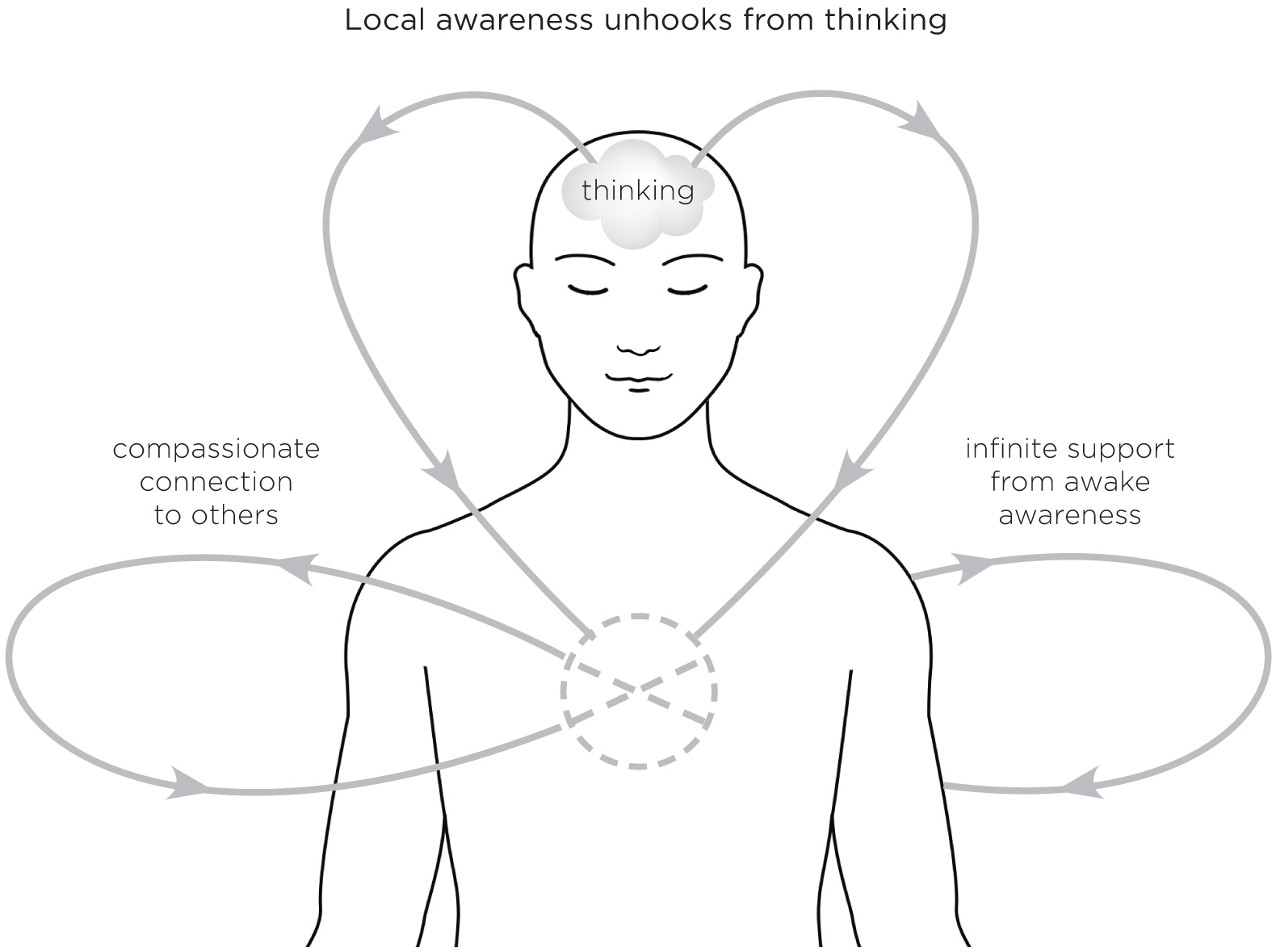
FIGURE 4. Relocating to open-hearted awareness.
This next practice is a version of an ultimate-level Tonglen practice. It is the same as the relative-level Tonglen practice, except that when you breathe into your heart, you don’t stop at taking the suffering into your body. Instead, you allow it to continue through your heart space to the support of awake awareness behind your back. Then you feel the support of awake awareness coming into your body. Next, you feel the loving awareness go out to the person in front of you and connect to the awake awareness within and behind them. As you breathe in, you feel their ignorance and suffering coming back to and through your body—and then back to the support of awake awareness. The key experience could be summarized this way: awake awareness has your back. We can learn to receive and give from here. Figure 4 is a visual representation of this practice.
In this practice, take a few minutes to glimpse open-hearted awareness for yourself.
1. Sit comfortably, eyes open or closed, and simply be aware of all your senses. Notice the activity of thinking in your head.
2. First, unhook local awareness from thoughts in your head. Next, let it move down through your neck and into your chest, and know—directly—from within your upper body.
3. Become familiar with this kind of direct knowing from within; it neither looks down from your head nor looks back up to your thoughts.
4. Feel the awareness and aliveness together: rest without going to sleep and stay aware without going to thought to know.
5. Feel that awareness can know both the awareness and aliveness from within your body.
6. Notice a feeling of an open-heart space from within the center of your chest.
7. Feel as if you have relocated from your head to this open-heart space, from which you are now knowing and aware.
8. Notice that you can invite and welcome any thoughts down, so that you can remain at home in your heart and still have information from the office of your head come to you via Wi-Fi.
9. Be here, receive light with your eyes, and look out from the eyes of open-hearted awareness.
10. Feel how local awareness can move behind and through your heart space to become aware of spacious awareness behind your body.
11. Surrender local awareness until local awareness merges with spacious awareness so that it’s aware of itself.
12. Wait until you are knowing from within the timeless, contentless, thought-free awareness.
13. Notice that as you surrender awareness, the field of spacious awareness behind your heart already includes your whole body.
14. Feel how awareness knows itself as pure awareness behind your body, and as the aliveness within your body from your toes to your head. Feel the joy and lightness of this inner-body presence.
15. Now notice how local awareness is also moving and looking out at the world through your heart space.
16. Be aware from this field of spacious awareness—behind, within, and in front. It’s simultaneously spacious and pervasive: a continuous field of awareness, stillness, and aliveness.
17. Notice that you don’t have to alternate being aware outside and then inside. Awareness is both outside and inside at the same time.
18. Without going to thought, ask, “What does open-hearted awareness know?”
19. Simply let go and let be. Rest in this new knowing and flowing; see from being.
Notice the loving awareness happening effortlessly.