A SIMPLE CASE OF MISTAKEN IDENTITY
To study the Way is to study the self. To study the self is to forget the self. To forget the self is to be enlightened by all things. To be enlightened by all things is to remove the barriers between one’s self and others.
DŌGEN1
Who am I? This is one of the most important questions people have asked throughout the ages. Learning how to inquire “Who am I?” can immediately clear up a great deal of suffering. To discover who we are, it’s important to be clear about who we are not. In this chapter, we’ll see how our current mistaken identity is constructed and held together in our minds, and we’ll come to understand what gets in the way of discovering our true nature.
The problem of identity can be described in words, but the solution can only be known through direct experience. It can be confusing to discuss the topic of identity, especially when we get contradictory advice. The Greek oracle at Delphi said: “Know thyself.” Jesus said that anyone who wanted to follow him had to “deny himself.”2 The Upanishads from India say that we need to move from a small self to a true Self. In Buddhism, one of the key foundations for awakening is realizing “no self.” In modern psychology, some growth models promote building a strong ego, yet other models insist that ego is the problem and that we need to deny, kill, transcend, or get rid of our ego. The issue of identity is further confused by different definitions for concepts like false self, true Self, selflessness, no self, ego strength, and egoless from psychology and the wisdom traditions. Which “self” am I, and which “self” is the problem? What is ego? Is there a good ego and a bad ego? Which ego is the problem, and which is a normal part of being human? Because we are interested in both awakening and growing up, let’s start by defining ego in a new way.
The word ego comes from the Latin personal pronoun “I.” We are going to explore five aspects of ego: ego body, ego functions, ego personality, observing ego, and ego-identification. As we clarify our understanding of each aspect, we’ll discover that we can simultaneously enjoy our human bodies, enhance our ego functions, appreciate our particular ego personalities, and learn how to grow beyond ego-identification.
Ego body is the acknowledgment that on the relative level each person is a separate individual because each has a distinct physical body.
Ego functions begin with the biological, innate, instinctual system that enables all human beings to survive and thrive. Ego functions are the ways living creatures organize and act upon information related to their particular physical bodies in order to respond effectively to their environments. Normal ego functions include perception, thinking, attention, memory, instincts, motor coordination, and socialization. Ego functions involve movement toward or away from things. The acts of craving (“I want”) or resistance/pushing away (“I don’t want”) are normal feelings related to survival and are not the root of suffering. Natural desires and aversions constantly arise based on liking and disliking as a way of discernment that aids thriving and surviving. Ego defense mechanisms are also functions that help regulate our instincts and different parts of our personalities to avoid conflict and reduce anxiety. Ego functions also include will, or agency: the ability to choose and act on a physical level. What we choose is influenced by the location of our identity, but the ability to choose, react, respond, and initiate actions is an ego function. Healthy ego functions help us learn to adapt and socialize in communities as well as to thrive in our environment.
Ego personality is the combination of our particular genetics, personal experiences, and social conditioning. A product of both nature and nurture, ego personality includes our emotional life. Our likes and dislikes, our temperaments, and our style of relating to other people are all part of ego personality. Here, I’m including our autobiographical ego: our personal history and the stories we tell about ourselves. Our normal ego personality includes the roles we play in daily life, the masks we sometimes show the world (Jung called these personas), and the myriad internal aspects of ourselves, which we can understand as subpersonalities. Identification with any one persona (a professional role) or subpersonality (like the hurt child or inner critic) is a personality issue.
Your personality is as unique as your fingerprints. Ego personality can make life interesting and diverse; it can light us up from within. Most people go through a stage of maturity (or immaturity) where their personality is ego centered. At the level of ego personality, we can be ego centered, egotistic, prideful, self-obsessed, or even diagnosed with narcissistic personality disorder. But these personality traits are not what is meant by ego-identification.
Observing ego is the ability to step back and establish a witness within your mind of your internal thoughts, feelings, and sensations. Rick Hanson, PhD, and Rick Mendius, MD, founders of the Well-spring Institute for Neuroscience and Contemplative Wisdom, explain it this way: “The psychological term, ‘the observing ego’—considered to be essential for healthy functioning—refers to this capacity (i.e., mindfulness) to detach from the stream of consciousness and observe it.”3 Observing ego uses mindfulness from self-awareness or subtle mind to be a nonjudgmental witness—similar to what Freud called “evenly hovering attention.”
Ego-identification is the end result of a process, one that feels like who you are is a mini-me located in your head that looks out of your body’s eyes. Ego-identification is not an entity but a mental process: a particular pattern of consciousness variously called ego-fixation, ego-grasping, or ego-clinging. This mental process only becomes ego-identification when it results in taking itself to be “I.”
Ego-identification is not just an “I” thought, a resistance, a self-image, a personal story, or a belief that can be changed by an effort of will. Ego-identification is not “you” identifying with “your ego.” Instead, self-awareness and ego functions cling inwardly to themselves, creating ego-identification, which then clings to outward things.
The process of ego-identification obscures our already-awake nature. The mental processes of thinking and ego functions can identify with each other and generate a closed loop: the feeling of “I.” Ego-identification is a “selfing” process. However, we don’t recognize this process because we’re totally immersed in the experience, fused with our ego functions and looking at the world from a felt sense of “me” that has become ego-identification. Only when looking from awake awareness can ego-identification be observed as a mental pattern. Ego-identification is also ocurring on the unconscious level with our default mode network, where it creates unhappiness as a self-referencing mini-me.
Ego-identification creates a mistaken identity that believes it needs the same nourishment and protection as a physical entity. It co-opts our ego defense mechanisms even though there is nothing to defend. Ego-identification is not a physical creature; therefore this mental pattern needs no food, and there’s no real threat to its existence. The delusion of a separate self struggling to survive leads to perpetual hunger, fear, dissatisfaction, and suffering. However, we can think of ego-identification as a transitional identity, a thought-based operating system out of which we can shift to awake awareness as our ground of Being.
THE RELATIONSHIP BETWEEN TYPES OF EGO
Ego body, ego function, ego personality, and observing ego are not in themselves obstacles to awakening—nor are they eliminated upon awakening. We can also see that our personality, body, ego functions, or the observing ego are not the center of our identity either, but only parts of us like our hands or our hearing. Full awakening includes our bodies, emotions, and personalities. From awake awareness you can see that “who you are” is not your appearance, job, age, race, income, or history. The dropping away of ego-identification does not leave you feeling vacant, spaced-out, disassociated, or depersonalized. With awake awareness as the ground of Being, there’s a feeling of “I am,” which is independent of “I am this” or “I am that.”
Ego-identification is not a single character, but a me-system composed of our many different subpersonalities that rotate through the driver’s seat of the self. We discover that these voices (or subpersonalities) are normal patterns of thought and feeling that most humans share. These patterns, or habits of mind, need to be liberated, not just stopped. When we can know and see from Being, our subpersonalities feel relieved that they no longer have to act as the driver. These parts can play or relax until they’re called upon for their particular talents. With awake awareness as our ground of Being, these voices and opinions still arise, but they don’t become the driver. Instead, all are welcomed and unburdened by the loving presence of open-hearted awareness.
Ego-identification is an organization and orientation built into our neural networks. It’s so deeply wired into our brain that it appears as the main character of our default mode network when we’re at rest. As a self-referential, looping pattern, ego-identification also projects images onto others and the world in an effort to feel safe. This habit is so ingrained that it starts first thing in the morning as soon as we transition from deep sleep: “Oh no, the deadline is today. Why do I always wait until the last minute? I’m such a failure.” The judging function, needed to recognize unhealthy environments or “bad water,” can get co-opted by ego-identification and turn against us. The mistaken identity causes shame, because we don’t feel okay about being who we are. We confuse feeling unloved with being unlovable; we confuse making mistakes with being stupid or worthless. However, in spite of the strong, ingrained nature of ego-identification, we can still shift out of this level of mind. The big realization—when we go beyond ego-identification and discover awake awareness as our ground of Being—is that we’ve always been okay.
We all have basic needs. It’s a mistake to try to reduce desire and aversion on all levels of ego as if they needed to be renounced, repressed, or transcended. We do need to seek and get food, money, sexual connection, social approval, joy, work, and safety. The issues of imbalance in these areas are about ego function, ego personality, and growing up. So we’re not really awakening from ego-identification through renunciation, repression, denial, willful restraint, or stronger measures of abstinence or mortification. Nor do we awaken by transforming our emotions, personality, or thinking. Shifting into mindfulness and cultivating loving-kindness and acceptance can be a stepping-stone toward awakening, yet these measures don’t help us cross the line into waking-up. When we get clarity about the different types of ego, awakening in the midst of worldly life is actually the most fully integrated way to go about it.
VIEW FROM NEUROSCIENCE
Neuroscience agrees that there’s no separate self or subject located in any one area of the brain. An attendee of a 2002 New York Academy of Sciences conference, titled “The Self: From Soul to Brain,” writes: “Most of us share a strong intuition that our own self is an irreducible whole, that there must be some place in our brains where our perceptions and thoughts all come together and where our future actions are decided. Yet this view is now known to be incorrect—different mental processes are mediated by different brain regions, and there is nothing to suggest the existence of any central controller.”4
The brain is a symphony, but no conductor can be found. Neuroimaging research has begun to identify key brain regions involved in self-referential processing, like the default mode network. Studies with meditators have revealed that the self-referential process can be dominant, turned off, or experienced as a mental process instead of being identified with as “my self.” Neuroscientist Sam Harris agrees that “this is where meditative insight actually makes contact with science: because we know that the self is not what it seems to be. There is no place in the brain for a soul or an ego to be hiding. And it is possible to examine this illusory self closely enough to have the feeling that we call ‘I’ disappear. As it happens, this comes as quite a relief.”5
Your current ego-identification is not an independent entity, but a pattern of consciousness that’s less than optimal for living. The interesting thing about this seemingly solid, mistaken sense of self is that it is a biological neural network operating both when we’re conscious and when we’re daydreaming. It runs on autopilot in every person’s brain, regardless of their history, conditioning, and culture. Neither the conscious operations of the mistaken identity called ego-identification nor the unconscious default mode network are set in stone. It seems to be a stage of development that we can grow out of. We can positively transform our consciousness and train our brains to discover a whole new way of seeing and being.
VIEW FROM PSYCHOLOGY
In psychoanalysis, ego is defined as: “The part of the mind that mediates between the conscious and the unconscious and is responsible for reality testing and a sense of personal identity.”6 The problem here is that ego means both ego function and ego-identification. There is no acknowledgment that the ego function is only a part of our identity and not the same as identity.
Separating ego function from ego-identification will begin to solve this case of mistaken identity. It is important that we don’t mistakenly deconstruct ego functions. It’s also important not to end up in the mindful witness of observing ego or to stop our awakening process at deconstructing ego-identification without also transitioning to awake awareness. Transitioning to awake awareness as an essential part of waking-up will help us avoid the pitfalls of depersonalization, dissociation, and becoming overwhelmed with unconscious material. Once we have recognized our new identity in the ground of Being, ego-identification can semiretire, giving up its second job of trying to fill the shoes of identity. We can let the ego relax, with full retirement benefits, returning to its natural role as ego function.
Most contemplative traditions agree that the root of suffering is the belief there’s a separate self within us. Realization that there is no separate existing self, anatta, is used in the early Buddhist texts as a strategy to view the self as a series of conditioned processes instead of an entity. When the Buddha was asked whether or not there was a self, he wouldn’t give a simple answer. He didn’t say the self was a complete illusion, but he considered the self the same as other relative phenomena: nonsubstantial and constructed on a moment-to-moment basis from the contents of consciousness.
When you go beyond ego-identification, who are you? You are still human, but with unconditioned awake awareness as the foundation, it is hard to say whether you are a true self or no-self. Once you have a direct experience beyond ego-identification, questions of self and no-self are no longer of philosophical interest. Our bodies, our personalities, and our ego functions are helpful tools within an ever-changing, interconnected field of awareness and consciousness. Let’s see if we can get a sense of how the process of ego-identification occurs, how it maintains itself, and how it can relax and allow ego functions and ego personality to return to their natural roles.
Once upon a time, only the simplest forms of life existed on Planet Earth, among them single-celled microorganisms. What distinguished these particular organisms from other forms of life was their semipermeable membrane, a kind of “skin” that formed a boundary, separating life inside from the life outside. Each of these microorganisms, whose primary purpose was survival, treated everything inside its boundary as “self” and everything outside as “other.” Evolutionary biologists tell us that a single-celled creature in its earliest, most primitive form could respond only at the part of its boundary that contacted another object. If one part of the creature bumped into an obstacle, that part would stop, while the sides oozed around the obstacle and tried to keep going forward.7
As time went on, an important evolutionary change occurred: the organism developed a simple representational system that enabled it to relay information from its boundary’s surface to an inner part of itself. When any stimulus was perceived at the boundary surface, the information traveled through the organism and got recorded in a kind of processing center, which gave the organism the capacity to store representations of past situations in order to respond more effectively to the environment, thereby increasing its chances for survival. For example, when the temperature rose, the organism retrieved the negative experience of feeling too hot, registered dislike, and then moved away. When the organism was hungry, it craved food and then retrieved information about what was nourishing, and moved closer to the nourishing source.8
FROM EGO FUNCTION TO EGO-IDENTIFICATION
Like those single-celled creatures, each of us is a bounded lifeform with an information-processing system. As our human ancestors acquired language and the present-day brain developed, an evolution in consciousness occurred that gave us many advantages. Modern science estimates that a human body is made up of 100 trillion individual cells. The web of nerves going from the body’s boundary (the skin) to the brain and back again is forty-five miles long. However, evolution also created an ongoing self-loop, out of a representational storage center, which has outlived its usefulness. The self-awareness that resulted from this human development co-opts our boundary survival program and is the key to understanding the bind of mistaken identity we face today.
Ego functions are the natural system by which humans organize information. Like a simple computer program, some of the ego functions say things that include: “I need to survive,” “Monitor the boundary,” “Protect the body from danger,” “Acquire nutrients,” “Procreate,” and “Bond with my group.” This intense part of our consciousness includes basic human needs and instincts.
The processing center mistakenly identifies with the pattern and creates the feeling of a separate entity out of its own thoughts.
The type of thinking that co-opts the boundary-survival program is what psychologists call self-awareness. This is the process of splitting our thinking into two parts by creating an observing self within our mind. The term self refers to our ability to become a consciously observing subject. Researchers have demonstrated that we are not born with the capacity for self-awareness; it begins to emerge at around one year of age. The capacity for self-awareness becomes much more developed around eighteen months, the age when children can recognize themselves in mirrors. Children then begin to use the pronouns “I,” “me,” and “mine” to refer to themselves. However, it’s not the naming of oneself as a separate person that causes ego-identification.
Self-awareness leads to ego-identification when we split our thinking into two parts, creating a separate subject. Your everyday mind is aware of your body and environment; self-awareness is the observer of the thoughts from your everyday mind. Instead of reacting to a situation from our current ego personality, self-awareness gives us the ability to step back and think about what we’ll say or do. When we’re self-conscious, or overly self-aware, we feel anxious because we feel viewed as a separate object that others can judge, criticize, or potentially attack. Self-awareness creates a separate sense of self that can observe the “me” made of the contents of consciousness as an object—as in: “I’m so mad at myself.” It’s as though the “I” (the viewer) and the “me” (the physical person) are two different entities. Self-awareness is one of the highest human developments, yet in some ways this gift also limits our growth and development.
The self-referential process locates itself within our brain and then starts to loop around itself, creating the sense of having its own boundary. The same programs for the body’s skin boundaries and its perceived conceptual boundary seduce us into feeling that the intangible ego-identification in our head is as solid and separate as our body. It’s almost as if the processing center, trying to do its job, carried its job one step too far by applying the boundary rules to itself. The information-processing center is like a security guard who monitors everything that comes in. Self-awareness has made itself the arbiter and last reference for identity. This situation self-perpetuates until our story can move to the next chapter by having our identity upgraded to awake awareness.
Like the representational center of the single-celled organism, self-awareness doesn’t know our body’s boundary directly; it only knows indirectly through representations like thoughts, images, or concepts. Ego-identification personifies self-awareness as if it were a physical entity, a physical “me,” living in our brain, needing to be protected. In some cases, even your physical body can be considered “not me,” but a part of the environment to be dealt with. For instance, in the science fiction film 2001: A Space Odyssey, the spaceship’s computer, Hal, begins as a monitoring system but ultimately takes over as the decision maker. However, ego-identification is not an evil master but a transitional identity that developed and is now innocently protecting itself because it doesn’t know any better. We can see how ego-identification is part of human evolution—a developmental stage we can grow out of—rather than a false self.
In the following story, Eckhart Tolle, author of The Power of Now, describes the way his ego-identification collapsed and revealed “pure consciousness.”
I woke up in the middle of the night. The fear, anxiety, and heaviness of depression were becoming so intense, it was almost unbearable. . . . Everything was totally alien and almost hostile. . . . And the thought came into my head, “I can’t live with myself any longer.” That thought kept repeating itself again and again.
And then suddenly there was a “standing back” from the thought and looking at that thought, at the structure of that thought, “If I cannot live with myself, who is that self that I cannot live with? Who am I? Am I one—or two?” And I saw that I was “two.” There was an “I” and here was a self. And the self was deeply unhappy, the miserable self. And the burden of that I could not live with. At that moment, a disidentification happened. “I” consciousness withdrew from its identification with the self, the mind-made fictitious entity, the unhappy “little me” and its story. And the fictitious entity collapsed completely in that moment, just as if a plug had been pulled out of an inflatable toy. What remained was a single sense of presence or “Beingness” which is pure consciousness prior to identification with form—the eternal I AM. I didn’t know all of that at the time, of course. It just happened, and for a long time there was no understanding of what had happened.9
For Eckhart Tolle, the dissolution of ego-identification happened quickly and dramatically. We too can see how the process of self-awareness divided his consciousness into two parts, one of which was an unhappy “little me.” Tolle’s story is an example of sudden, unintentional awakening. For me and for many others, the same process happened more gradually, through a series of shifts.
While the idea of sudden awakening may hold a strong appeal, we need to remember that Eckhart says that it took him ten years to integrate his awakening. I know many people who’ve had similar experiences of awakening but were never able to integrate them. This kind of identity transition does not fit into our conventional cultural understanding of human growth, and so these individuals who experienced sudden awakenings had no context in which to place them. Their experiences were too foreign for them to categorize and make sense of. Many did not have the resources (books and people) that described the process of going through this kind of consciousness shift. Most of these people didn’t know how to familiarize themselves with and stabilize in their new sense of Being.
On the physical level, if we forget to eat, we will die, so our body registers our need for intake of food as hunger pains. Hunger creates unpleasant feelings of dissatisfaction that motivate us to crave food, seek it, possess it, and consume it. As such, desire, seeking, and dissatisfaction are natural on the everyday level. When our bellies are full, our bodies produce sensations of pleasure and satisfaction.
Our suffering begins when ego-identification mistakes itself to be a real physical entity and then looks outside for “nourishment.” Because ego-identification is a mental construction and not a living creature, it doesn’t need food. Nor does it need to be fearful or protective, because it is only a pattern of thought and cannot be hurt. However, when ego-identification believes it is the physical creature “I” that has a boundary, it uses the biological survival programs of our ego functions and constantly feels unfulfilled cravings and worries about imaginary potential dangers.
The boundary-survival program is designed to serve the physical body. As soon as self-awareness creates ego-identification as a location, it syncs up with the biological boundary program to crave, seek, possess, and consume. These drives are natural and useful at the physical level, but they create suffering at the level of identity. Nothing can relieve the mistaken identity’s desires, resulting in a perpetual feeling of lack, fear, and dissatisfaction. The attempt to solve this feeling of dissatisfaction through seeking from ego-identification reinforces the problem. Ego-identification is driven to be constantly seeking, which makes us feel like something is always missing, that who we are and whatever is happening is never quite enough or right. This is the root of suffering that can be relieved by awakening.
When ego-identification co-opts the body’s survival strategies to defend its illusory identity, it builds a fortress around itself for protection and then feels isolated. Ego-identification perpetually tries to solve problems that are not real, and then—not succeeding—it feels more anxious and develops more strategies. A set of defensive attitudes and patterns of behavior multiplies to preserve its perceived existence. When self-awareness identifies with our boundary-survival program, we contract our natural boundless nature and feel as if all our life energy is being squeezed into a narrow point of view. Identification with this narrow point of view severely limits us and obscures our connection to the larger and subtler dimensions of life. Our brain, driven by the mini-me, is constantly on alert for potential danger, often ending up overwhelmed, anxious, or depressed.
The mini-me responds to exaggerated or imaginary situations that frighten it with physical survival strategies, including fight, flight, freeze, or please. When we fight imaginary enemies, we end up feeling frustrated, confused, or anxious. When we run away from them, we end up in denial, dissociation, or fantasy. If we freeze, we get depressed or shut down. If we please, we often end up feeling minimized, oppressed, or victimized. The more we try to think our way out of situations that frighten the ego-identification, the more neurotic and confused we become. Because we don’t know what to do with our mistaken perceptions of danger, we frequently act out our feelings instead of expressing or examining them. We may react aggressively as if we are being attacked. Or we may repress our feelings, resulting in painful, energy-sapping shame, hopelessness, or self-hatred.
When the mistaken identity feels threatened, it’s as though a car alarm has gone off accidently and the mind immediately scans for suspects—even though no crime has been committed. Ego-identification begins to strategize, creating multiple delusional scenarios that are confused with memories of actual physical and emotional threats that occurred in the past. The mistaken identity’s conclusion—I am in danger—sends fear signals cascading through our innocent bodies, releasing a flood of chemicals such as adrenaline and cortisol that increase the very real feelings of immediate physical danger. Since fear is a biological experience, fear cements the mistaken identity’s belief that someone real is being threatened. The strong emotions accompanying fear can be acted out through attack, blame, or addiction; or they can be suppressed, often leading to anxiety or depression.
From the perspective of mistaken identity, making a slight error or engaging in a disagreement can be interpreted as causing a potential risk of death, and thus a threat to its sense of “me.” Our mistaken identity feels that it has to maintain control and avoid criticism; it must be right or the ego-identification feels it could become “dead wrong.” One student told me that she’d just been promoted at work, but the very next day when her boss frowned, she watched the ego-identification’s story play out on the screen of her mind. She went from joy to an immediate fear of being fired, of losing her home and her partner for being such a failure, of becoming homeless on the streets, and of ultimately falling sick and dying alone. However, she was able to realize no real threat of being fired existed. In addition, she saw that ego-identification had co-opted her physical-survival program. Next, she was able to step back to awake awareness, and from there she watched how she had contracted into ego-identification. She was able to soothe her scared personality and body while feeling spacious and connected.
We can learn to shift levels of mind and see what is true. Feelings aren’t facts. It is a fact that she was feeling fear, but it was not a fact that there was a threat to her physical safety.
At root, our chronic pain and suffering comes from a simple case of mistaken identity. Ego-identification is happening by itself; it is not something we intentionally create. We often don’t know that it’s happening or that there’s an alternative—and from our current level of mind, we can’t see how it’s created. This lack of knowing is often called “ignorance” or “confusion.” Most of us do the best we can with what we know from our current level of ego-identification. It’s often only after shifting out of ego-identification, and looking back, that we recognize ego-identification for what it is. By directly experiencing life from the awareness-based operating system, we can begin to free ourselves from the suffering caused by our mistaken identity.
Ego-identification can piggyback on existing biological or psychological cravings such as an addiction to cigarettes, alcohol, or food; or it can create its own addiction out of anything. In its attempts to find satisfaction, the mini-me gloms onto different potential solutions. But these attempts can never succeed in restoring balance; instead they result in a perpetual feeling of lack, dissatisfaction, and craving that feels as painful as physical hunger. There is nothing wrong with desire, which is a strong biological impulse wired within us. Desire is not the problem. The problem occurs when awareness attaches to a limited type of consciousness, creating the feeling of “I,” which then desires and seeks relief from the loneliness and separation that the small self has just created. When we find some relief, pleasure, or satisfaction, then we addictively return to this until there is another option.
There are three kinds of cravings: physical, psychological, and those caused by ego-identification. Suffering and addiction can happen on any of these levels, and each has its own methods and treatments. Sometimes working on one level is enough, but often all three levels are needed for treatment. For instance, in treating substance abuse, the twelve-step program uses all three levels. Abstinence from the substance is the physical level. On the psychological level, group support, behavioral changes, and personal honesty are added. The third level of treatment involves moving beyond reliance on ego-identification by finding a power greater than the self. When we realize that our will, our everyday mind, and our ego are unable to overcome addiction—and that they actually stand in our way—then we can choose to find, rely on, and identify with a vast support of awake awareness that can be called by any name.
Distinguishing ego-identification from ego body, ego functions, and ego personality is the key to waking up and growing up. When we don’t see this creation of ego-identification as an unnecessary mistaken identity, we may try to get rid of the suffering it causes by trying to change or control our body, personality, or ego functions. When you’ve stepped out of ego-identification, you immediately leave behind the seeking, craving, and aversion it created. From the ground of Being, on the level of identity, you feel fulfilled, interconnected, and complete. Thus, there is nothing to be pushed away. Nothing is needed. You feel fundamentally well and whole.

GLIMPSE 1 The Now
A set of famous Mahamudra instructions is called the Six Points of Tilopa, also known as the Six Ways of Resting the Mind in Its Natural Condition.
Don’t recall |
Let go of the past |
Don’t anticipate |
Let go of what may come in the future |
Don’t think |
Let go of what is happening in the present |
Don’t particularize or analyze |
|
Don’t control |
Don’t try to make anything happen |
Rest |
Relax naturally, right now |
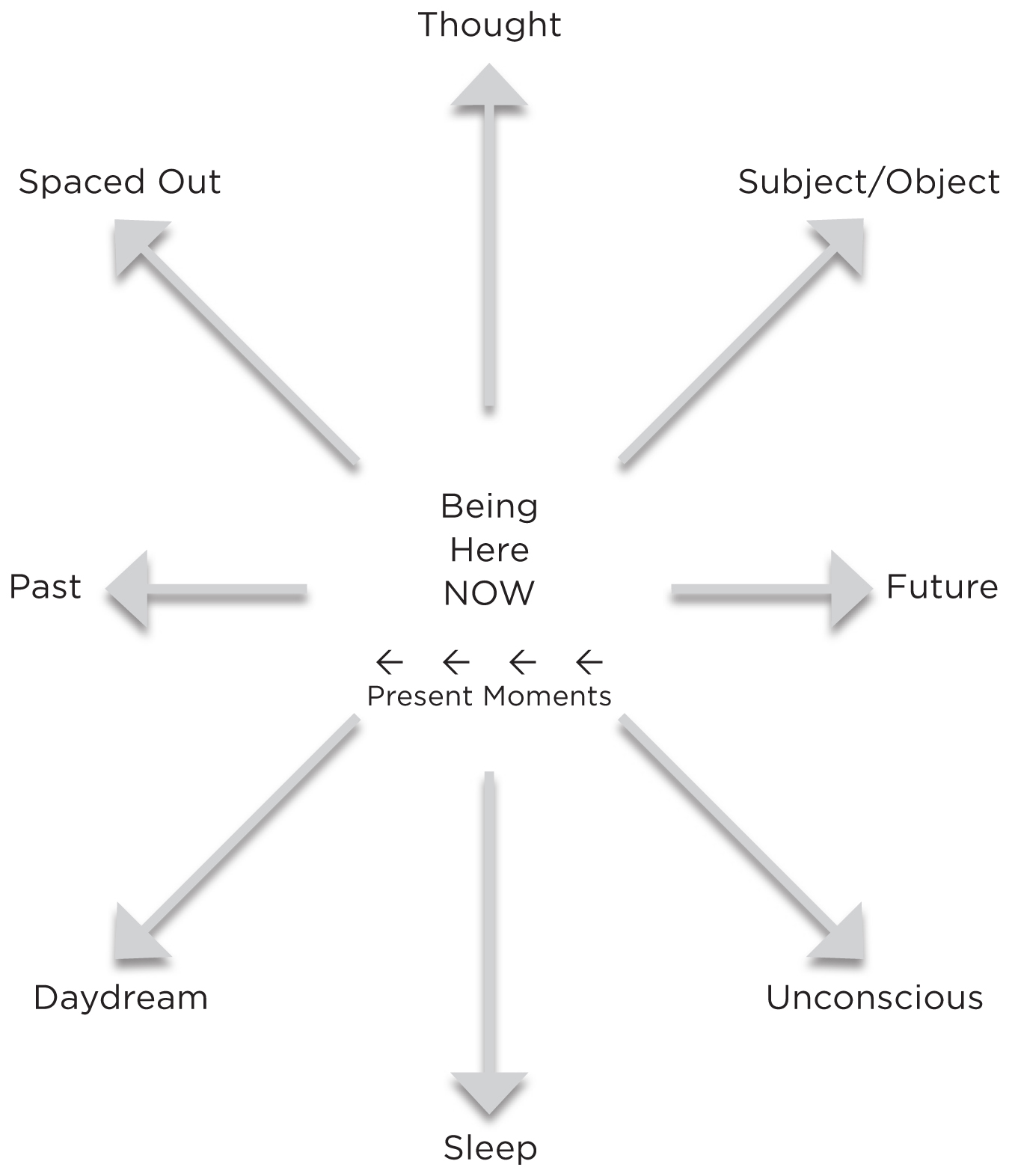
Figure 3 is a pointer to help you discover and remain in the Now. The Now is the timeless time that includes the three times of past, present, and future. The Now is not the present moment, but is aware of present moments arising and passing. We can learn not to collapse into identifying with one particular time or state of mind. From awake awareness, familiarize yourself with the view from the Now.
1. Allow yourself to find a comfortable place to sit and settle in. Take a few comfortably full breaths and let a smile come to your face. Become aware of your breath as it comes and goes. Relax and be here Now without needing to change anything.
2. As you notice your next in-breath, let local awareness unhook from thought and ride the breath down below your neck.
3. Feel the intelligence of awareness that knows your senses directly from within your body. Rest in your heart space that is open and knowing without going up to thought.
4. Begin to be aware of each passing moment, each passing thought that comes and goes, appearing and disappearing.
5. Look and feel from timeless spacious awareness. Open to the Now that includes past, present, and future and doesn’t get stuck in any present moment.
6. Inquire: When am I? Stuck in the past? Chasing the future? Trying to hold on to the present moment? Or in the Now that includes everything? Rest here, deeper than sleep and wide awake, and simply:
FIGURE 3. Learning to be here and now with the past, present, future, and passing present moments.
7. Don’t go up to refer to thought.
8. Don’t go down to sleep.
9. Don’t go back to refer to the past.
10. Don’t go even one moment forward to anticipate the future.
11. Don’t cling to the passing present moments.
12. Don’t look out to the world to create a subject/object relationship.
13. Don’t fall into daydreaming.
14. Feel the magnetic pull forward to the future, the pull back to the past, and the pull to hold onto the present while remaining in the Now.
15. Rest your awareness equally inside and outside. Open to the Now and notice the timeless, continuous field of open-hearted awareness in which all of these present moments of experience are appearing and disappearing.
16. Let be and relax in the all-at-onceness of the Now.
GLIMPSE 2 Infinite No-Self
In this practice, we’re shifting away from the witnessing self and any tendency to contract into a single point of view. The feeling of being a self is the feeling of being an observer with a particular location. No-self is the realization that we are viewing from everywhere, nowhere, and here. We can let go of the tendency to construct a subject-versus-object view and to hold onto positive qualities that arise, such as bliss, clarity, and nonthought. We will no longer be looking from a particular location of the ego, the meditator, or skylike spacious awareness. When you shift away from self-location, then you can let everything be as it is. Paradoxically, you will feel ordinary in an open-hearted way.
In this practice, you’ll check for any remnant of the location of an ego or self-viewpoint so awake awareness can show us clearly that it’s the natural ground of being. If you like, do one of the previous glimpse exercises as the first part of this practice until you feel as if you’re an ocean of awareness with waves of experience appearing. Then, let local awareness search for any remaining sense of self.
1. Unhook local awareness and have it search your entire body-mind system from head to toe to see if a self as an object or subject can be found. Allow the awareness to scan quickly and thoroughly until nothing is found.
2. Upon not finding a self located in any one place or looking from any one place, notice how awake awareness and aliveness are free and unconfined—and seamlessly permeating.
3. Notice that the field of open and empty awareness is aware of itself, by itself, as itself. The awake field is infinitely aware from everywhere, interconnected to everything. The ocean of awareness knows all waves from inside the wave.
4. Feel that there is no boundary, no center, yet continue to observe with no observer.
5. Notice the arising of the aliveness in your human body out of formless awareness moment to moment.
6. Notice the quality of the Now, where everything is here all at once.
7. Let everything be as it is, ordinary and free.