THINKING AS THE SIXTH SENSE
In theory there is no difference between theory and practice. In practice there is.
YOGI BERRA1
One of the most important developments in human evolution is the ability to think. However, an even more important development is the ability to grow beyond thinking. To do this, we need to discover the intelligence that’s inherent in awareness itself. It is important to note that growing beyond thinking is not a regressive, dumb, or irrational state. Consider the innocence of a young child at an adult party, who asks the group of adults what they would do in this situation: “Imagine you are surrounded by hungry tigers with a cliff behind you. What would you do?” Each adult comes up with a different creative solution, but the boy just shakes his head. So they turn to him and ask, “What would you do?” The boy smiles and says, “I’d simply stop imagining.”
When we are identified with our thinking, then that believing creates our perceiving. It is through our five senses that we receive information about the world. Hearing, seeing, touching, tasting, and smelling connect our bodies with our environment. In Buddhist understanding, thinking is considered the sixth sense. Each of the six senses (including thinking) processes a particular kind of information. For instance, our ears can hear sound, but they cannot perceive light. Thinking is a complex sense that performs several roles. One function is to mediate between the other five senses by categorizing: we hear a sound and then thinking goes to memory, finds a match, and labels it “dog barking.”
We’ve spent a lot of time training our thinking mind, and this is important for functioning in the world. But the thinking mind is not meant to be the central source of knowing—let alone the foundation of our identity. Because cognition plays an organizing role, in Western culture we have elevated thought beyond the realm of the senses and overestimated the role of thinking. None of us would consider ourselves to be our hearing or even what we’re hearing at any given moment. Yet we routinely take ourselves to be thoughts and emotions that come and go like sounds. When we place thinking at the center of our identity, we overvalue this mental process.
We can begin to wake up from identification with thinking by directly experiencing another way of knowing. If thinking is actually one of the senses, then to whom or what does this sense appear? We’ll come to see that information from the senses appears to the always already-present and pervasive wisdom of awake awareness.
It’s impossible to know awake awareness with our conceptual mind, our senses, or our attention! But once we discover awake awareness it can use thinking as needed. In making these important distinctions about ways of knowing, we return thinking to its natural role. Next, we can go beyond thinking to encounter the wisdom of nonconceptual knowing.
Conceptual thinking means creating an abstract image, symbol, or picture to represent our experience. Conceptual thinking is also called reflective thinking, because thinking looks to itself in order to know. When we look to thinking, we’re reflecting; that means we’re creating a conceptual image in our brain so we know what’s happening. But here’s the key: Reflective thinking is always one second removed from direct experience. If we get too lost in thoughts, we end up living in a virtual reality in our head. We then miss the direct experience—which does not need thought beyond its labeling function. Too often this kind of self-reflection alienates us from the direct experience of seeing and feeling.
We can end up living in a world of pictures, old stories, and imagination. We can also project our story onto other people and the world until we’re unable to see things as they really are. Reliance on conceptual knowing can create a tremendous amount of suffering because it looks only to itself for answers. This perpetual loop of self-referential thinking is its own prison. We think up a sense of separation that’s not really there. The thinker is always looking for one right answer, generating pressure to decide whether we are right or wrong, which leads to feeling like a good or bad person.
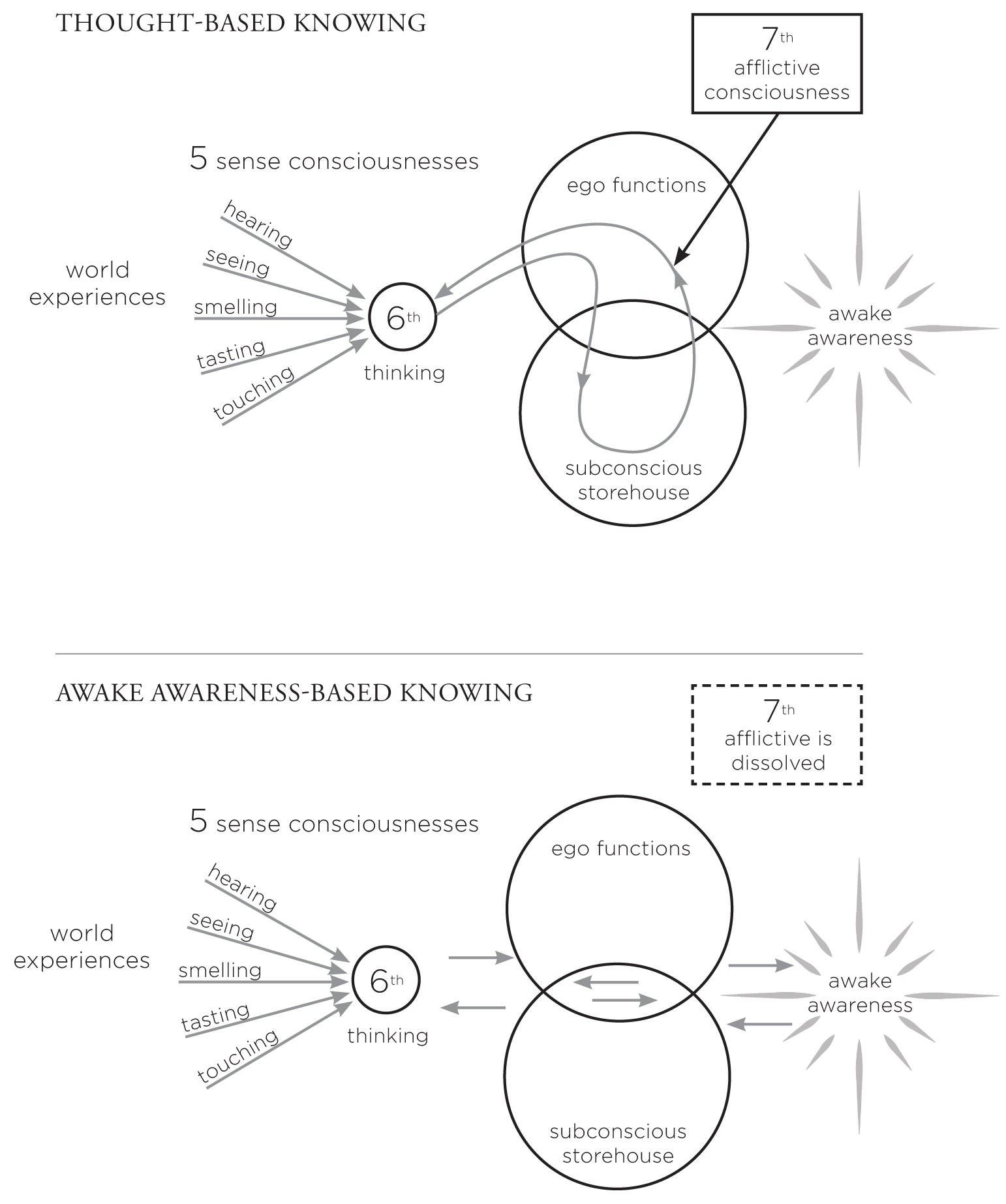
When thinking is elevated to a position above our senses, it can create a mistaken identity called ego-identification. In one Tibetan Buddhist map of consciousness, each of the six senses is a sense consciousness: seeing-consciousness, hearing-consciousness, etc. The seventh consciousness is called afflictive consciousness or deluded awareness, which is ego-identification. In this map, the eighth consciousness is a storehouse of past memories and actions. Afflictive consciousness creates a thinker out of thinking and ego function, and this thought-based sense of self forms the core of mistaken identity. Nothing more than a self-referential loop of thinking about thinking, our mistaken identity is actually a continuous conceptual proliferation that creates solid things out of images and a solid self out of thinking.
The most crucial mistake we make is turning to thought to know who we are. Unfortunately, philosopher René Descartes’s famous statement “I think, therefore I am” is often misunderstood to mean “I am my thinking,” or “I am a thinker.” When we identify ourselves as our thoughts, we become anxious, isolated, and obsessively caught in our own self-images and stories. To grow beyond afflictive consciousness, we need to experience awake awareness, the feeling of “am” that is not thought based. Intellectually understanding this experience can be a helpful first step. But, because intellectual understanding is still the first kind of knowing, it is only a first step toward a much vaster, all-encompassing mode of knowing. When “the thinker” looks through our eyes, we wear the bifocals of dualism. The thinker’s way of knowing joins with a survival program that is meant to protect our physical body to create the afflictive consciousness of ego-identification.
Sigmund Freud described how children develop from primary-process thinking to secondary-process thinking. He defined primary-process thinking as the preverbal way a child perceives and knows the world. Freud considered secondary-process thinking the development of conceptual thinking and the highest level of mental development a human could achieve. Perhaps awake awareness, nonconceptual knowing, can be considered tertiary-process knowing.
Thinking is a great servant, but a lousy master. Thinking is not the center of who you are, and thinking is not the way to discover who you are. As soon as we shift into awareness-based knowing, conceptual thinking moves out of the driver’s seat, yet it continues to be an important function of our operating system. When we’re able to view thinking as a function of awareness-based knowing, we can even use our thinking more effectively when it’s needed. When we stop identifying ourselves as the thinker, we gain the capacity to experience thought in the context of awake awareness, recognizing thought as movement and sensation without needing to regress to the old operating system.
In Figure 2, the illustration of Thought-Based Knowing shows experiences from the world coming to our five consciousnesses, then to our sixth consciousness (thinking), and then it goes in a loop of the seventh consciousness (afflictive). This loop of self-referencing thinking creates ego-identification and obscures awake awareness.
As the illustration of Awake Awareness-Based Knowing shows, when we turn awareness around to look through the loop of afflictive consciousness, we discover awake awareness, which includes all of our thoughts, feelings, sensations, ego functions, and unconscious storehouse. We have shifted.
I’ve asked many people how they experience thinking. Most reply, “What do you mean? It’s like . . . thinking. You know . . . just thinking.” They laugh or shrug their shoulders because they’ve never examined how they experience thoughts. Some people have a ticker-tape concept of thought; it’s as if they’re reading words scrolling across their minds. But thought is not written language like the CNN crawl. You’re not reading it.
Thinking is a way of actively using all the sensory parts of the brain. It is inner sensing, inner seeing, and inner hearing. Thinking can be experienced as a vivid inner movie. The full sensory experience of thinking happens when we use our imagination. For instance, you can think about a beach, feel the sand under your feet, see the sky above your head, smell the salty ocean, feel the soft breeze on your skin, and even hear seagulls cry—all inside your head. As studies show, the same areas of the brain are activated in exactly the same way whether you’re imagining a beach or physically sitting on the beach.
Some people are visual types, but for most of us, thinking is mainly experienced as inner hearing and inner talking. Yes, we all hear voices! Thinking is mostly hearing speech in your head without using your ears. It’s also self-talk, speaking silently to yourself inside your head without using your mouth but with your brain hearing the words as if they’re spoken into your ear.
Try this now: Go ahead, take a moment now and see what the experience of thinking is like for you. You can silently say to yourself, “I am thinking this thought.” And then listen to thought as inner hearing. Then wait, and you will hear the next thought spoken in your mind. What was that like, hearing the inner talk?
Thinking as inner hearing includes all manner of inner monologue, commentary, and dialogue. Inner talking can take the form of a dialogue among subpersonalities who argue, debate, and plead with each other—all inside our heads. When we identify with one of these subpersonalities, we take the voice that is talking at that moment to be “me.” The most common inner talker is a narrator who comments on what’s going on, like a radio announcer at a baseball game: “Now I am going to take the garbage out. Okay, but first why don’t I just see what’s on TV? No, I watch too much TV. But there’s a good show on Tuesdays.”
The other main talker is the judging voice, the superego, the inner critic, or the doubter. This voice adds a second part of ourselves to create a continuous inner dialogue. We have an initial experience, and then the second voice judges it. The dialogue between these two parts generates a continuous tension; the push-pull of their dialogue never seems to stop. This is where the emotional qualities of fear, anger, despair, self-hatred, depression, and anxiety create an embodied feeling of “me” from what’s just a bunch of opinions, points of view, and thoughts.
Most of us are so identified with thinking that we don’t know there are options. We look from our thoughts—not at them. One reason it’s hard to examine the thinking experience is that we constantly use thinking as what we’re knowing with. When thought orients toward and believes the first thought, and then that thought refers to the next thought, a self-referencing loop forms. This conceptual loop gives rise to the illusion of a separate, thought-based identity. Becoming aware of the felt experience of thinking as inner hearing and inner talking is one step toward breaking free of the repetitive loop of senseless chatter. Stepping back from thinking and allowing our inner chatter to pass is an important skill to learn.
We tend to focus on intentional thinking: the analytic, problem-solving, calculating, decision-making, reasoning type of thinking. Automatic thinking—the continuous stream of consciousness and chattering thoughts—is another kind of thinking we all experience. Often we don’t notice automatic thoughts because we’re immersed in them, identified with them, arguing with them, or trying to ignore them. But automatic thoughts keep coming, whether or not we’re paying attention to them. We can experience automatic thoughts as a kind of random commentary, like a tape playing on a continuous loop in our heads. We each have tens of thousands of thoughts per day, and the majority of them are the same thoughts every day.
We are in the habit of believing that if a thought arises, we need to check it out. After all, it could be an important life-saving message, such as: “Watch out for that car!” But few messages are that critical. Most are not even relevant. If we’re always believing our thoughts, no wonder we’re exhausted, anxious, and neurotic! Our relationship to automatic thinking is one of the most important things we’ll learn to change—to our great relief. Much of the time we’re identified with or lost in our own thoughts. But we can also step back to notice our thoughts as the contents of our consciousness. Mindfulness from everyday mind is done from another thought-based part of us, like a judge, commentator, or self-awareness. Awake awareness is the ability to be aware of thoughts and the contents of our consciousness from an awareness that is not a thought.
The field of cognitive behavioral therapy is largely based on the observation that identifying with automatic negative thoughts (ANTS) causes depression. But depressed people aren’t the only ones who experience negative thoughts—everyone does. Or maybe everyone who identifies with their thoughts is a little bit depressed? A recent study of people on six continents showed that 94 percent of those surveyed experienced unwanted, intrusive, or impulsive thoughts. The most common type reported were doubts.3
The type of suffering that we are addressing in the open-hearted awareness approach is not caused by identifying with negative thoughts, but by identifying with any thoughts: positive or negative. You are not the voices in your head. The automatic thoughts that you hear are not you talking. You are not even the second voice that comments on the first thoughts. You start by listening to the thoughts, then you believe the thoughts, and then you believe the thoughts are you. It is important that you directly experience that you are primarily the awareness that hears all voices and thoughts. In order to experience awake awareness, it will be important for you to move beyond choosing good thoughts over bad thoughts on the level of identity. Of course, you’ll still prefer positive thoughts to inform behavior. You will also be able to more easily accept negative thoughts.
Choosing not to listen to the content of automatic thinking and the narrator voice is an easy way out of ego-identification. When automatic thoughts move into the background, we no longer have to listen to each one or hypervigilantly monitor them all. It doesn’t matter if automatic thoughts are negative or positive, because we don’t have to listen to them. However, thought itself is not a problem or an enemy. We’re not interested in stopping thoughts, but in returning thought to its natural function. Shifting our automatic thoughts to the background of our minds allows awake awareness to come to the foreground. When operating from awake awareness, we are better able to include and liberate our subpersonalities as well as inner shadow parts.
When you have shifted into awake awareness, it can be helpful to consider automatic thoughts as mental sensations. Most of us are in the habit of focusing on these mental sensations as they pass through our minds. However, if we can learn to not consciously engage with them, they can be relegated to the background, where awake awareness knows which few thoughts actually do need attention. Awake awareness precludes the necessity of going back to thoughts to orient ourselves on a constant basis.
What is it like when automatic thoughts are in the background? To find out, do a quick experiment now: Bring your awareness to the sensations in your right foot. What do you notice when you focus your awareness in your right foot for a few moments? Do you feel a lot of sensations?
Here’s the thing: A minute ago, you didn’t notice these sensations, although they were already happening. It’s only when you focused on the sensations in your foot that they moved to the foreground of your awareness and began to seem so active and incessant.
You will see that you don’t need to monitor your thoughts continuously any more than you need to constantly monitor the sensations in your foot. Paying attention to automatic thoughts is simply a habit we can change. When you shift into awareness-based knowing, automatic thinking moves into the background, and you experience true peace of mind. You’ll learn to trust that the intelligence of awake awareness will tell you if there is a particular automatic thought that needs attention (which is not that often).
Neurobiologist Patricia Sharp, PhD, is an expert in addiction. She says, “Almost all of our repetitive thought patterns can be viewed as forms of addiction.”4 Pleasurable sensory or mental states are the rewards that condition us to seek the same experiences again. These pleasurable brain states are believed to be generated by dopamine and opioids released in the pleasure centers of the brain. However, as the activities associated with particular pleasures are repeated, the amount of dopamine released in the brain is reduced. We are left with a mental craving for pleasure, but decreased levels of neurotransmitter activity. Due to increased mental craving, we’re driven to indulge more and more in activities that gave us pleasure in the past, hoping to experience that same pleasure, but disappointed because we keep receiving less and less dopamine.5 The habit of continually looking to thoughts for satisfaction, even positive thoughts, creates a similar kind of addiction.
Sharp studied meditators and found that certain Buddhist meditations (similar to those you’ll be learning in this book) stimulate the brain’s pleasure centers. However, unlike dopamine surges, this pleasure does not diminish over time. Unlike addiction, this kind of awareness-based meditation does not lead to craving. When we shift to awake awareness, dopamine reduction doesn’t occur. This means we can establish a natural bliss inside our bodies as a new baseline for living.
This background, low-level bliss is true to my experience, though I had never thought of it as a biochemical process before reading Sharp’s study. This may be why the series of meditations you are learning is particularly helpful for people in recovery from substance addiction or physical pain. In fact, these meditations are helpful for everyone because we’re all in need of recovery from thought-based addiction. This natural bliss is not a high, with fireworks and an orgasmic rush. Rather, it is as if your most intensely blissful bodily experience is spread out thinly throughout the sky. You can experience natural dopamine without becoming doped up! In this recovery program, instead of learning “Don’t pick up the first drink,” you learn: “Don’t pick up the first think.”
The purpose of the following series of glimpses is to shift our primary experience of intelligence from thinking to awake awareness. We will break the habit of orienting ourselves by thinking. In the process, we’ll go through a thought-free state. Eventually, we’ll learn to use thoughts as tools when they’re needed. Our goal is to be emotionally sensitive and vulnerable without becoming wounded or reactive.
Glimpsing awake awareness can help you establish a new baseline of peace in your life by introducing you to a silent presence of mind that’s alert and joyful. Glimpses help you learn to trust the intelligence that knows which thoughts and emotions need attention as opposed to 99 percent of the stuff that doesn’t. If all this sounds mysterious, it’s only because you haven’t experienced it yet. If it sounds too conceptual, remember that these words are designed to prepare you for a direct experience of nonconceptual, awake awareness.

GLIMPSE 1 Inner Hearing
In this glimpse, you’re going to deliberately stop talking to yourself. Then you’re going to stop being interested in what your automatic thoughts are saying. To accomplish this, you’ll simply stop trying to understand the inner talk by no longer being interested in the meaning, words, or sentences you hear. In the process, your chattering thoughts will shift into being mental sensations, a background experience—like the buzz of conversation at a restaurant.
1. Start by noticing what it’s like listening to yourself and speaking to yourself in your head. Talk to yourself internally by saying: “Thinking is inner talk and inner hearing.” Then feel what it’s like to experience thinking as inner talk and inner hearing.
2. Now give yourself these instructions: “I am going to stop talking to myself in a moment and move to only hearing what the thoughts are saying.” See what this is like.
3. Next, give yourself the instruction: “I’m going to hear background chatter, but I’ll become disinterested in what the thoughts say. Instead, my interest will be in the awake space.”
4. Now choose not to talk to yourself for a while. Just listen to the background buzz as though it is a foreign language. Don’t try to understand any inner language being spoken. Instead, be interested in alert, thought-free awareness.
5. Regard all thinking and inner self-talk as the movement of mental sensations. Focus on the sensations in your left hand and then on the mental sensations in your head. Then let all comments about experiences become mental sensations. Let awareness itself, which is already aware and intelligent, be your interest.
6. Notice the clarity and knowing that is here when you stop the habit of going to inner self-talk.
7. Once you discover this thought-free knowing without looking to thought, ask that your phone number slowly arise to awake awareness. Say it to yourself, hear it, and then go back to the awake, peaceful silence.
The key is to shift out of a thought-based operating system. So it’s not just about going beyond your story or a belief system. Instead of asking yourself, “Who am I without my story or a particular thought?” the shift is to go beyond orienting yourself by any thought; “Who am I if I don’t go to any thoughts to know who I am?” Then from awake awareness we see that all thoughts and emotions are not separate. These next glimpses will give you some alternative ways of unhooking from thought and shifting into one of your other senses so that awareness becomes primary.
GLIMPSE 2 Awareness Following the Breath Home
Try hitching a ride on your breath to help local awareness unhook, drop, and know directly from within.
1. Begin by unhooking local awareness from thinking. Then have it move a short distance, from behind your eyes to where your breath contacts your nostrils. As inhalation occurs, let local awareness focus completely on this small area of sensation. As exhalation occurs, sense the breath touching the nostrils as it goes out. Do this for several breaths in a row.
2. With the next in-breath, allow local awareness to ride the air as it moves from your nostrils down your throat and into your chest.
3. Now allow local awareness to unhook from the breath and remain with the awake awareness and aliveness below your neck, even as the air goes back up and out again. Notice local awareness opening to the aliveness and spacious awareness both within and outside your body, while not returning to your head and thoughts.
4. Let the feeling of your chest rising and falling with each new breath be the place of contact for your awareness to stay interested in witnessing from within and opening out, letting go and being here and now. Notice the breath happening by itself as if you are being breathed.
5. Notice that the breath is happening by itself, just as awake awareness is also happening and knowing by itself.
GLIMPSE 3 The Eighteen-Inch Drop from Head to Heart
Take a few minutes now and glimpse open-hearted awareness for yourself.
1. Sit comfortably, eyes open or closed, and simply be aware of all your senses. Notice the activity of thinking in your head.
2. First, unhook local awareness from thoughts in your head. Next, let it move down through your neck and into your chest, and then know—directly—from within your upper body.
3. Become familiar with this kind of direct knowing, which is neither looking down from your head nor going back up to your thoughts.
4. Feel the awareness and aliveness together: rest without going to sleep, and stay aware without going to thought to know.
5. Feel that awareness can know both the awareness and aliveness from within your body.
6. Notice a feeling of an open-hearted awareness from within the space in the center of your chest.
7. Feel as if you have relocated from your head to this open-hearted awareness, which you are now aware from.
8. Notice that you can invite and welcome any thoughts and emotions into your heart space so that you can remain at home in open-hearted awareness and have information from the office of your head come to you by Wi-Fi.
9. Inquire within: “What does open-hearted awareness know?” Wait and feel what it’s like to know, from this not-knowing that knows.
10. Be here, receive light with your eyes, and look out from the eyes of open-hearted awareness.