LOCATION, LOCATION, LOCATION
Now every great meditative tradition the world over has major maps of the significant steps or stages in meditation as their tradition has come to understand and practice them. And what significant research has demonstrated is that, although the surface features of each of these traditions and their stages differ considerably from culture to culture, the deep features of all of them are in many ways significantly similar. In fact, virtually all of them follow the four or five major natural states of consciousness given cross-culturally and universally to all human beings.
KEN WILBER1
In the open-hearted awareness approach to awakening and growing up, the simplest way to answer all questions about how to relieve the root of suffering is the same: shift. This includes questions like: What should I do about this issue or situation in my life? How do I deal with this difficult relationship? How do I become more accepting, peaceful, and loving? Any time you mistake a self-image, an emotion, or a belief for who you are, you need to shift and relocate your identity. You’re not just shifting out of the problem, you’re shifting into that which sees the situation differently. Once you shift, the answer will come from within you.
The most-asked question in meditation classes is: How do I deal with my disturbing emotions? Having spent thirty years as a psychotherapist, I know the value of good psychological and common-sense advice. However, we need to separate awakening from psychological improvement so that we can do both. Thinking positive thoughts or being more accepting may help us temporarily deal with difficult emotions, but we’re still working in the realm of ego-identification and the everyday mind.
We have all heard the saying “seeing is believing.” But our beliefs create how we see. In other words, our perspectives influence our perceptions. This is why we need to shift out of the limited location of our everyday mind and its conditioning.
Swiss psychiatrist Carl Jung called neurosis the avoidance of legitimate suffering. We avoid suffering related to loss, disappointment, or growing pains because we don’t have the capacity to bear it if we’re operating from ego-identification. Our sense of self is just too small to deal with more powerful emotions. How do we remain vulnerable, sensitive, and intimate with life without being overwhelmed? Tulku Urgyen Rinpoche says, “Everyone is overcome by disturbing emotions unless they are stable in nondual [awake] awareness.”2 We begin by immediately shifting our location into awake awareness rather than working first with our emotions or external situations from ego-identification.
What if your difficult feelings, your sensitive emotional make-up, or the memories of your traumas never go away? What I’m getting at is that instead of focusing on what emotions are arising, the real question is who or what are the feelings arising to? From what level of consciousness are you viewing and feeling? From awareness-based knowing, you can be sensitive, vulnerable, and courageous.
Of course, it’s important to know what does the shifting, how to shift, and where to shift. All human beings have the same structure of consciousness. In this book, we’ll learn to shift our awareness through five major, natural dimensions of consciousness. Each level of consciousness and its contents can be observed. However, when we know from any of the five levels of consciousness rather than look at them, we will call them the five levels of mind. When we look from a particular level of mind, we experience its unique way of perceiving and knowing. We have very distinct experiences of the same situations depending on which level of mind we’re located in.
Most adults throughout the world have a similar way of locating their identity and way of knowing within these levels of mind. We are most often located in the first level, called everyday mind, with its fast-moving thoughts, physical instinctual impulses, and strong emotions, while the subtlest dimensions of consciousness are harder to access. In themselves, even the denser and faster-moving dimensions of consciousness aren’t a problem. It is when we locate our identity in these dimensions that we create suffering. Albert Einstein famously said, “You can’t solve the problem on the level of consciousness that created it.” We’ll learn how to use local awareness to make the shift to locate our identities within the subtler and more pervasive levels of mind.
Look at figure 1. What is this a picture of?
Did you think, “It’s a picture of birds”? That’s what most people say. What if you were to look at this picture again, in a fresh way, as a picture of the sky through which birds are passing. Rather than focusing on the objects, how does it feel when you shift to looking at space as your primary interest?
What is your experience now? This is how a shift might feel.

FIGURE 1. A picture of birds? Or of sky?
This exercise can give you a sense of the perspective change that can happen in a moment. We’re not only shifting our way of perceiving, but we’re also shifting the location of the perceiver.
According to Buddhism, suffering is created by ignorance, craving, and aversion. There are two common ways to alleviate suffering. The first approach focuses on reducing craving and aversion; the second aims to clear up ignorance. Each begins with a different starting point.
The first approach tries to decrease cravings that “I” feel attached to and reduce aversions to what “I” don’t like. “I” can become attached to and identified with various roles, places, and things such as money, status, or objects of desire as “mine.” “I” try to decrease or renounce desire and aversion, while increasing loving-kindness, acceptance, and compassion. Or “I” try to transform the disturbing emotions that accompany craving and aversion. These types of practices can lead to temporary relief of suffering; they can also end up supporting a less stressed, but still separate, sense of self.
The second approach goes right to the root of suffering: the creation of a sufferer. Rather than focusing on what “I” am attached to or repelled by, this approach goes directly to the source of identification that creates an “I” in the first place. Ultimately, the cause of suffering is always ignorance. Here, however, ignorance does not mean lack of information or knowledge.
What are we ignorant about? In Tibetan, the word for “ignorance” is ma-rigpa, which simply means not recognizing rigpa (awake awareness). When awareness does not recognize itself but identifies instead as a thinker, the small separate “I” forms. Immediately, the separate “I” has insatiable desires and aversions and, because it is made of thought, nothing can satisfy or threaten it. Desires and aversions can be understood as symptoms we can resolve merely by shifting our identity into awake awareness as our ground of being. Ultimately, there is nothing to reject or transform.
During meditation, five hindrances are named as obstacles to peaceful abiding and can hinder your ability to be mindful. From this second approach, the five hindrances—craving, aversion, apathy, worry, and doubt—are simply signs that you’re looking and feeling from everyday mind. The doubt “I am not going to get this” is correct, on one level, because the “I” of the everyday mind cannot know awake awareness. Rather than trying to counteract these hindrances, simply recognize them as a sign you’re caught and shift into awake awareness, which by its nature is never identified with these hindrances.
The open-hearted awareness approach helps us shift our perception, our sense of identity, and our way of knowing. On the level of perception, we are shifting out of ego-identification’s dualistic perspective that sees everything as either a potential threat or object of satisfaction. On the level of identity, we are shifting out of ego-identification, away from the sense of being a separate, small entity that co-opts our physical-boundary program and feels perpetually dissatisfied. On the level of knowing, we are shifting out of the noise of the chattering, everyday mind. We often use words related to location to describe this condition: “stuck,” “hooked,” “trapped,” “isolated,” “lost,” “contracted,” or “distracted.”
The type of thinking that co-opts the boundary-survival program is called self-awareness. Psychologists define self-awareness as the “psychological state in which one takes oneself as an object of attention.”3 Self-awareness allows us to objectify ourselves for the purpose of introspection, ethical behavior, and planning for the future. In order to do this, we have to split our identity into two parts. Self-awareness creates a separate sense of self, a mini-me, out of thought, which can then observe “me” as an object—as in, “I’m so upset with myself.” The process of self-awareness uses the physical body’s survival programs to create the feeling of a mini-me within us that mistakenly perceives it has a physical boundary. It is not able to be aware of itself because “you” are looking out from it. It is looking out of your eyes and you feel like it is you. Self-awareness, as a form of mindfulness, can be aware of thoughts, feelings, and sensations, and of your body and personality as a separate object, “me,” but it cannot see itself.
This is why mindfulness has to reach a level of being able to observe not just thoughts, but self-awareness. You can be mindful from self-awareness, and then you can be mindful from awake awareness of the process of self-awareness. Only when you are looking from awake awareness can you see that what you took to be a solid self is a flurry of changing content arising within your mind.
Our current address is ego-identification, the habitual looping pattern of ego functions and thinking that has created the sense of “I.” Ego-identification is not just a belief, story, thought, or attitude, but a habitual way of organizing consciousness that we can shift out of. The reason we want to shift out of it is that this thought-based creation of an illusory sense of self leaves us feeling alienated, as if something is always wrong with who we are or what is happening to us. Shifting into awake awareness can relieve us of the bondage of a self.
In the simplest sense, we are shifting into a new awareness-based operating system. The first step is to shift out of ego-identification and our current level of everyday mind. When we shift, there are many different dimensions of consciousness that we may access, but not all of them are useful in this approach. We will need to learn how to shift into awake awareness specifically, instead of landing in other types of consciousness and unconsciousness, such as daydreaming, calm meditation states, or personal or collective unconscious.
When we shift into awake awareness, our perception returns to its natural way of seeing people and the world, without projecting onto them. Instead of trying to calm our chattering mind, to redecorate the rut we’re stuck in, or to improve our ego-identification, we can learn to use local awareness to immediately shift out of this mental bandwidth, just as if we were changing the channel.
We are shifting from everyday mind and ego-identification into awake awareness as our ground of being. When awake awareness is the new foundation, we include our body and thoughts as we discover embodied open-hearted awareness as our way of knowing and relating. We can get to open-hearted awareness in one shift, or we can get there through a series of smaller shifts. With every shift, we access a new view from a new level of mind. When we shift, we need to become more comfortable with going through a gap of not-knowing. When we discover awake awareness, we need to become familiar with feeling more spacious, fluid, and open—without referring to thought for orienting ourselves as to who we are. We become free from alienation, anxiety, fear, and shame.
With awake awareness as our ground of being, we begin to have an entirely new relationship with our issues, subpersonalities, thoughts, and emotions. We can see them more clearly. Over time, emotions that have been repressed or frozen will detox spontaneously. The subpersonalities we took to be ourselves—our mistaken identities—are now recognizable as patterns of thought and emotion. With repeated glimpses of awake awareness, achieved by practicing open-hearted awareness, we begin to rewire our neural networks to create the new normal: the awareness-based operating system.
“Location, location, location” is a phrase used by real-estate agents to emphasize that identical homes have different values based on where they’re located. If a building has two apartments—one with windows looking out at brick walls and the other, three floors higher, with panoramic views—the upstairs apartment is much more valuable. The open-hearted awareness approach helps you shift into your best location with a spacious view from which you can realize how valuable you already are.
The small sense of self feels separate, and this location makes us feel contracted, isolated, and in our heads. The experience of opening up during the process of awakening first brings spaciousness, emptiness, and freedom; these qualities can then be followed by embodiment, oneness, fullness, unity, and flow. In our journey of awaking the sense of no-self is a freedom from a specific place of viewing. We can feel infinite, everywhere, nowhere, here, and now.
Location matters: Where are you viewing from? From which level of mind are you looking? Contrary to popular belief, relief from suffering is not achieved by changing the thoughts, emotions, and situations that arise. Instead, relief is directly related to the level of mind from which we experience these. Ask yourself this question about any thoughts, feelings, beliefs, judgments, worries, and fears that arise:
Who or what are these experiences arising to?
This focus on location may seem like a new way to do meditation or inquiry. However, I’ve found that working with our identity shift in the context of location makes awakening more visceral and easier to learn.
You may not have previously thought about meditation as a way of shifting location. Our sense of self and our way of knowing is “normally” located within our thoughts. We can learn to shift the location of the observer out of identification with thinking. When you become aware of your thoughts—instead of remaining located within them—you begin to feel some relief from stress. Research showing that meditation reduces stress demonstrates that the stress is not caused by the external situations we usually blame, but is generated instead by the previous location of identity in our thoughts.
We all know what it’s like to be located in a bad mood, a daydream, a righteous point of view, or a fantasy. When we’re self-centered, our location is clearly the problem. When we put ourselves into another person’s shoes, we’re changing our location to feel empathy and compassion.
In the open-hearted awareness approach, we learn to use local awareness for shifting our location. When we shift location, we change the way our brain works. When we use local awareness to shift our level of mind, our perception of the whole world changes. We are no longer confined to a small self in our heads, looking out from behind our eyes. We can learn how to move local awareness to a new location that generates a profound change in our sense of identity. This change takes us out of the emotional turmoil perpetuated by our current location. When we shift to a new level of mind, we find more capacity, space, and the ability to relate without fear or shame.
The movement of local awareness occurs on an invisible level within our physical body. Once we get the hang of it, moving local awareness feels very palpable. As we shift locations, our point of view changes to a new level of mind. The felt sense of each level of mind can be slightly different for each person.
The most common inquiry used to shift out of the current location of your identity is not “Who am I?” or “What am I?” but “Where am I?” Asking where leads to an experiential, felt-sense pointer for shifting from a small, separate sense of self into the boundless ground of being.
Let’s use local awareness to look back now and inquire: Where is the hearer?
When no hearer can be found, notice how it feels to have a more spacious view.
Contrary to popular belief, you can’t be in the present moment. However, you are always here now. It is only a matter of whether you know it or not. The Now is often confused with our understanding of the present time or the present moment. In Tibetan Buddhism, the Now is considered the “timeless time” that includes the three relative times of past, present, and future. We know not to get caught in the past or the future, but in order to be in the Now, we also have to let go of the present. The Now is not confined by relative clock time, yet it is also not only pure timelessness. The Now is the meeting place of timeless spacious awareness with the relative world and its conventional time. The Now does not come and go, but includes everything all at once. When we’re aware of being in the Now, present moments come and go, like ripples and waves in the ocean of awake awareness.
When we don’t know the alternative to the three relative times, we create an imitation of the Now and call it “the moment” or “the present.” Here’s how Merriam-Webster defines moment.
a: a minute portion or point of time: INSTANT
b: a comparatively brief period of time4
Clearly, we can’t live in the moment, because moments come and go like the tick-tock of a clock. Moment . . . gone . . . new moment . . . gone . . . new moment . . . gone. You can’t stop moments or be quick enough to be in any moment of time. Physicist Max Planck recognized that moments are flashes in relative time. He divided moments into small measures known as Planck units, which are 10–43 seconds long. No matter how hard we try, we can never slice time thin enough to enter the moment.
Our perceived experience is made up of mind moments that appear continuous, like movies. Films project twenty-four still frames every second in order to make the movement of their images appear lifelike to the brain. A moment is like a single frame that we can look at but cannot remain in. Even if we took one still frame from a movie, we would see a frozen moment, not the dynamic living Now.
Trying to be in the Now by entering the present moment is also like sitting at the edge of a river, looking at the water flowing over one rock. As soon as you focus on one moment in the flow of water, that portion of water has already moved downstream. We cannot enter present moments because they move too fast and change continuously. Contemporary Tibetan Buddhist teacher Mingyur Rinpoche says, “If you examine even the present moment carefully, you find that it also is made up of earlier and later moments. In the end, if you keep examining the present moment, you find that there is no present moment that exists either.”5
Interestingly, mindfulness meditation begins with the opposite approach to trying to be in the moment; it asks us to actually notice moment-to-moment change. One of the great insights we can get from mindfulness meditation practice is that each moment of experience arises and passes. Having a direct experience of this impermanence, from observing awareness, helps us to let go of the attempt to calcify any single moment of time, to try to make something stable that is not. When we really get a feeling for the coming and going of moments, it helps us break the illusion of a solid, separate self, which gives us relief from suffering.
The present time is not the Now. When Gampopa, an eleventh-century Buddhist teacher, said, “Don’t invite the future. Don’t pursue the past. Let go of the present. Relax right now,”6 he was pointing to the fact that trying to locate yourself in any of the three relative times, including the present, can cause suffering. It’s not always a benefit to strive to be in the present. While working as a psychotherapist, I saw that the distinguishing feature of clinical depression is feeling stuck in the present. As one client said, “It feels like there is only this present, unbearable pain and no hope of it changing.” Being depressed is like being in a prison where you’re cut off from positive memories of the past and from the potential to change in the future. Part of the treatment for depression is to have people remember how they got through sad periods in the past and realize there’s a positive future. In terms of the present, it’s helpful to realize “This too shall pass.”
It is true that our attention can be negatively obsessed with remembering the past. However, most of us would agree on an everyday level with poet and philosopher George Santayana, who said, “Those who cannot remember the past are condemned to repeat it.”7 We can also be preoccupied with fearing the future. The ability to imagine the future has helped all of us survive and thrive, for instance by being able to prepare for the coming winter or spring. You can plan for the future and recall the past while being in the Now.
The most important thing to know is that we are always already in the Now—however, we are not always aware of being in the Now. You can only know the Now from awake awareness. Many of us have experienced being in the Now when we were “in the zone” or in a panoramic flow state.
When we learn to shift into directly being aware of being in the Now, our whole sense of reality changes for the better. We can’t be aware of being in the Now from our everyday, ego-identified state of mind. We can shift through the door of the Now into awake awareness, or when abiding in awake awareness, we can begin to notice the feeling of being in the Now. The purpose of clarifying and distinguishing the Now from the present and present moment is for us to be able to shift into being in the Now and know we are here.
Most of us have spent a lot of time trying to reduce suffering by changing our thoughts, beliefs, attitudes, or circumstances. This is the basis for behavioral, cognitive, or analytic approaches to reduced suffering. Now, instead of adding or subtracting thoughts, emotions, and behaviors, we will learn to shift our awareness into another level of mind that has a completely different view of the same conditions. We are relocating our view—decentering from ego-identification, where we’d previously been located—to the foundation of awake awareness.
Each level of consciousness and its contents can be observed, and we can observe from each level of consciousness. When we look out from a particular level of consciousness, we experience its unique way of perceiving and knowing. When we are knowing from the five levels of consciousness rather than looking at them, we will call them the five levels of mind.
In this open-hearted awareness approach, we will relocate our identity in five different levels of mind and their associated types of awareness. We can look at each of these levels of mind from the event perspective or the mind perspective. The event perspective is when we look at and experience the contents and capabilities of any level of mind. The mind perspective is when we are located in and look from that level of mind. The lower levels cannot know the higher levels, but each new level of mind can know and include the previous ones.
1. Everyday mind is experienced as sense perceptions, thoughts, and emotions. Everyday mind looks from thoughts and ego functions to create ego-identification and a subject-versus-object dualistic split that obscures the subtler levels of mind. Everyday mind uses attention and self-awareness to focus.
2. Subtle mind is experienced as the ability to step back from everyday mind and be located in mindful awareness, the meditator, or an observing ego. Subtle mind looks from a mindful witness of thoughts, feelings, and sensations as the contents of our experience arise and pass. Subtle mind uses mindful awareness and subtle-body awareness to focus.
3. Awake-aware mind knows itself as timeless, formless, changeless, contentless, spacious awareness. Awake-aware mind looks from a big-sky witness of spacious awareness to see subtle mind and everyday mind, as well as the world. Awake-aware mind is already here and aware by itself, so when we look from it, we are using effortless mindfulness.
4. Simultaneous mind experiences ultimate reality and relative reality at the same time. The ocean of awake awareness experiences all energy and form as its own waves. We feel spacious and pervasive boundless freedom, and awake awareness is embodied as an interconnected presence while being capable of perceiving each previous level of consciousness. Simultaneous mind looks from unity consciousness, where nondual awareness is knowing from within our consciousness while not becoming ego-identified.
5. Heart mind is free of the location of any particular witnessing self. In this level of mind, we feel connected and protected, vulnerable and courageous, and motivated to create and relate. Heart mindfulness looks from our ground of being, which is now operating from open-hearted awareness, a wisdom-based loving intelligence that feels boundless, interconnected, and fully human.
Mindfulness is the connection from the level of mind we are perceiving from, to what is perceived. The perceiver is different from each level of mind. So mindfulness is the connection and relating from your level of mind to objects and tasks on the relative level.
When located in everyday mind, you can use concentration to be mindful of thinking and performing tasks. From subtle mind, you can look from the meditator, aware of the contents of your mind, realizing you are not your thoughts. Then you can be ego-less when awareness is aware of itself as spacious awake awareness. Local awareness steps back and discovers the awareness that is leaning in, including and welcoming. Effortless mindfulness begins when we are located in spacious awareness. Then awareness is embodied as presence, knowing from innate simultaneous mindfulness. Then heart-mind uses heart mindfulness to feel interconnection, creativity, and compassion.
We begin our journey of awakening by being ego-identified. This is when the thought-based operating system creates a small, separate sense of a “mini-me” located in the center of the head. As we shift the location of our identity, we won’t have to get rid of our ego functions (like knowing how to do our tasks at work) or our basic ego personality (like our sense of humor). What we let go of is our ego-identification. Our ego functions and ego personality become less stressed, defensive, and constricted; ego-identification is no longer experienced as the center of who we are. We will go through a gap of egolessness—the dropping away of the illusory sense of ego-identification—before discovering awake awareness to be the true foundation of our identity.
When we wake up, we shift into an awareness-based identity called the witnessing self, which is a skylike, detached observer of the contents of our consciousness. We are no longer ego-identified, as from this self we are able to observe from outside. This self is a mindful witness that uses nonconceptual awareness as the primary way of knowing. You will learn to observe from a big-sky view, a witness consciousness looking from spacious awareness. With this shift, our identity will be located in the awake-aware level of mind. We don’t want to get stuck here in the “witness-protection program.”
The next shift is waking-in, when spacious awareness, which is formless and boundless, recognizes that it is energy and form as well as space. From the witnessing self, you feel as though you are the sky, in which thoughts and feelings are objects that come and go. When awake awareness becomes embodied, you feel at first as though you are a wave in the ocean of awareness. There can be a transition here—a feeling of no-self, the experience of perceiving without a perceiver located in any one point of view. Awake awareness is not a new, separate, individual identity because we now correctly perceive ourselves as always interconnected. Awake awareness is the ground of Being that we all have in common. Being is the discovery or rediscovery of your identity based in okay-ness, basic trust, basic goodness, and the coming together of the ultimate level of reality with our relative humanity. Seeing from Being uses simultaneous mind to perceive formlessness as awake awareness within form. We begin waking-out by discovering open-hearted awareness, which is the fabric of love, connected to all.
At this point, we are no longer centered in our head, but are knowing from heart-mind. Most of us have not been taught how to access open-hearted awareness. It’s not that it’s so esoteric or difficult to find. Mainly we don’t access it because we haven’t known it was possible and natural. The truth is that even if you haven’t known anything about shifting via local awareness, you can do it. No matter how long a room has been dark, the minute you flip the switch, the room is completely filled with light.
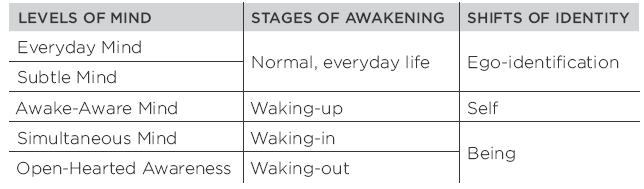
What Is the Relationship between Mind, Identity, and Awakening?
LEVELS OF MIND |
STAGES OF AWAKENING |
SHIFTS OF IDENTITY |
Everyday Mind |
Normal, everyday life |
Ego-identification |
Subtle Mind |
||
Awake-Aware Mind |
Waking-up |
Self |
Simultaneous Mind |
Waking-in |
Being |
Open-Hearted Awareness |
Waking-out |
A glimpse is not a spiritual experience happening to our current identity and conceptual mind. A glimpse begins as if we were knowing awake awareness as an object, but we realize awake awareness knows itself—and then we shift into knowing from awake awareness. A glimpse is a shift into seeing and being from a new level of mind and identity. In other words, a glimpse is a not always a peak experience, one that’s a euphoric state. Instead, it could be called a “peek” experience because the underlying ground of our Being is now the location of seeing.
You could say that a glimpse is an insight. In this context, insight means seeing from within or discovering a new way of seeing and being. This insight is not information that you get from a new level of mind, but the way that nonconceptual awareness sees. Our goal is to get a full glimpse of our natural awakeness and its positive qualities. When local awareness shifts, it glimpses from a new way of being. We let go of any effort and let everything be. Once we glimpse, we can immediately go about our daily activities or we can sit quietly, but rather than meditating, we can let our system marinate in awake awareness. Awake awareness can be marinating, saturating, and detoxing your body. We are resting as awake awareness, and from awake awareness we can be active.
The main practice is small glimpses many times, but sometimes one small glimpse changes everything. These shifts can be done in the midst of our daily life.
The reason the glimpses are small is that when we shift into awake awareness, we let go of efforting and allow the new knowing to know on its own. We can’t use the effort of the egoic doer to help in any way. It can be helpful to begin our day with a twenty-minute session of awareness inquiry in order to tune into awareness-based knowing. We can finish this initial session by marinating in a new mode of perception, knowing, and identity, and by familiarizing ourselves with this way of being and seeing.
The practice of small glimpses many times during the day is what builds the new habit of knowing from awake awareness. This trains our brain to remain in it for longer periods of time. Eventually, we are able to glimpse even while standing in line at the grocery store. When the inertia of old habits returns you to ego-identification, you can say to yourself, “No big surprise, just re-recognize.” We realize that our quality of life is not dependent on the experiences arising in the world or our minds, but on the level of mind they are rising to. We can feel good even when we do not feel good.
No matter what you do, no matter what situation you are in—whether walking, sitting, eating, or lying down—always return your awareness within the nature of awake awareness. That’s it!
TULKU URGYEN RINPOCHE, WHEN ASKED ABOUT HIS DAILY PRACTICE8
In order not to get pulled back to identification, you can do the following process of recognizing your true nature:
• Recognize that you are caught, attached, or identified.
• Realize there is another way to be.
• Remember a method of returning or recognizing that has worked for you.
• Choose a glimpse practice that works for you.
• Do it! Surrender local awareness back to spacious awareness. Look from spacious awareness. Allow awareness to embody.
• Feel the dance between formlessness and form, without landing in either one.
• Know with your new heart-knowing—without going back to thought for a second opinion or allowing a subpersonality to take over.
• Let be and rest in the ground of being. Be this safety, live from this, as this. Invite all experience to this new, centerless center.
• Live from open-hearted awareness. Allow the knowing from unconditioned awareness and unconditional love to connect outward to all.
• Do from being. Trust in the new knowing and begin to rewire your brain and ego functions by going about your daily tasks from this new view.
• Detox, welcome, liberate. Open-hearted awareness welcomes and liberates unpleasant feelings, detoxing, rewiring, and working with emotions and subpersonalities.
• Remain undistracted without effort.
• When you get re-identified and caught, no big surprise . . . just re-recognize.
Being located in everyday mind is like living in a storm cloud: chaotic, turbulent, and filled with fog, wind, and lightning. You may feel that “who you are” is located in this cloud, and everything outside is “other.” In the cloud, it’s a struggle to see clearly. No matter where you move or what you do, as long as you’re confined to the cloud, your feelings will be stormy and your vision foggy. When local awareness makes its first shift, it simply steps out of the cloud and recognizes the wide-open sky of awake awareness. You feel free and spacious. You’re now the witness, aware of the sky and aware from the sky. You’re now located in spacious awareness with a new perspective on the cloud of your mind and body. Then, as the open sky, you can include the stormy contents of the cloud, while remaining open. The ground of being is able to welcome and embrace all thoughts and feelings without becoming reidentified with them.
In other words, when you feel anxious, fearful, lonely, depressed, or upset, your awareness is obscured by the habit of looking to your small, conceptual mind. Local awareness deliberately shifts out of identification with the cloud to a skylike view from awake awareness. From the sky of awake awareness, any thought patterns or emotional storms are included. By recognizing the spacious dimension of awake awareness as the source of mind, you have discovered that you are both the sky of awake awareness and your particular body and mind. Everything that happens is just weather.
After all, no storm ever hurts the sky, and the sky permeates even the thickest, darkest clouds. If you go all the way with this, to the point where awake awareness recognizes itself as both the sky and the cloud, then you will feel a compassionate, open-hearted response to your own stormy feelings and those of others. Ultimately, our wellbeing is not based on the changing weather conditions, but on what level of mind we are aware from.
This is one of the full practices in the open-hearted awareness approach, which uses local awareness to shift through each of the five levels of mind. Let me give you a sense of the steps, and then you can do the experiment for yourself. Once you learn these simple steps, you can do it anywhere, at any time of the day.
1. Unhook. You will step off the train of thought you’re on. Once unhooked, local awareness will become the primary source and location of intelligence. Local awareness will know directly from within your body rather than looking down from your everyday mind. The key of this step is to unhook awareness so that you’re not looking from your thoughts, not looking up to your thoughts, and not applying your mind by using attention. Local awareness can completely detach, unhook, or step away from thinking. You can discover local awareness without knowing what it is. Just give it a try.
2. Drop. What will drop is not your everyday mind, not your ego, and not your attention; it will be local awareness. Local awareness will move like an invisible globe of awareness below your neck and will know awareness and aliveness directly from within your body. You will come back to your senses and know directly with thought-free awareness. This is the experience of subtle mind and body or inner-body presence.
3. Open. Local awareness will open to space and then mingle with spacious awareness all around your body. You become aware of open space, then open space is aware.
4. See. Local awareness will become aware of spacious awareness, then spacious awareness becomes aware of itself as a field: boundless, formless, timeless, contentless, continuous, and awake. Spacious awareness is nonconceptually knowing and seeing.
5. Include. Begin by witnessing the contents of your body and mind from spacious awareness. Spacious awareness that knows itself as formless will now also know itself as form. Spacious awareness will remain boundless as it includes aliveness within your body. This natural, embodied awake awareness will be effortlessly aware and include energy, thoughts, feelings, and sensations without becoming reidentified with an egoic point of view. Embodied awake awareness does not resist anything, but welcomes everything that’s arising.
6. Know. When awake awareness is embodied it will not need to go back to thought to know or to create an ego manager. Local awareness will search through the contents of body and mind for an object called “self,” and when it is not findable then awareness will be free. A new kind of knowing will arise that has no thoughts on the screen of the mind, but it has access to all information instantly as needed. This new heart-knowing does not have to orient by going up to thought, going down to sleep, going one moment forward into the future, referring to past memory, or holding on to the experience of the present moment. You will notice the shift as nonconceptual awareness takes on the flavor of heart-knowing; feeling connected, curious, loving, safe, creative, and response-able; and knowing that all is well.
7. Let be. During this step, notice that open-hearted awareness is already awake and aware and does not require thought or effort. At this point, you can remain undistracted without effort. You can let go of controlling and let be. Rest like a child who was lost and has returned to the loving arms of a mother.

GLIMPSE 1 Shift into Freedom
We are going to do a simple series of shifts. These begin with unhooking local awareness from thought and having local awareness be the location of knowing. You do not need to understand how to unhook local awareness from thinking. Just assume you will be able to do it intuitively. If it helps, you can let awareness ride your in-breath below your neck to be aware from within.
1. Sit comfortably with your eyes open or closed, and simply be aware of your senses. Notice the activity of thinking in your head.
2. Now, unhook local awareness from thinking and let it drop down through your neck and into your upper body.
3. Feel local awareness knowing sensations and awareness directly from within your body. Stay with this for a while.
4. With awareness knowing the aliveness and awareness directly within your upper body, don’t go back up to thought or down to sleep.
5. Now, let local awareness open to the space outside your body.
6. Simply be aware of space.
7. Let awareness mingle with space.
8. Be aware of open space and then notice that open space is aware.
9. Feel the awareness aware of itself as a boundless, contentless, changeless field of spacious awareness. Stay here for a while.
10. Now shift from being aware of spacious awareness to see from spacious awareness. Ask: “Am I noticing spacious awareness or is spacious awareness aware of the thoughts, feelings, and sensations that I formerly took to be me?”
11. Notice that the spacious awareness outside is the same as the awareness and aliveness within your body. The field of awareness is spacious and pervasive.
12. Feel how the formless spacious awareness includes all appearances and aliveness within as one continuous ocean of awareness with waves of experience arising.
13. Notice how you can be simultaneously aware outside and within.
14. Let local awareness search the contents of the body and mind for the location of a witnessing self. When no self can be found, notice the awareness that’s knowing from everywhere, nowhere, and here.
15. Rather than going back up to thought for words, wait and feel the potential to know from open-hearted awareness. Inquire: “What does open-hearted awareness know?”
16. Feel the boundless, embodied, alert, and interconnected sense of knowing, safety, and wellbeing.
17. Inquire: “What is here now if there is no problem to solve?” Rather than going back to thought to know the answer, allow open-hearted awareness to know.
18. Remain undistracted without effort.
19. Let be.
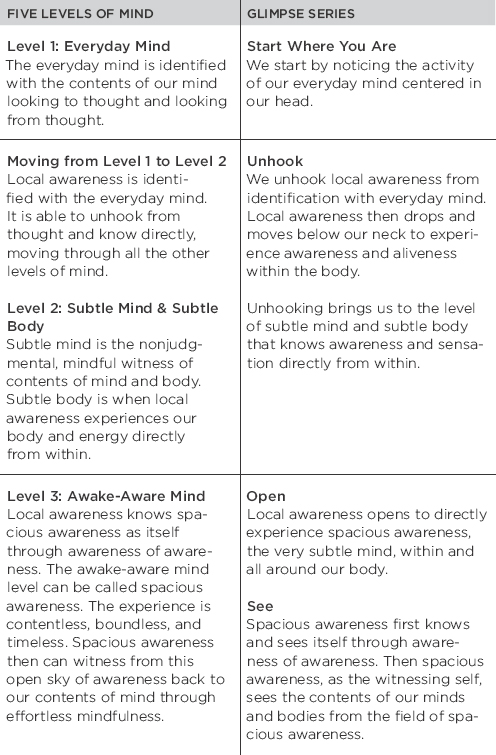
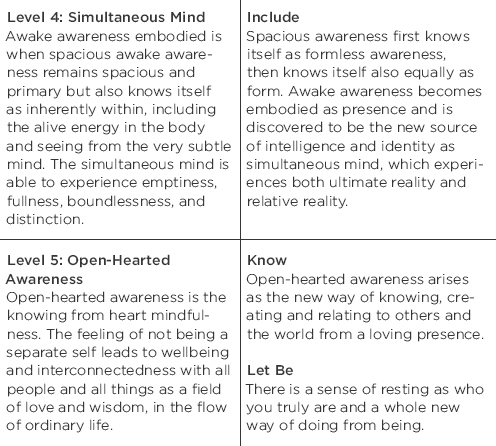
The following table shows the shifts you made into and through each of the five levels of mind.
FIVE LEVELS OF MIND |
GLIMPSE SERIES |
Level 1: Everyday Mind The everyday mind is identified with the contents of our mind looking to thought and looking from thought. |
Start Where You Are We start by noticing the activity of our everyday mind centered in our head. |
Moving from Level 1 to Level 2 Local awareness is identified with the everyday mind. It is able to unhook from thought and know directly, moving through all the other levels of mind. |
Unhook We unhook local awareness from identification with everyday mind. Local awareness then drops and moves below our neck to experience awareness and aliveness within the body. |
Level 2: Subtle Mind & Subtle Body Subtle mind is the nonjudgmental, mindful witness of contents of mind and body. Subtle body is when local awareness experiences our body and energy directly from within. |
Unhooking brings us to the level of subtle mind and subtle body that knows awareness and sensation directly from within. |
Level 3: Awake-Aware Mind Local awareness knows spacious awareness as itself through awareness of awareness. The awake-aware mind level can be called spacious awareness. The experience is contentless, boundless, and timeless. Spacious awareness then can witness from this open sky of awareness back to our contents of mind through effortless mindfulness. |
Open Local awareness opens to directly experience spacious awareness, the very subtle mind, within and all around our body. See Spacious awareness first knows and sees itself through awareness of awareness. Then spacious awareness, as the witnessing self, sees the contents of our minds and bodies from the field of spacious awareness. |
Level 4: Simultaneous Mind Awake awareness embodied is when spacious awake awareness remains spacious and primary but also knows itself as inherently within, including the alive energy in the body and seeing from the very subtle mind. The simultaneous mind is able to experience emptiness, fullness, boundlessness, and distinction. |
Include Spacious awareness first knows itself as formless awareness, then knows itself also equally as form. Awake awareness becomes embodied as presence and is discovered to be the new source of intelligence and identity as simultaneous mind, which experiences both ultimate reality and relative reality. |
Level 5: Open-Hearted Awareness Open-hearted awareness is the knowing from heart mindfulness. The feeling of not being a separate self leads to wellbeing and interconnectedness with all people and all things as a field of love and wisdom, in the flow of ordinary life. |
Know Open-hearted awareness arises as the new way of knowing, creating and relating to others and the world from a loving presence. Let Be There is a sense of resting as who you truly are and a whole new way of doing from being. |