IN 1969, FOR THE first time ever, people saw images of the Earth taken by astronauts orbiting the moon. This was the first time we could see the totality of our planet. Seen from space, we could see the Earth as one living system. We could see how beautiful but also how fragile the Earth was and her atmosphere too—just a tiny thin layer protecting us all. To the astronauts, the Earth appeared as a dynamic, alive, and constantly glowing jewel. When I first saw those pictures, I was amazed. I thought, “Dear Earth, I didn’t know that you are so beautiful. I see you in me. I see me myself in you.”
The physicist Albert Einstein, looking deeply into the natural world, was moved by the great harmony, elegance, and beauty of the cosmos. It produced in him a feeling of great admiration and love, which he described as a cosmic religious feeling. Einstein didn’t believe in religion or a God as such, yet looking into the nature of the cosmos he expressed a religious sentiment which transcended the need for a personal God, and avoided dogma and theology.
TAKING REFUGE, TAKING RESPONSIBILITY
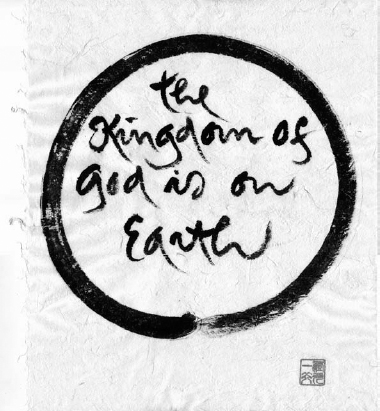
Many people think that heaven is somewhere else and they want to go there when they die. Yet they have no proof that such a place really exists. We shouldn’t let ourselves be lured by the idea of a faraway paradise. The Earth is real. The Earth is here. She is a wonderful phenomenon, present right here and now. In fact, the Earth is the most beautiful place in the heavens. We have to come back to take refuge in Mother Earth. The Kingdom of God is on Earth. Each step taken in mindfulness can put us in touch with the Kingdom of God. When we come back to the present moment, and we are in touch with ourselves. When our minds are calm, our senses open, we can see the wonders of life all around us. We can see that we’re truly walking in the Kingdom of God. Each day as we walk on the planet we can say,
I take refuge in the Earth.
I love the Earth.
I am in love with Mother Earth.
To take refuge in the Earth is to come back to our true home. There are those of us who live in very comfortable houses. You may have a roof over your head, a comfortable bed to sleep in, sufficient food to eat, and yet still not feel at home. All of us are looking for our true home, the place where we feel safe and sheltered. If we practice mindful breathing and with each breath we get in touch with the Earth, then we will know we’re already home. While practicing mindful walking, we have a chance to enter into deep communion with the planet Earth and we may realize that Earth is our home. One breath, one step is all we need to feel at home and feel comfortable in the here and the now. When we can come back to ourselves like this and take refuge in our inner island, we become a home for ourselves and we become a refuge for others at the same time.
The shortest and deepest teaching I can offer is this: “I have arrived. I am home.” Breathing in, you know you have already arrived. Breathing out, you know you are home. With each breath, you can bring your body and your mind back to the present moment. You don’t have to run after anything else anymore. The Earth is right here already. You feel completely satisfied with the present moment. Nothing is missing. With each step you can say,
I am home.
RETURNING TO THE EARTH
Many of us wonder what will happen to us when we die. Some of us think that after the disintegration of this body we will rise up to heaven or up to the clouds. Many of us believe we will go to a distant paradise after we die, and we imagine it must be a wonderful place, without suffering.
But we know that we need our suffering. We understand the goodness of suffering. We can make good use of our suffering by looking deeply into it, recognizing and embracing it. In this way our suffering will transform and increase our understanding, love, and compassion. Our suffering is the compost that enables beautiful flowers to grow. We don’t need to find an imaginary place where there is no pain or suffering and where we can finally be happy. We can accept the Earth as our homeland. She is a living reality we can touch, see, and experience directly in the here and now.
Looking deeply like this, we can overcome the fear of death. We’re born from the Earth and will return to the Earth; nothing is lost. As the eighteenth century French scientist Antoine Lavoisier discovered: nothing is created, nothing is destroyed; everything is in transformation. Energy can be changed from one form to another, but it can’t be created or destroyed.
We don’t need to go anywhere else when we die. We’re already carrying the bodhisattva Mother Earth inside us. When we truly have the insight that we and the Earth are one, and not two separate entities, all fear dissolves. When we realize that the Earth gave birth to us and that the Earth will receive us again at the end of our lives, only to bring us forth again as a different manifestation, we arrive at a state of non-fear. We know that nothing is lost; nothing is gained. Nothing is born; nothing dies. We’re no longer caught in the idea that we are a separate self. We will no longer ask the question, “What will happen to me after my body has disintegrated? Where will I go? Will I still exist or not?”
We don’t have to wait until we die to return to Mother Earth. In fact, we’re in the process of going back to Mother Earth right now. Thousands of cells in our bodies are dying each moment, and new ones are being born. Whenever we breathe, whenever we walk, we are returning to the Earth. Whenever we scratch ourselves, dead skin cells fall. We’re constantly dying and being born again. There is a continual cycle of input and output taking place all the time. We are returning to Mother Earth at each moment as a natural part of our life process.
What do we mean when we say someone “dies”? We use the word “die” but that isn’t really the right word. In our usual way of thinking, to die means that from being someone, we suddenly become no one at all. It means we pass from the realm of being into the realm of nonbeing. But looking deeply, we can see that it’s impossible to die. Matter can be transformed into energy, and energy can be transformed into matter. But nothing is lost. Nothing dies. There is only transformation.
Think of a cloud. Before it appeared as a cloud, it must have been something else. The cloud couldn’t have come from nothingness. The cloud is just a manifestation, a continuation. Before the cloud appeared in the sky, it existed in another form—as mist, ocean, rain, or river. If we look deeply into the nature of a cloud, we see that a cloud can’t die and pass from a state of being into nonbeing. A cloud can become rain or snow or ice, but it can’t become nothing. So if the sky is clear, it doesn’t mean that the cloud has died. It continues on in other forms.
When we look at a cloud, we have the tendency to say that the cloud exists. Existence is a perception. Tomorrow, if we don’t see the cloud, we might say the cloud is no longer there; the cloud doesn’t exist anymore. But there is moisture in the air we’re breathing. And that moisture may eventually form part of a cloud. We don’t see the moisture in the air, but we know it’s there and that a cloud is hiding in it. When we no longer see something, we may think it doesn’t exist. We think that something only exists when we can see it and that it doesn’t exist when we can’t. But the true nature of a cloud is that of no-birth and no-death. Superficially there is birth and death. This is the conventional truth. But looking deeply, in the ultimate dimension, we see that there’s no birth and no death. That is the ultimate truth.
If a cloud can’t die, how can we die? One of the Budhha’s first insights was that of interdependent co-arising. Everything arises in dependence on everything else. There’s no beginning or ending; there’s no creation or destruction of anything at all. This is equally true of the universe. Billions and billions of conditions have come together for us to manifest in this form. When different conditions arise, we will manifest in a different form. If you look around in autumn, you notice that there are dead leaves covering the ground. I don’t think the falling leaves suffer. They are just going back to Mother Earth in order to be reborn again. So all of us are like a leaf. We spend some time on the tree enjoying the sunshine, the rain, the wind, and at the same time we nourish the tree. The leaf spends many months on the tree, absorbing carbon dioxide and sunshine, producing oxygen, and enjoying itself. In the meantime, it creates food for the tree and helps the tree to grow.
Imagine the Earth is the tree and that we are a leaf. We think that the Earth is the Earth and that we are something outside of the Earth. But in fact we are inside the Earth. We may think that some day we’ll die and we’ll go back to the Earth. But we don’t need to die in order to go back to Mother Earth. I am in Mother Earth right now and Mother Earth is in me. We can say,
Breathing in, I know Mother Earth is in me.
Breathing out, I know that I am in Mother Earth.
When we look into a kaleidoscope, we see a beautiful symmetrical image. And whenever we turn the kaleidoscope, the image disappears. Can we describe it as a birth or a death? Or is the image only a manifestation? After this manifestation there is another manifestation that is equally beautiful. Nothing is lost at all. In our current form, we are a beautiful manifestation that Mother Earth has helped to create. When this manifestation is over, we will manifest in another way. There is no birth and no death. Being a cloud may be wonderful, but being rain falling to the Earth is wonderful as well.
You may like to lie on the ground and get in touch with Mother Earth. You can say,
Mother Earth, I am in you.
I am dying and being born in every moment.
You are always there.
We are being born and we are dying in every moment. Contemplating dying is actually very helpful and even pleasant, because it helps us see our true nature of no-birth and no-death, and reminds us we have nothing to fear. The Earth is always available to teach us this. Touching our nature of no-birth and no-death, we stop being a victim of anxiety and fear, and joy becomes possible straight away.
Is the Earth afraid of dying? The planet is not afraid of dying at all. She knows that she is the cosmos. Just as we are made of non-human elements and the flower is full of non-flower elements, the Earth is made of non-Earth elements. Like us, the Earth contains air, fire, and water, as well as the sun and particles from distant stars in faraway galaxies. In fact, we can see that the Earth is made exclusively of non-Earth elements. The whole cosmos has come together in order to produce the wonder that is this planet. Like us, it might change form, but it can never die.
OUR LEGACY
Every moment that we’re alive in this body, in this human manifestation, we’re emitting energy. This energy can be transformed but it can’t die; it remains in the world forever. The Sanskrit word for this is karma, which means action. Karma is the action of our thoughts, speech, and body. A thought is an action because it already has energy and it has the power to affect things. When we produce a thought of compassion, understanding, and love, that thought has the power to heal our body, our mind, and the world. If we produce a thought of hatred, anger, or despair, that thought has an effect not only on ourselves but on the world; it can destroy us and lead to the destruction of many other lives.
Suppose a nation produces a collective thought of anger and fear and decides to go to war. The whole country is then produc-ing fear and anger. That collective fear and anger can cause much real destruction and suffering. Karma is very powerful. The thoughts and feelings we send out into the world have a powerful effect. Every thought we produce, everything we say and do, is an action. These actions continue forever. They can transform, but like the cloud, they will not disappear. We have to recognize the power of our karma and make a firm determination to be mindful of our thoughts, speech, and actions in order to heal ourselves and the Earth.